
BGA Package Types for PCB Design and Assembly
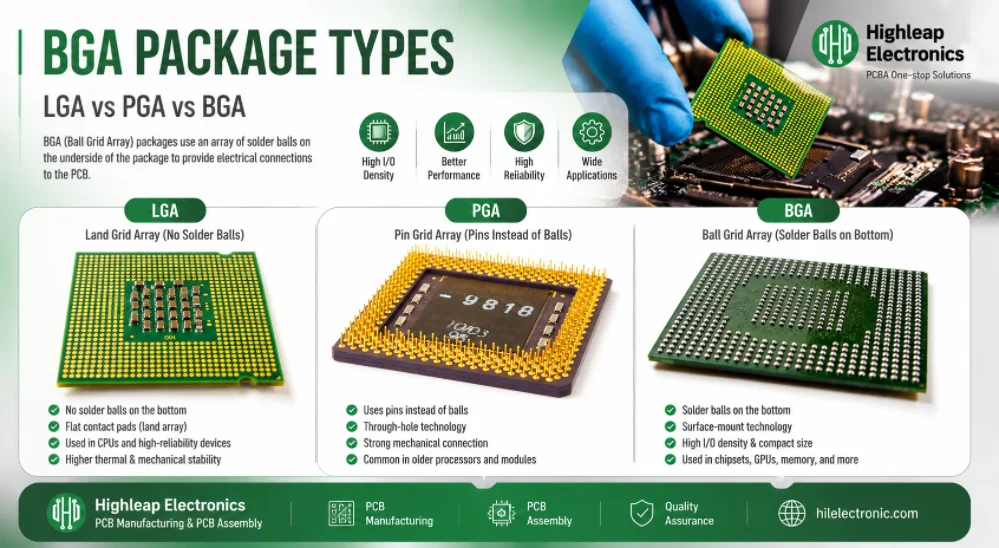
Figure 1. BGA package types
A ball grid array (BGA) is a surface-mount package that connects to the board through a grid of solder balls underneath the component instead of leads around its edge. That arrangement allows many connections in a small footprint with good electrical and thermal performance, which is why BGAs dominate modern processors, memory, and complex ICs. There are several types, plastic, ceramic, tape, fine-pitch, chip-scale, flip-chip, and more, each with its own trade-offs. This guide explains the main BGA types, their key attributes, and what they mean for assembly, inspection, and board design. For micro-BGA circuit-board assembly, package pitch and ball geometry must be considered together with the land pattern, stencil design and hidden-joint inspection.
Key takeaways
- A BGA connects through solder balls on its underside, packing many I/O into a small area.
- Common types include PBGA (plastic), CBGA (ceramic), FBGA/fine-pitch, uBGA/CSP, FCBGA (flip-chip), LGA, and PoP.
- Ball pitch ranges from 1.27 mm down to 0.4 mm and finer, with smaller pitch driving denser, HDI boards.
- Because the joints are hidden, BGA assembly must be verified by X-ray, not visual inspection alone.
- Fine-pitch BGAs need careful pad design, via-in-pad or dog-bone routing, and a controlled reflow profile.
Table of Contents
- What Is a BGA Package?
- Types of BGA Packages (PBGA, CBGA, FBGA, FCBGA)
- BGA vs Leaded Packages (QFP and QFN)
- BGA Pitch and Ball Count
- BGA Ball Composition and Moisture Sensitivity
- How BGAs Are Assembled
- How BGA Solder Joints Are Inspected (X-Ray)
- Designing a PCB for BGA Packages
- BGA Rework and Reballing
- Frequently Asked Questions
What Is a BGA Package?
A BGA places its connections as an array of solder balls on the bottom of the package. When the board is reflowed, those balls melt and join to matching pads, forming the electrical and mechanical connection.
Why the format exists
Leaded packages run out of room as I/O counts climb, because leads only fit around the perimeter. A grid of balls uses the whole underside, so a BGA offers far more connections in the same area, with shorter paths that help electrical performance and a large thermal contact for heat removal. The trade-off is that the joints are hidden, which shapes everything about assembly and inspection.
Where BGAs are used
Processors, memory, FPGAs, and other high-I/O devices are almost all BGAs. Working with them confidently is part of modern PCB assembly, especially on dense, high-performance boards.
Types of BGA Packages (PBGA, CBGA, FBGA, FCBGA)
The “BGA” label covers a family of related packages that differ mainly in substrate material and how the die is attached.
| Type | Description | Typical use |
|---|---|---|
| PBGA (plastic) | Plastic substrate; the most common, cost-effective type | General-purpose ICs |
| CBGA (ceramic) | Ceramic substrate; rugged, higher cost | High-reliability and harsh environments |
| TBGA (tape) | Flexible tape substrate | Thin, lighter packages |
| FBGA (fine-pitch) | Smaller ball pitch for higher density | Memory and compact ICs |
| uBGA / CSP | Chip-scale package, barely larger than the die | Space-constrained mobile devices |
| FCBGA (flip-chip) | Die flip-mounted to the substrate for performance | CPUs, GPUs, high-speed devices |
| LGA (land grid array) | Flat pads instead of balls; solder added at assembly | Some processors and modules |
| PoP (package-on-package) | Stacked packages, e.g. processor with memory on top | Mobile processors and memory |
The big distinctions are substrate (plastic, ceramic, or tape), whether the die is flip-chip mounted (FCBGA, for the highest performance), and whether the part even has balls, an LGA has lands and gets its solder from the board’s paste. PoP is a packaging strategy that stacks devices to save board area. The right type is usually dictated by the chip you must use, not a free choice.
BGA vs Leaded Packages (QFP and QFN)
It helps to see where BGAs sit relative to leaded packages such as QFP and QFN.
| Aspect | Leaded (QFP / QFN) | BGA |
|---|---|---|
| I/O density | Limited to perimeter leads | Full underside grid, much higher |
| Inspection | Visual and AOI feasible | X-ray required for hidden joints |
| Hand rework | Feasible for leaded parts | Hot air and reballing only |
| Electrical / thermal | Adequate for many parts | Shorter paths, better thermal contact |
| Board complexity | Standard routing | Often HDI for fine pitch |
BGAs win on I/O density and on electrical and thermal performance, which is why high-pin-count and high-speed devices use them. The trade-offs are inspection (X-ray instead of visual), rework (hot air and reballing instead of an iron), and often a more complex board. For lower pin counts a leaded package may be simpler; the choice usually follows the part. Either way, planning the footprint and stackup during a design review keeps the chosen package manufacturable.
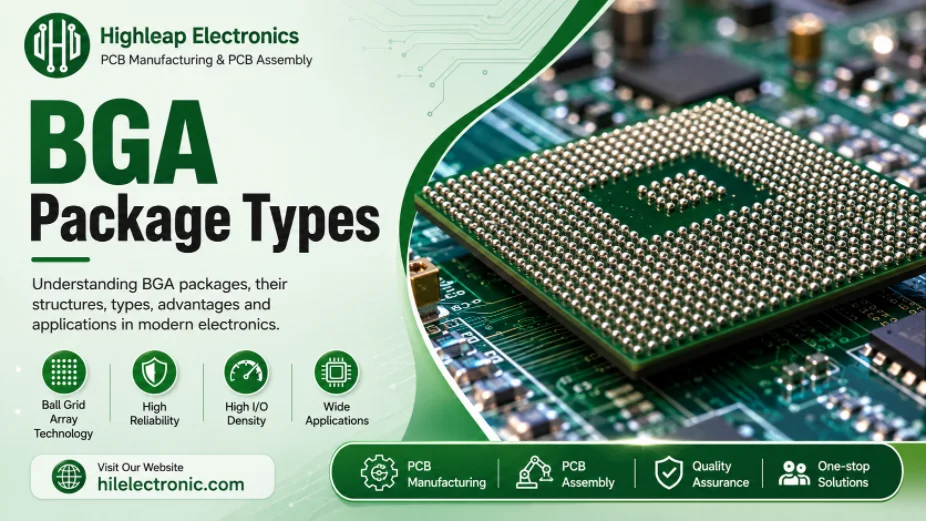
Figure 2. BGA package type comparison
BGA Pitch and Ball Count
Pitch, the center-to-center spacing of the balls, is the attribute that most affects how hard a BGA is to fabricate for and assemble.
| Pitch | Implication |
|---|---|
| 1.27 / 1.0 mm | Relatively easy; standard routing and vias work |
| 0.8 / 0.65 mm | Tighter routing; careful escape and pad design |
| 0.5 / 0.4 mm and finer | Often needs HDI, microvias, and via-in-pad |
As pitch shrinks, you can no longer route a trace between balls, so the board needs more layers, smaller vias, and often via-in-pad. Fine-pitch BGAs therefore push a design toward the HDI techniques used in high-speed and high-density manufacturing. Higher ball counts compound this, since every ball needs a route out. For a part identified as uBGA, uBGA package-specific assembly review should use the actual component drawing and ball arrangement rather than infer a process from the package name.
BGA Ball Composition and Moisture Sensitivity
Two material facts about BGAs affect how they are handled and soldered.
- Ball alloy. Modern BGAs use lead-free (tin-silver-copper) balls, which set the reflow peak temperature; legacy parts may use leaded balls.
- Moisture sensitivity (MSL). BGAs are moisture-sensitive: absorbed moisture can flash to steam during reflow and damage the package (“popcorning”), so parts are rated by MSL and baked before assembly if exposed.
Respecting MSL handling, keeping parts dry and baking when required, is a basic but critical step. Skipping it can crack packages during reflow regardless of how good the rest of the process is, which is why it is built into a controlled assembly flow.
How BGAs Are Assembled
Placing a BGA is routine on an automated line, but it depends on a few things going right.
- Stencil and paste. A correctly designed stencil deposits the right paste volume on each pad.
- Placement. The part is positioned over its pads; it does not need perfect alignment because of the next point.
- Reflow profile. A controlled profile melts the balls; surface tension then pulls the package into alignment (“self-centering”).
- Thermal balance. The profile must suit the board’s mass so every ball reaches temperature together.
Self-centering is one of the BGA’s nicer traits, molten balls tug the package into position. But it only works with a good paste deposit and a profile matched to the board, which is harder on thermally heavy boards such as metal-core assemblies. Getting the profile right the first time is what makes BGA assembly reliable.
How BGA Solder Joints Are Inspected (X-Ray)
Because every joint is hidden under the package, you cannot judge a BGA by eye. X-ray is the primary inspection tool.
| Defect | What it is |
|---|---|
| Voiding | Gas bubbles trapped in a ball, reducing joint quality |
| Bridging | Adjacent balls joined, causing a short |
| Head-in-pillow | Ball and paste fail to merge, leaving a weak, intermittent joint |
| Open / non-wet | A ball that did not connect, often from warpage |
Warpage and coplanarity are common culprits: if the package or board bows at reflow, corner or center balls may not touch their pads, causing opens or head-in-pillow defects. X-ray reveals these hidden problems, and on critical boards it is a required step, not an option. Visual inspection can confirm only the outer row’s edges, not the joints themselves.
Designing a PCB for BGA Packages
A BGA’s reliability is set largely in the board design, before a single part is placed.
Escape routing and vias
Each ball needs a path out. At larger pitch, a short “dog-bone” trace to a via between balls works. At fine pitch there is no room, so via-in-pad, a filled and capped via directly in the pad, becomes necessary, which in turn requires HDI fabrication.
Pad and stencil design
Pad type (solder-mask-defined vs non-solder-mask-defined) and stencil aperture affect joint shape and reliability, and they should follow the package and assembly guidelines. These are exactly the details a design-for-manufacturing review checks before fabrication.
Stackup and fabrication
Fine-pitch, high-ball-count BGAs drive layer count, microvia structures, and registration tolerances, all decided during PCB manufacturing. Designing the board and the BGA escape together avoids a part that cannot be routed or reliably soldered.
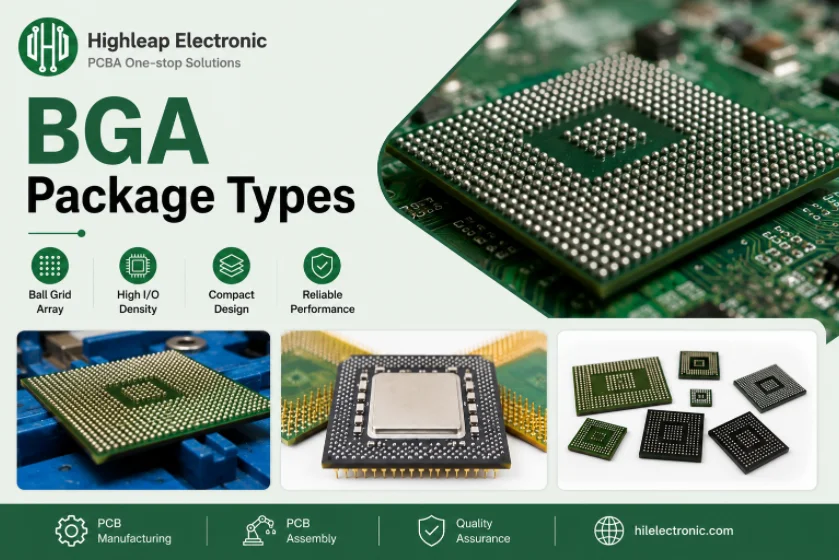
Figure 3. BGA package types for PCB assembly
BGA Rework and Reballing
BGAs can be removed and replaced, but the process is specialized.
- Removal. A hot-air or infrared rework station reflows the hidden balls so the package can be lifted straight up.
- Reballing. To reuse a BGA, fresh balls are applied with a stencil and preform, restoring the array.
- Verification. The reworked joints are checked by X-ray, since they remain invisible.
Reballing is common for expensive or obsolete devices, but it requires the right equipment and a controlled profile. For most production, getting the original assembly right, with good paste, profile, and design, is far preferable to reworking BGAs, and that consistency matters most in high-volume assembly.
BGAs come in many types, plastic, ceramic, fine-pitch, chip-scale, flip-chip, LGA, and PoP, but they share hidden, ball-based joints that demand careful design, a controlled reflow profile, and X-ray inspection. Choose the type your chip dictates, design the escape routing to match the pitch, and verify with X-ray. You can read more about Highleap Electronics and our BGA assembly capability.
Frequently Asked Questions
What is a BGA package?
A ball grid array is a surface-mount package that connects to the board through a grid of solder balls on its underside instead of leads around its edge. This packs many connections into a small area with good electrical and thermal performance, which is why processors, memory, and complex ICs use it.
What are the main types of BGA?
Plastic (PBGA), ceramic (CBGA), tape (TBGA), fine-pitch (FBGA), chip-scale (uBGA/CSP), flip-chip (FCBGA), land grid array (LGA, which has pads not balls), and package-on-package (PoP, which stacks devices). They differ mainly in substrate material and how the die is attached.
What is the difference between a BGA and an LGA?
A BGA arrives with solder balls already on the package, while an LGA has flat lands and no balls, getting its solder from the paste printed on the board during assembly. Otherwise both are grid-array, bottom-connected packages and share similar routing and inspection considerations.
Why do BGAs require X-ray inspection?
Because the solder joints sit under the package and cannot be seen, X-ray is the only way to confirm them. It reveals voiding, bridging, head-in-pillow, and open joints, especially those caused by package or board warpage. On critical boards, X-ray is a required inspection step rather than optional.
What pitch counts as fine-pitch, and why does it matter?
Pitches of roughly 0.5 mm and below are fine-pitch. They matter because you can no longer route a trace between balls, so the board needs more layers, microvias, and via-in-pad, pushing it toward HDI fabrication. Larger pitches (1.0 to 1.27 mm) route with standard techniques.
What is via-in-pad and when is it needed?
Via-in-pad places a via directly inside the BGA pad, with the via filled and capped so it can be soldered over. It is needed at fine pitch, where there is no room for a dog-bone escape trace to a via beside the ball. It requires HDI fabrication and adds cost but enables dense routing.
Can a BGA be removed and reused?
Yes, with hot-air or infrared rework to remove it and reballing to apply fresh solder balls before reuse, followed by X-ray verification. It is common for costly or obsolete parts, but it needs proper equipment and a controlled profile. For production, a correct first-pass assembly is preferable to reworking BGAs.
When should I use a BGA instead of a leaded package?
Use a BGA when the part has a high I/O count or needs the better electrical and thermal performance of a full underside grid, which is why processors and FPGAs use them. For lower pin counts, a leaded package like a QFP or QFN can be simpler to assemble, hand-rework, and inspect. The chip you must use often decides it.

Recommended Posts
TMM4 Filter PCB Manufacturing
TMM4 filter PCB manufacturing is controlled by the...
TMM3 PCB Manufacturing for RF Modules
TMM3 PCB manufacturing is most useful where the RF module...
TMM6 PCB Fabrication
TMM6 fabrication is the process-control page for a mid-Dk...

TMM10 PCB Manufacturing for Compact RF Designs
Table of contentsHow TMM10 Shrinks RF StructuresTMM10 vs...
How to get a quote for PCBs
Let‘s run DFM/DFA analysis for you and get back to you with a report. You can upload your files securely through our website. We require the following information in order to give you a quote:
-
- Gerber, ODB++, or .pcb, spec.
- BOM list if you require assembly
- Quantity
- Turn time
For PCBA services, please provide your BOM (Bill of Materials) and any specific assembly instructions. We also offer DFM/DFA analysis to optimize your designs for manufacturability and assembly, ensuring a smooth production process.