
Isola IS680 PCB Manufacturer for Cost-Effective Low-Loss RF Boards
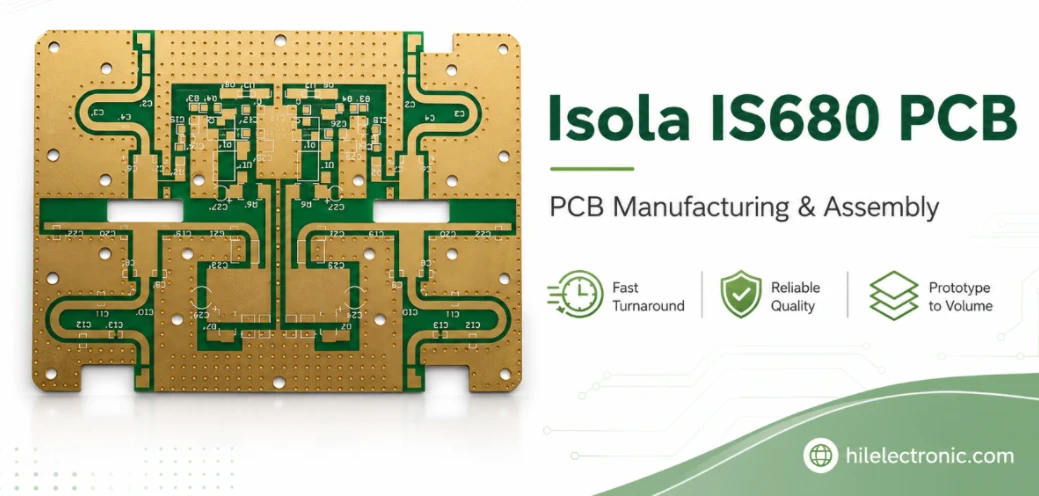
IS680 is considered when a commercial RF board needs lower loss than ordinary FR-4 but the cost and processing complexity of a conventional PTFE construction are difficult to justify. The family is offered in multiple dielectric-constant grades, so the first production decision is the exact grade and thickness—not simply the word “IS680.”
Highleap Electronics manufactures IS680 double-sided RF boards and evaluates related multilayer or hybrid requests according to the available construction. Highleap Electronics focuses on cost-performance fit, grade control and practical fabrication.
When IS680 Is a Practical Alternative to PTFE PCB
IS680 can simplify drilling and hole preparation compared with many PTFE composites while providing very-low-loss behavior for commercial microwave applications. That can improve production economics for antennas, feeds, amplifier circuits and other double-sided RF boards. It is not a direct drop-in replacement: Dk, loss, thickness, copper and thermal behavior must match the released model.
Cost should be evaluated as qualified-board cost
The relevant cost is not only laminate price. It includes drill wear, special activation, yield, test, lead time and supplier availability. A non-PTFE route can be attractive when the electrical margin remains adequate and the available IS680 grade matches the required geometry.
| Project condition | Why IS680 may fit | What must be confirmed |
|---|---|---|
| Commercial double-sided RF board | Low loss with a simpler fabrication route | Exact Dk grade, thickness and copper |
| PTFE processing is driving cost | No conventional PTFE activation route | Electrical equivalence and available construction |
| Space-limited RF layout | Higher-Dk grades can reduce size | Narrower lines and tolerance sensitivity |
| Broadband antenna or feed | Lower-Dk grade can preserve wider geometry | Loss, finish and mechanical integration |
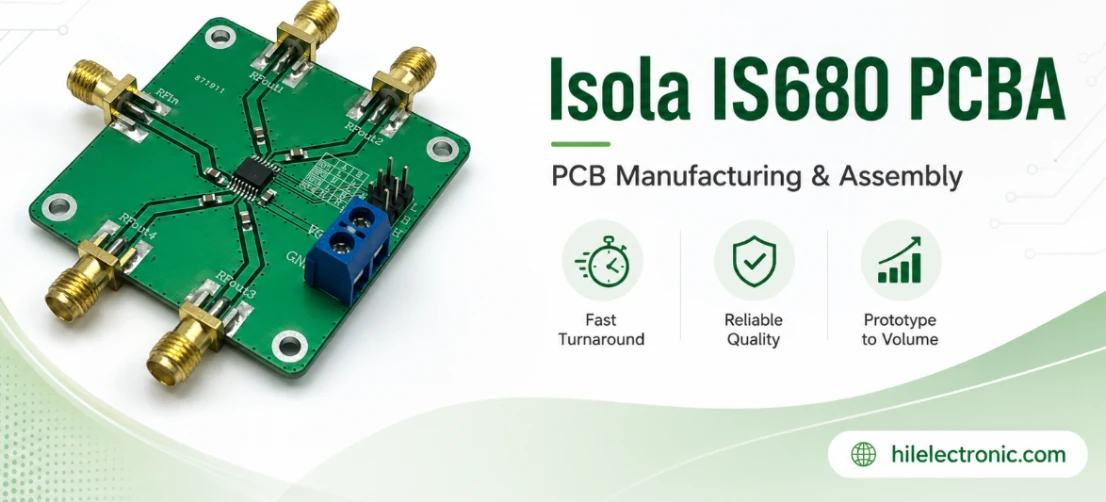
Designing Within the Published IS680 Construction
IS680 is primarily positioned for double-sided commercial RF and microwave circuits. A multilayer request should not assume that any desired prepreg or thickness exists. Highleap checks the exact grade, laminate thickness and copper against current availability before confirming the stackup.
What high-frequency stability claims mean
A material may have stable published behavior into very high frequency ranges, but a finished board still depends on copper roughness, line dimensions, connector launch, finish and measurement method. “W-band capable” does not mean every W-band layout will pass without design and production correlation.
Preserving the low-loss advantage
Rough copper, unnecessary surface finish, solder mask over RF structures or poor launch geometry can consume the margin gained from the laminate. The fabrication drawing should specify copper, mask keep-outs, critical dimensions and finish. Highleap’s high-frequency copper and surface-finish guide covers these choices in more detail.
Manufacturing Notes for IS680 RF PCB
IS680 can offer a more familiar drill and desmear route than PTFE, but that does not make it identical to FR-4. Material handling, drill parameters, edge quality, plating and dimensional control still need to be matched to the exact grade and board thickness.
- Put the exact Dk grade on the stackup and purchase order.
- Confirm the published thickness and copper construction.
- Use finished RF dimensions where frequency response is geometry-controlled.
- Define mask and finish conditions around antennas, filters and launches.
- Verify hole and edge quality on the first article.
- Do not approve a PTFE substitution or replacement from Dk alone.
Best-fit applications
IS680 is a practical candidate for commercial antennas, RF amplifier boards, point-to-point radio, microwave sensors and double-sided feed networks. A highly integrated multilayer, unusual thickness or severe mechanical environment may need another Isola or specialty low-loss laminate system with broader construction support.
Prototype, Production and Cost-Performance Review
IS680 should be compared with Astra MT, I-Tera MT, PTFE laminates and other low-loss materials according to circuit length, frequency, board architecture, available grade and qualified-board cost. Highleap can fabricate prototypes before the project is transferred to repeat production, with material lot and approved construction retained for future orders.
What Highleap confirms before quotation
The engineering review confirms the exact grade, thickness, copper, outline, hole plan, finish, mask, critical RF geometry, test requirement and quantity. Optional PCB assembly can be added for amplifier or communication modules when BOM and placement data are supplied.
Provide the intended IS680 grade or target Dk, the RF stackup and the PTFE material being compared. Highleap will review availability, fabrication route and whether the proposed alternative preserves the design intent.
IS680 questions
Is IS680 one material grade? No. The exact Dk grade must be stated.
Can IS680 replace PTFE without redesign? Not automatically. The model, thickness, copper and qualification must be reviewed.

Recommended Posts
TMM4 Filter PCB Manufacturing
TMM4 filter PCB manufacturing is controlled by the...
TMM3 PCB Manufacturing for RF Modules
TMM3 PCB manufacturing is most useful where the RF module...
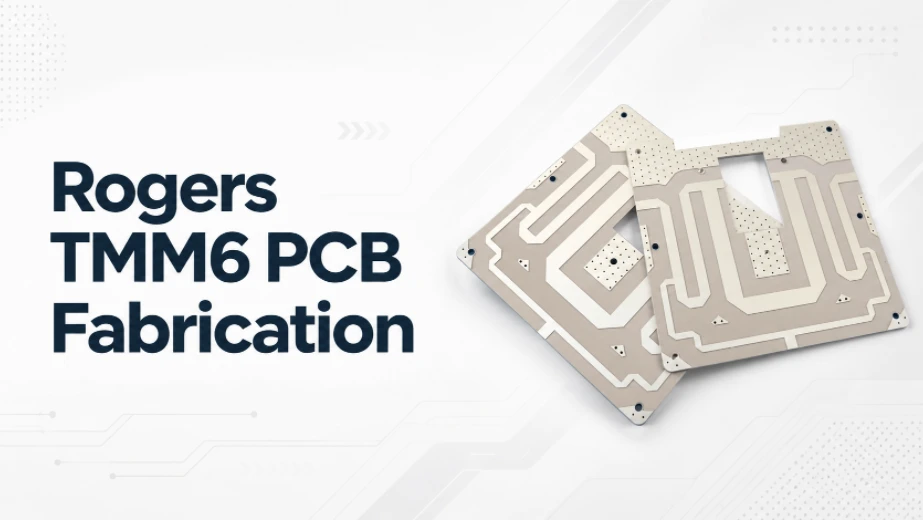
TMM6 PCB Fabrication
TMM6 fabrication is the process-control page for a mid-Dk...

TMM10 PCB Manufacturing for Compact RF Designs
Table of contentsHow TMM10 Shrinks RF StructuresTMM10 vs...
How to get a quote for PCBs
Let’s run DFM/DFA analysis for you and get back to you with a report. You can upload your files securely through our website. We require the following information in order to give you a quote:
-
- Gerber, ODB++, or .pcb, spec.
- BOM list if you require assembly
- Quantity
- Turn time
For PCBA services, please provide your BOM (Bill of Materials) and any specific assembly instructions. We also offer DFM/DFA analysis to optimize your designs for manufacturability and assembly, ensuring a smooth production process.