
How Copper Foil and Surface Finish Affect High-Frequency PCB Performance

Introduction
In high-frequency PCB design, signal attenuation and impedance stability are strongly influenced by the copper foil’s surface roughness and the type of surface finish applied. As operating frequencies extend beyond 5 GHz into millimeter-wave ranges, even minor variations in conductor surface characteristics translate into measurable insertion loss and return loss degradation. Understanding how these factors affect high-frequency performance is essential for achieving low-loss, high-reliability circuits in applications ranging from 5G infrastructure to automotive radar systems. When reviewing LoPro copper options for Rogers RF boards, specify the copper construction used in the loss model and confirm that it matches the material ordered for fabrication.
1. Role of Copper Foil in High-Frequency PCBs
1.1 Types of Copper Foil
The selection of copper foil type fundamentally determines the baseline loss characteristics of a high-frequency PCB. Each foil type offers distinct surface roughness profiles and performance trade-offs:
- Electro-deposited copper – Surface roughness 4-8 μm, standard for general applications below 5 GHz.
- Rolled annealed copper – Roughness below 2 μm, mechanically processed for superior smoothness in designs above 5 GHz.
- Reverse-treated foil – Modified tooth structure on bonding side with smoother signal surface, balancing adhesion and performance.
- Very-low-profile/Ultra-low-profile copper – Roughness 0.5-1.5 μm, premium choice for frequencies exceeding 10 GHz.
1.2 Surface Roughness and Signal Loss Mechanism
Surface roughness affects high-frequency PCB performance through its interaction with the skin effect, where current concentrates near the conductor surface as frequency increases. The skin depth shrinks to less than 0.7 micrometers at 10 GHz in copper, calculated as √(2/ωμσ). When surface roughness approaches or exceeds this depth, the effective current path lengthens substantially, increasing surface resistance and insertion loss. For millimeter-wave applications demanding minimal attenuation, rolled annealed or very-low-profile copper becomes essential rather than optional. With HVLP foil in PCB fabrication and assembly, the ordered copper profile must match the signal-loss assumptions while still supporting the agreed bonding and processing requirements.
2. Influence of Surface Finish on High-Frequency Performance
2.1 Overview of Common Surface Finishes
High-frequency PCB fabrication employs several surface finish options, each presenting distinct electrical characteristics:
- ENIG – Electroless nickel (3-5 μm) with immersion gold, robust but magnetic.
- ENEPIG – Adds palladium layer between nickel and gold for enhanced wire bonding reliability.
- Immersion Silver – Thin silver layer directly on copper, non-magnetic with good conductivity.
- Immersion Tin – Copper-tin intermetallic layer, non-magnetic with moderate shelf life.
- OSP – Organic coating less than 0.5 μm thick, minimal electrical impact but limited shelf life.
2.2 Impact on Signal Integrity
The magnetic properties of nickel-based finishes introduce measurable signal loss in high-frequency PCB designs. Electroless nickel layers exhibit relative permeability between 100 and 500 depending on phosphorus content, creating additional attenuation above 2 GHz through increased skin effect losses. Immersion silver and organic solderability preservative avoid this penalty through non-magnetic characteristics and minimal thickness, making them preferable for critical RF signal paths.
| Finish Type | Magnetic Effect | Loss at GHz Frequencies | Surface Flatness | Long-Term Reliability |
|---|---|---|---|---|
| ENIG | High (Ni layer) | Moderate to High | Good | Excellent |
| ENEPIG | High (Ni layer) | Moderate to High | Excellent | Outstanding |
| Immersion Silver | None | Low | Very Good | Good |
| Immersion Tin | None | Low to Moderate | Good | Moderate |
| OSP | None | Very Low | Excellent | Limited |
2.3 Surface Finish and Impedance Control
The thickness and dielectric properties of surface finishes directly influence characteristic impedance in high-frequency PCB transmission lines. Electroless nickel immersion gold adds both metallic and dielectric layers to signal conductors, requiring compensation in trace geometry to maintain target impedance. Non-magnetic finishes combined with smooth copper foils ensure impedance consistency while minimizing insertion loss penalties.
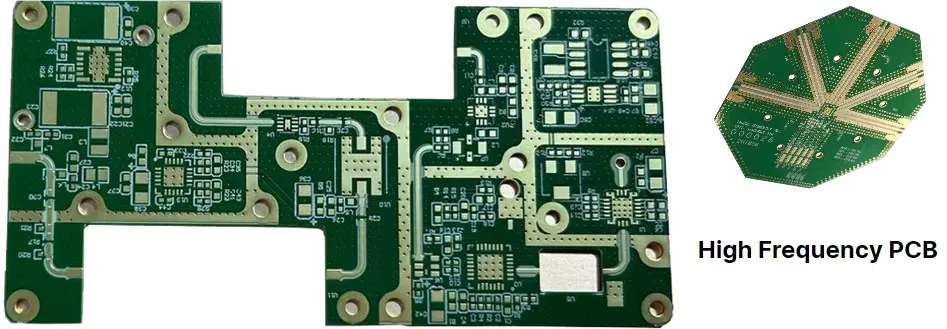
High Frequency Circuit Board
3. Material Interaction and Design Optimization
3.1 Combined Effect of Copper and Finish
The cumulative loss in high-frequency PCB designs results from copper surface roughness and surface finish interactions. Measurements demonstrate that very-low-profile copper with organic solderability preservative delivers lower insertion loss than reverse-treated foil with electroless nickel immersion gold above 10 GHz. The nickel layer compounds with copper roughness to create additive loss where each contributor reinforces signal degradation. For millimeter-wave applications beyond 20 GHz, ultra-low-profile copper paired with immersion silver or OSP finishes delivers optimal signal integrity.
3.2 Practical Design Tips
Material optimization for high-frequency PCB projects requires careful specification and strategic choices:
- Request detailed roughness data – Obtain both Rz (maximum height) and Ra (average roughness) specifications from fabricators.
- Avoid nickel on RF paths – Specify non-magnetic finishes for critical signal channels despite reduced oxidation resistance.
- Balance cost versus performance – Premium copper and finish combinations often add modest cost while delivering substantial loss improvements.
- Validate impedance models – Account for finish thickness in electromagnetic simulation to ensure accurate impedance prediction.
4. Case Examples
A 5G massive MIMO radio module design illustrates material optimization benefits. By specifying very-low-profile copper with organic solderability preservative on antenna feed networks at 28 GHz, the design achieved 0.3 dB per inch insertion loss reduction compared to standard electro-deposited copper with electroless nickel immersion gold, extending communication range and reducing power amplifier requirements.
Automotive millimeter-wave radar systems at 77 GHz require balancing electrical performance with mechanical reliability. A production design utilized rolled annealed copper with electroless nickel electroless palladium immersion gold, where the intermediate palladium layer provided wire bonding compatibility while reduced copper roughness maintained acceptable insertion loss for radar front-end circuitry through stringent automotive qualification testing.
Conclusion
The performance of high-frequency PCB designs depends critically on copper foil surface characteristics and applied surface finishes. Rough copper surfaces and magnetic nickel layers both contribute measurably to signal attenuation at gigahertz frequencies, with compounding effects when combined. Design engineers must evaluate material choices early in development, balancing electrical performance against manufacturing cost and reliability requirements.
Highleap Electronics delivers comprehensive high-frequency PCB manufacturing capabilities:
- Low-loss material selection – Access to VLP/ULP copper foils and non-magnetic surface finishes optimized for GHz applications.
- Precision impedance control – Controlled dielectric thickness and trace geometry for consistent characteristic impedance across production panels.
- Advanced surface treatments – Multiple finish options including ENIG, ENEPIG, immersion silver, and OSP with documented electrical properties.
- RF-focused design support – Engineering consultation on material selection, stackup optimization, and loss budget analysis.
Contact Highleap Electronics to discuss your high-frequency PCB requirements and leverage our expertise in signal integrity optimization for demanding RF and millimeter-wave applications.

Recommended Posts
Optical Transceiver PCB Manufacturing in China
Highleap Electronics provides optical transceiver PCB...
Optical Transceiver PCB Assembly Services in China
Highleap Electronics provides optical transceiver PCB...
Precision Press Fit PCB Manufacturing with Tight Tolerances
Press-fit PCB manufacturing requires close coordination...
8 Layer HDI PCB Manufacturer in China
Highleap Electronics provides 8 layer HDI PCB...
How to get a quote for PCBs
Let‘s run DFM/DFA analysis for you and get back to you with a report. You can upload your files securely through our website. We require the following information in order to give you a quote:
-
- Gerber, ODB++, or .pcb, spec.
- BOM list if you require assembly
- Quantity
- Turn time
In addition to PCB manufacturing, we offer a comprehensive range of electronic services, including PCB design, PCBA, and turnkey solutions. Whether you need help with prototyping, design verification, component sourcing, or mass production, we provide end-to-end support to ensure your project’s success.
For PCBA services, please provide your BOM (Bill of Materials) and any specific assembly instructions. We also offer DFM/DFA analysis to optimize your designs for manufacturability and assembly, ensuring a smooth production process.