
机器人I/O和安全接口PCB,适用于急停、隔离I/O、PL和SIL。
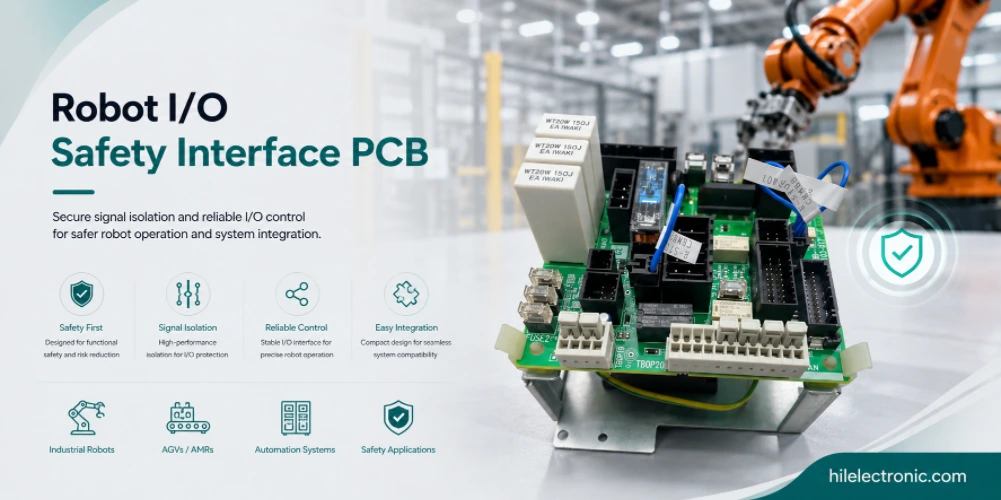
Robot I/O and safety interface PCBs connect the robot to emergency stops, light curtains, safety scanners, enabling switches, interlocks, industrial sensors, actuators, and external control systems. These boards often implement the hardware paths that place the robot into a safe state when software, field wiring, or a connected device fails.
This guide explains safety I/O boards as an industry topic: dual-channel architecture, PL and SIL targets, isolated industrial inputs, output drivers, analog I/O, diagnostic test pulses, fault detection, documentation, and production test. The FAQ has been reframed around what engineers and buyers normally ask before building safety-related robot electronics.
What Robot Safety I/O PCBs Actually Do
在机器人系统中的作用
Robot I/O and safety interface PCBs handle the connection between the robot and its environment — external emergency stops, safety curtains, light barriers, industrial I/O, digital inputs and outputs. What makes these boards distinct is that they carry the robot safety architecture — the hardware paths that guarantee safe behaviour even when higher-level software fails. The specific characteristics of safety I/O boards are:
- Dual-channel redundancy: safety-related signals routed through two independent channels. Discrepancy detection ensures both channels agree.
- Cross-monitoring: each channel monitors the other. Fault in either channel is detected quickly.
- Diagnostic test pulses: regular test pulses verify the safety chain works. Absence of pulses indicates fault.
- Isolated inputs and outputs: galvanic isolation between field wiring and control electronics. Protects control side from field-side transients.
- 认证组件: safety-rated components with defined failure modes and diagnostic coverage. Meets ISO 13849 or IEC 62061 requirements.
- Fail-safe defaults: loss of signal, loss of power, or fault produce safe state. Never fail in dangerous state.
控制设计风险
For safety I/O PCBs, manufacturability input should happen before connector placement, enclosure fit, fixture access, thermal paths, and harness routing are frozen. Late changes to these details usually trigger mechanical rework, test-fixture redesign, or reliability compromises that could have been avoided with early DFM review.
Component selection should include lifecycle status, approved alternates, package availability, temperature rating, and safety or isolation ratings where relevant. Safety i/o pcbs often stay in production or service longer than consumer electronics, so unresolved sourcing risk becomes a field-support issue, not only a purchasing issue.
在系统层面,电路板的设计应基于功能、环境、使用寿命和测试覆盖率,而不仅仅是原理图。这可以避免常见的错误,即设计出技术上正确但难以装配、难以维护或安装到机器人后不够坚固的PCB。
Safety architecture has to be reviewed with the main robot controller electronics and, in regulated systems, the medical robotics PCB package.
Safety Architecture: ISO 13849, IEC 62061, PL, SIL
Architecture Choices for Safety Architecture
Safety architecture on robot I/O boards typically implements one of the standard safety patterns. The main patterns are:
- Category 3 (ISO 13849): single fault tolerated. Standard for most industrial robotics safety functions.
- 第 4 组别: faults detected before next demand. Higher requirement; more complex architecture.
- SIL 2 (IEC 62061): equivalent process safety requirement. Standard for most industrial applications.
- SIL 3: higher process safety requirement. Less common in robotics.
- Performance Level d (ISO 13849): equivalent overall safety requirement. Standard for collaborative robots.
- Performance Level e: highest safety requirement. Standard on the most demanding applications.
Validation Requirements for Safety Architecture
Reliability depends on preserving the margins designed into the board: copper width, isolation spacing, thermal relief, connector retention, component derating, and inspection coverage. Manufacturing should verify these characteristics instead of treating the PCB as a generic assembly with a generic pass/fail test.
Serviceability should be considered through labelled connectors, accessible test points, clear board variants, and serial-number tracking. When a robot fails in the field, good board-level diagnostics let the service team isolate the problem quickly instead of replacing large assemblies or returning the whole robot.
实际操作中,应选择满足信号、安全、散热和机械性能要求的最简单的结构。规格过高会增加成本,而规格过低则会导致测试或现场部署期间需要返工。

Digital Input Handling for Industrial Signals
Key Design Choices for Digital Input Handling for Industrial Signals
Digital input handling on industrial I/O boards addresses the industrial input environment. The main considerations are:
- 电压耐受性: industrial digital signals typically 24 V DC. Board tolerates wide voltage range and reverse polarity.
- 限流: input current limited to prevent damage from wiring faults. Standard opto-isolator inputs at 10 mA typical.
- 过滤: input filtering rejects noise and short glitches. Filter time constant chosen for the specific input signal.
- 隔离: optical isolation between field wiring and control electronics. Standard for industrial safety-related inputs.
- Test capability: input state verification through test paths. Standard on safety-related inputs.
- Wire-break detection: some inputs detect broken wiring as fault. Enables diagnostic coverage for cable faults.
制造和可靠性方面的考虑
Test coverage discipline scales with reliability requirement. Consumer applications need less coverage than industrial; industrial less than medical; medical less than safety-critical. Matching test coverage to actual requirement preserves cost budget while providing the assurance the application needs.
Manufacturing documentation is often under-invested during design phase and expensive to construct retroactively. Per-unit test records captured during production support field investigation years later; component lot traceability supports post-mortem analysis of field returns. Programs that plan documentation early have the records they need; programs that add documentation later often lose the data they would have wanted.
Digital Output Driving External Devices
Key Design Choices for Digital Output Driving External Devices
Digital output handling drives external devices — relays, contactors, indicators, safety actuators. The main considerations are:
- Current capability: output current sized for the connected load. 100 mA to 2 A typical per output; higher currents through external contactors.
- Voltage clamping: freewheel diodes on inductive loads. Standard for relay and solenoid drives.
- 隔离: optical or magnetic isolation between control electronics and field wiring. Standard on safety-related outputs.
- Diagnostic coverage: output state readback compared to command. Fault detection for stuck outputs.
- Test pulses: regular test pulses on safety outputs verify the output path works. Load must handle the test pulses.
- 短路保护: output protection against wiring shorts. Automatic recovery after fault clears.
制造和可靠性方面的考虑
Supply chain visibility during production affects both cost and reliability. Manufacturers with active sourcing capability absorb allocation cycles that would otherwise cause production stoppages; manufacturers without active sourcing pass through supply issues to customers. The value of active sourcing is highest during industry-wide shortages and lowest during stable supply conditions.
Design iteration cycles benefit from tight design-manufacturing feedback. A manufacturing partner who provides prompt DFM feedback enables rapid iteration; a partner who provides slow or superficial feedback slows iteration proportionally. Programs that select manufacturing partners partly on feedback quality typically move through prototype phase faster than programs that select on lowest-cost quote alone.
Analog I/O for Process Control and Measurement
Key Design Choices for Analog I/O for Process Control and Measurement
Analog I/O extends the digital I/O with measurement and analog control. Common on process-control and specialty applications. The main considerations are:
- 4-20 mA current loop: standard industrial analog. Loop current proportional to signal. Handles long cable runs with good noise immunity.
- 0-10 V voltage: standard industrial analog voltage. Shorter cable runs than current loops.
- 热电偶: specific analog interface for temperature. Cold junction compensation and linearisation.
- 热电阻: platinum resistance temperature detection. Precision temperature measurement.
- 模拟输出: current or voltage output driving external devices. Standard control interface.
- 隔离: galvanic isolation on analog interfaces. Standard for industrial applications.
制造和可靠性方面的考虑
Volume-band economics affect the right process choices differently at different production scales. Practices that pay back at 100,000 units per year rarely pay back at 500 units; practices that make sense at prototype rarely make sense at high volume. Matching manufacturing approach to actual production volume is what makes each volume band economically viable.
Regulatory certification obligations vary substantially by application and market. Manufacturing evidence supporting customer submissions can range from minimal (consumer products in unregulated markets) to extensive (medical devices with tight retention periods). Programs that specify certification requirements at quote get manufacturing set up correctly; programs that add certification requirements later sometimes need process changes.
Diagnostic coverage is only meaningful when it is backed by a documented functional test procedure and communicated over a reliable robot interface board.
Diagnostic Coverage and Fault Detection
Safety Function Requirements
Diagnostic and testing capability on safety I/O boards distinguishes safety-rated from ordinary I/O. The main diagnostic features are:
- Cross-monitoring: each safety channel monitors the other. Discrepancy indicates fault.
- Test pulses: regular test pulses through the safety chain. Missing pulses indicate fault.
- Feedback verification: commanded output compared to measured output. Difference indicates fault.
- Self-test on startup: safety chain integrity verified before operation. Startup fault prevents unsafe operation.
- Periodic proof test: some safety functions require periodic full proof testing. Reveals faults that automatic diagnostics miss.
- Fault reaction: defined behaviour on fault detection. Immediate safe state; alarm to supervisor; fault log entry.
Evidence, Diagnostics, and Traceability
Consolidated production at one manufacturing partner preserves institutional knowledge that accumulates across product generations. A partner who has built multiple generations of similar products knows the specific issues that arise, the process tweaks that improve yield, the design patterns that manufacture well. This knowledge does not transfer to new partners without cost.
Continuing engineering-manufacturing dialogue improves both the products and the supplier relationship over time. Yield data flowing back to engineering informs design refinement; field return data flowing back informs both design and manufacturing improvements. Programs where this dialogue is active improve across product generations.
有关相邻设计决策,请参见 robot communication PCB isolation and EMC guide 和 industrial robot PCB safety architecture guide.
Manufacturing Safety I/O PCBs at Highleap
生产前DFM审查
Highleap manufactures safety I/O boards with the process discipline safety-rated products need. The specific capabilities include:
- Certified component sourcing: safety-rated components from authorised distribution with lot traceability.
- Assembly for safety: specific attention to the components implementing safety functions. Placement verification and inspection.
- 功能测试: safety chain verification during production test. Fault injection tests confirm safe behaviour.
- Per-unit safety verification: safety functions verified per unit; test data captured for traceability.
- 文档: manufacturing records supporting customer certification submissions. First-article inspection with safety focus.
- Isolation verification: isolation testing between field side and control side per unit.
测试、可追溯性和构建交接
The manufacturing process discipline for robotics blends practices from several traditional electronics categories. From consumer electronics — cost discipline and volume manufacturing. From industrial electronics — reliability engineering and long service life. From automotive electronics — vibration and environmental tolerance. From medical electronics — documentation and traceability. Robotics benefits from combining these.
Programs that treat manufacturing as strategic — investing in supplier relationships, sharing forecast information, coordinating on capacity — typically outperform programs that treat manufacturing transactionally. The transactional approach saves negotiation time but forfeits the compounding benefits of long-term supplier partnership.
Robot I/O and Safety Interface PCB FAQs
What is a robot I/O and safety interface PCB?
It is the board that connects a robot to external inputs, outputs, and safety devices such as emergency stops, light curtains, safety scanners, interlocks, and industrial sensors. It may include isolated digital I/O, redundant safety channels, diagnostic circuits, output drivers, and communication to the main controller or safety controller.
What is the difference between standard I/O and safety I/O?
Standard I/O reports and controls normal machine signals. Safety I/O is designed so faults are detected and the system moves to a safe state. Safety I/O often uses redundancy, cross-monitoring, test pulses, certified components, known failure-mode analysis, and documentation aligned with the required Performance Level or SIL target.
How do PL and SIL relate to robot safety PCBs?
Performance Level under ISO 13849 and Safety Integrity Level under IEC 62061 describe the required risk reduction for safety functions. The PCB does not achieve PL or SIL alone; the full safety function includes sensors, logic, outputs, wiring, diagnostics, software, and validation. The board must support the target architecture and evidence requirements.
Why are dual-channel emergency-stop circuits used?
Dual-channel emergency-stop circuits allow the system to detect a single fault, such as a broken wire, welded contact, or short between channels. The two channels are monitored for agreement and timing. If they disagree or fail diagnostic checks, the safety controller should command a safe stop rather than trusting a single signal.
When should robot I/O be galvanically isolated?
Isolation is recommended when field wiring leaves the enclosure, connects to industrial equipment, uses different ground references, or may carry transients. It protects control electronics from voltage spikes and ground loops. Safety-related signals often use isolation plus diagnostic monitoring so electrical faults are detected rather than hidden.
What are diagnostic test pulses in safety I/O?
Diagnostic test pulses are short signals used to confirm that an input or output channel is still connected and not shorted or stuck. The safety controller expects a known response. Missing, delayed, or unexpected pulses can indicate wiring faults, component failure, or channel-to-channel shorts requiring a safe-state response.
How should safety I/O PCBs be tested in production?
Production test should verify input thresholds, isolation where specified, output drive capability, short-circuit response, diagnostic pulses, channel discrepancy detection, communication, firmware programming, and safe-state behaviour. Test records should map to the serial number because safety-related boards often require traceability during audits or field investigations.
What documentation is needed for robot safety interface boards?
Documentation usually includes schematics, PCB files, BOM with approved safety components, isolation ratings, safety function description, diagnostic coverage assumptions, test plan, production test records, firmware version, change-control records, and traceability data. Certification bodies and end customers may require this evidence for the complete machine safety file.
Send robot safety interface PCB files for DFM and test review

推荐文章

Taconic RF-35 PCB制造服务——从原型到批量生产
图 1. Taconic RF-35 PCBTaconic RF-35 是主力机型……

Isola Astra MT77 PCB制造
图 1. Isola Astra MT77 PCB 制造 Isola Astra...

定制 Rogers RO4835 PCB 制造和组装服务
图 1. Rogers RO4835 PCB Rogers RO4835 PCB 是一款……

Nelco N4000-13 PCB材料和制造指南 | Highleap Electronics
图 1. Nelco N4000-13 PCB Nelco N4000-13 PCB 是一款……
如何获取 PCB 报价
我们将为您进行DFM/DFA分析,并尽快向您提供报告。您可以通过我们的网站安全上传文件。为了给您报价,我们需要以下信息:
-
- Gerber、ODB++ 或 .pcb,规格。
- 如果需要组装,请提供 BOM 清单
- 数量
- 转弯时间
如需 PCBA 服务,请提供您的 BOM(物料清单)和任何具体的装配说明。我们还提供 DFM/DFA 分析,以优化您的设计,提高可制造性和装配性,确保生产流程顺畅。