
Alternate Electronic Components PCBA: Selection, Approval and Production Validation

Alternate electronic components can protect a PCB assembly from allocation, EOL notices, price volatility and single-source dependence. They can also create electrical failures, assembly defects or compliance problems when a replacement is approved only because the value, package name or pin count appears similar.
Highleap Electronics supports controlled alternate-component projects for new and existing PCBAs. The work can include BOM normalization, component sourcing, technical comparison, PCB and stencil impact review, first-article assembly, inspection, programming and customer-defined testing. Every proposed alternate remains subject to customer engineering approval.
Ask Highleap to review alternate-component options
Send the BOM, annual quantity, original MPNs, approved brands, target cost and test requirements. Highleap can prepare original-versus-alternate sourcing and manufacturing scenarios.
Define What “Alternate Electronic Component” Means for the Project
The word “alternate” is often used for several different situations. The safest projects classify the proposed change before comparing price or availability.
| Alternate class | Example | Normal approval depth |
|---|---|---|
| Source alternate | Same manufacturer part number from another authorized distributor | Authorization, traceability, lot and date-code review |
| Manufacturer-approved equivalent | Second manufacturer already listed in the AVL | Confirm released BOM and purchasing conditions |
| Form-fit-function alternate | Different MPN intended to perform the same role | Technical comparison and first-article validation |
| Compatible device with controlled differences | Same basic function but different limits, defaults or package details | Engineering review, possible firmware or PCB changes |
| Redesign candidate | Replacement changes architecture, interface or footprint | Full design release and product qualification plan |
A distributor change is not the same as a component change. Likewise, a footprint-compatible IC is not necessarily electrically interchangeable. The BOM and approved vendor list should state whether purchasing may change distributors, manufacturers or MPNs without further authorization. General notes such as “equivalent allowed” are too broad for controlled production.
Compare the Parameters That Actually Control Product Behavior
Comparison fields depend on component class. For resistors, confirm resistance, tolerance, power rating, working voltage, pulse capability, temperature coefficient, technology, failure mode and package dimensions. For ceramic capacitors, include capacitance tolerance, rated voltage, dielectric, DC-bias loss, temperature range, aging behavior, ESR, ESL and termination requirements. The same nominal capacitance in the same case size can deliver very different effective capacitance in circuit.
For inductors and ferrites, check inductance or impedance test conditions, saturation current, temperature rise, DCR, self-resonant frequency and magnetic shielding. For connectors and switches, compare mating system, current rating, contact plating, retention force, insertion cycles, height, keepout and mechanical tolerances.
Semiconductors require a more structured review:
- absolute maximum ratings and recommended operating limits;
- pinout, unused-pin requirements and power sequencing;
- startup defaults, timing, analog accuracy and protection thresholds;
- package dimensions, exposed pad, thermal resistance and moisture sensitivity;
- firmware registers, memory organization, boot mode and security features;
- qualification grade, change-notification policy and expected lifecycle.
Highleap normalizes ambiguous BOM descriptions before sourcing. A line such as “10 µF 0805” is insufficient because it omits the manufacturer series, voltage, dielectric, tolerance and approved substitution boundary.
Record unknowns instead of forcing an equivalence conclusion
When a datasheet does not publish a needed parameter, mark it as an open item. Do not infer surge capability, internal pull states, terminal material or qualification grade from a similar series. The resolution may require a manufacturer statement, sample measurement or a decision to reject the candidate. A comparison matrix is valuable because it makes missing evidence visible to engineering and purchasing before the part is ordered.
Check PCB Footprint, Stencil and Assembly Compatibility
Datasheet electrical equivalence does not prove manufacturability. Package drawings should be compared at terminal width, pitch, body size, stand-off, exposed-pad geometry, coplanarity and orientation marking. A nominally identical QFN or LGA may require different stencil apertures or inspection criteria. A connector may fit the pads but interfere with an enclosure or mating cable.
Assembly review should cover:
- land-pattern compatibility and solder-joint geometry;
- stencil aperture and paste-volume requirements;
- MSL, bake conditions and reflow limits;
- component packaging, feeder and polarity presentation;
- AOI visibility and X-ray need for hidden joints;
- hand-solder, press-fit or selective-solder process impact;
- mechanical fit, retention and service loading.
Highleap can compare proposed alternates against the released PCB files and assembly process. When a layout or stencil change is required, the update should pass design for assembly review before a pilot build. Inspection methods such as AOI verify placement and visible solder conditions, but they do not replace electrical or functional validation.
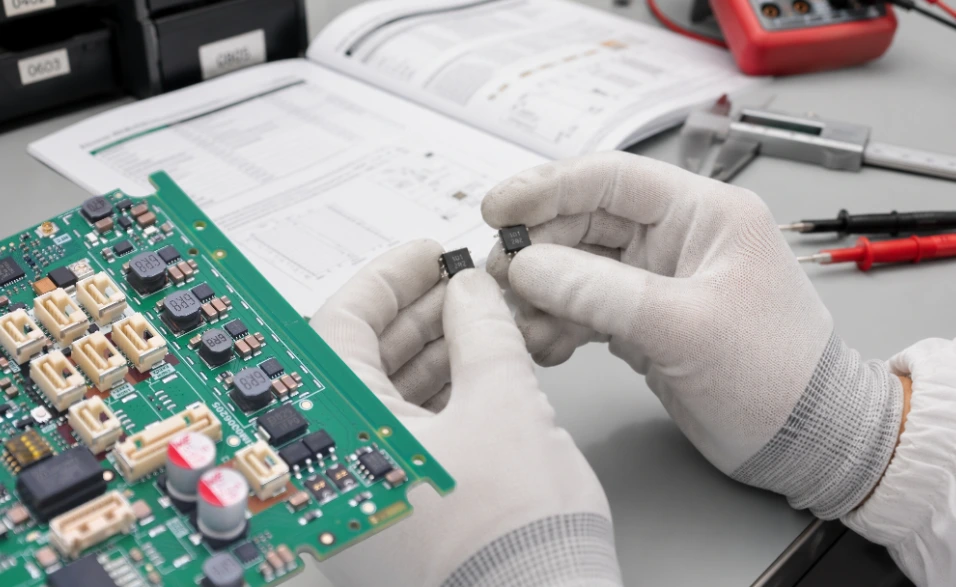
Evaluate Firmware, Test and Compliance Impact at System Level
Many alternates fail outside the component datasheet comparison. A replacement MCU may use the same package but require changed clock configuration, boot settings or peripheral initialization. A memory device may match density while changing page size, timing or erase behavior. A sensor may preserve the digital interface but use different scaling, filtering or calibration.
The review should identify every artifact affected by the change: schematic, layout, BOM, firmware source, programming image, calibration data, production test, service procedure, labeling and regulatory evidence. For power components, evaluate efficiency, transient response, protection behavior and thermal margin at the product’s worst-case input and load. For analog devices, compare offset, drift, noise, bandwidth and input/output range under real operating conditions.
Compliance responsibility remains with the product owner. Changes may affect EMC, safety, automotive documentation, medical-device files, environmental declarations or customer qualification. The validation plan should state which tests are engineering checks and which are formal requalification. Highleap can execute agreed programming and PCBA test methods, but acceptance limits and product-level certification requirements must be defined by the customer.
Build an Alternate-Part Approval Matrix and Change-Control Process
An approval matrix prevents emergency sourcing from becoming uncontrolled substitution. Each BOM line should have a defined status:
- Released: the alternate is approved in the current BOM or AVL and may be purchased under stated conditions.
- Conditional: the alternate may be used after a specified review, sample approval or first-article result.
- Restricted: no substitution without written design-owner approval.
- Source-only change: the same MPN may be purchased through another approved authorized distributor.
The matrix should also record approved package, qualification grade, date-code policy, compliance documentation, customer part number and applicable product revisions. A single alternate may be valid for one assembly revision but not another.
Change control should define who proposes, evaluates and approves the alternate. Purchasing should not approve electrical equivalence; engineering should not approve commercial liability or NCNR exposure; manufacturing should confirm process compatibility; quality should confirm traceability and inspection. The released evidence should include the comparison record, approval, revised BOM/AVL, affected manufacturing files, sample results and effective production lot.
Validate Alternate Components Through Samples, Pilot Assembly and Test
The validation depth should follow the consequence of failure and the magnitude of the change. A low-risk passive alternate may require dimensional review, derating confirmation and a functional sample. A new MCU, memory device, radio, power stage or safety-related component normally needs broader regression testing.
| Validation stage | Purpose | Typical output |
|---|---|---|
| Document comparison | Identify known differences and open questions | Signed comparison matrix |
| Incoming sample check | Confirm MPN, package, markings and source | Inspection record |
| First-article PCBA | Verify placement, soldering, programming and basic function | FAI, AOI/X-ray records where applicable |
| Engineering regression | Test operating limits, interfaces, thermal behavior and firmware | Customer-approved result set |
| Pilot lot | Confirm process repeatability and yield | Yield, defect and test data |
Highleap can build a controlled pilot using the original and alternate components for comparison. The test plan should avoid vague pass/fail statements. It should define supply range, load, temperature where relevant, communication checks, programmed version, current limits and product-specific acceptance criteria. Only after approval should the alternate be released for volume procurement.
The pilot should also verify manufacturing controls that may not appear in a bench test. Confirm feeder packaging, polarity recognition, placement stability, solder paste response, reflow behavior, inspection visibility and rework method. Record the lot and source used for validation so that production does not later substitute a different package revision or supplier lot without review.
Compare Total Production Cost, Not Only Component Unit Price
A cheaper alternate can increase the total PCBA cost through MOQ, reel quantity, validation NRE, feeder changes, stencil modification, slower placement, lower yield or longer test time. A higher-priced component can reduce total cost when it is widely available, supports multiple distributors or eliminates a manual assembly step.
The commercial comparison should include:
- authorized unit price at prototype and forecast volume;
- MOQ, standard pack, reel and NCNR conditions;
- lead time, approved-source count and lifecycle outlook;
- PCB, stencil, fixture, firmware and test changes;
- sample and qualification cost;
- assembly yield, rework and inspection impact;
- excess inventory and future redesign exposure.
Highleap can separate immediate purchase-price savings from manufacturing and lifecycle effects in the PCBA quotation. This allows the customer to reject a low-price substitution that would create hidden process or field cost.
What Highleap Delivers for Alternate-Component PCB Assembly Projects
A Highleap alternate-component project can include a normalized BOM, exact-MPN verification, authorized-source options, technical-difference tables, PCB and stencil impact review, original-versus-alternate quotation, pilot assembly and revision-controlled production release. The final scope depends on component complexity and customer validation requirements.
To begin, provide:
- BOM with reference designators, quantities and original MPNs;
- annual volume and expected product life;
- approved brands, forbidden sources and no-substitution lines;
- Gerbers or ODB++, centroid and assembly drawings;
- firmware/programming files where relevant;
- functional-test specification and compliance constraints;
- target cost or affected lead-time problem.
Highleap will identify which proposals are purchasing changes, which require customer engineering approval and which need PCB or firmware work. Production will not use an unapproved technical alternate merely because it is available.
The quotation can be organized in three layers: sourcing-only review for released alternates, engineering comparison for candidates with controlled differences, and prototype/validation work for changes that affect PCB, firmware or test. This keeps the customer from paying redesign-level NRE for a distributor change while also preventing a complex semiconductor substitution from being handled as a purchasing-only task.
For volume release, Highleap can record the approved source and MPN in the production BOM, identify customer-controlled substitutions, and retain manufacturing records according to the agreed order requirements. Any product-level certification or formal qualification remains outside the standard assembly scope unless explicitly included.
Convert alternate availability into an approved production option
Highleap can compare the original and proposed parts, identify PCB/assembly impact and quote the pilot and validation work required for release.

Recommended Posts

Taconic RF-35 PCB Manufacturing Service — Prototype Through Volume Production
Figure 1. Taconic RF-35 PCBTaconic RF-35 is the workhorse...

Isola Astra MT77 PCB Manufacturing
Figure 1. Isola Astra MT77 PCB ManufacturingIsola Astra...

Nelco N4000-13 PCB Material and Manufacturing Guide | Highleap Electronics
Figure 1. Nelco N4000-13 PCBNelco N4000-13 PCB is a...

Copper Clad Laminate: Complete Material Selection Guide for PCB Engineers
Every electrical property that matters in a printed...
How to get a quote for PCBs
Let’s run DFM/DFA analysis for you and get back to you with a report. You can upload your files securely through our website. We require the following information in order to give you a quote:
-
- Gerber, ODB++, or .pcb, spec.
- BOM list if you require assembly
- Quantity
- Turn time
For PCBA services, please provide your BOM (Bill of Materials) and any specific assembly instructions. We also offer DFM/DFA analysis to optimize your designs for manufacturability and assembly, ensuring a smooth production process.