
Multi-Variant PCB Assembly Without Mixing BOMs, Firmware or Labels
Table of contents
- 1. What Is Multi-Variant PCB Assembly?
- 2. How Are BOM and Stuffing Options Controlled?
- 3. How Are Shared Components and Inventory Managed?
- 4. How Are Firmware, Calibration and Labels Controlled?
- 5. How Are Changeovers Planned Between Variants?
- 6. How Are Inspection and Functional Test Set by Variant?
- 7. How Is Multi-Variant PCB Assembly Priced and Scheduled?
- 8. Request a Multi-Variant PCB Assembly Quote
- 9. Multi-Variant PCBA Manufacturing Questions
Multi-variant PCB assembly is used when an OEM manufactures several product versions that share a PCB, components or assembly process but differ by fitted options, connectors, firmware, calibration, labels or packaging. The commercial benefit comes from common materials and reusable setup. The manufacturing risk is building a valid board in the wrong configuration.
Highleap Electronics supports product family PCBA manufacturing for prototypes, high-mix low-volume programs and repeat production. The factory reviews the complete variant family, identifies real commonality and controls the items that distinguish each sellable part number. This can reduce repeated setup and inventory while preserving revision and test accuracy.
For quotation, send the board files and BOMs for the variants you want built, or send the base BOM plus a simple list of differences. Include quantity by variant. Highleap can create the manufacturing comparison; the customer does not need to prepare a complex configuration matrix before inquiry.
1. What Is Multi-Variant PCB Assembly?
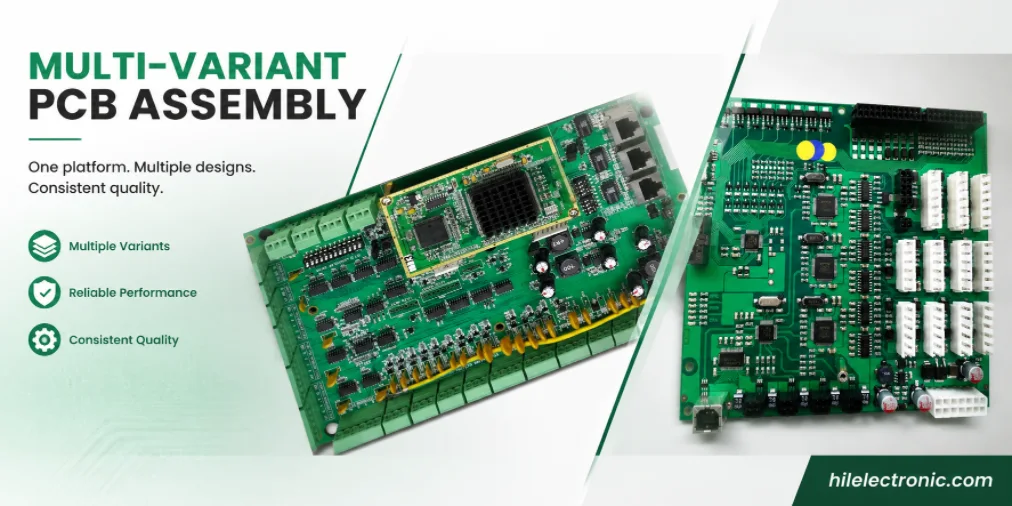
Multiple PCB variants assembly may use one bare PCB with different do-not-fit options, several BOMs on related PCBs or a common assembly that receives different firmware and labels. The service differs from a single low-volume board because changeovers and shared inventory must be managed across a family.
Same PCB, different fitted or omitted components.
Different interfaces, power options or regulatory components.
Common hardware with different programmed features.
Different values or limits tied to the finished product.
Same PCBA delivered under different customer or market identities.
Highleap connects the program with high-mix low-volume PCB assembly when variants run in short, frequent batches. The key control is the customer part number and revision, not an informal description such as “standard” or “EU version.”
2. How Are BOM and Stuffing Options Controlled?
Each variant should map to a specific PCB revision, BOM revision and assembly option. Highleap can compare the files and build a reference-designator-level difference list. Shared parts are identified, but items with the same value are not automatically treated as interchangeable when manufacturer, tolerance, qualification or programming differs.
| Configuration item | Family-level control | Variant-level control |
|---|---|---|
| Bare PCB | Common board or related board family. | Exact fabrication revision used for each part number. |
| BOM | Approved common components and source rules. | Fitted, omitted and alternate parts by reference designator. |
| Assembly drawing | Common orientation and workmanship information. | Variant-specific notes, connectors or hardware. |
| Firmware | Controlled programming environment. | Approved file, checksum and option for each variant. |
| Label/package | Shared format or process. | Exact text, serial range and customer/market identity. |
Highleap can review PCB BOM structure and accuracy and return conflicts before material purchase. Procurement can submit separate BOMs or a simple difference list; the factory should convert that information into a controlled production definition.
3. How Are Shared Components and Inventory Managed?
Common components can reduce cost and lead time, but only when they are genuinely approved across the family. Highleap can purchase shared resistors, capacitors, ICs or connectors against the combined forecast while preserving lot and source control. Variant-only parts remain allocated to the correct product.
| Material category | Planning approach | Risk to control |
|---|---|---|
| True common part | Buy against combined demand where commercially useful. | One change can affect several products. |
| Same description, different approval | Keep separate MPN/source control. | False commonality can violate product qualification. |
| Variant-only part | Buy against the specific release and forecast. | MOQ and excess may be concentrated in one low-demand variant. |
| Programmed/configured device | Control blank device and final programmed identity separately. | Wrong firmware may create an invisible variant mix. |
| Customer-supplied strategic part | Receive and issue by customer part/variant. | Shortage or misallocation can stop one version. |
Highleap can combine the program with electronic component sourcing and consigned PCB assembly material control. The quote should show shared-material assumptions and how excess inventory is assigned.
4. How Are Firmware, Calibration and Labels Controlled?
Firmware and labels often create more variant risk than component placement because the physical assemblies may look identical. Highleap should connect the customer part number to the correct programming file, checksum, calibration procedure, serial-number rule and label template.
- Release approved firmware or configuration for each product variant.
- Verify file name, version and checksum before production.
- Program and confirm the device using the agreed method.
- Apply calibration or configuration values when required.
- Print and verify the correct label and serial range.
- Run the variant-specific functional test.
- Record the relationship between hardware, firmware and finished part number.
Highleap can use IC programming services and variant-level hardware and firmware traceability at the level required by the product. For simple commercial products, batch records may be sufficient; for configured equipment, serial-level linkage may be necessary.
5. How Are Changeovers Planned Between Variants?
A changeover may involve feeders, do-not-fit options, manual parts, programming, test software, labels and packaging. Running similar variants together can reduce setup, but similarity also increases mix-up risk. Highleap balances sequence efficiency with verification and line-clearance requirements.
| Changeover area | Control | Why it matters |
|---|---|---|
| Components/feeders | Verified setup and removal of variant-only material. | Prevents wrong fit or leftover parts. |
| Placement program | Controlled program selected by work order. | Avoids loading a related but incorrect variant. |
| Manual/THT parts | Kitted by variant and checked before insertion. | Visible connectors may define the product version. |
| Programming/test | Correct file and test sequence loaded. | Hardware-identical variants can otherwise be mixed. |
| Labels/packaging | Line clearance and first-label verification. | Prevents correct boards shipping under the wrong identity. |
For high-change programs, SMT contract manufacturing should include retained programs, controlled feeder setup and a repeatable first-unit gate. Highleap can quote the actual batch and changeover pattern rather than treating annual demand as one continuous order.
6. How Are Inspection and Functional Test Set by Variant?
Common manufacturing defects can share one inspection route, but variant-specific options require targeted checks. AOI may confirm fitted and omitted references; programming verifies firmware identity; functional test confirms features and interfaces; final inspection verifies connector, label and packaging configuration.
| Check | Common across family | Variant-specific element |
|---|---|---|
| AOI/visual | General placement and soldering criteria. | Presence/absence of option components. |
| X-ray | Hidden-joint acceptance for shared packages. | Only variants containing the relevant BGA/QFN. |
| Programming | Programming station and security controls. | File, checksum, keys or options. |
| Functional test | Core power and communication checks. | Enabled features, I/O, calibration or region behavior. |
| Final inspection | Workmanship and packaging method. | Connector type, label, serial and accessory set. |
Highleap can integrate functional testing for multiple PCBA variants and AOI inspection. The test result should identify the finished product variant rather than only the base PCB number.
7. How Is Multi-Variant PCB Assembly Priced and Scheduled?
Pricing depends on total family volume, quantity per variant, common-material percentage, changeover frequency, variant-only components, programming/test differences and release pattern. One annual quantity can be misleading if it is split across many small builds and revisions.
High true commonality, stable variants, grouped releases and shared test assets.
Frequent tiny changeovers, similar-looking variants, unique labels and many manual options.
Combined forecast for approved common parts with separate control for variant-only items.
Provide expected batch size and frequency for each variant, not only annual totals.
Highleap can compare low-volume releases with repeat batch PCB assembly planning. The quote should separate family-level NRE from variant setup and recurring unit cost so the customer can see where consolidation provides value.
For family programs with very uneven demand, Highleap can separate common-material economics from variant setup cost. This allows a high-demand version to benefit from larger purchasing while low-demand versions remain build-to-order without distorting the commercial model for the entire family.
8. Request a Multi-Variant PCB Assembly Quote
Send the PCB files, BOMs and quantity by variant. If the product family uses one base board, send the base BOM plus a simple list of fitted options, firmware and label differences. Highleap can organize the information into a controlled build matrix.
The response should show shared and unique materials, changeover assumptions, programming/test differences, first-article checks and material liability. This enables procurement to compare a product-family service rather than obtain disconnected quotations.
Use the multi-variant PCBA quote request to begin. Highleap can support pilot batches, high-mix schedules and stable repeat releases under the same family control.
Highleap can quote the family as one program while keeping unit price, setup and material exposure visible by variant. This makes it easier to decide whether low-demand versions should be grouped, scheduled separately or built to stock.
9. Multi-Variant PCBA Manufacturing Questions
Can one PCB support many product variants?
Yes, when the design intentionally supports stuffing, firmware or connector options. Manufacturing control must still identify the exact BOM and finished part number for each build.
Can common components be purchased together for all variants?
Yes, but only when the exact part and source are approved across the family. Similar descriptions do not automatically create valid commonality.
How are wrong-firmware shipments prevented?
The work order, programming file, checksum, label and functional test are tied to the finished variant. Highleap applies setup verification and records at the agreed batch or serial level.
Is multi-variant assembly only for low volume?
No. It is common in high-mix low-volume programs, but product families can also run at medium or high aggregate volume. The operating challenge is variant changeover and configuration control, not only quantity.
How are PCB assembly BOM variants managed?
PCB assembly BOM variants are mapped by finished part number, PCB revision and reference designator. Shared components are controlled centrally, while fitted, omitted and variant-only items remain explicit.
Can a configurable PCB assembly service handle PCB assembly firmware variants?
Yes. A configurable PCB assembly service can manage PCB assembly firmware variants by linking the approved file, checksum, hardware option, serial or label and functional test to the work order.
What does high mix PCBA variant control include?
High mix PCBA variant control includes material setup, line clearance, program selection, manual parts, firmware, testing, labels, packaging and first-unit verification for every changeover.

Recommended Posts
TMM4 Filter PCB Manufacturing
TMM4 filter PCB manufacturing is controlled by the...
TMM3 PCB Manufacturing for RF Modules
TMM3 PCB manufacturing is most useful where the RF module...
TMM6 PCB Fabrication
TMM6 fabrication is the process-control page for a mid-Dk...
TMM10 PCB Manufacturing for Compact RF Designs
Table of contentsHow TMM10 Shrinks RF StructuresTMM10 vs...
How to get a quote for PCBs
Let’s run DFM/DFA analysis for you and get back to you with a report. You can upload your files securely through our website. We require the following information in order to give you a quote:
-
- Gerber, ODB++, or .pcb, spec.
- BOM list if you require assembly
- Quantity
- Turn time
For PCBA services, please provide your BOM (Bill of Materials) and any specific assembly instructions. We also offer DFM/DFA analysis to optimize your designs for manufacturability and assembly, ensuring a smooth production process.