
AI Server PCB Demand in 2026
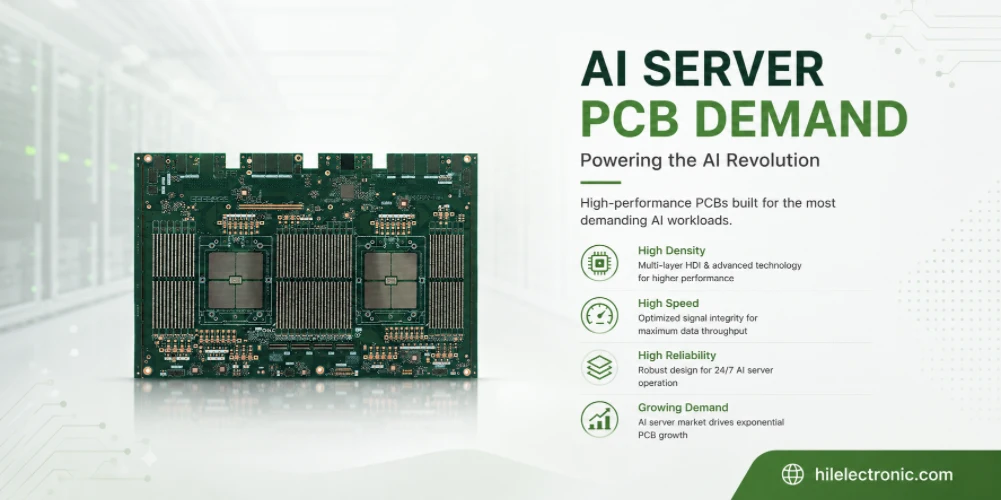
AI server hardware is the single largest force reshaping the PCB industry in 2026. The change is not incremental — it is a step-function move in PCB content value, material grade, layer count and supplier concentration. Per Morgan Stanley’s May 22, 2026 BOM teardown of NVIDIA’s upcoming Vera Rubin VR200 NVL72 rack, PCB content value per rack rose 233% generation-over-generation — from approximately $35,100 on GB300 to approximately $116,700 on VR200. The same report shows MLCC content value up 182%, ABF substrate up 82%, and the full rack ASP at approximately $7.8 million — nearly double the current GB300 rack.
This guide walks through the technical and material changes inside the Rubin platform, the supplier ecosystem that builds it, and the propagation effect on PCB material allocation for everyone else. The pricing context is in the PCB price increase analysis, the underlying material economics in the PCB raw material costs guide, supply concentration in the PCB material shortages analysis, and design and procurement responses in the guide to reducing PCB costs.
1. The Headline Number: $35,100 → $116,700 per Rack
Morgan Stanley’s bottom-up BOM teardown of the NVIDIA Vera Rubin VR200 NVL72 rack — published by analyst Howard Kao on May 22, 2026 — established the headline numbers for AI server PCB economics in 2026. Among all downstream components, PCB content value posted the largest year-over-year increase:
| Component | GB300 Content Value | VR200 Content Value | Change |
|---|---|---|---|
| PCB content per rack | ~$35,100 | ~$116,700 | +233% |
| MLCC (multilayer ceramic capacitors) | ~$1,530 | ~$4,320 | +182% |
| ABF substrate | — | — | +82% |
| Memory (HBM + SOCAMM) | ~$370,000 | ~$2,000,000 | +435% |
| GPU silicon | ~$2,520,000 | ~$3,960,000 | +57% |
| Power supply | — | — | +32% |
| Liquid cooling | — | — | +12% |
Translated into per-square-meter terms, multi-layer PCBs for general electronics in 2026 are running approximately $204 per square meter according to industry teardown data via Reuters, while the high-end AI server boards reach approximately $1,970 per square meter — close to 10× the standard rate. The difference is material-driven: layer count, CCL grade, copper-foil profile, glass cloth grade and surface finish all sit at the premium tier of their respective categories.
Why is AI server PCB content rising 233% generation-over-generation->
Because Rubin combines two effects. First, the existing PCB types are getting larger and more complex — Rubin’s compute board upgrades from a 22-layer HDI PCB on GB300 to a 26-layer board, with material grade moving from M7 to M8. Second, Rubin introduces entirely new PCB modules that did not exist on GB300, including the Midplane PCB (18 units per rack at $1,500 each) and the ConnectX module PCB (72 units per rack at $270 each). These two new types alone contribute approximately $46,400 in added PCB content value per rack.
2. Why a Rubin VR200 NVL72 Costs $7.8 Million from the ODM
Morgan Stanley’s analysis estimates the full Rubin VR200 NVL72 rack at approximately $7.8 million from the ODM, with even higher prices through OEM channels such as Lenovo, Asustek, Giga-Byte and Dell. This is nearly double the current GB300 rack at under $4 million. The increase is broad-based across the BOM:
- Memory is the largest single driver. Memory share moved from 5-10% of the GB200 NVL72 BOM to 25-30% of the VR200 BOM. The absolute memory cost rose from approximately $370,000 (GB300) to approximately $2 million (VR200) — a 435% increase driven by both higher HBM content and the underlying memory market repricing.
- GPU silicon dollar value rose 57% — from approximately $2.52 million to approximately $3.96 million per rack — but GPU share of total BOM fell from approximately 65% to approximately 51% because memory and other components grew faster.
- PCB content surged 233% from approximately $35,100 to approximately $116,700 per rack, on the back of higher layer counts, premium CCL grades, and entirely new PCB modules (Midplane, ConnectX) introduced by Rubin.
- MLCC content grew 182% from approximately $1,530 to approximately $4,320 per rack. A single VR200 rack now uses approximately 600,000 multilayer ceramic capacitors, more than 30% above the GB300 count.
- ABF substrate value grew 82%, reflecting both the larger substrate area required for Rubin GPUs and the same T-glass-driven cost pressure that touches CCL.
What this means for non-AI buyers: the $116,700 of PCB content in a single Rubin rack is dramatically denser per dollar than non-AI workloads. CCL makers (Kingboard, Shengyi, EMC, TUC, Doosan, MGC), copper foil makers (Mitsui Kinzoku, Furukawa, JX Nippon), glass cloth makers (Nittobo) and surface-finish chemistry makers (Atotech, Uyemura) each see hyperscale AI buyers placing orders that take priority over standard industrial or consumer PCB demand. The propagation through allocation is one reason every other industry is paying more in 2026 — covered in Section 7.
3. The CCL Grade Ladder: M6 → M7 → M8 → M9 Q-Glass → M10
The technical reason for AI PCB cost growth is the move up the CCL grade ladder. Each step changes resin chemistry, copper-foil profile and glass-cloth grade at the same time, multiplying material cost rather than adding to it. The progression from H100 / GB200 through Rubin Ultra spans five M-grades in approximately three generations.
| NVIDIA Platform | PCB Layers | CCL Grade | Glass Cloth | Foil Profile |
|---|---|---|---|---|
| H100 (Hopper, 2022-2024) | ~22 | M6 / Megtron 6 | NE-glass | VLP |
| GB200 (Blackwell, 2024) | ~22 | M7 / Megtron 7 class | NE-glass / T-glass | HVLP |
| GB300 (Blackwell Ultra, 2025) | 22-34 | M7 / Megtron 7 | T-glass | HVLP / HVLP4 |
| VR200 (Rubin compute, 2026-2027) | 26 (compute board); midplane up to 44 | M8 / Q-glass | T-glass / Q-glass | HVLP4 |
| Rubin LPX | ~52 | M9 Q-glass | Q-glass | HVLP4 / HVLP5 |
| Rubin Ultra (Kyber, 2027+) | ~78+ | M9+ Q-glass / M10 (in qualification) | Q-glass | HVLP5 |
The cost multiplier up this ladder is dramatic. Per industry data: M6 CCL runs roughly 3-5× standard FR-4; M7 runs 6-9×; M8 runs 10-15×; M9 Q-glass runs 15-20×. The next-generation M10 grade currently in qualification (Df <0.002) extends the ladder further. On March 13, 2026, analyst Ming-Chi Kuo confirmed that NVIDIA had partnered with Wus Printed Circuit to test M10 CCL for 448G+ signaling, with the test boards using next-generation HVLP5 copper foil and Q-glass cloth.
What is Q-glass and why does it matter for AI->
Q-glass is glass fiber cloth made from high-purity quartz fiber (~99.99% SiO₂). It has a dielectric constant Dk of approximately 3.0 and a dissipation factor Df of approximately 0.0007 — both materially lower than NE-glass and T-glass. At 224G and 448G data rates, the entire signal path’s loss budget is so tight that the residual loss from glass-weave non-uniformity becomes a controlling factor. Q-glass reduces this loss by lowering the bulk dielectric constant of the reinforcement itself. The leading Q-glass suppliers are Shin-Etsu, Asahi Kasei, Glotech, Feilihua, Taishan Fiberglass and Hong Ho.
4. Layer Count Inflation: From 22 to 26 to 44 to 78 Layers
The progression in PCB layer count for NVIDIA AI compute boards has accelerated over the past three generations:
- H100 compute board: ~22 layers.
- GB300 compute board: 22-34 layers depending on the configuration.
- Rubin VR200 compute board: 26 layers (per Morgan Stanley teardown), upgraded from GB300’s 22-layer HDI.
- Rubin VR200 midplane PCB: reaching 44 layers for the highest-rate interconnect plane in the rack.
- Rubin LPX: approximately 52 layers on M9 Q-glass.
- Rubin Ultra / Kyber: projected at approximately 78+ layers.
Each layer added to a PCB roughly increases fabrication cost by 20-30% because each layer adds a CCL core, a prepreg, a lamination cycle, drilling, plating and registration risk. Doubling from 22 to 44 layers does more than double cost — it multiplies it because of the compounding lamination cycle count, hole-aspect-ratio difficulty, and registration tolerance buildup. By the time the design reaches 78 layers on Q-glass, every step of the fabrication process is at the boundary of what current equipment supports.
Why does the midplane need so many layers-> The midplane PCB on Rubin VR200 sits between the compute boards and connects all 72 GPUs in the NVL72 rack into a unified compute fabric. It carries every high-rate signal between every pair of compute boards, with no room for re-driver chips along the way. The layer count is determined by the signal-rate channel count multiplied by the strict impedance and crosstalk discipline required to maintain signal integrity across the entire backplane span. 44 layers on Q-glass is what is required to maintain the channel quality at full rack scale.
5. The Midplane PCB and ConnectX Module — Two New PCB Types
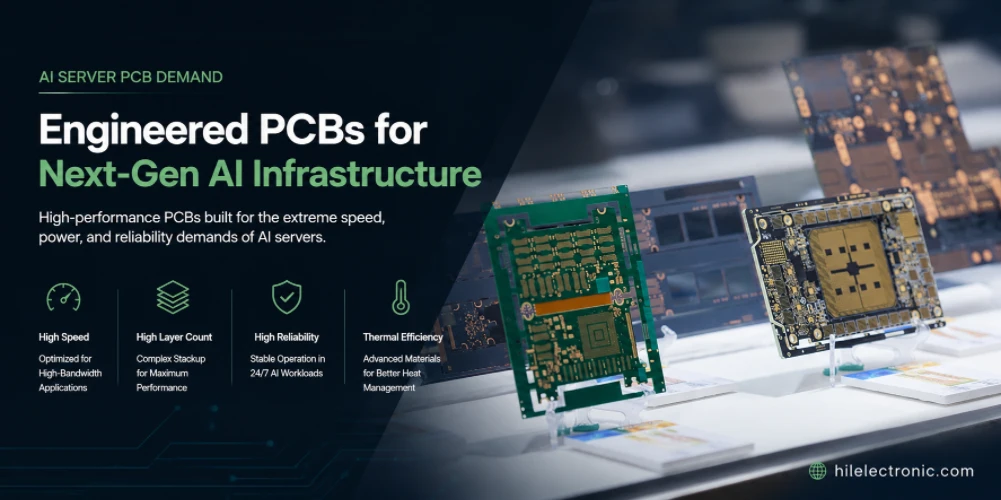
Rubin introduces two PCB types that were not present on GB300, and per Morgan Stanley’s BOM teardown they alone contribute approximately $46,400 of new PCB content value per rack:
- Midplane PCB. 18 units per rack at approximately $1,500 unit price. The midplane is the giant interconnect PCB that ties together compute boards into the unified NVLink fabric across the entire NVL72 rack. Layer counts reach 44 with Q-glass dielectric, requiring HVLP4 or HVLP5 copper foil to maintain 224G channel integrity over the long span. ABF and BT substrate makers cannot easily make boards this large; this is PCB territory.
- ConnectX module PCB. 72 units per rack at approximately $270 unit price. Each ConnectX-8 module sits as a daughter card to a compute board, providing the NICs for the rack-level network. The ConnectX PCB itself is a smaller HDI board built on M7 or M8 CCL with HVLP foil and tight impedance control.
Each of these new PCB types requires premium CCL grade, premium copper foil profile, and specialty glass cloth — all categories already constrained by Section 7 below. The cumulative effect is that NVIDIA Rubin has materially increased the demand for the same scarce material grades that 5G base-station, automotive radar, and high-end networking PCB customers also depend on.
How does the new midplane PCB compete for materials with the rest of the industry->
It competes directly. The midplane uses the same Q-glass cloth supplied by Nittobo, Shin-Etsu and Asahi Kasei that next-generation 5G millimeter-wave PCBs need. The same HVLP4/HVLP5 copper foil from Mitsui Kinzoku that radar and high-rate networking boards need. The same M8/M9 CCL from Doosan, Panasonic, Resonac and Shengyi. NVIDIA’s Rubin allocation absorbs leading-edge material capacity at every layer.
6. PCB Sourcing and Manufacturing Considerations
AI server programs place unusually high demands on signal integrity, power delivery, layer registration and process control. The right production route depends on the approved stackup, channel loss budget, impedance table, via structure, copper distribution, BGA pitch and inspection requirements.
- Confirm low-loss laminate availability and approved substitution rules before production release.
- Review controlled-impedance targets, roughness requirements and coupon strategy with the fabrication package.
- Assess sequential lamination, filled vias, backdrilling and high-layer-count registration during DFM.
- Coordinate fabrication, component sourcing and assembly requirements when the board is supplied as PCBA.
Highleap can review the manufacturing package for high-speed PCB manufacturing before quotation, including the stackup, impedance data, drawings and test expectations. Projects with special process requirements can be evaluated for both prototype and volume production.
7. How AI Demand Pulls Material Allocation from Everyone Else
The propagation of AI demand through the material supply chain is the single most important PCB story of 2026 for non-AI buyers. Hyperscale AI customers — building Rubin VR200 racks for OpenAI, Google, Microsoft, Amazon, Oracle, Meta, xAI and other large data-center operators — have effectively pre-reserved much of the available capacity at every leading-edge material producer:
- Mitsui Kinzoku MicroThin copper foil — 2026 orders exceed installed capacity at the leading producer of premium HVLP foil.
- Nittobo T-glass and Q-glass cloth — orders backlogged into the following year’s Q2 at approximately $100/kg.
- Panasonic Megtron 6/7, Doosan high-end CCL, MGC/Resonac CCL — moved to allocation-based supply.
- Topoint / Union Tool / Zhongwu micro-drills — utilization above 90%, supply unable to meet demand.
- Atotech / Uyemura plating chemistry — premium ENIG and electroplating capacity allocated to high-margin AI server programs.
What this means in practice is that even if a non-AI buyer is willing to pay 2024-equivalent prices for premium CCL or HVLP foil, the material is not necessarily available because hyperscale AI buyers have placed forward orders that take priority. The Korea Customs Service data — CCL import prices reaching $20,728 per ton in March 2026, up 74.5% year-on-year, the first time on record above $20,000/ton — is one quantitative reflection of this allocation rationing.
Why hyperscalers pay first: in a quota market, allocation goes to the customer with the longest forward commitment and the highest unit value per ton. A hyperscaler ordering 100,000 Rubin compute boards on M8 CCL provides a CCL maker with allocation-able volume and pricing power that a 50-unit industrial PCB order cannot match. The CCL maker accepts the hyperscaler forward order, allocates capacity, and the residual production is what remains available to general PCB demand.
8. What Non-AI Buyers Are Now Experiencing
For industries that do not buy AI server PCBs but use the same underlying materials, the 2026 cycle has produced uncomfortable effects on lead time, pricing and material availability:
- Telecom and networking equipment OEMs. 5G base stations, switches and routers depend on PPE-based mid-loss CCL (Megtron 6 class) — the same material families AI consumes. Many are facing 14-18 week lead times and 20-40% price increases on the same grade they purchased in 2024.
- 5G infrastructure providers. Direct PPE-resin exposure from the upstream supply event. Some designs have been temporarily re-engineered onto thicker or higher-grade stackups to maintain channel performance with available material.
- Automotive electronics (especially 77 GHz radar). Specialty PTFE / hydrocarbon laminates (a specialty low-loss laminate/a specialty low-loss laminate class) are also AI-allocated for hyperscaler high-frequency programs. Automotive radar production now depends on qualifying alternative laminate grades or accepting longer lead times.
- Industrial control, power and consumer electronics. Standard FR-4 absorbs displaced demand from premium-grade buyers; lead times have stretched from 2-3 weeks to 6-8 weeks. Even buyers fully insulated from AI-grade material exposure see the propagation effect.
- RF / aerospace defense. Specialty PTFE specialty low-loss laminate-type material is less directly exposed but lead times have extended as specialty low-loss laminate, Taconic and Arlon allocate capacity to higher-margin hyperscaler programs.
What can a non-AI OEM do in 2026->
The realistic response combines four moves: (1) qualify a second CCL grade per board to give the fabricator an allocation alternative; (2) extend forecasts to 12-26 weeks rolling so the fabricator can secure CCL allocation against your demand; (3) audit designs for over-specification — M7 specified where M6 fits, HVLP foil specified where LP fits, ENIG specified where OSP fits; (4) use hybrid stackups that drop premium CCL on non-critical layers. These are covered in detail in the cost reduction guide.
9. AI Server PCB Demand FAQs
How does AI server demand affect PCB manufacturing?
Demand for high-layer-count, controlled-impedance boards can tighten availability for selected low-loss laminates, copper foil and process capacity. The impact varies by approved material, stackup complexity, quantity and required delivery date.
What information is needed to quote an AI server PCB accurately?
Provide Gerber or ODB++ data, the stackup, impedance table, fabrication drawing, drill data, finished thickness, surface finish, quantity, test requirements and assembly files when PCBA is required. Complete data allows an engineering review before material and process decisions are made.
Can complex high-speed boards be built in prototype and production quantities?
Yes. The appropriate process route is confirmed during engineering review. Complex constructions may require material confirmation, sequential lamination, controlled impedance, via treatment, specialized inspection or a pilot build before volume production.
How can a design team reduce supply risk for an advanced PCB?
Specify qualified material options where the electrical budget allows, release the stackup early, define substitution controls in the fabrication drawing and involve the manufacturer before finalizing a high-risk routing or via structure.
When should Highleap review an AI server board?
Review is most useful before the design is released for quotation, especially when the board includes high-speed channels, dense BGA escape routing, special laminates, backdrilling, HDI features or strict traceability requirements.

Recommended Posts
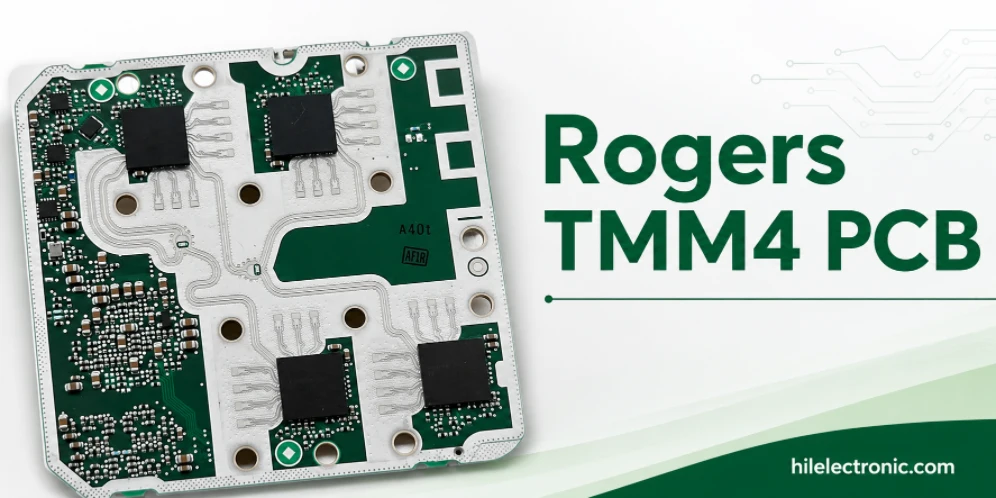
TMM4 Filter PCB Manufacturing
TMM4 filter PCB manufacturing is controlled by the...
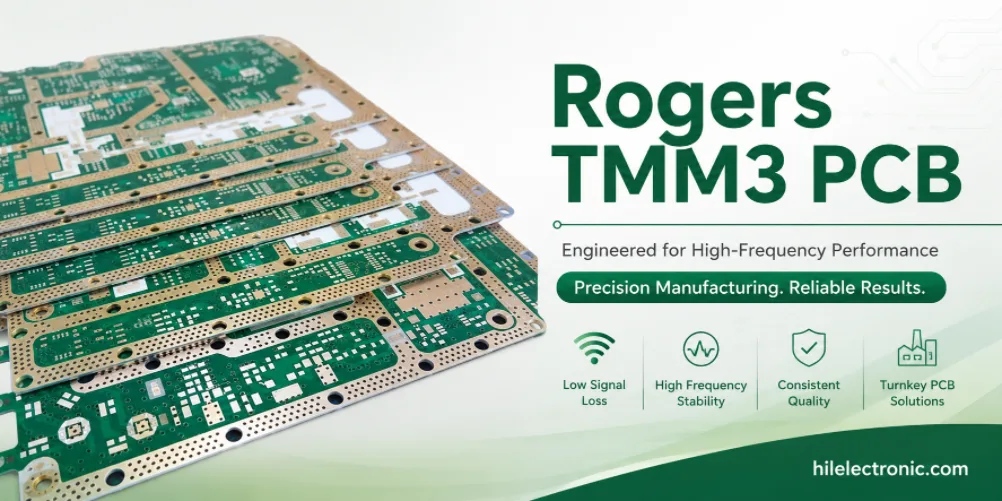
TMM3 PCB Manufacturing for RF Modules
TMM3 PCB manufacturing is most useful where the RF module...
TMM6 PCB Fabrication
TMM6 fabrication is the process-control page for a mid-Dk...
TMM10 PCB Manufacturing for Compact RF Designs
Table of contentsHow TMM10 Shrinks RF StructuresTMM10 vs...
How to get a quote for PCBs
Let’s run DFM/DFA analysis for you and get back to you with a report. You can upload your files securely through our website. We require the following information in order to give you a quote:
-
- Gerber, ODB++, or .pcb, spec.
- BOM list if you require assembly
- Quantity
- Turn time
For PCBA services, please provide your BOM (Bill of Materials) and any specific assembly instructions. We also offer DFM/DFA analysis to optimize your designs for manufacturability and assembly, ensuring a smooth production process.