
PCB Trace Resistance Calculator: How to Calculate Trace Resistance and Voltage Drop
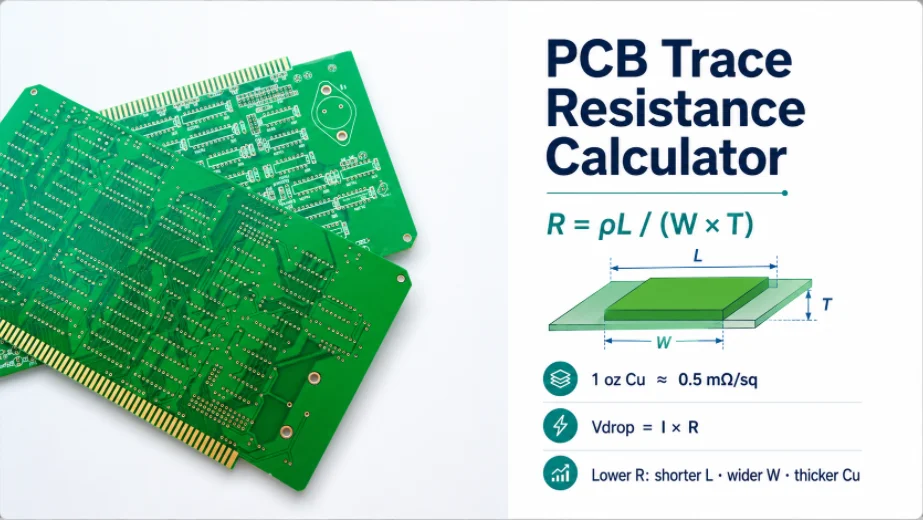
Figure 1. PCB trace resistance affects voltage drop, heat rise, and power integrity on finished boards.
Every copper trace has resistance, causing voltage drop and heating that can quietly undermine a good design. A trace resistance calculator turns width, copper thickness, length, and temperature into the actual ohms a trace adds. This guide answers the real questions – how to calculate PCB trace resistance, the resistance of 1 oz copper, how to cut it down – and shows how Highleap Electronics makes sure the trace you draw is the trace it builds.
1. How do you calculate PCB trace resistance?
Calculate PCB trace resistance with R = ρ × length ÷ (width × thickness), or more simply multiply the copper’s sheet resistance by the number of squares (length ÷ width). Both give the same answer – the squares method is just faster. The resistivity ρ is copper’s material constant (about 1.7 × 10⁻⁸ ohm-metres at room temperature), and the cross-sectional area is width times copper thickness.
The squares shortcut is worth internalizing: sheet resistance depends only on copper thickness, the number of squares is just length divided by width, so:
Trace resistance ≈ sheet resistance × (length ÷ width)
This is why a long, narrow trace has high resistance and a short, wide one has low resistance – and why doubling copper weight (1 oz to 2 oz) roughly halves the resistance, because the cross-section doubles. Copper weight is therefore a primary lever, which is why power designs reach for a heavy copper PCB when resistance has to come down. A refresher on how PCB traces behave makes the rest easier to apply.
2. What is the resistance of a 1 oz copper trace?
1 oz copper has a sheet resistance of about 0.5 milliohm per square, so a trace ten times longer than it is wide (ten squares) is roughly 5 milliohms before temperature and via effects. Thicker copper lowers this proportionally – 2 oz copper is about 0.25 milliohm per square – because resistance is inversely proportional to cross-sectional area.
“Squares” is a unitless ratio (length divided by width), which is why the same sheet-resistance number works for any trace in that copper weight. To get from squares to ohms, multiply by the sheet resistance for your copper; to get from ohms to voltage drop or heat, bring in the current. That single sheet-resistance figure, paired with the squares count, is enough for the quick estimates that drive most layout decisions.
3. Worked example: trace resistance, voltage drop, and power
For a 50 mm long, 0.5 mm wide trace in 1 oz copper carrying 2 A, the resistance is about 50 milliohms, the voltage drop is 100 mV, and the power dissipated is 0.2 W. Here is the full calculation:
- Squares: length ÷ width = 50 ÷ 0.5 = 100 squares.
- Resistance: 100 squares × ~0.5 mΩ/square ≈ 50 milliohms.
- Voltage drop: resistance × current = 0.050 Ω × 2 A = 0.1 V (100 mV).
- Power dissipated: current² × resistance = 2² × 0.050 = 0.2 W of heat.
For a 3.3 V rail, a 100 mV drop is about 3% – often acceptable, sometimes not. Now widen the trace to 2 mm: squares fall to 25, resistance to about 12.5 mΩ, voltage drop to 25 mV. A four-times-wider trace gives four-times-lower resistance – the core trade-off a calculator reveals, and the decision to make before layout is finished, not after a board runs hot. For the highest-current rails, dedicated heavy copper current-capacity engineering keeps both resistance and temperature in check.
4. Does trace resistance change with temperature and vias?
Yes – copper resistance rises about 0.4% per °C, so a trace running 40°C above room temperature has roughly 16% more resistance than its cold value, and each via in the path adds a little more. Because that extra resistance also makes more heat, the temperature and resistance reinforce each other on hot, high-current traces. Other real-world refinements:
- Etch tolerance. Manufacturing narrows every trace slightly versus what you drew, nudging resistance up; heavier copper widens this tolerance.
- Vias. A path that hops between layers accumulates via resistance, so for high-current transitions use copper pours and via stitching to lower the combined value.
- Plating. Finished outer-layer copper includes plating, so actual thickness can exceed the base foil weight.
For most work the room-temperature squares estimate is close enough to decide; for tight power or sensing designs, fold in temperature and via resistance, treating it as part of overall PCB thermal management.
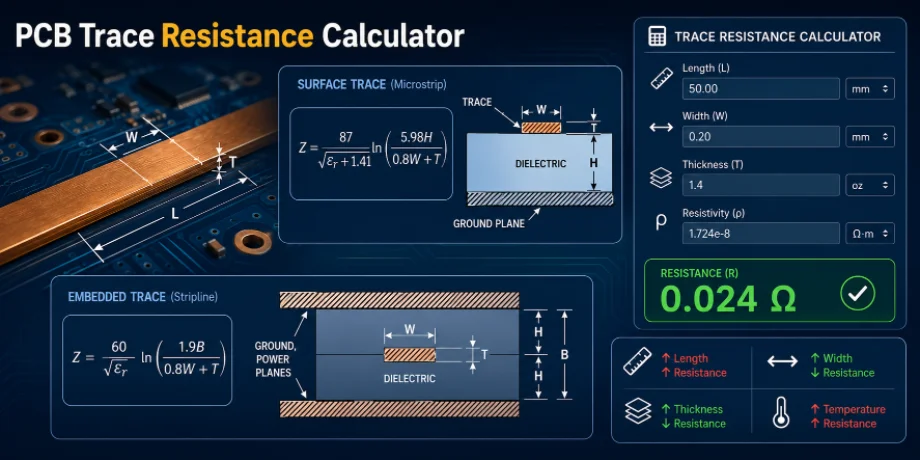
Trace width and copper thickness calculations should be checked against fabrication limits.
5. How to reduce PCB trace resistance
Reduce trace resistance by widening the trace, using heavier copper, shortening the path, switching power nets to a copper pour or plane, and paralleling vias at layer changes. Each lever works because resistance is sheet resistance times squares: widen or thicken to add cross-section, shorten to cut squares. In order of impact:
- Heavier copper – 2 oz or 3 oz cuts resistance proportionally in the same width.
- Wider traces or pours – a plane is effectively a very wide, very low-resistance conductor.
- Shorter routing – fewer squares, less resistance and drop.
- Parallel vias – multiple vias at a layer transition divide the via resistance.
Where signals are fast rather than high-current, the related discipline is controlled impedance rather than resistance – different target, different math.
6. Will the resistance hold after fabrication?
A calculated resistance only holds if the trace is fabricated to the assumed dimensions, and etching plus plating shift the finished value slightly – usually a little, but enough to matter on a tight power budget or a trace you rely on as a precise value. When width is critical, confirm the design intent with your fabricator.
A pre-build design-for-manufacturing check confirms your power traces, copper weight, and via strategy are achievable and that the finished geometry lands where you need it. Highleap then carries the board through thick-copper fabrication and assembly, with heavy-copper options for low-resistance power paths and first-article measurement when a design depends on a specific trace resistance or voltage drop. When you request pricing, include the copper weight, the rails where voltage drop is critical, and any trace whose resistance you are relying on.
7. Trace resistance FAQ
How do you calculate PCB trace resistance?
Use R = ρ × length ÷ (width × thickness), or multiply the copper’s sheet resistance (about 0.5 mΩ/square for 1 oz) by the number of squares (length ÷ width). Both give the same result.
What is the resistance of a 1 oz copper trace?
About 0.5 milliohm per square. A trace ten times longer than it is wide is therefore roughly 5 mΩ in 1 oz copper, before temperature and via effects.
Does trace resistance change with temperature?
Yes. Copper resistance rises roughly 0.4% per °C, so a trace running well above room temperature has noticeably higher resistance than its cold value.
How do I reduce trace resistance?
Widen the trace, use heavier copper, shorten the path, use a copper pour or plane for power, and parallel multiple vias at layer transitions.
Can Highleap build low-resistance, heavy-copper power boards?
Yes. Highleap offers heavy copper for low-resistance power paths, via strategies for layer transitions, and first-article measurement when a design relies on a specific trace resistance or voltage drop.

Recommended Posts
TMM4 Filter PCB Manufacturing
TMM4 filter PCB manufacturing is controlled by the...
TMM3 PCB Manufacturing for RF Modules
TMM3 PCB manufacturing is most useful where the RF module...
TMM6 PCB Fabrication
TMM6 fabrication is the process-control page for a mid-Dk...

TMM10 PCB Manufacturing for Compact RF Designs
Table of contentsHow TMM10 Shrinks RF StructuresTMM10 vs...
How to get a quote for PCBs
Let’s run DFM/DFA analysis for you and get back to you with a report. You can upload your files securely through our website. We require the following information in order to give you a quote:
-
- Gerber, ODB++, or .pcb, spec.
- BOM list if you require assembly
- Quantity
- Turn time
For PCBA services, please provide your BOM (Bill of Materials) and any specific assembly instructions. We also offer DFM/DFA analysis to optimize your designs for manufacturability and assembly, ensuring a smooth production process.