
Copper Pour and Via Stitching: A Technical Guide for PCB Design

Introduction: Understanding Copper Pour and Via Stitching
Copper pour refers to filling large areas of a PCB layer with copper to serve specific electrical or thermal functions. Via stitching involves placing multiple vias to connect copper regions across different layers. These two techniques are fundamental to modern PCB design, yet their application requires careful engineering judgment rather than blanket implementation. The decision to use copper pour and via stitching should always be driven by design objectives including electrical performance, thermal management, and electromagnetic compatibility.
Technical Mechanisms of Copper Pour and Via Stitching
The Technical Role of Copper Pour
Low-Impedance Power and Ground Networks
Copper pour provides a low-impedance return path for power distribution networks. By increasing the cross-sectional area of conductors, copper planes reduce resistance and inductance, enabling more stable voltage delivery to active components. This is particularly critical in designs with high current demands or sensitive analog circuits.
Thermal Management
Large copper areas act as effective heat spreaders, distributing thermal energy across the board surface. In power electronics or LED applications, copper pour helps dissipate heat from high-power components, reducing localized hot spots and improving overall thermal performance. The thermal conductivity of copper makes it an ideal medium for passive heat management.
Electromagnetic Compatibility
A continuous copper reference plane helps contain electromagnetic emissions by providing a consistent return path for high-frequency currents. However, designers must exercise caution—copper pour placed too close to high-speed signal traces can introduce parasitic capacitance, potentially degrading signal integrity rather than improving EMC performance.
The Technical Role of Via Stitching
Enhancing Inter-Layer Connectivity
Via stitching establishes robust electrical connections between copper planes on different layers. By distributing multiple vias across a plane area, designers ensure uniform potential across all connected layers. This technique is essential for maintaining ground plane integrity in multilayer PCB designs.
Signal Integrity in High-Frequency Designs
Properly spaced stitching vias minimize the return path loop area for high-frequency signals. Smaller loop areas translate to reduced inductance and lower EMI emissions. The via spacing should be calculated based on the maximum operating frequency to prevent unintended resonance effects.
Thermal Conductivity and EMI Shielding
Beyond electrical connectivity, via stitching improves vertical thermal transfer between layers. When combined with copper pour, stitching vias can also form effective EMI shielding structures, creating a Faraday cage effect around sensitive circuitry or high-radiation components.
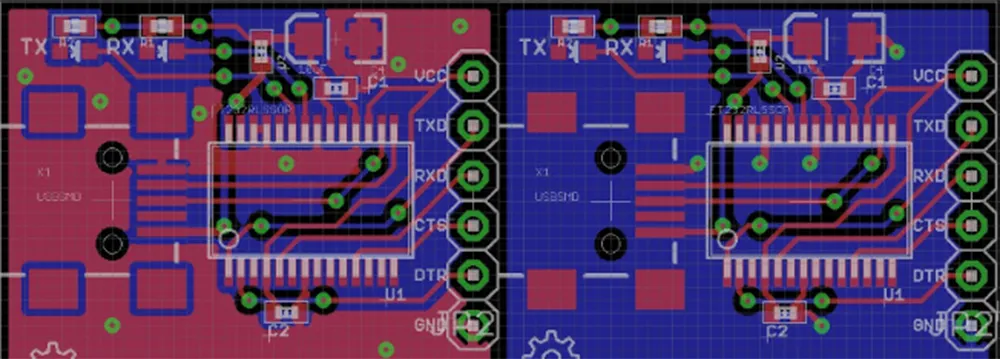
When to Apply Copper Pour and Via Stitching
Recommended Application Scenarios
Copper Pour Applications
Copper pour is well-suited for low to medium frequency power distribution networks where impedance reduction is the primary goal. It excels in thermal management applications such as power amplifiers and motor drivers. EMI-sensitive designs also benefit from copper pour when proper connectivity strategies ensure the plane remains at a stable reference potential.
Via Stitching Applications
Via stitching is essential in multilayer boards requiring continuous ground or power plane connectivity. High-speed digital and RF designs demand via stitching to maintain return path continuity and minimize signal degradation. EMI-sensitive systems use stitching vias around critical sections to form effective shielding boundaries.
Potential Risks and Scenarios to Avoid
Copper Pour Risks
Improperly implemented copper pour can cause signal crosstalk and unintended resonances. Large copper areas may also create thermal imbalance during soldering, leading to tombstoning or poor solder joints. Floating copper regions disconnected from any net can act as antennas, exacerbating EMI issues rather than mitigating them.
Via Stitching Risks
Excessive via spacing can create resonant cavities between planes, amplifying noise coupling at specific frequencies. Over-stitching in high-density designs may consume valuable routing real estate and complicate PCB fabrication. The via pitch must be carefully calculated to align with the highest operating frequency.

Combining Copper Pour and Via Stitching for Optimal Performance
Building Three-Dimensional Plane Structures
Connecting copper pours across multiple layers through stitching vias creates a three-dimensional low-impedance structure. This approach is particularly effective for power delivery networks in high-current applications, where both lateral current spreading and vertical current distribution are critical for stable operation.
Integrated Thermal Management
Placing copper pour beneath heat-generating components and connecting it via thermal vias to inner ground planes creates an efficient heat dissipation path. The vias transfer thermal energy vertically while the copper planes spread it laterally, maximizing the effective cooling area.
EMI Shielding Structures
Surrounding sensitive signals or noisy circuits with copper pour and connecting the edges through closely spaced stitching vias forms an effective shielding enclosure. This combined approach contains electromagnetic radiation and prevents external interference from coupling into critical signal paths.
Design Best Practices for Copper Pour and Via Stitching
Ensuring Proper Electrical Connectivity
Every copper pour region must have a defined electrical connection to avoid floating copper. Use thermal relief patterns for pad connections to balance electrical performance with solderability. Verify net connectivity in your CAD tool before finalizing the design.
Calculating Via Spacing for Target Frequencies
Via stitching spacing should be determined by the maximum operating frequency. A common guideline is to keep via spacing below one-tenth of the wavelength at the highest frequency of concern. This prevents cavity resonance and maintains shielding effectiveness across the operating bandwidth.
Manufacturing Considerations
In high-density PCB layouts, extensive copper pour can cause manufacturing challenges including copper balancing issues and etch variations. Work with your fabrication partner to understand their process capabilities. Consider adding thieving patterns or balancing copper distribution across layers.
Conclusion: A Decision Framework for Copper Pour and Via Stitching
There is no universal answer for when to apply copper pour and via stitching—each design demands its own tailored approach. The decision should be guided by three key criteria: electrical performance requirements, thermal management needs, and manufacturing feasibility. By evaluating these factors against your specific design objectives, you can determine the appropriate application of these techniques.
Thoughtful implementation of copper pour and via stitching transforms them from generic features into powerful tools that enhance PCB performance, reliability, and manufacturability.

Recommended Posts
Electronic Compass PCB Manufacturing & PCBA for Digital Heading Products
An Electronic Compass PCB converts magnetometer data—and...
Smart Bracelet PCB Manufacturing and Assembly
A smart bracelet PCB can support very different products:...
Server Motherboard PCB Manufacturing and Assembly
Server motherboard PCB manufacturing is becoming more...
TMM PCB Fabrication
Table of Contents TMM PCB Fabrication Scope for RF and...
How to get a quote for PCBs
Let‘s run DFM/DFA analysis for you and get back to you with a report. You can upload your files securely through our website. We require the following information in order to give you a quote:
-
- Gerber, ODB++, or .pcb, spec.
- BOM list if you require assembly
- Quantity
- Turn time
In addition to PCB manufacturing, we offer a comprehensive range of electronic services, including PCB design, PCBA, and turnkey solutions. Whether you need help with prototyping, design verification, component sourcing, or mass production, we provide end-to-end support to ensure your project’s success.
For PCBA services, please provide your BOM (Bill of Materials) and any specific assembly instructions. We also offer DFM/DFA analysis to optimize your designs for manufacturability and assembly, ensuring a smooth production process.