
TUC TU-862 HF PCB Manufacturing and Assembly Service
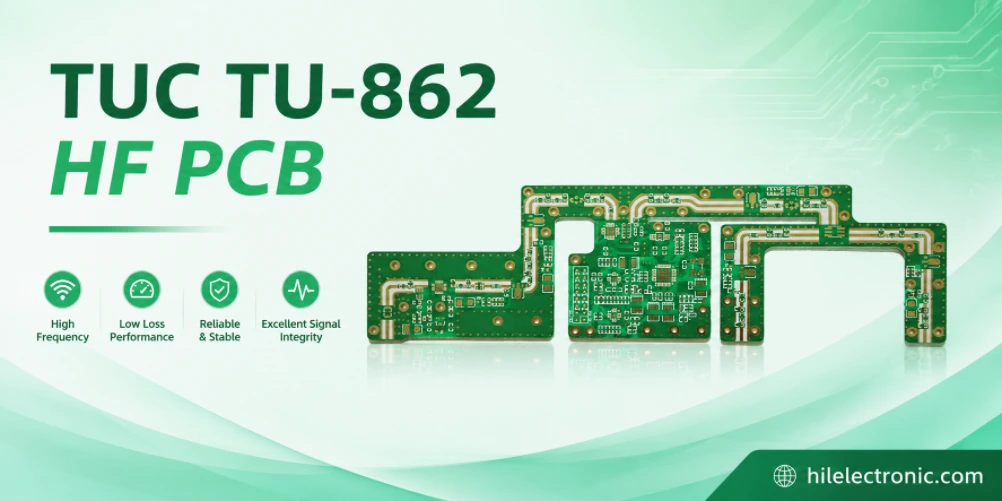
A TUC TU-862 HF PCB is fabricated with TU-862 HF laminate and TU-86P HF prepreg in the approved stackup. TUC manufactures the material. Highleap Electronics does not manufacture the laminate; we are the PCB fabrication and PCB assembly factory that processes the material into finished boards and products.
TU-862 HF is positioned as a high-Tg, halogen-free epoxy/E-glass material for boards exposed to lead-free assembly, thermal cycling and CAF reliability requirements. It is not an ultra-low-loss material, so the correct decision depends on thermal, environmental and signal-integrity needs.
Can Highleap build a TU-862 HF PCB? Yes, after verifying the exact laminate/prepreg construction, halogen-free documentation, stackup, via design, copper, finish and assembly profile. We support prototypes through volume production subject to DFM and material supply.
What Is TU-862 HF?
TUC describes TU-862 HF/TU-86P HF as high-Tg halogen-free materials made from epoxy resin and E-glass fabric. The flame-retardant system uses phosphorus- and nitrogen-based chemistry rather than conventional brominated resin. Published representative values include Tg of 200°C by DMA and 170°C by TMA, with lead-free process compatibility and CAF-resistant positioning.
This is not a stand-alone material or interface decision. The final behavior is produced by the interaction of high-Tg thermal behavior with CAF and plated-hole reliability, while exact laminate and prepreg identity and halogen-free documentation determine whether the same design can be repeated across panels and material lots. That is why Highleap begins with the board files instead of a generic product questionnaire.
The definition becomes commercially useful when it answers whether the design is manufacturable and what must remain fixed from prototype to production. Material identity, conductor construction, vertical interconnects and mechanical references can all affect the result. Our engineers separate mandatory performance conditions from preferences, then document the manufacturing controls needed for repeat orders.
Why Choose TU-862 HF for a PCB?
Halogen-free requirement
Useful when the customer specification requires controlled chlorine and bromine limits. This requirement must be documented; the word “green” is not enough.
Lead-free thermal margin
High Tg and thermal stability support demanding multilayer lamination, reflow and rework, subject to via design and moisture control.
CAF reliability
CAF-resistant positioning helps long-term reliability, but spacing, drilling, cleanliness, voltage and humidity remain critical.
Standard multilayer manufacturability
The epoxy/E-glass platform fits mainstream rigid multilayer production better than specialty PTFE materials.
The practical outcome is a clear go/no-go decision: use the requested solution when the performance or compliance requirement needs it; choose a simpler approved construction when it does not. That judgement is made from the board and product data, not from the assumption that the highest specification always produces the best PCB.
The factory should also state when another construction may be more appropriate. Over-specification increases material cost and sourcing time, while under-specification can lead to use of an unapproved equivalent or barrel cracking after repeated reflow. Highleap can compare manufacturable options, but the approved material and qualification basis remain under customer change control.
Applications of TU-862 HF PCBs
Typical applications include servers, storage, backplanes, telecom equipment, base stations, office routers, industrial controls and products that require halogen-free construction with robust lead-free reliability.
TU-862 HF is appropriate when thermal and environmental requirements dominate. For long 112G channels or ultra-low-loss RF paths, a lower-loss material may be required. High Tg does not equal low Df.
For buyers, the commercial consequence of selection is immediate: the decision changes sourcing, lead time, process capability and test scope. Choosing the wrong basis can cause RoHS to be confused with halogen-free compliance or result in use of an unapproved equivalent; choosing far more margin than the channel needs increases cost without improving yield. Our assigned engineer explains that trade-off in project terms, not as a generic materials lecture.
A sound selection also considers supply continuity. Core thickness, prepreg, copper profile and certificates may not all be available with the same lead time. Highleap verifies the exact construction and identifies any supply risk before tooling, instead of substituting a nearby grade after the design has already been released.
Halogen-Free, RoHS and Lead-Free Are Not the Same Requirement
| Term | What it controls | What must be confirmed |
|---|---|---|
| Halogen-free | Limits on specified halogens in materials | Exact declaration, test method and scope |
| RoHS | Restricted substances in electrical products | Material and assembly compliance documentation |
| Lead-free compatible | Ability to survive lead-free assembly temperatures | Stackup, vias, moisture and reflow history |
| UL 94 V-0 | Flammability classification | Applicable construction and UL file requirements |
A quotation should state which documents must be supplied with the finished boards: certificate of conformity, material declaration, UL marking, lot traceability or customer-specific evidence.
This subject becomes useful when it is converted into a production decision. Highleap checks exact laminate and prepreg identity, halogen-free documentation, high-Tg thermal behavior and CAF and plated-hole reliability, then records the agreed result in the stackup, process route and inspection plan. Purchasing receives a clear feasibility and quotation response rather than a theoretical explanation alone.
When a risk remains, it is described in specific terms such as an unapproved material substitution or possible barrel cracking after repeated reflow. This lets the customer approve a practical engineering choice instead of interpreting a long list of generic options.
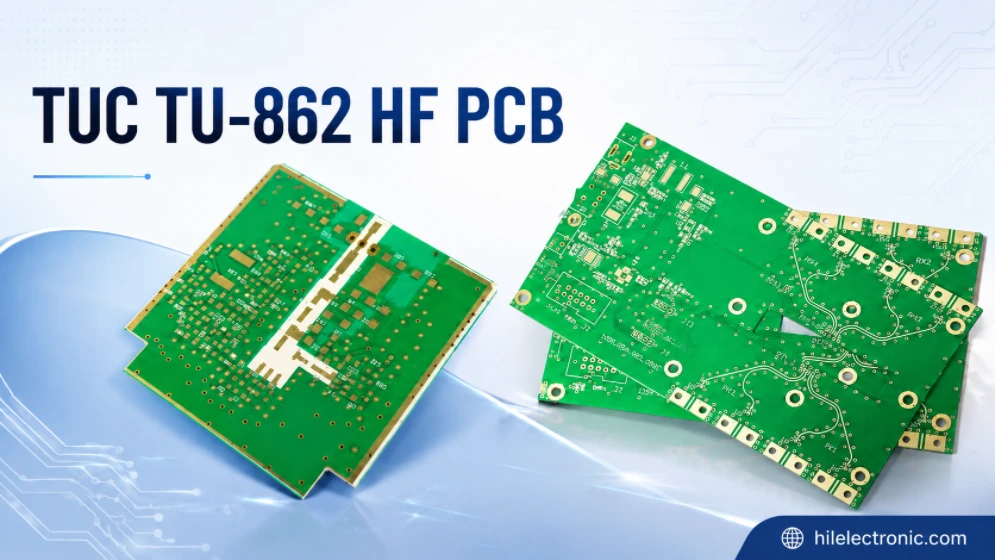
Implications of Using the Wrong “Halogen-Free FR-4”
- A material may be RoHS compliant but not meet the customer’s halogen-free limits.
- A high-Tg laminate can still fail if via geometry and Z-axis expansion are not managed.
- Different resin contents can change pressed thickness, Dk, resin fill and warpage.
- Unapproved equivalent materials can invalidate UL, automotive or OEM qualification.
- Repeated reflow and rework can exceed the released thermal history.
- CAF risk remains if drill smear, spacing, contamination or humidity controls are weak.
The serious failures usually appear after components have been assembled. A board may pass continuity and still show invalid material compliance, barrel cracking after repeated reflow or CAF damage caused by weak process control during system validation. Early DFM is therefore less expensive than investigating a finished PCBA, because material, geometry, fabrication and assembly causes can still be separated before tooling and component placement.
A broad response such as tightening every tolerance is usually wasteful. The correct action depends on whether the dominant cause is high-Tg thermal behavior, CAF and plated-hole reliability, exact laminate and prepreg identity or halogen-free documentation. Targeted controls improve yield and make the root cause traceable without turning the entire drawing into an unnecessarily expensive special process.
TU-862 HF Stackup and Reliability Design
Highleap reviews resin content, glass style, copper balance, via aspect ratio, annular ring, dielectric spacing and thermal exposure. Dense via fields and high voltage require special attention to CAF spacing and cleanliness.
For high-layer-count boards
Prepreg selection must provide enough resin to fill copper topography without excessive squeeze-out. The pressed thickness—not only the raw prepreg thickness—controls the final stackup.
For lead-free assembly
The assembly profile must consider board thickness, component thermal mass, moisture baking, number of reflow cycles and allowed rework.
Design intent and factory compensation have different owners. The customer defines electrical and reliability requirements; Highleap applies the approved CAM, drilling, plating and lamination adjustments needed to reach the finished values. Any change that affects architecture or qualification is raised for approval instead of being hidden inside CAM processing.
Generic datasheet values are not enough when ordinary electrical testing cannot reveal an unapproved material substitution or predict barrel cracking after repeated reflow. The review must use the exact core or prepreg, copper profile, finished thickness and via route. This is where one-to-one engineering support prevents the buyer from having to interpret multiple supplier documents alone.
Highleap TU-862 HF PCB and PCBA Services
Highleap supports multilayer rigid PCB fabrication, HDI where appropriate, controlled impedance, via-in-pad, back drilling, ENIG/ENEPIG and other finishes, AOI, electrical test and cross-section inspection. For assembly we provide component sourcing, SPI, SMT, BGA placement, AOI, X-ray, through-hole processing, programming and functional testing.
Exact manufacturing limits are confirmed after reviewing board dimensions, thickness, copper and layer count.
Repeatability is the factory’s responsibility. Material traceability, manufacturing compensation, process controls and inspection data are connected to the job so prototype and production lots are built from the same basis.
Most of the initial information is already present in the Gerber or PCB design files. Our engineer identifies any unresolved point, coordinates our material compliance, multilayer fabrication, reliability and PCBA engineers and asks the customer only for decisions that affect function, qualification, cost or schedule.
Manufacturing and Quality-Control Flow
- Verify TU-862 HF/TU-86P HF identity and required compliance documents.
- Review stackup, resin fill, copper balance and impedance.
- Laminate, drill and desmear with process controls matched to the released construction.
- Plate holes and inspect registration and copper thickness.
- Image, etch, AOI and apply the specified solder mask and finish.
- Perform electrical test, dimensional inspection and cross-section checks as required.
- Assemble under a controlled lead-free profile with SPI, AOI and X-ray.
- Supply traceability and compliance documents agreed in the purchase order.
A capability claim has value only when it is connected to a controlled shop-floor route. Highleap links lamination and resin-fill control, drilling, desmear and copper plating, moisture and reflow management and supplier and certificate verification to incoming inspection, lamination, drilling, plating, imaging and final verification. The exact sequence remains subject to the approved material and board construction.
Manufacturing feedback is presented as specific actions. Routine CAM and process decisions stay with Highleap; questions are sent to the customer only when they change function, qualification, cost or lead time. That service model keeps complex fabrication from becoming an administrative burden for purchasing.
Begin a TU-862 HF Quote with Your Gerber Files
The easiest way to begin is to send the Gerber files or PCB design files. If the board notes already state TU-862 HF, board thickness, copper or compliance requirements, you do not need to repeat that information in another form.
We help complete the manufacturing specification
A Highleap engineer will check the material designation, halogen-free requirement, stackup, thermal reliability and assembly scope with our process team. We contact you directly when a decision is needed and keep the questions limited to the actual project. BOM and assembly files may be supplied later when PCBA service is required.
The assigned engineer keeps all communication in one project path. Material, stackup, CAM, fabrication, quality and assembly questions are consolidated so the buyer does not have to route technical issues between multiple factory departments.
TU-862 HF PCB Cost Factors
Price depends on material construction, compliance documentation, layer count, resin-fill complexity, copper weight, via density, controlled impedance, finish, inspection class and quantity. PCBA price is affected by component sourcing, BGA count, reflow profile, X-ray and functional test.
For prototype-to-volume planning, yield matters more than unit material price alone. Weak CAF process control or use of an unapproved equivalent can increase scrap and rework. A stable, documented construction often produces a lower total cost than an aggressive design that requires repeated engineering changes after assembly.
Cost reduction should remove unnecessary complexity, not the control that protects performance. Highleap reviews panel utilization, noncritical layer construction, via architecture and test scope. Any proposal that changes approved material, copper, stackup or qualification is returned for customer approval.
Compliance documents and material traceability should be included in the commercial scope when they are contractual requirements. A lower material price is not equivalent if the substitute lacks the approved halogen-free declaration, UL basis or customer qualification. Layer count, resin fill, via density and reflow reliability then determine the manufacturing route and expected yield.
Use TU-862 HF for the Right Requirement
TU-862 HF is a practical high-Tg halogen-free platform, not a universal high-speed solution. Highleap helps confirm whether the project needs environmental compliance, thermal reliability, signal performance—or a different combination—then fabricates and assembles the approved design.
Use TU-862 HF when the project genuinely requires its verified halogen-free and high-Tg characteristics. Do not select it merely because the product is high-speed, since loss requirements may call for a different material class. Highleap reviews the customer files, confirms the compliance and reliability priorities, and manufactures the approved construction without presenting ourselves as the laminate producer.
The quotation can begin with Gerber or PCB design files. Our engineer coordinates material verification, stackup, fabrication, quality documents and assembly, then asks only for decisions that affect the product. This gives procurement a simple starting point while keeping the technical work with the factory team.
Frequently Asked Questions
Does Highleap make TU-862 HF laminate?
No. TUC manufactures the laminate and prepreg. Highleap manufactures the PCB and PCBA.
What should I send first for a TU-862 HF PCB or PCBA project?
Send the Gerber files or native PCB design files first. A Highleap engineer will review the material and compliance notes with you; BOM and assembly files can be added when the PCBA scope is confirmed.
Is halogen-free the same as RoHS?
No. They cover different substances and evidence. Both may be required.
Can TU-862 HF be used for high-speed boards?
It can support many digital systems, but long high-speed channels must be checked against the actual Dk, Df, copper and loss budget.
Can Highleap provide assembly and functional testing?
Yes, when the BOM, assembly files, test procedure and fixtures or fixture requirements are provided.
What is the main production risk?
Treating a generic high-Tg or halogen-free material as equivalent without verifying construction, compliance and thermal reliability.
Technical reference note: Material properties and interface descriptions must be checked against the current manufacturer datasheet, customer specification and applicable interface standard for the exact production construction. Highleap Electronics is the PCB fabrication and PCB assembly provider; laminate and component trademarks belong to their respective manufacturers.

Recommended Posts
Taconic RF 35 vs RO4350B PCB
Table of contentsRF-35 vs RO4350B Procurement and...
TMM4 Filter PCB Manufacturing
TMM4 filter PCB manufacturing is controlled by the...
TMM3 PCB Manufacturing for RF Modules
TMM3 PCB manufacturing is most useful where the RF module...
TMM6 PCB Fabrication
TMM6 fabrication is the process-control page for a mid-Dk...
How to get a quote for PCBs
Let’s run DFM/DFA analysis for you and get back to you with a report. You can upload your files securely through our website. We require the following information in order to give you a quote:
-
- Gerber, ODB++, or .pcb, spec.
- BOM list if you require assembly
- Quantity
- Turn time
For PCBA services, please provide your BOM (Bill of Materials) and any specific assembly instructions. We also offer DFM/DFA analysis to optimize your designs for manufacturability and assembly, ensuring a smooth production process.