
Ventec VT-47 PCB Manufacturing for Heavy-Copper and Thick Multilayer Builds
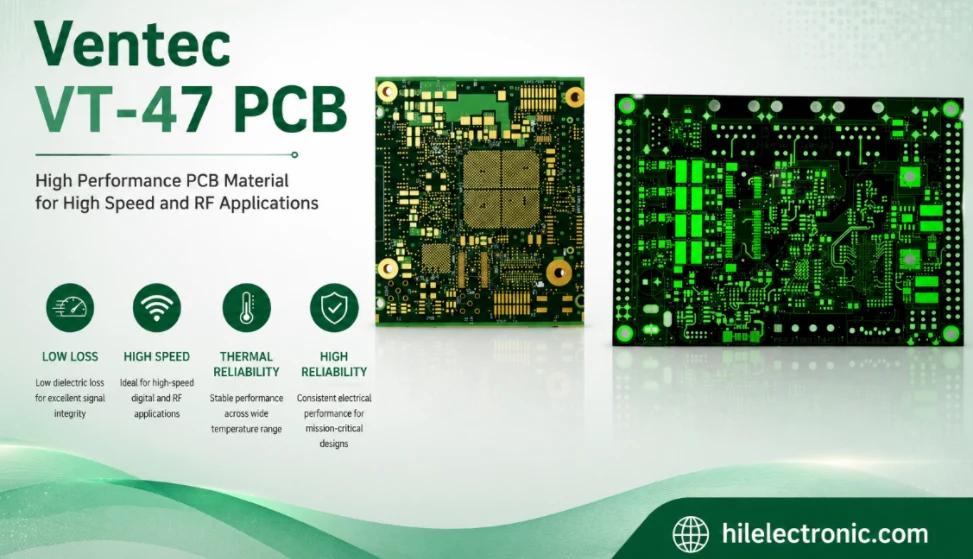
Ventec VT-47 is a high-Tg, low-Z-CTE FR-4.0 system that gives designers broad core and copper options for thermally demanding multilayers. Highleap Electronics uses VT-47 in heavy-copper PCB manufacturing where the board needs more thermal margin than mainstream FR-4 and the construction may include thick sections, mixed copper weights, press-fit connectors or selected heavy-copper layers.
VT-47 is not a universal answer for power boards. Heavy copper still requires enough resin, suitable glass styles, controlled etching and plating, balanced copper distribution and realistic flatness limits. The material provides a capable platform; the released stackup and manufacturing process determine whether the finished PCB is reliable.
Why Buyers Specify VT-47
Ventec identifies VT-47 as a phenolic-cured, lead-free-compatible, high-Tg FR-4.0 with low Z-axis expansion, CAF resistance and broad availability. Published availability includes cores from approximately 0.05 mm to 5 mm and copper foil from 1/4 oz to 12 oz. That range makes VT-47 attractive for designs that do not fit a narrow “standard 1 oz, 1.6 mm” construction.
| Design requirement | Why VT-47 may fit | What remains to be qualified |
|---|---|---|
| Thick multilayer with plated-through holes | High-Tg and low-CTE material class supports thermal margin | Aspect ratio, drill quality, desmear, hole copper and thermal cycling |
| Selected heavy-copper layers | Broad copper availability and robust resin platform | Resin fill, etch factor, plating, spacing and flatness |
| Thin cores or dense layer spacing | Core availability extends to thin constructions | Handling, copper profile, registration and peel strength |
| Lead-free assembly with high thermal mass | High thermal reliability | Actual reflow, wave solder, selective solder and rework history |
| Low-loss high-speed channel | Not the primary reason to choose VT-47 | Use a loss-budget review and lower-Df material if required |
VT-47 competes on construction flexibility and thermal reliability, not on being an ultra-low-loss laminate. Projects driven mainly by insertion loss should start with high-speed material selection rather than choosing VT-47 for its Tg.
Heavy Copper, Thick Boards and Thin Cores
Resin fill is the first heavy-copper question
Large copper step heights displace resin during lamination. If the prepreg selection does not provide sufficient flow and cured resin, the board can develop resin starvation, voiding, poor encapsulation or local thickness variation. Highleap evaluates copper percentage by layer, isolated copper islands, plane clearances and glass style before proposing the press construction.
The heavy-copper stackup guide explains why simply increasing prepreg count is not a complete solution. More resin affects finished thickness, dielectric spacing, impedance and dimensional stability.
Etch factor and spacing limit the design
Thick copper cannot use the same line/space assumptions as 1 oz copper. Sidewall etching, conductor width at the base and solder-mask coverage must be reviewed. The copper requirement should state finished copper or starting foil plus plating, because those are not interchangeable purchasing descriptions.
Thin cores require a different handling strategy
Ventec recommends reverse-treated copper for very thin cores because of the low profile, while noting a peel-strength tradeoff. Thin cores can improve layer spacing and total thickness, but they increase handling, registration and damage risk. Highleap will confirm whether the chosen core and copper form are available and compatible with the line/space requirement.
Provide copper weight by layer, board thickness, layer count, minimum spacing, finished holes and any press-fit zones. A copper distribution image is useful even before final Gerbers.
Prepreg and Lamination Engineering
A VT-47 stackup should identify the exact core, prepreg glass style, resin content, nominal pressed thickness and copper treatment. For mixed-copper boards, the press recipe must fill copper topography without creating excessive resin-rich areas or thickness drift.
Copper symmetry and panel flatness
Asymmetric copper weights and uneven copper coverage create different shrinkage and stress on each side of the board. Highleap reviews layer symmetry, copper balancing and panel orientation before tooling. Flatness acceptance should be appropriate for the board size, thickness, connector type and assembly process rather than copied from an unrelated product.
Material storage and prepreg control
Prepreg condition affects flow and cure. Material should be stored and conditioned under the manufacturer’s current requirements, with lot identity and shelf-life control. For repeat orders, material source and approved construction should be locked so a later build does not change resin behavior without engineering review.
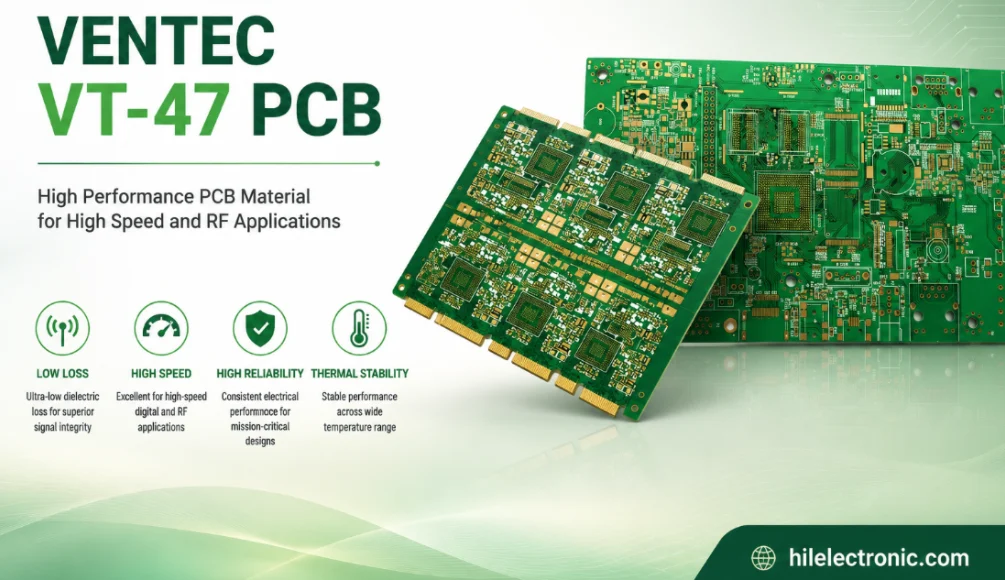
Drilling, Plating and Dimensional Control
Thick boards magnify drill and plating risk
A small finished hole through a thick board can exceed a practical aspect ratio even when the laminate itself is robust. Highleap reviews drill diameter, tool entry/exit quality, smear removal, electroless copper coverage and pattern-plating distribution. The acceptance plan may include microsections at representative hole sizes and copper regions.
Heavy copper changes routing and plating current distribution
Large copper planes can affect plating uniformity and etching. Thieving, robbers, panel design and current density may be adjusted to protect feature consistency. When high current is the reason for the copper requirement, the design should also be checked against conductor temperature rise and terminal interfaces; material Tg does not replace current-capacity engineering.
Insulation reliability is not the same as thermal reliability
VT-47 is positioned with CAF resistance, but conductor spacing, moisture, bias voltage, cleanliness and drilling damage still matter. A high-Tg label should not be used as evidence that every high-voltage or high-humidity layout is safe.
PCBA Thermal Mass and Quality Evidence
Heavy copper and thick boards require more energy during reflow, wave soldering or selective soldering. The profile must heat large copper masses while protecting components and avoiding excessive time above liquidus. Connector barrels and thermal pads may need special soldering strategy.
When Highleap supplies PCBA, the quotation can include component sourcing, stencil design, SMT, THT, selective or wave soldering, AOI, X-ray for appropriate packages, first-article inspection and functional testing when a method and fixture scope are supplied. These services are project-defined; they should not be assumed from the laminate selection alone.
| Evidence | Useful when | Decision it supports |
|---|---|---|
| Material certificate or lot record | VT-47 is customer-specified | Confirms approved material identity |
| Microsection | Thick board, small holes or heavy copper | Checks hole copper, resin fill and layer condition |
| Bow/twist result | Large panel or connector-heavy assembly | Protects assembly coplanarity |
| Reflow profile | High thermal mass PCBA | Shows the soldering window was developed for the product |
| Electrical and functional test | Finished PCB/PCBA release | Separates continuity from end-function verification |
Example: mixed-copper industrial power/control board
A 10-layer board may use 4 oz internal power planes, 1 oz signal layers and 2 oz outer copper. The design must provide enough dielectric resin to fill the 4 oz topography while keeping thin signal dielectrics and total thickness within tolerance. Highleap may propose multiple prepreg plies, copper balancing or spacing changes. The material’s broad copper availability makes the construction possible, but the press design determines yield.
Press-fit and connector-heavy assemblies
Thick VT-47 boards are often paired with press-fit or high-current connectors. Finished-hole diameter, plating thickness, local support and insertion sequence must be defined. Replacing a connector or compliant pin can change the mechanical requirement even if the PCB drawing is unchanged.
Thermal management boundary
High Tg and low CTE improve thermal reliability; they do not make FR-4 a high-conductivity substrate. If heat must move rapidly from a device into a chassis, consider copper coins, thermal vias, metal-core structures or an external heat spreader. The quotation should distinguish current-carrying copper from heat-spreading requirements.
What a complete VT-47 quotation should show
The response should identify copper by layer, proposed resin-fill construction, minimum feature assumptions, hole/plating plan, flatness basis, included inspection and PCBA thermal-process assumptions. Optional microsection, solder-float, X-ray or functional-test work should be priced separately so the buyer sees the real scope.
Supply risk and approved alternatives
Broad published availability does not mean every core/copper combination is stocked at every moment. For scheduled production, Highleap can confirm material lead time and propose an approved alternate construction. Equivalent decisions should preserve thermal class, copper capability, press behavior and customer documents, not merely the words “high Tg.”
Cost, Alternatives and Quote Preparation
VT-47 pricing is driven by board area, material utilization, copper weight, layer count, press complexity, drill count, plating time, surface finish and inspection requirements. Heavy copper can dominate cost through process time and yield even when the laminate premium is moderate.
When another material may be better
- A normal-Tg FR-4 may be adequate for simple boards with no demanding thermal or copper requirement.
- A lower-CTE automotive or high-reliability grade may be preferred when customer approvals and mission-profile validation drive the program.
- A low-loss material is more appropriate when insertion loss, not thermal mass, is the limiting factor.
- An IMS or metal-core construction may be better when heat transfer to a chassis is the central requirement. See the heavy copper versus IMS comparison.
RFQ checklist
- Board size and quantity
- Layer count and total thickness
- Copper by layer
- Minimum line/space
- Smallest finished hole
- Press-fit or high-current areas
- Surface finish
- PCBA and test scope
- Flatness requirement
- Certificate and microsection needs
VT-47 Buyer FAQ
Is VT-47 a heavy-copper laminate?
It is a high-Tg FR-4.0 system with broad copper availability that can support selected heavy-copper constructions. The finished design still needs resin-fill, etch, plating and thermal review.
Can VT-47 be used for 12 oz copper?
Ventec publishes copper availability up to 12 oz, but availability does not automatically approve every multilayer geometry. Highleap must review the copper location, spacing, board thickness and process route.
Is VT-47 a low-loss material?
No. It is selected primarily for thermal reliability, low Z-axis expansion and construction flexibility. Tight high-speed loss budgets require a separate material comparison.
What is the fastest way to obtain a realistic quote?
Send the copper map, layer count, thickness, smallest holes, quantity and required evidence. Those details prevent a misleading “price per square meter” estimate.
Primary material reference: Ventec VT-47 laminate/prepreg data. Manufacturer figures are typical reference values; use the current datasheet and approved construction for production specifications.
Highleap can combine VT-47 PCB fabrication, component sourcing, PCBA and product-specific inspection in one manufacturing review.

Recommended Posts
TMM6 Filter PCB Manufacturing
Table of contentsWhy Microwave Filter Designers Use...
TMM4 Filter PCB Manufacturing
TMM4 filter PCB manufacturing is controlled by the...
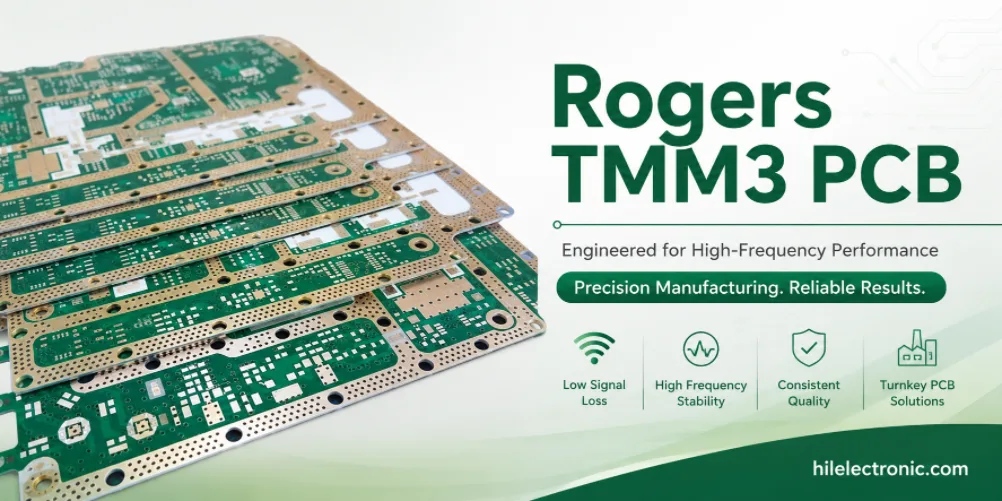
TMM3 PCB Manufacturing for RF Modules
TMM3 PCB manufacturing is most useful where the RF module...
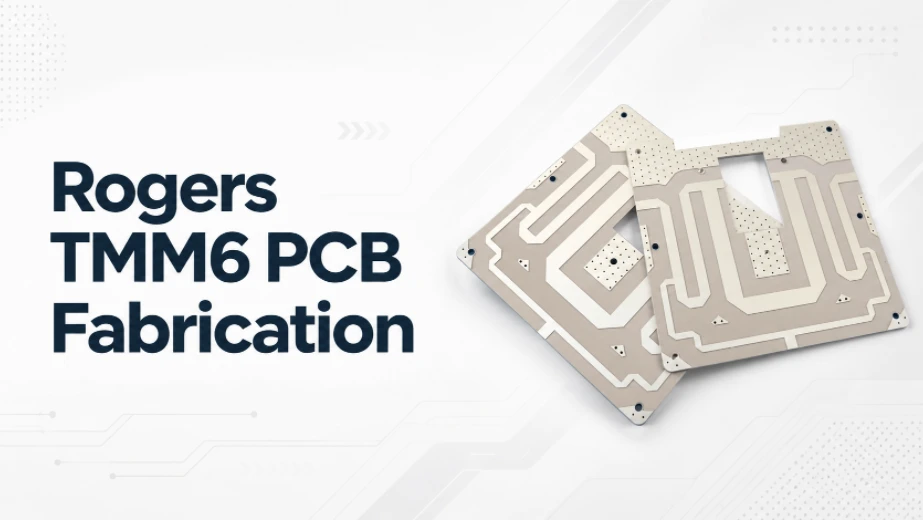
TMM6 PCB Fabrication
TMM6 fabrication is the process-control page for a mid-Dk...
How to get a quote for PCBs
Let’s run DFM/DFA analysis for you and get back to you with a report. You can upload your files securely through our website. We require the following information in order to give you a quote:
-
- Gerber, ODB++, or .pcb, spec.
- BOM list if you require assembly
- Quantity
- Turn time
For PCBA services, please provide your BOM (Bill of Materials) and any specific assembly instructions. We also offer DFM/DFA analysis to optimize your designs for manufacturability and assembly, ensuring a smooth production process.