
Shengyi S1141 PCB Manufacturing for Cost-Controlled FR-4 Builds
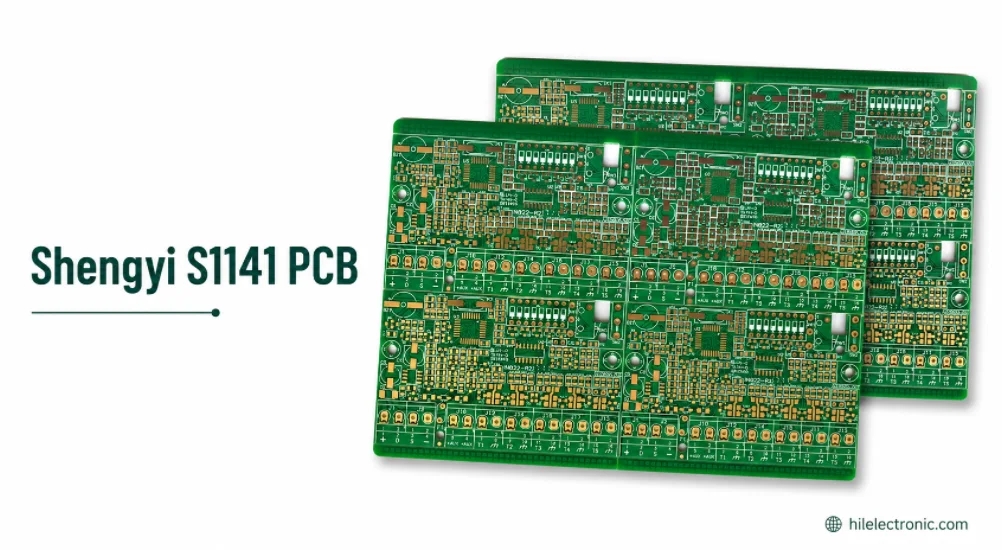
A Shengyi S1141 PCB is a practical choice when the product needs a mainstream FR-4 construction, stable mechanical processing and disciplined cost control—without HDI, very high layer counts, formal anti-CAF requirements or copper above 2 oz. Highleap Electronics manufactures S1141 bare boards and PCB assemblies after checking that the design stays inside those limits.
The commercial advantage is not simply a lower laminate price. It is avoiding an unnecessary premium material while still defining a stackup, hole structure, soldering history and inspection plan that fit the product. This page is written for buyers and engineers deciding whether S1141 is appropriate, what information belongs in the RFQ and when a higher-reliability material is the safer choice.
Is S1141 the Right Material for Your PCB?
S1141 should be selected from the finished-board requirements, not from the material name alone. The most useful screening variables are layer count, finished thickness, copper weight, smallest finished hole, assembly temperature history, insulation spacing and field environment.
| Project condition | S1141 assessment | Commercial implication |
|---|---|---|
| Conventional 1–8 layer consumer, instrumentation or general industrial board | Usually a reasonable candidate, subject to stackup and assembly review | Avoids paying for thermal or electrical performance the design does not use |
| Lead-free SMT with one normal reflow sequence | Possible, but moisture control and the real peak profile still matter | Quote should state assembly scope so the laminate is not assessed in isolation |
| HDI, laser microvias or sequential lamination | Not recommended by Shengyi | Move to an HDI-qualified material and released lamination process |
| 12 layers or more | Not recommended by Shengyi | Use a high-Tg, lower-CTE platform designed for higher layer count |
| Copper above 2 oz | Not recommended by Shengyi | Review a resin system qualified for heavy-copper fill and thermal stress |
| Formal anti-CAF requirement | Not recommended by Shengyi | Select a published CAF-resistant grade and define test evidence |
For a broader comparison, the site’s FR-4 materials guide explains how normal-Tg, high-Tg, low-CTE and low-loss categories differ. The important buying decision is not “standard FR-4 versus premium FR-4”; it is whether the approved material can survive the actual board geometry and thermal history with adequate margin.
Send board size, layer count, finished thickness, copper, smallest hole, quantity and whether PCBA is required. Highleap can screen the construction and identify any reason S1141 should be upgraded.
What the Published S1141 Properties Mean in Production
Shengyi publishes S1141 as a conventional FR-4 with a typical DSC Tg of 140°C, Td of 310°C, total Z-axis expansion of 4.5% from 50–260°C, T260 of 15 minutes and T288 of 2 minutes. These are typical material values, not finished-board guarantees. They describe the material’s thermal class and help the fabricator judge risk; they do not replace microsection acceptance, solder-float evaluation or assembly-profile review.
Tg is not a standalone pass/fail number
A board can fail plated-hole reliability even when its laminate Tg looks acceptable. Finished thickness, drill diameter, aspect ratio, hole-wall copper, resin recession, rework count and moisture exposure all influence barrel strain. S1141 provides less thermal margin than high-Tg low-CTE systems, so designs near the edge need tighter process control or a material upgrade.
T288 exposes the narrow thermal margin
A published T288 of 2 minutes does not mean every S1141 board fails after two minutes in production. It does mean the material should not be treated as a generous platform for repeated high-temperature excursions. Double-sided assembly, selective soldering, connector rework and BGA repair must be included in the review. The lead-free PCB material guide provides additional context for matching laminate class to assembly exposure.
Reference: Shengyi’s current S1141 product page lists the typical values and explicitly excludes anti-CAF, HDI, copper above 2 oz and 12-layer-and-above applications. Typical values are for reference and should not be copied into a purchase specification as guaranteed limits.
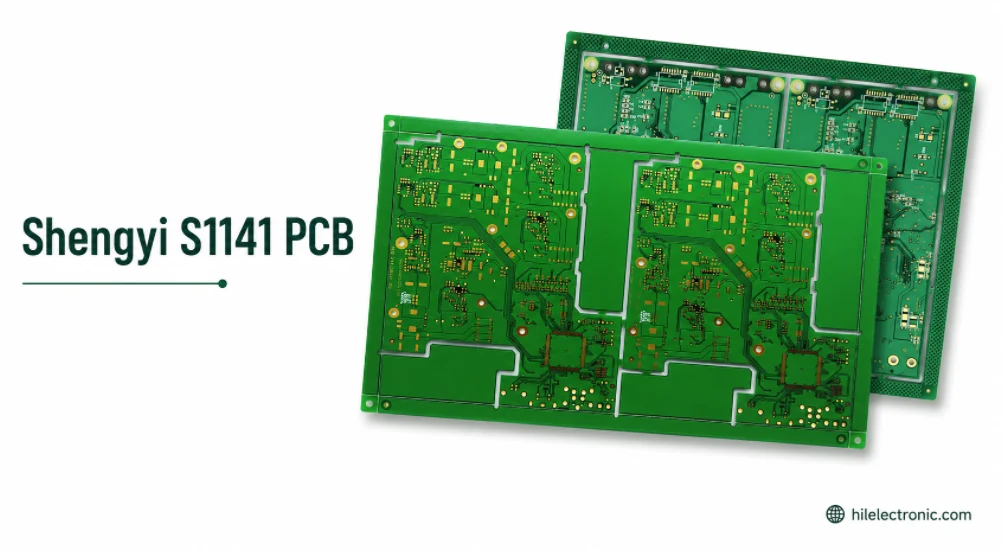
Design and Fabrication Rules for Reliable S1141 Boards
Keep the hole structure proportionate to the material class
Small finished holes in thick boards increase drilling, desmear and plating difficulty. For S1141, a conservative aspect ratio and sufficient annular ring are more valuable than forcing a high-density geometry onto a mainstream material. Highleap reviews drill-to-copper spacing, breakout risk, resin smear removal and finished copper requirements before releasing the tooling.
Balance copper and resin demand
Uneven copper distribution can create local resin starvation, thickness variation and bow or twist. Plane layers should be balanced across the centerline where possible, and dense copper areas should not be paired with large open windows without compensation. When the design approaches 2 oz or includes large copper islands, the heavy-copper design guide is a better starting point than simply increasing the material grade.
Define controlled impedance only where it adds value
S1141 can be used for many controlled-impedance designs, but the construction-specific Dk, pressed dielectric thickness and copper geometry must be solved by the PCB manufacturer. Do not copy a catalog Dk into the field solver and assume the coupon will match. State the target impedance, tolerance, reference layers and coupon requirement in the fabrication drawing; Highleap can then build a production stackup and provide coupon measurement when quoted.
Example: cost comparison between S1141 and a high-Tg alternative
A four-layer control board with 1 oz copper, generous 0.40 mm finished holes and one lead-free reflow sequence may gain little from a high-Tg material. S1141 can be the more rational choice if the environment and customer specification permit it. By contrast, an eight-layer 2.0 mm board with 0.25 mm holes and two reflows plus selective soldering may justify the higher-Tg upgrade even though both designs are below 12 layers.
How Highleap presents a material upgrade
If S1141 is not suitable, the quote should explain the trigger: layer count, heavy copper, HDI, anti-CAF, thermal cycles or via aspect ratio. This makes the upgrade commercially defensible. Procurement can see that the recommendation is tied to the design rather than a preference for a more expensive material.
Prototype-to-production controls
For a cost-sensitive product, material source and approved equivalents should be settled before volume production. Prototype availability sometimes leads to a different FR-4 grade. If that happens, the production material should be reviewed for stackup, drill behavior and assembly correlation rather than assumed equivalent.
What the buyer should receive with the quote
Highleap can return the material-fit decision, preliminary stackup, major DFM issues, included quality controls, optional reports and missing information. This creates a clear conversion path: the buyer can approve S1141, accept an upgrade or revise the design before committing to tooling.
Cost, Alternatives and RFQ Information
The lowest unit price is achieved when the material, design and order conditions are aligned. An S1141 quote becomes unreliable when the RFQ omits copper distribution, smallest hole, panel constraints, soldering route or quality documentation. Those items affect yield and process time more than the laminate name alone.
When to upgrade
- Use a high-Tg, lower-CTE material for high layer count, thick boards, high aspect-ratio holes or repeated thermal cycles.
- Use a published CAF-resistant grade for dense spacing in humid, biased environments or when the customer specification explicitly calls for CAF evidence.
- Use an HDI-qualified system for laser vias or sequential lamination.
- Use a heavy-copper-qualified construction when copper exceeds 2 oz or resin-fill demand becomes significant.
Highleap will not substitute a material solely because two grades are both called FR-4. An equivalent review should compare Tg by test method, Z-axis expansion, T288, resin system, copper compatibility, certificates, approved factory source and the customer’s end-use requirements.
Minimum information for a useful quotation
- Board dimensions and quantity
- Layer count and finished thickness
- Copper weight by layer
- Smallest finished hole
- Surface finish and solder mask
- Impedance targets, if any
- Bare PCB or complete PCBA scope
- Inspection, microsection or certificate needs
No schematic is required for an initial commercial review. Gerber, ODB++ or IPC-2581 data are needed before final DFM and production release.
Highleap Manufacturing and Release Controls
For an approved S1141 build, Highleap converts the material callout into a controlled traveler covering laminate identity, stackup, inner-layer registration, lamination, drilling, desmear, electroless copper, pattern plating, final thickness and electrical test. The release plan is matched to the product class instead of applying an expensive high-reliability package to every order.
| Control point | What it protects | Typical evidence when specified |
|---|---|---|
| Incoming material identity | Prevents undocumented laminate or prepreg substitution | Lot record, supplier documentation or certificate copy |
| Stackup and pressed thickness | Protects finished thickness, impedance and drill geometry | Released stackup and in-process thickness data |
| Drill/desmear/plating | Protects plated-through-hole continuity | Microsection, copper-thickness record or coupon review |
| Final electrical test | Detects opens and shorts | Test record or pass status by lot |
| PCBA controls, if included | Limits avoidable thermal and handling damage | Reflow profile, AOI, first-article and functional-test records as quoted |
For repeat production, the approved material source, stackup revision and inspection level should be locked on the purchase order. This prevents a low-cost board from becoming a high-cost troubleshooting problem after an undocumented change.
Buyer Questions About Shengyi S1141
Can S1141 be used for a 10-layer board?
Potentially, because Shengyi’s explicit exclusion begins at 12 layers and above. A 10-layer build still requires review of thickness, holes, copper and assembly cycles; layer count alone does not approve the construction.
Is S1141 suitable for lead-free assembly?
It can be used in appropriately controlled lead-free builds, but its thermal margin is narrower than high-Tg FR-4. The number of reflow, wave-solder and rework exposures must be known before release.
Does choosing S1141 automatically reduce cost?
Only when the design fits the material. Stretching S1141 into a high-risk construction can increase scrap, rework and field risk. Material cost should be evaluated together with yield and qualification needs.
Can Highleap quote from incomplete information?
Yes. Approximate dimensions, layers, thickness, copper, hole size, quantity and service scope are sufficient for an initial range. Final pricing follows the completed fabrication data and DFM review.
Primary material reference: Shengyi S1141 product data. Manufacturer figures are typical reference values; use the current datasheet and approved construction for production specifications.
Highleap can quote S1141 bare PCB, component sourcing and PCBA as a single project after confirming the construction is appropriate.

Recommended Posts
TMM4 Filter PCB Manufacturing
TMM4 filter PCB manufacturing is controlled by the...
TMM3 PCB Manufacturing for RF Modules
TMM3 PCB manufacturing is most useful where the RF module...
TMM6 PCB Fabrication
TMM6 fabrication is the process-control page for a mid-Dk...
TMM10 PCB Manufacturing for Compact RF Designs
Table of contentsHow TMM10 Shrinks RF StructuresTMM10 vs...
How to get a quote for PCBs
Let’s run DFM/DFA analysis for you and get back to you with a report. You can upload your files securely through our website. We require the following information in order to give you a quote:
-
- Gerber, ODB++, or .pcb, spec.
- BOM list if you require assembly
- Quantity
- Turn time
For PCBA services, please provide your BOM (Bill of Materials) and any specific assembly instructions. We also offer DFM/DFA analysis to optimize your designs for manufacturability and assembly, ensuring a smooth production process.