
PCB Assembly Production Transfer Without Disrupting Supply
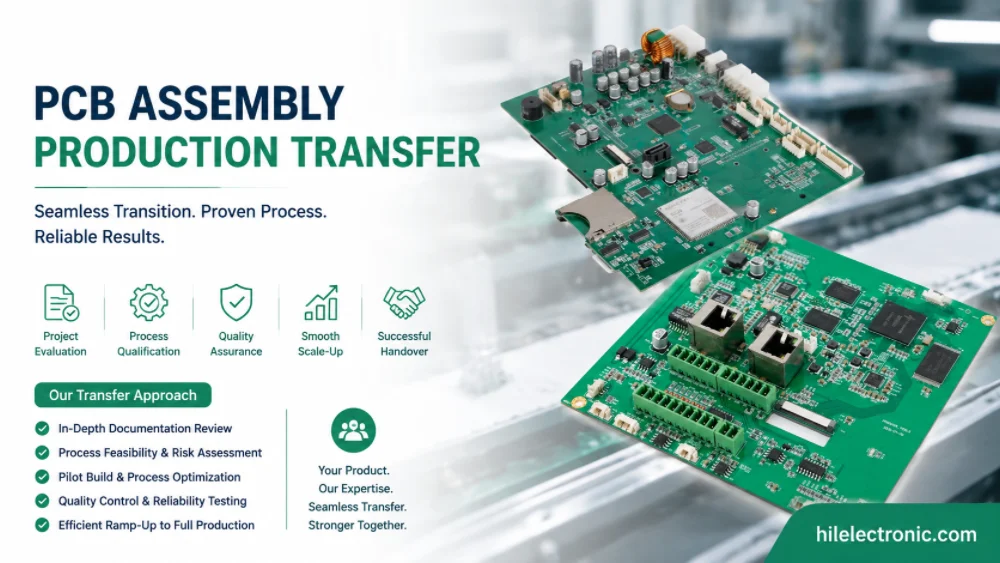
Table of contents
- When Should an OEM Transfer PCB Assembly Production?
- How Can PCB Production Be Transferred Without Interrupting Supply?
- What Highleap Checks From the Existing Product
- How Materials, Tooling and Test Assets Are Transferred
- How a Golden Sample and Transfer Build Are Used
- Testing, Programming and Traceability During Transfer
- PCB Assembly Transfer Cost and Timeline
- Start a PCB Assembly Production Transfer
- PCB Assembly Transfer Questions From Procurement and Engineering
PCB assembly production transfer is required when an OEM moves an existing product to a new contract manufacturer, adds a second source or brings an engineering build into stable repeat production. The risk is not only whether the new supplier can assemble the board. The risk is losing undocumented process knowledge, approved material choices, programming conditions, test behavior or configuration details that were built into the previous supply chain.
Highleap Electronics supports PCBA manufacturing transfer through a staged review, validation build and controlled ramp. The service can cover PCB fabrication, component sourcing, SMT and through-hole assembly, programming, testing and related documentation. The transfer plan is adapted to the reason for change—cost, capacity, quality, delivery, geography or lifecycle support.
To begin, send the current board files and BOM, the expected order quantity and any test method or approved sample you have. A purchasing team does not need to reconstruct every historical record before requesting a quote. Highleap can first identify the gaps that affect price or validation and then build a practical transfer plan.
1. When Should an OEM Transfer PCB Assembly Production?
Common triggers include repeated delivery problems, weak communication, insufficient capacity, rising cost, supplier closure, poor component sourcing or the need for a second manufacturing source. Some customers also transfer after prototype approval because the original supplier is not suited to repeat production.
Supplier replacement
Move the complete program when quality, delivery or commercial performance is unacceptable.
Second-source qualification
Create an approved backup without immediately closing the existing supplier.
Prototype-to-production transfer
Move from an engineering-oriented builder to a production-capable PCBA manufacturer.
Regional supply change
Shift manufacturing closer to components, customers or logistics routes.
A transfer PCB production to China project should be evaluated on total operating fit, not only lower unit price. Highleap reviews the volume pattern, product complexity, sourcing scope, test needs and required records before recommending a transfer route. This prevents a low initial quote from hiding tooling, excess material, test development or requalification cost.
2. How Can PCB Production Be Transferred Without Interrupting Supply?
The safest electronics manufacturing transfer separates validation from cutover. Existing supply remains available while Highleap reviews the release, sources a limited quantity of materials and builds comparison units. The customer then approves the new source before the old source is reduced or stopped.
- Define the reason for transfer and the latest acceptable cutover date.
- Review available files, samples, test assets and current inventory.
- Identify differences between released data and the actual shipped product.
- Build a validation lot using the proposed Highleap route.
- Compare product, inspection and test results with the approved reference.
- Close gaps and release a limited production batch.
- Increase the share of supply after delivery and quality performance are confirmed.
For urgent transfers, some steps can run in parallel, but the acceptance criteria should not be removed. A staged PCBA transfer build protects business continuity because the OEM retains a fallback while the new factory proves the product.
Transfer principle
Do not make the commercial cutover date the same as the first time the new factory sees the product.
3. What Highleap Checks From the Existing Product
Highleap begins with the current production definition and compares it with the available evidence. The review may use files, approved units, photos, previous inspection reports, test results and a list of known deviations. A PCB assembly process review helps identify where the new route must match the existing product and where it can be improved.
| Transfer input | What Highleap checks | Why it matters |
|---|---|---|
| PCB and BOM revision | Whether the data matches the currently approved product. | Prevents building an older or incomplete configuration. |
| Approved sample | Component options, workmanship, labels and mechanical details. | Captures product reality that may not be documented. |
| Test procedure or fixture | Connections, software, limits and cycle time. | Shows whether acceptance can be repeated at the new site. |
| Open deviations | Temporary substitutions or repair instructions. | Prevents a temporary workaround becoming the new standard. |
| Order and forecast history | Batch size, release frequency and material exposure. | Supports a realistic sourcing and capacity plan. |
The result is a gap list ranked by impact. Highleap does not require the customer to provide every possible manufacturing document at the start. The factory asks for additional information only when the gap can change quotation, product acceptance or transfer risk.
4. How Materials, Tooling and Test Assets Are Transferred
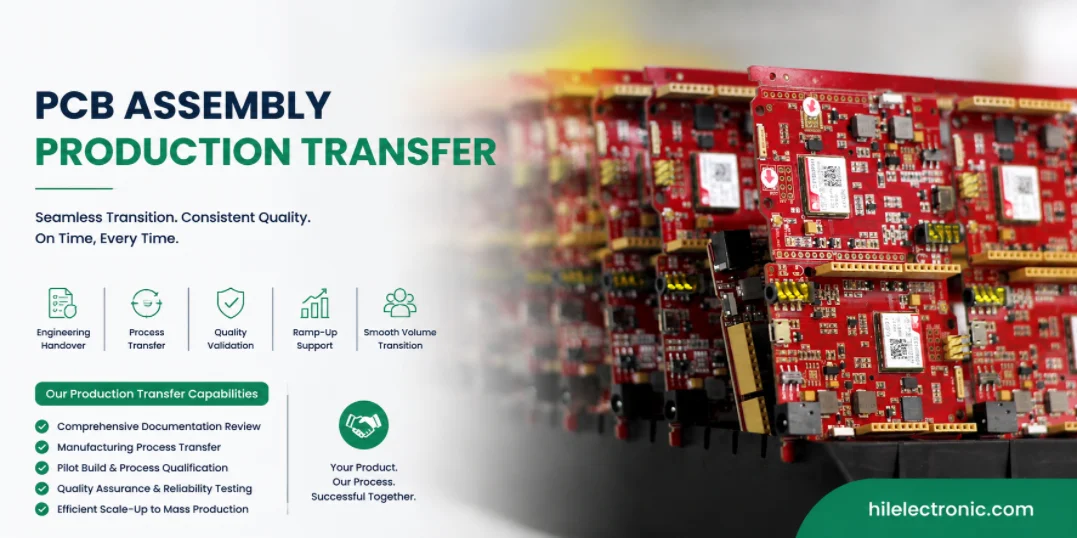
A PCB assembly supplier transfer often involves more than digital files. Customer-owned components, stencils, fixtures, programming adapters, labels, packaging and test equipment may need to be moved, replaced or recreated. Ownership and condition should be confirmed before the old supplier ships anything.
| Asset | Transfer option | Commercial point to define |
|---|---|---|
| Components and bare PCBs | Move usable inventory, consume at old site or replace through Highleap sourcing. | Quantity, traceability, storage condition and liability. |
| Stencil and assembly tooling | Transfer only when compatible and in acceptable condition; otherwise rebuild. | Ownership, freight and replacement cost. |
| Programming files/adapters | Transfer controlled software and verify device support. | Version, checksum, access rights and maintenance. |
| Test fixture | Move, duplicate or redevelop at Highleap. | Calibration, correlation, spare parts and failure support. |
| Golden samples | Retain approved units for comparison and troubleshooting. | Identification, custody and return terms. |
When Highleap takes responsibility for turnkey PCB assembly sourcing, the material review should include current stock, open purchase orders, minimum-order quantities and non-cancellable commitments. This prevents duplicate purchases and helps the customer decide whether to transfer, consume or write off legacy inventory.
5. How a Golden Sample and Transfer Build Are Used
A golden sample is useful when it represents the approved product and its history is known. Highleap can compare component configuration, soldering, mechanical features, programming and functional behavior. The sample should not be treated as the only authority when it conflicts with released design data; the customer must decide which condition is correct.
The PCBA transfer build is then assembled using the proposed production route. Critical features are reviewed through first-article inspection for transferred PCBAs, and the customer can approve the first unit before the remaining quantity is completed.
- Confirm exact PCB, BOM and firmware revision.
- Compare critical dimensions, connectors, labels and product options.
- Review AOI, X-ray or solder-joint evidence where the product requires it.
- Run the existing functional test or an agreed equivalent check.
- Record differences from the reference product and assign disposition.
The acceptance comparison should focus on product requirements, not visual imitation of every historical manufacturing habit. If Highleap proposes a different but equivalent process, the reason, evidence and customer approval should be documented.
6. Testing, Programming and Traceability During Transfer
Test transfer is frequently the longest hidden task. A fixture may depend on a specific PC, software license, cable, power supply or operator knowledge. Highleap reviews the complete test path and can support PCB functional circuit testing using customer-provided procedures or agreed production checks.
Confirm file version, device support, checksum and serialization rules.
Use known-good and known-fail conditions where possible to confirm detection.
Define whether failures are analyzed, returned, repaired or held for customer review.
Agree which serial, lot, test and material data must accompany shipment.
For a PCB assembly second source, the two factories should produce comparable acceptance data even if their equipment differs. The OEM may compare a defined set of units across both sites. This establishes confidence before orders are divided and helps identify whether differences originate in product, process or test.
7. PCB Assembly Transfer Cost and Timeline
Transfer cost depends on how much of the existing manufacturing system can be reused. A clean release with available components and transferable test assets may require only review, setup and a validation lot. An incomplete release, unavailable parts or an undocumented fixture may require substantial reconstruction.
| Transfer cost category | When it occurs | How Highleap can reduce exposure |
|---|---|---|
| Engineering and file reconciliation | Data and approved product do not match. | Focus on gaps that affect build or acceptance. |
| New stencil/tooling | Existing assets are unavailable or incompatible. | Quote reusable assets separately from recurring cost. |
| Material duplication | Old and new suppliers both hold stock. | Reconcile inventory before new purchasing. |
| Test redevelopment | Fixture or software cannot be transferred. | Use interim checks while the production test is completed, if approved. |
| Qualification lot | Customer requires comparison or formal approval. | Select a quantity based on risk and evidence needs. |
The schedule should include review, material, tooling, validation, approval and ramp—not only assembly days. Highleap can provide a phased plan and show which actions can run in parallel. For cost comparison, the buyer can also review consigned PCB assembly options when strategic or existing material will remain customer-owned.
8. Start a PCB Assembly Production Transfer
Send the latest PCB files and BOM, expected order quantity, current product status and any test information or approved sample available. Highleap can start with this limited package and return a focused transfer gap list. Procurement does not need to wait until every historical document has been collected.
A useful transfer quotation will separate validation costs from repeat-production pricing and explain material assumptions, tooling, test scope and the proposed ramp. The plan should also state whether Highleap is being qualified as the primary supplier, a replacement supplier or a second source.
Use the Highleap contact page for production transfer to submit the initial package. The first response should help the customer understand the transfer route and next decision, not request an excessive list of specialist files.
Where the transfer is urgent, Highleap can separate the immediate continuity actions from improvements that can wait until the first stable repeat order. This avoids delaying supply for lower-priority documentation cleanup while keeping the remaining risks visible.
9. PCB Assembly Transfer Questions From Procurement and Engineering
Can a PCB assembly transfer start without full cooperation from the old supplier?
Yes, although the transfer may require more reconciliation work. Highleap can begin with the latest board files, BOM, approved sample and test information. When BOM or design records are incomplete, PCB BOM reconstruction support may help identify the actual product configuration before a validation build.
Can Highleap buy components for the transferred product?
Yes. Highleap can source the full BOM, selected standard parts or only the items not transferred from the existing supplier. The components sourcing service for existing products can be combined with customer-owned inventory to avoid duplicate purchases.
Must the existing test fixture be moved to Highleap?
No. The fixture may be transferred, duplicated, redeveloped or replaced by an agreed interim test. The correct choice depends on fixture condition, product life, volume and access to software. Highleap can review PCB test fixture redevelopment as a separate transfer workstream.
Can Highleap be qualified as a second source rather than replace the current supplier?
Yes. A second-source program uses a validation build, approved comparison and controlled share of demand. This approach reduces supply risk while preserving the existing source. Highleap can support the role of PCBA contract manufacturing second source with separate validation and repeat-production pricing.

Recommended Posts
TMM4 Filter PCB Manufacturing
TMM4 filter PCB manufacturing is controlled by the...
TMM3 PCB Manufacturing for RF Modules
TMM3 PCB manufacturing is most useful where the RF module...
TMM6 PCB Fabrication
TMM6 fabrication is the process-control page for a mid-Dk...
TMM10 PCB Manufacturing for Compact RF Designs
Table of contentsHow TMM10 Shrinks RF StructuresTMM10 vs...
How to get a quote for PCBs
Let’s run DFM/DFA analysis for you and get back to you with a report. You can upload your files securely through our website. We require the following information in order to give you a quote:
-
- Gerber, ODB++, or .pcb, spec.
- BOM list if you require assembly
- Quantity
- Turn time
For PCBA services, please provide your BOM (Bill of Materials) and any specific assembly instructions. We also offer DFM/DFA analysis to optimize your designs for manufacturability and assembly, ensuring a smooth production process.