
GPU Server PCB Fabrication Services in China

Figure 1. GPU Server PCB Fabrication
Highleap Electronics is a PCB manufacturing and assembly factory with proven capability in GPU server PCB fabrication. We build 8-GPU and 4-GPU baseboards, NVLink switch boards, NVSwitch carriers, optical host boards, PCIe Gen5 risers, and the supporting power and management PCBs that go into AI hardware platforms — alongside our broader PCB and EMS portfolio.
Table of Contents
- What OEMs Look for in GPU Server PCB Fabrication
- GPU Server PCB Fabrication Capability Matrix
- Board Types Covered by Our GPU Server PCB Fabrication Line
- Materials & Stackup Strategy for GPU Server PCB Fabrication
- Quality Flow, S-Parameter Test & AVL for GPU Server PCB Fabrication
- Engaging Highleap for Your GPU Server PCB Fabrication Program
1. What OEMs Look for in GPU Server PCB Fabrication
GPU server programs sit at the intersection of three demanding domains: very-high-density board layout, ultra-high-frequency signaling, and rapid product-cycle pressure. A capable GPU server PCB fabrication partner must satisfy all three at once, against procurement cost-down expectations that don’t relax just because the technology is new.
Engineering requirements for GPU server PCB fabrication
- Stackup engineering partnership: High-layer-count baseboards (24–32 layers) demand careful dielectric thickness selection, prepreg matching across material transitions, and resin-content balance to control warp — capabilities our multilayer PCB manufacturing line is structured around.
- Impedance modeling and verification: 85Ω differential to ±5% on PCIe Gen5 and NVLink routing; modeled at design stage, verified on TDR coupons in every production run.
- Back-drilling capability: Via stubs at 28 GHz Nyquist cost 1–4 dB per stub; back drilling to ≤8 mil residual stub with ±5 mil tolerance is non-negotiable for 112G PAM4 GPU server PCB fabrication.
- Glass-weave skew mitigation: Fine glass styles (1080, 2113) on signal layers; differential pair rotation; spread-glass options when available — standard discipline on our GPU server PCB fabrication line.
- Material co-lamination: Hybrid stackups with ultra-low-loss material on signal layers and standard high-Tg FR4 on power layers — single-press cycle to manage cost while preserving signal integrity.
- Coupon-level S-parameter characterization: Insertion loss, return loss, crosstalk to 40 GHz on test coupons delivered with each panel.
Procurement requirements for GPU server PCB fabrication
- Capacity for AI volume ramps: GPU platform volumes can ramp from prototype to 10,000+ units per quarter in 6 months; capacity reservation against rolling forecast is essential.
- Hyperscaler-aligned quality systems: AVL qualification at hyperscaler ODMs and Tier-1 GPU server OEMs requires documented process control, change management, and audit support throughout the GPU server PCB fabrication lifecycle.
- Change-of-revision discipline: AI hardware platforms iterate aggressively; ECN responsiveness within days, not weeks.
- Cost transparency: Material cost (ultra-low-loss laminates run 5–10× FR4), tooling, NRE, and unit price all break out clearly in GPU server PCB fabrication proposals.
- Lead-time predictability: Committed lead times that hold under volume ramp; supplier-side capacity buffers against demand spikes.
- Geographic and political risk hedging: Dual-source qualification, alternate-site capacity, transparent supply chain mapping.
2. GPU Server PCB Fabrication Capability Matrix
Production-line numbers our GPU server PCB fabrication line confirms in writing during AVL qualification — proven across multiple GPU server platform generations.
| Parameter | GPU Server PCB Fabrication Spec |
|---|---|
| Layer count | 8 to 32 layers production; 36 on selected programs |
| Minimum trace / space | 0.060 / 0.060 mm production; 0.050 / 0.050 mm prototype |
| Minimum mechanical drill | 0.15 mm production; 0.10 mm prototype |
| Laser microvia | 0.075 mm minimum; 0.10 mm with 0.20 mm capture pad standard |
| Controlled impedance | ±10% standard; ±5% on critical Gen5/NVLink pairs — see impedance control PCB |
| Back-drill residual stub | ≤8 mil with ±5 mil tolerance on Gen5 and 112G PAM4 |
| Maximum board size | 600 × 500 mm — covers HGX 8-GPU baseboard footprint |
| Copper weight | 0.5 oz to 4 oz inner; 0.5 oz to 3 oz outer |
| Imaging | LDI at 25 µm resolution across the line |
| Electrical test | 100% flying probe or fixture; TDR coupon per panel; S-parameter to 40 GHz on request |
| Quality certifications | ISO 9001:2015, IATF 16949, UL recognition; AS9100D-aligned flow available |
| IPC acceptance class | IPC-A-600 Class 2 standard; Class 3 on request |
| Prototype turnaround | 10–14 working days for 24–28 layer baseboards; 14–18 for 32 layer |
3. Board Types Covered by Our GPU Server PCB Fabrication Line
A GPU server platform is rarely a single PCB. Our GPU server PCB fabrication line covers the full board portfolio inside a modern AI server, coordinated under one fabrication agreement with unified change control and quality reporting.
8-GPU baseboards — the centerpiece of GPU server PCB fabrication
- HGX-class 8-GPU baseboards: approximately 460 × 350 mm board area; 24–32 layer construction; over 1,000 high-speed differential pairs per board. The most demanding category we build.
- OAM-class 8-GPU baseboards: OCP Universal Baseboard (UBB) reference design supporting AMD Instinct, Intel Gaudi, and custom hyperscaler accelerators in 8-module configuration.
- MGX modular server baseboards: NVIDIA MGX-class modular building-block server mainboards; 18–24 layer construction.
- 4-GPU baseboards: smaller-format AI server mainboards — typically 380 × 280 mm, 20–24 layer construction; air-cooled rather than liquid-cooled.
NVLink switch and bridge boards
- NVSwitch carrier boards: 24–30 layer carriers hosting NVSwitch ASICs; some of the densest high-speed routing in GPU server PCB fabrication.
- NVLink bridge boards: small high-frequency boards (60 × 30 mm typical) built fully on Tachyon 100G — small board area justifies premium material throughout.
- NVLink Switch System boards: 28–32 layer line cards for multi-rack scale-up domains.
Network and host interface boards
- 800G optical module host boards: OSFP and QSFP-DD with 8×112G PAM4 host-side interface.
- 1.6T optical host boards (emerging): next-generation OSFP-XD with 16×112G or 8×224G PAM4.
- NIC and DPU carriers: ConnectX-7/8 NIC carriers, BlueField-3 DPU mainboards with 400G/800G interfaces — covered by our high-speed PCB manufacturing line.
Host CPU mainboards and risers
- Dual-socket host CPU mainboards: Xeon Scalable or EPYC mainboards interfacing to the 8-GPU baseboard via PCIe Gen5; 18–22 layer construction.
- PCIe Gen5 risers: short signal-integrity-critical riser boards; back drilling and Tachyon 100G material standard.
- Cabled riser solutions: connector-to-cable launch boards for distributed PCIe topology.
Power, BMC, and infrastructure boards
- 48V power shelf PCBs: heavy-copper backplanes for rack-level DC distribution.
- VRM daughter boards: point-of-load power delivery near GPU sockets.
- BMC management boards: ASPEED AST2600-based service processor mainboards.
- Cold plate carrier boards: mechanical-precision PCBs for liquid-cooled GPU server PCB fabrication.
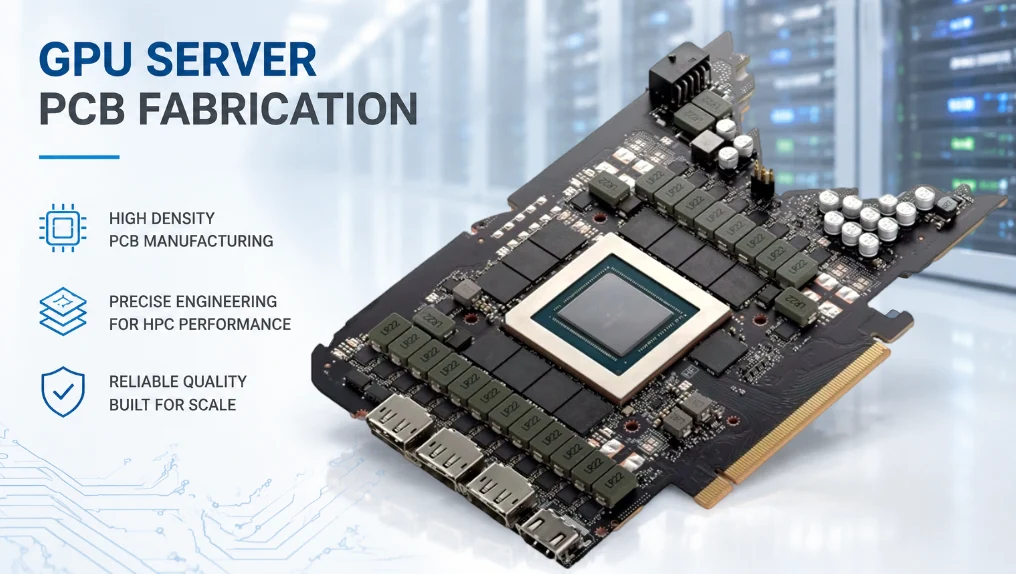
Figure 2. GPU Server PCBA
4. Materials & Stackup Strategy for GPU Server PCB Fabrication
Material selection drives both the cost and the performance ceiling of any GPU server PCB fabrication build. Our line carries every material listed below in active production qualification — not just on prototype panels.
| Application | Signal Rate | Recommended Material | Cost vs FR4 |
|---|---|---|---|
| GPU baseboard signal layers — current gen | 112G PAM4 NVLink | Tachyon 100G / Megtron 7 | 5–8× |
| GPU baseboard signal layers — next gen | 224G PAM4 | Tachyon-100GX / Megtron 8 | 8–12× |
| GPU baseboard power layers | DC + 100 kHz switching | Isola 370HR or equivalent | 1.2× |
| NVLink bridge boards | 100G PAM4 | Tachyon 100G throughout | 5× |
| NVSwitch carrier boards | 112G PAM4 | Tachyon 100G / Megtron 7 | 5–8× |
| PCIe Gen5 routing (short) | 32 GT/s NRZ | I-Tera MT40 / 370HR | 1.2–2× |
| PCIe Gen5 routing (long) | 32 GT/s NRZ | I-Tera MT40 / Tachyon 100G | 2–5× |
| 800G optical host board | 8×112G PAM4 | Tachyon 100G | 5× |
| Power management daughter | DC + 100 kHz | 370HR or IS410 — see our FR4 PCB manufacturing | 1.0–1.2× |
| BMC / management board | under 1 Gbps | IS410 or 370HR | 1.0–1.2× |
Hybrid stackup philosophy in GPU server PCB fabrication
The economics of GPU server PCB fabrication strongly favor hybrid stackups: ultra-low-loss material only on layers carrying the highest-speed signals, high-Tg FR4 on power, ground, and slower-signal layers. A 32-layer GPU baseboard might use Tachyon 100G on 8 signal layers and 370HR on the remaining 24 — typically cutting material cost 50–60% versus all-Tachyon construction while preserving high-speed performance where it matters.
Co-lamination compatibility
Tachyon 100G and 370HR co-laminate in a single press cycle at standard FR4 conditions. The same applies to Megtron 7 + Megtron 4 and I-Tera MT40 + 370HR combinations. Prepreg matching at material transitions requires attention — we coordinate with Isola and Panasonic technical support on critical GPU server PCB fabrication builds to verify prepreg compatibility before tooling release.
5. Quality Flow, S-Parameter Test & AVL for GPU Server PCB Fabrication
GPU server platforms ship into hyperscaler environments where a single PCB defect can take down an AI training run worth thousands of GPU-hours. The quality cost of any field issue is orders of magnitude higher than the cost of catching it at GPU server PCB fabrication. Our quality flow is structured accordingly.
Process control on critical parameters
- Dielectric thickness: ±5% tolerance on signal-bearing layers; verified by post-lamination cross-section sampling on every panel.
- Trace width: ±10 µm via laser direct imaging; etch compensation tuned per material.
- Impedance: ±5% on critical differential pairs; TDR coupon verification per panel.
- Back-drill depth: ±5 mil from target; verified by cross-section on first article and at agreed sampling frequency.
- Plated through-hole thickness: 25 µm minimum in via barrel; XRF on outer copper plus coupon microsection.
- Layer-to-layer registration: X-ray verification with target tolerance ±3 mil on high-layer-count GPU server PCB fabrication builds.
S-parameter test per delivery
- Insertion loss: measured on test coupons to 40 GHz; compared against modeled targets.
- Return loss: verifies connector launch and via transition quality.
- Differential crosstalk: NEXT and FEXT on representative coupon structures.
- Phase delay: time-domain or frequency-domain skew verification on length-matched pairs.
- Eye diagram simulation: customer-provided IBIS-AMI models can be run against measured channel S-parameters on request.
Documentation per GPU server PCB fabrication delivery
- Certificate of Conformance per panel with material lot and process run traceability
- Material certifications (laminate, prepreg, copper foil)
- Electrical test report — 100% flying probe or fixture
- Impedance test report with TDR plots per panel
- S-parameter test report on coupons (on request)
- Microsection report on first article and per agreed sampling frequency
- AOI inspection logs
- Visual inspection per IPC-A-600 Class 2 or 3
- Cross-section verification of back-drill depth (sampling per panel)
- RoHS, REACH, conflict-minerals declarations
- Process traceability log linking finished serial to internal work order, material lot, operator
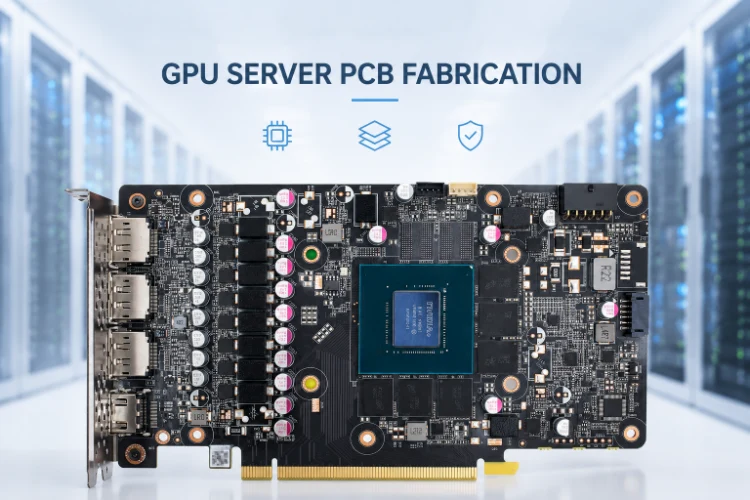
Figure 3. GPU Server PCB
6. Engaging Highleap for Your GPU Server PCB Fabrication Program
- Early platform design: stackup consultation, material recommendation, impedance modeling — typically engaged 6–9 months before first prototype.
- Prototype builds: 5–25 piece quantity with 10–14 working day turnaround for 24–28 layer baseboards; longer for 32 layer and HDI builds.
- Qualification samples: 50–500 piece quantity for environmental qualification, system-level testing, customer AVL approval; full PPAP-style documentation available.
- Pilot production: first volume runs at customer-managed capacity allocation; typically 1,000–5,000 units; quality data feeds AVL approval.
- Volume production: scheduled monthly or weekly deliveries against rolling forecast; capacity reserved against customer commit.
Highleap Electronics is a full-service PCB manufacturing and assembly factory; the GPU server PCB fabrication capability described here is one of several specialized programs we run. We are ISO 9001 and IATF 16949 certified, with AS9100D-aligned process flow available for programs requiring elevated quality system support. Our GPU server PCB fabrication line is equipped with laser direct imaging at 25 µm resolution, controlled-depth back drilling at ±5 mil tolerance, 100% impedance test coverage, S-parameter test to 40 GHz, X-ray registration verification, and microsection capability for first-article and in-process verification.
Submit Gerber files, drill data, stackup specification, channel performance targets, and target quantities through our online quote portal for a 24-hour response. For complex GPU server PCB fabrication programs — new GPU platform launches, scale-out fabric host boards, hyperscaler-specific qualification flows — our program team can engage directly. For related capability detail, see our pages on GPU server PCB manufacturing and AI server PCB solutions.

Recommended Posts
TMM4 Filter PCB Manufacturing
TMM4 filter PCB manufacturing is controlled by the...
TMM3 PCB Manufacturing for RF Modules
TMM3 PCB manufacturing is most useful where the RF module...
TMM6 PCB Fabrication
TMM6 fabrication is the process-control page for a mid-Dk...

TMM10 PCB Manufacturing for Compact RF Designs
Table of contentsHow TMM10 Shrinks RF StructuresTMM10 vs...
How to get a quote for PCBs
Let‘s run DFM/DFA analysis for you and get back to you with a report. You can upload your files securely through our website. We require the following information in order to give you a quote:
-
- Gerber, ODB++, or .pcb, spec.
- BOM list if you require assembly
- Quantity
- Turn time
For PCBA services, please provide your BOM (Bill of Materials) and any specific assembly instructions. We also offer DFM/DFA analysis to optimize your designs for manufacturability and assembly, ensuring a smooth production process.