
Mixed Technology PCB Assembly Services for SMT and Through-Hole Boards
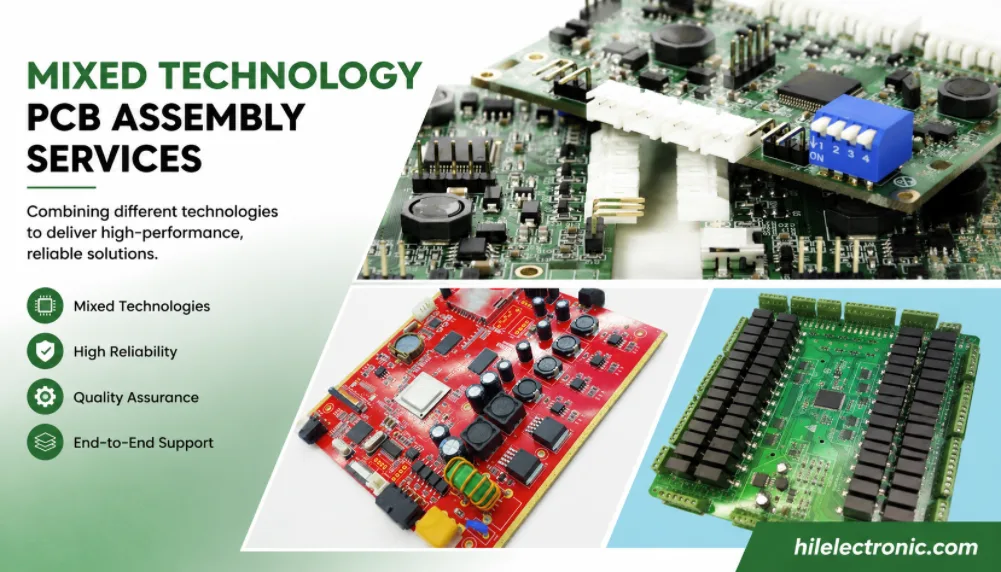
Table of contents
- 1. What Is Included in Mixed Technology PCB Assembly?
- 2. When Is a Mixed SMT and THT Process the Right Choice?
- 3. How Are SMT and Through-Hole Assembly Sequenced?
- 4. Selective, Wave, Pin-in-Paste or Hand Soldering?
- 5. What Design Details Affect Mixed Assembly Cost and Quality?
- 6. How Are Mixed Technology Boards Inspected and Tested?
- 7. Mixed Technology PCB Assembly Cost and Lead Time
- 8. Request a Mixed Technology PCB Assembly Quote
- 9. Mixed SMT and Through-Hole Assembly Questions
Mixed technology PCB assembly services are used when one board combines surface-mount components with through-hole connectors, transformers, relays, terminal blocks, heat sinks or other mechanically demanding parts. The main manufacturing challenge is not simply that two component types are present. The process sequence, thermal exposure, board support, soldering method, inspection and test must work together without damaging completed operations.
Highleap Electronics supports SMT and through-hole PCB assembly from prototype and small-batch builds through repeat production. The route may include reflow, wave soldering, selective soldering, pin-in-paste, controlled hand soldering, programming, functional testing and mechanical assembly. Highleap reviews the actual board before confirming which operations are appropriate.
For quotation, send the board files, BOM and quantity. If the board has special connectors, transformers or a required soldering method, mention it; otherwise Highleap can recommend the route. Buyers do not need to prepare a detailed process specification before asking for price.
1. What Is Included in Mixed Technology PCB Assembly?
A mixed assembly PCBA manufacturer should manage the complete route rather than quote SMT and through-hole work as disconnected services. Highleap can combine surface mount PCB assembly capability, component insertion, soldering, inspection, programming and testing under one controlled work order.
Paste printing, placement, reflow and visual or automated inspection.
Manual or automated insertion for connectors, power components and odd-form parts.
Wave, selective, pin-in-paste or controlled hand soldering according to layout and volume.
Programming, functional testing, coating, hardware and shipment preparation when required.
The service scope can be full turnkey, partial turnkey or consigned. Highleap can also coordinate PCB fabrication for mixed assemblies so panel rails, tooling holes and solder-side clearances support both SMT and through-hole operations. This integration is useful for boards where the assembly process is constrained by the PCB outline or bottom-side component placement.
2. When Is a Mixed SMT and THT Process the Right Choice?
Mixed technology is usually selected because SMT provides compact, automated assembly while through-hole parts provide mechanical strength, high-current connection or a package that is not available in surface-mount form. Typical products include industrial controls, power supplies, communications equipment, medical instruments, automotive modules and test equipment.
| Board requirement | Why mixed technology is used | Manufacturing implication |
|---|---|---|
| Cable or field connector | Through-hole pins resist insertion and cable loads. | Connector alignment and solder fill must be controlled. |
| Large transformer or relay | Part size, weight or electrical function favors leaded construction. | Insertion, support and thermal mass affect soldering. |
| Dense control electronics | SMT reduces size and supports fine-pitch ICs. | Reflow and inspection occur before later THT operations. |
| High-current terminal | Leaded connection and copper structure support current and mechanics. | Hole, copper and soldering route need joint review. |
| Serviceable product | Sockets, switches or replaceable parts may remain through-hole. | Manual access and downstream assembly must be considered. |
Highleap evaluates the mix by actual reference designator and package rather than applying one method to every leaded part. Some connectors may suit pin-in-paste, while larger thermal components require selective or hand soldering. The result is a product-specific hybrid PCB assembly service.
3. How Are SMT and Through-Hole Assembly Sequenced?
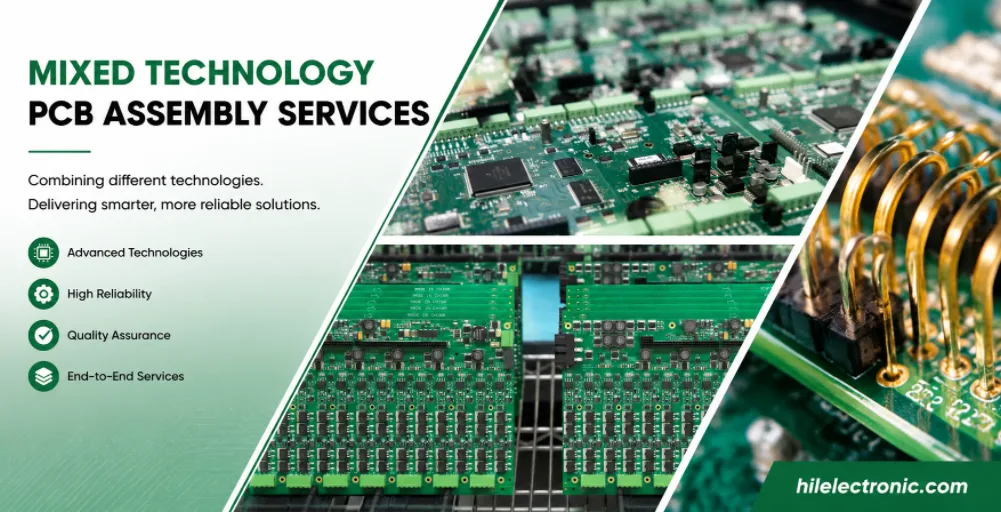
The usual route places and reflows SMT components before most through-hole operations, but the correct sequence depends on bottom-side parts, heat-sensitive components, selective-solder access and mechanical hardware. Highleap reviews the entire route before production so a later operation does not disturb or contaminate completed work.
- Print, place and reflow the first SMT side.
- Complete the second SMT side when the design is double-sided.
- Inspect visible SMT joints and review hidden-joint components as agreed.
- Insert through-hole and odd-form parts using fixtures where necessary.
- Run wave, selective, pin-in-paste or hand soldering for each compatible group.
- Complete cleaning, hardware, programming, functional testing and final inspection.
The sequence may change when heavy parts require adhesive, a connector must be mechanically fixed before soldering, or a temperature-limited device must be installed late. Highleap can use panelization requirements for SMT lines to confirm that the panel remains stable through all operations.
The customer should see the assumed process route in the quotation. This prevents an automated-cost estimate from later becoming a labor-intensive manual build after the factory reviews the physical board.
4. Selective, Wave, Pin-in-Paste or Hand Soldering?
Searchers comparing SMT THT assembly services often need to know which soldering method will be used. No single method is best for every mixed board. Highleap chooses by component type, quantity, solder-side access, thermal mass, spacing and the risk to nearby SMT components.
| Method | Best fit | Main limitations |
|---|---|---|
| Wave soldering | Many compatible through-hole joints with a wave-friendly underside. | Requires clearance, masking or pallets and exposes a larger board area to heat. |
| Selective soldering | A limited number of THT joints on boards with bottom-side SMT. | Needs nozzle access, keep-outs, stable fixturing and program development. |
| Pin-in-paste | Compatible connector pins that can be soldered during reflow. | Hole, paste volume, pin geometry and component temperature must be suitable. |
| Hand soldering | Low quantity, unusual components, wires or inaccessible locations. | Higher labor and operator dependence; workmanship controls are important. |
Highleap can review selective soldering process options and wave soldering for through-hole parts against the board layout. Where more than one method is required, the quote should state which component group uses each method and whether special fixtures or masking are included.
5. What Design Details Affect Mixed Assembly Cost and Quality?
The most common cost and quality issues come from insufficient solder-side clearance, tight connector alignment, large copper heat sinks, incompatible finished-hole sizes, unsupported panels and parts that block each other during insertion or soldering. Highleap checks these features during DFM and returns only the items that require customer action.
- Finished hole and lead dimensions for critical connectors and power parts.
- Bottom-side SMT clearance around wave or selective-solder locations.
- Component height, insertion direction and mechanical alignment.
- Thermal connections that make solder fill difficult.
- Board edge and panel support for heavy or off-center components.
- Access for inspection, touch-up and functional-test connectors.
A focused PCB DFM checklist for assembly can reduce fixtures, hand work and solder defects before the first build. Procurement does not need to interpret every design rule; Highleap should identify the affected part, expected manufacturing impact and recommended option.
6. How Are Mixed Technology Boards Inspected and Tested?
Inspection should follow the defect type. AOI is effective for visible SMT placement and soldering. X-ray may be appropriate for BGA, QFN or other hidden joints. Through-hole inspection focuses on component seating, orientation, solder fill, wetting, bridging and mechanical completion. Functional testing then verifies the assembled board performs the required operation.
| Process stage | Typical checks | Customer value |
|---|---|---|
| After SMT reflow | SPI/AOI, visual review and X-ray where required. | Find SMT defects before they are hidden by later hardware. |
| After THT soldering | Solder fill, bridges, wetting, orientation and connector alignment. | Confirm electrical and mechanical completion. |
| After programming | File version, checksum, serial or basic communication. | Prevent software configuration mix-ups. |
| Final acceptance | Power-up, functional test, labeling and visual completion. | Verify the delivered assembly matches the order. |
Highleap can combine the route with PCB functional testing services and X-ray inspection for hidden joints. The agreed coverage should be stated in the quote so “inspection included” has a clear meaning.
7. Mixed Technology PCB Assembly Cost and Lead Time
Cost depends on PCB and component materials, number of SMT sides, placement count, through-hole quantity, odd-form handling, soldering method, fixtures, inspection and test. Manual operations and repeated changeovers have a larger effect in low-volume mixed assemblies, while fixture and automation investment become more attractive for repeat orders.
Stable design, compatible panel, available components, grouped THT parts and reusable fixtures.
Custom components, new pallets, difficult selective access, incomplete test or multiple customer approvals.
Provide the first quantity and expected repeat quantity so Highleap can separate NRE from recurring cost.
The PCB assembly lead-time factors should be reviewed together with the BOM. Actual line time may be short, but long-lead connectors, transformers or custom mechanical parts often control delivery. Highleap can identify these items early and propose staged purchasing when appropriate.
8. Request a Mixed Technology PCB Assembly Quote
Send Gerber or ODB++ files, the BOM and required quantity. Add any known test requirement and photos or drawings for unusual connectors or mechanical parts. If you are unsure whether the board needs wave, selective or hand soldering, Highleap can make that recommendation after review.
The quote should show PCB and component sourcing scope, SMT and THT process assumptions, fixtures, inspection, testing and any first-article approval. This gives procurement a complete commercial scope and gives engineering a clear route without requiring a long technical submission.
Start with the mixed PCB assembly quotation request. Highleap can quote prototype, low-volume and repeat-production scenarios under the same process plan.
Highleap can include an operation-by-operation scope so the buyer sees which joints use reflow, selective, wave or hand soldering and which inspections follow each stage. This prevents later disagreement about manual work or special tooling.
9. Mixed SMT and Through-Hole Assembly Questions
Can one supplier handle SMT, THT and final testing?
Yes. Highleap can coordinate these operations under one route when the project fits the reviewed capability. One supplier can reduce handoffs, but the quotation must still define each soldering method, inspection and test deliverable.
Is mixed technology suitable for prototypes and repeat production?
Yes. Prototype builds may use more manual work and flexible tooling, while repeat orders can justify selective soldering, fixtures and retained programs. The process should evolve without changing the accepted product.
Can bottom-side SMT remain during through-hole soldering?
Often yes, but the layout determines whether wave, selective or hand soldering is feasible. Highleap checks component height, keep-outs, thermal exposure and fixture needs before confirming the route.
Does mixed technology always cost more than SMT-only assembly?
It usually adds operations and setup, but the total cost depends on component count, soldering method, quantity and test. A well-planned mixed route can be more economical and reliable than forcing mechanically demanding components into unsuitable SMT packages.
What is mixed technology circuit board assembly?
Mixed technology circuit board assembly combines SMT and leaded or mechanical operations on one PCBA. The route may use reflow, selective or wave soldering, hand work, inspection and testing in a sequence designed for the actual board.
Can hybrid PCB assembly services support both prototypes and production?
Yes. Hybrid PCB assembly services can use flexible manual methods for prototypes and reusable fixtures or automation for repeat production. Highleap shows which setup and tooling can be retained as volume grows.
When is selective soldering mixed PCB assembly preferred?
Selective soldering mixed PCB assembly is preferred when through-hole joints must be soldered after SMT reflow and a full wave would affect nearby components. Layout access and quantity still determine whether it is the best route.

Recommended Posts
TMM4 Filter PCB Manufacturing
TMM4 filter PCB manufacturing is controlled by the...
TMM3 PCB Manufacturing for RF Modules
TMM3 PCB manufacturing is most useful where the RF module...
TMM6 PCB Fabrication
TMM6 fabrication is the process-control page for a mid-Dk...
TMM10 PCB Manufacturing for Compact RF Designs
Table of contentsHow TMM10 Shrinks RF StructuresTMM10 vs...
How to get a quote for PCBs
Let’s run DFM/DFA analysis for you and get back to you with a report. You can upload your files securely through our website. We require the following information in order to give you a quote:
-
- Gerber, ODB++, or .pcb, spec.
- BOM list if you require assembly
- Quantity
- Turn time
For PCBA services, please provide your BOM (Bill of Materials) and any specific assembly instructions. We also offer DFM/DFA analysis to optimize your designs for manufacturability and assembly, ensuring a smooth production process.