
Nanya NPG-170D PCB for Halogen-Free High-Tg Builds
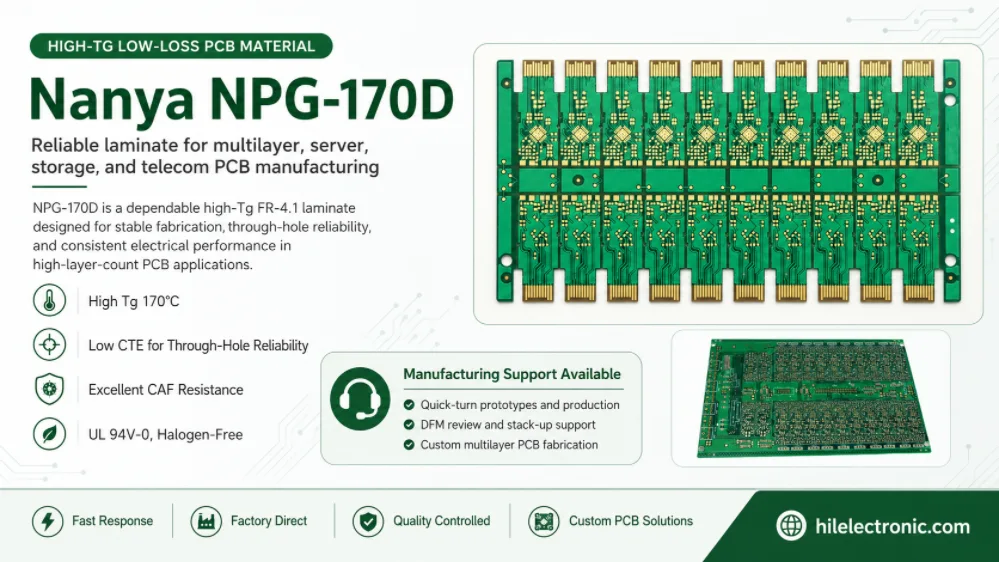
“NPG-170D” is a family-level shorthand, not a complete production specification. Nan Ya’s current public datasheet identifies at least NPG-170DR and NPG-170DTL as separate glass-cloth epoxy, flame-retardant materials. Both are described as halogen-, antimony-, and red-phosphorous-free, use reactive-type flame retardants, meet UL 94 V-0, have 170°C DSC Tg, low CTE, long-term reliability, dimensional stability, through-hole reliability, UV blocking, and superior CAF resistance.
The suffix matters. The public datasheet presents NPG-170DR with a reliability-oriented 1 GHz property set, while NPG-170DTL includes construction- and resin-content-dependent Dk/Df data at 1, 3, and 10 GHz. The same document also includes a separate design-parameter page with its own test conditions and reference values. Procurement, impedance modeling, qualification, and certification must therefore use the exact grade, exact construction, exact data page, matching prepreg, and controlled document revision.
Why “NPG-170D” Is Not a Complete Procurement Callout
A family name may be convenient during PCB material screening, but it is unsafe in a drawing or purchase order. The supplier can interpret the shorthand differently, quote a locally available suffix, or provide a construction that meets thermal requirements but not the impedance assumptions. The ambiguity becomes expensive after artwork, UL documentation, or customer qualification is tied to a particular grade.
| Incomplete callout | Hidden ambiguity | Complete release item |
|---|---|---|
| NPG-170D | DR or DTL; laminate/prepreg; construction and revision unknown. | Exact grade, laminate and matching prepreg designations, current TDS revision. |
| Halogen-free | Which standard, limits, test method, parts and certificate? | Named IEC/JPCA/customer limit and required declarations for laminate, prepreg and finished PCB. |
| 170°C Tg | DSC or TMA, tolerance and specimen not stated. | Exact grade and controlled datasheet; include other thermal/CTE requirements. |
| Dk 3.x | Frequency, resin content, method, construction and suffix unknown. | Layer-specific Dk/Df source tied to exact NPG-170DTL construction and test method. |
| UL V-0 | Exact UL file/construction/thickness/copper coverage not verified. | Required UL file and recognized construction confirmed by supplier/fabricator. |
| Equivalent allowed | No approval criteria. | Property/document matrix, test vehicle, compliance evidence and written approval. |
The family-level shorthand can remain in internal category fields, but the controlled stackup and PO should use the exact suffix. This also improves traceability when a supplier issues a new revision or when a customer asks which material was used in a specific lot.
Separate NPG-170DR and NPG-170DTL Before Design Starts
NPG-170DR and NPG-170DTL share a high-Tg, halogen-free reliability platform, but the public data support different engineering uses. A practical boundary is to treat DR as the general reliability-oriented grade and DTL as the grade for projects that also need published construction-dependent dielectric data for controlled impedance or moderate high-speed design.
| Grade | Public data emphasis | Best-fit use | Caution |
|---|---|---|---|
| NPG-170DR | 1 GHz Dk about 4.0–4.1, Df about 0.005–0.006, low moisture absorption, 170°C DSC Tg, low CTE and CAF/PTH reliability. | Halogen-free high-Tg multilayers where thermal, moisture, CAF and through-hole reliability dominate. | Do not borrow NPG-170DTL 10 GHz values for a DR construction. |
| NPG-170DTL | Dk/Df values by resin content at 1, 3 and 10 GHz, plus the shared high-Tg/low-CTE/CAF positioning. | Controlled-impedance and moderate high-speed multilayers that require construction-specific electrical modeling. | It is not an ultra-low-loss backplane material; values vary by resin content and data section. |
The suffix should be selected before impedance is finalized
If the design begins with a DR assumption and procurement later changes to DTL—or the reverse—the field-solver inputs, glass/prepreg construction, pressed thickness, and qualification evidence may change. Freeze the exact suffix while the fabricator is developing the stackup, not after Gerbers are complete.
Freeze Halogen-Free and Compliance Evidence
Nan Ya describes both grades as halogen-, antimony-, and red-phosphorous-free with reactive-type flame retardants. That statement is valuable, but a customer’s “halogen-free” requirement may use specific chlorine/bromine limits, methods, declarations, and scope. The laminate claim does not automatically certify solder mask, legend, adhesive, components, or the assembled product.
| Compliance item | Question to freeze | Document/evidence |
|---|---|---|
| Halogen-free standard | IEC, JPCA, customer-specific or another threshold? | Current declaration/test report naming exact NPG-170DR or NPG-170DTL and prepreg. |
| Antimony/red phosphorous | Is absence required and how is it documented? | Supplier declaration or test report tied to grade/revision. |
| RoHS/REACH | Which revision and exemptions apply? | Current compliance declaration. |
| Flammability | Is UL 94 V-0 sufficient and is the exact construction recognized? | UL file/construction, thickness/copper range and supplier/fabricator confirmation. |
| IPC slash sheet | Which IPC-4101 requirement is on the drawing? | Exact slash sheet and any customer additions. |
| Lot traceability | How will the finished board be linked to material lot? | CoC, traveler, laminate/prepreg labels and production records. |
| Change notification | Which formulation, site, construction or document changes require notice? | Supplier/fabricator PCN agreement and approval workflow. |
Do Not Mix DR, DTL, Performance-List, and Design-Parameter Data
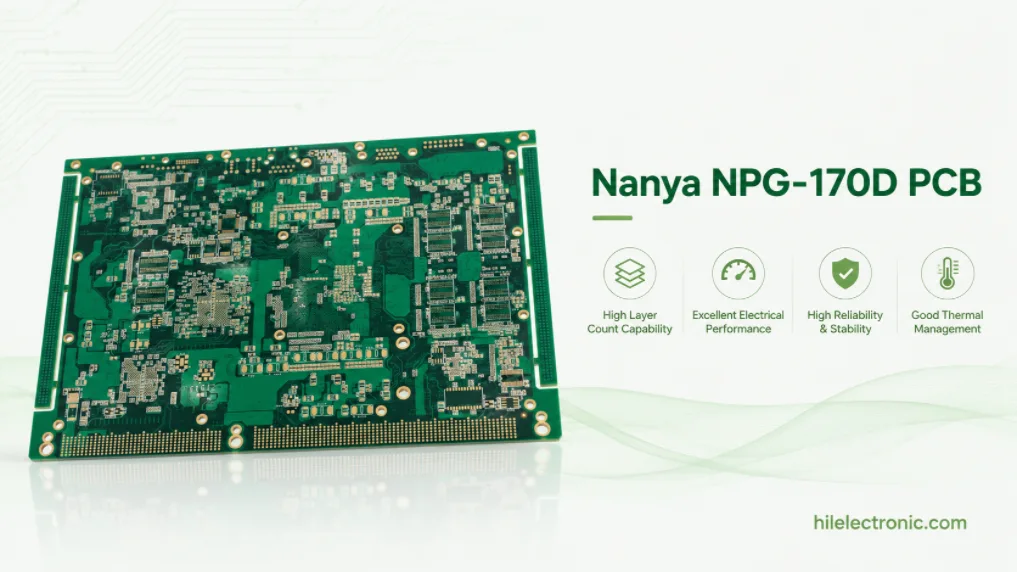
The current Nan Ya datasheet contains multiple data sets. NPG-170DR has a 1 GHz performance list. NPG-170DTL has a performance list with 1, 3, and 10 GHz values at different resin contents. A later design-parameter page includes additional Dk/Df references and explicitly warns that values vary by test method and that real loss should be evaluated with SI coupons. These data should not be combined without preserving the source condition.
| Data source | Example information | Correct use | Incorrect use |
|---|---|---|---|
| NPG-170DR performance list | 1 GHz Dk 4.0–4.1 and Df 0.005–0.006 on the stated specimen. | DR-grade screening and controlled design only with construction confirmation. | Using DTL 10 GHz numbers for DR because the family name is similar. |
| NPG-170DTL performance list | At 10 GHz, Dk 3.81 at RC50% and 3.30 at RC70%; Df 0.007 for both stated conditions. | Compare DTL constructions and build a layer-specific model with the supplier/fabricator. | Averaging RC50% and RC70% into one “NPG-170D Dk.” |
| Design-parameter page | Separate 3/10 GHz reference values and a note to correlate with actual SI coupons. | Use as an engineering reference tied to the exact construction and method; verify with the current supplier stackup. | Selecting the lowest number from any page without matching specimen or method. |
| Finished-board coupon | Measured impedance/loss on the released stackup and copper. | Correlate the field solver and production acceptance. | Treating one coupon’s fitted Dk as universal for all NPG-170DTL layers. |
Create a controlled material-data record
- Grade and suffix: NPG-170DR or NPG-170DTL.
- Laminate and matching prepreg designation.
- Core/prepreg construction, glass style, resin content and target pressed thickness.
- Frequency and test method for every Dk/Df value.
- Reference document title, issue/revision date and page.
- Copper profile and finished copper used in any coupon correlation.
- Fabricator-specific design value and the coupon from which it was derived.
- Approval owner and conditions under which the value may be reused.
This data discipline prevents one of the most common procurement/design errors: copying a favorable Dk or Df from a different resin content into the entire stackup. It also protects impedance if the supplier proposes a new prepreg construction to improve availability.
Where Each Grade Fits—and Where It Does Not
| Application | NPG-170DR direction | NPG-170DTL direction | Boundary |
|---|---|---|---|
| Halogen-free industrial controller | Strong candidate when reliability and compliance dominate. | Also possible if controlled impedance data are useful. | Verify voltage, CAF, moisture, assembly and exact compliance scope. |
| Automotive/transport control board | Candidate subject to customer mission-profile qualification. | Candidate where moderate high-speed links are present. | Material datasheet does not replace automotive qualification. |
| Communication/control multilayer | Suitable for moderate routes with reliability needs. | Often preferable when layer-specific Dk/Df and impedance are required. | Long PAM4 backplanes may need a lower-loss family. |
| Consumer/office equipment requiring halogen-free construction | Possible if cost, availability and reliability fit. | Use DTL only if electrical data justify it. | Do not over-specify a higher data grade without a functional need. |
| Long 112G/224G backplane | Not the intended default. | DTL still may not be low enough; model the complete channel. | Use a dedicated very-low/ultra-low-loss material if distributed loss dominates. |
| 77 GHz antenna | Not appropriate as the default. | Not appropriate as the default. | Use a frequency-specific mmWave laminate and module validation. |
The product category should not decide the suffix. A simple halogen-free control board may favor DR; a moderate-speed controlled-impedance board may favor DTL. The longest channel and the required compliance/qualification should make the decision.
Exact Construction, Matching Prepreg, and Impedance Release
The controlled stackup should name the matching prepreg and exact construction. Even when the laminate grade is correct, an unspecified prepreg can change resin flow, cured thickness, Dk, impedance, glass weave, and reliability. The fabricator should provide a signed stackup before impedance artwork is frozen.
| Stackup field | Procurement/design requirement |
|---|---|
| Exact grade by layer | NPG-170DR or NPG-170DTL; no family-only callout. |
| Core/prepreg construction | Glass style, resin content, nominal/finished thickness, ply count and availability. |
| Matching prepreg | Exact Nan Ya prepreg designation or approved construction tied to the grade. |
| Dk/Df source | Document revision, page/data set, frequency, method and fabricator correlation. |
| Copper | Foil type/profile, base weight, finished thickness, treatment and plating. |
| Impedance | Target/tolerance, finished width/spacing, dielectric/copper tolerances, coupon and TDR method. |
| Loss where relevant | S-parameter coupon, frequency range, fixture removal and acceptance. |
| Thermal/reliability | Tg/CTE/Td references, hole geometry, assembly history, CAF/moisture test and customer class. |
Do not release impedance before construction availability is confirmed
A calculated stackup may use a glass style or resin content that the selected fabricator cannot source routinely. Procurement pressure then drives a late substitution. Confirm material, prepreg, panel size, copper and lead time before artwork compensation. A slightly different available construction may require a new impedance model but can be more reliable commercially.
Supplier and Document Control
NPG-170D procurement is a document-control problem as much as a material problem. The PO, drawing, stackup, certificate, UL record, and impedance model must all point to the same suffix and revision.
- Vendor qualification: approve the laminate source, PCB fabricator, plant/site and relevant product construction.
- Controlled datasheet: archive the exact Nan Ya document revision used for design and compliance.
- Construction approval: sign the core/prepreg/glass/resin/copper stackup before fabrication.
- Certificate package: define CoC, halogen-free, RoHS/REACH, UL/slash sheet and lot traceability.
- Incoming verification: require the PCB supplier to check labels, prepreg, shelf life, storage and lot.
- Production traveler: link material lots to panel/board serials where required.
- PCN control: require notification for suffix, formulation, site, glass, copper, prepreg, document or process changes.
- Record retention: retain supplier documents and test data for the product life/customer requirement.
Where a contract manufacturer purchases the PCB, the OEM should ensure that the material suffix and certificate requirements survive the handoff. A high-level AVL entry such as “Nan Ya NPG-170D” can reintroduce the ambiguity that the engineering drawing tried to remove.
Equivalent-Material and Suffix-Change Rules
A suffix change is not clerical. DR to DTL, DTL to DR, or another halogen-free high-Tg family can change electrical data, moisture behavior, prepreg construction, compliance documents, availability, and qualification status.
| Change | Minimum review |
|---|---|
| NPG-170DR to NPG-170DTL | Stackup/Dk/Df, prepreg, impedance, loss, compliance, UL, thermal/CAF, availability and board-level test. |
| NPG-170DTL to NPG-170DR | Confirm that controlled-impedance/high-speed assumptions remain valid; do not reuse DTL data. |
| Same suffix, different glass/resin construction | Recalculate pressed thickness, Dk/impedance, resin fill, skew and process. |
| Same construction, different copper foil/treatment | Review impedance, conductor loss, peel, etch and qualification. |
| Different halogen-free manufacturer | Full property/document/process comparison plus board-level electrical and reliability evidence. |
| Datasheet revision or manufacturing site change | Review PCN, formulation/construction changes, certificates and correlation data. |
Procurement-Centered RFQ Checklist
| RFQ block | Required content |
|---|---|
| Exact identity | Nan Ya NPG-170DR or NPG-170DTL laminate and matching prepreg; exact construction and current revision. |
| Compliance | Named halogen-free limits/method, antimony/red-phosphorous declaration if required, RoHS/REACH, UL and IPC slash sheet. |
| Stackup | Glass style, resin content, core/prepreg thickness, ply count, copper profile, finished copper, total thickness. |
| Electrical | Layer-specific Dk/Df source, frequency/method, impedance targets/tolerance, coupon; S-parameters for DTL routes if needed. |
| Reliability | Hole geometry, wall copper, assembly thermal history, CAF/humidity, moisture, IPC/customer class. |
| Documents | CoC, material lot, TDS, declarations, UL evidence, stackup report, test records and retention. |
| Availability | Approved manufacturing site, standard constructions, panel sizes, copper options, MOQ and lead time. |
| Substitution/change | No suffix or construction change without property/document matrix, test plan and written approval. |
The RFQ should explicitly prohibit combining DR and DTL properties in one compliance or engineering table. If the board uses both grades—which would be unusual but possible in different subassemblies—each should have its own material record and certificates.
Pre-Release Audit Questions
- Does every drawing, stackup, PO, AVL entry and certificate show the same exact suffix?
- Is the matching prepreg named, and is the proposed glass/resin construction available from the selected factory?
- Are halogen-free limits and document scope defined instead of implied?
- Is the UL/slash-sheet requirement tied to the exact recognized construction?
- Does each Dk/Df value have a frequency, method, resin content, grade, document page and construction?
- Have DR and DTL data been kept separate?
- Has the impedance model been built from the supplier-approved stackup rather than a family-level Dk?
- Does the channel need DTL electrical data, or would DR meet the reliability/compliance need at lower complexity?
- Is the material appropriate for the route length, or should a lower-loss family be used?
- Are suffix, glass, prepreg, copper, site and document changes under formal approval?
A pre-release audit that can answer all ten questions has eliminated most of the avoidable NPG-170D procurement risk. The material then becomes traceable, modelable, certifiable, and substitutable only through evidence—not through a shortened family name.
Manufacturer references and release notes
The Nan Ya document below is the primary public basis for separating NPG-170DR from NPG-170DTL and for the cited compliance, thermal, and dielectric references. Procurement should archive the exact controlled revision received with the quotation and prevent values from separate grades or test-method tables from being merged.

Recommended Posts
Taconic RF 35 vs RO4350B PCB
Table of contentsRF-35 vs RO4350B Procurement and...
TMM4 Filter PCB Manufacturing
TMM4 filter PCB manufacturing is controlled by the...
TMM6 PCB Fabrication
TMM6 fabrication is the process-control page for a mid-Dk...
TMM3 PCB Manufacturing for RF Modules
TMM3 PCB manufacturing is most useful where the RF module...
How to get a quote for PCBs
Let’s run DFM/DFA analysis for you and get back to you with a report. You can upload your files securely through our website. We require the following information in order to give you a quote:
-
- Gerber, ODB++, or .pcb, spec.
- BOM list if you require assembly
- Quantity
- Turn time
For PCBA services, please provide your BOM (Bill of Materials) and any specific assembly instructions. We also offer DFM/DFA analysis to optimize your designs for manufacturability and assembly, ensuring a smooth production process.