
Macropad PCB Manufacturing & Custom PCBA
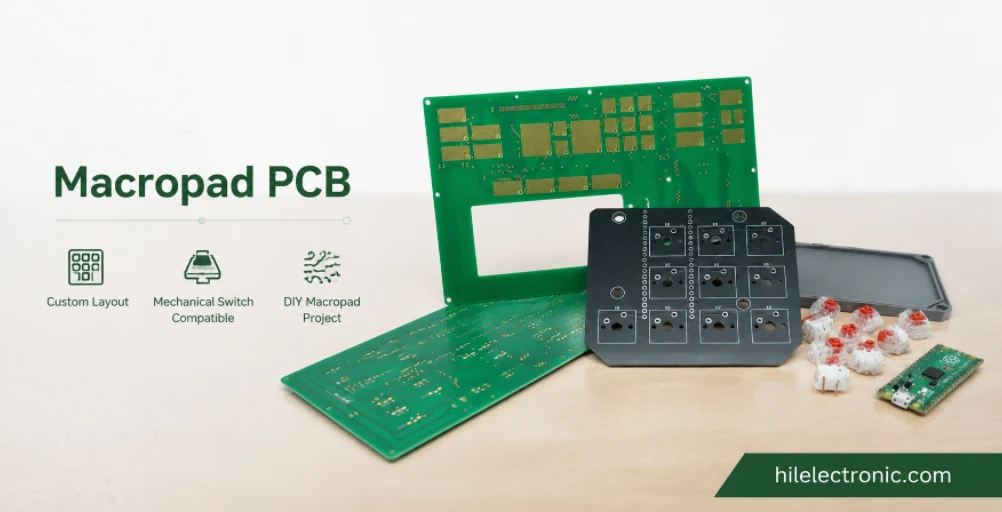
A macropad can be a simple USB shortcut board or a complex programmable control surface with encoders, displays, sliders, RGB, wireless connectivity and custom firmware. Highleap Electronics manufactures bare PCBs and turnkey PCB assemblies for a wide range of electronic products. For macropad, macro keyboard and programmable keypad projects, the production scope can include DFM, component sourcing, SMT/THT assembly, hot-swap sockets, USB-C, Bluetooth or 2.4 GHz, QMK/VIA or ZMK programming, functional testing, enclosure integration and branded packaging.
Moving from a DIY prototype to a sellable macropad requires controlled manufacturing data rather than only Gerbers or an online project repository. The PCB revision, BOM, switch and socket options, encoder or display interfaces, firmware, product variants, test procedure and mechanical files should be released together. Highleap reviews these dependencies so the same approved design can be repeated from engineering samples through launch and volume orders.
Macropad PCB Buying Guide and Quick Specifications
Highleap can quote a custom macro keyboard PCB as a bare board, a populated macro keyboard PCBA, or a finished programmable keypad PCB with enclosure and accessories. Mechanical macropad PCB and USB macro pad PCB projects can use QMK/VIA, ZMK or customer firmware, while every sellable variant retains its own controlled BOM, firmware and test route.
| Procurement item | Highleap supply and quotation basis |
|---|---|
| Product formats | Custom macro keyboard, programmable keypad, mechanical macropad, USB macro pad, wireless macro controller or industrial shortcut panel. |
| PCB construction | Rigid two-layer or multilayer PCB as required; size, thickness, copper and surface finish released after DFM. |
| Input hardware | Mechanical switches, hot-swap sockets, encoders, sliders, joysticks, buttons and customer-defined sensors. |
| User interface | Per-key RGB, status LEDs, OLED/LCD, USB-C, BLE/2.4 GHz, audio/MIDI or other customer interfaces. |
| Assembly and firmware | SMT/THT, QMK/VIA or customer firmware flashing, bootloader recovery and complete input/output test. |
| Prototype MOQ | Custom macropad assembly is available through Highleap’s low-MOQ program from 5 units. Encoder, display, custom key, enclosure and packaging order multiples can make a larger prototype or launch lot more economical. |
| Lead-time commitment | Macropad delivery is committed after MCU, encoders, displays, sockets, enclosure parts, firmware and functional-test access are reviewed. Highleap’s PCBA lead-time guide explains the standard phases; custom controls and box-build operations are added to the quotation. |
| Primary cost drivers | Key and RGB count, sockets, encoders/displays, MCU, wireless functions, custom controls, enclosure, fixture, packaging and number of variants. |
| Preferred quotation files | Prepare Gerber/ODB++, Excellon drills, BOM, centroid, fabrication and assembly drawings, schematic, enclosure data, switch/encoder/display specifications, firmware and test instructions. Highleap’s assembly-file checklist gives the preferred formats and revision rules. |
| Assembly limitations | Custom knobs, displays, cases, batteries and branded packaging require approved samples/drawings and can control MOQ or lead time. |
The Highleap rigid-PCB capability supports compact control boards, fine routing and multiple surface finishes. Macropad DFM focuses on panel efficiency, USB mechanical load, encoder/display clearance, component height and enclosure datums rather than applying every factory maximum to one small board.
Custom Macro Keyboard and Programmable Keypad PCB Builds
Highleap manufactures more than a simple grid of keys. The production route is tailored to the user interface and commercial product.
Highleap can supply a macro keypad PCB for productivity, streaming, point-of-sale, industrial shortcuts, audio control or branded accessories. A programmable keypad PCB can be built as PCB only, turnkey macropad PCBA service or a complete OEM module with case, cable, labels and packaging when those items are included in the controlled package.
Analog key products can use the sensor and calibration controls in Hall Effect keyboard PCB manufacturing.
| Macropad type | Typical electronics | Manufacturing focus |
|---|---|---|
| Productivity keypad | Keys, layers, USB-C, indicators | Reliable matrix, labels and firmware programming. |
| Streaming controller | Keys, rotary encoders, displays and RGB | Mixed component heights and complete functional test. |
| Audio or MIDI controller | Encoders, sliders, buttons and USB/MIDI | Analog inputs, mechanical controls and calibration. |
| Industrial shortcut panel | Durable switches, connectors and mounting | Mechanical retention, traceability and repeat orders. |
| Wireless macro controller | BLE/2.4 GHz, battery and charging | Antenna, current, pairing and regulatory samples. |
| Magnetic/analog keypad | Hall sensors and magnetic switches | Alignment, calibration and key-travel validation. |
Macro Keypad Electronics, MCU and Component Selection
A compact product can become difficult to assemble when controls, connectors and displays crowd the board edge. Highleap reviews the schematic, mechanical envelope and BOM together before fabrication.
QMK and VIA products should also follow the controlled firmware package described for QMK/VIA keyboard PCBs.
- select an MCU with enough matrix, encoder, display, USB and firmware resources;
- define QMK/VIA, ZMK or customer firmware and the programming/recovery interface;
- confirm encoder shaft, mounting tabs, detents and knob clearance;
- approve display module, flex or header orientation and enclosure window;
- control USB-C mechanical load and ESD protection;
- review RGB current, regulator capacity and thermal behavior;
- provide alternate components only when firmware and mechanics remain compatible.
Highleap can support component sourcing through electronic component sourcing, including lifecycle review and customer-supplied parts.
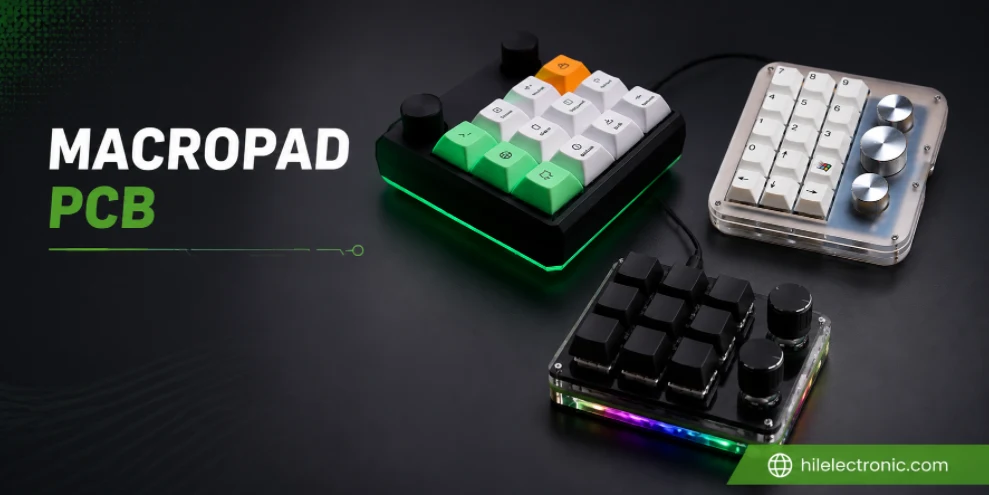
Macropad PCB Manufacturing Specifications
The following values are taken from the published Highleap rigid PCB capability table. They are factory-level limits, not a promise that every extreme can be combined in one build. Macropads are often small enough to panel efficiently, but component height, enclosure datums, USB loading and user controls determine the practical process.
| Manufacturing item | Published Highleap capability | Project condition |
|---|---|---|
| Maximum layer count | Up to 60 layers | Actual stackup is released after DFM review. |
| Minimum inner/outer trace and space | 2/2 mil | Copper weight, board size and process combination can change the practical limit. |
| Finished board thickness | 0.2–8.0 mm | Keyboard mechanical stack and connector height usually control the selected thickness. |
| Finished board size | 10 × 10 mm minimum; 22.5 × 47.5 in maximum | Panel utilisation, outline shape and assembly support must be reviewed. |
| Outline tolerance | ±0.1 mm | Critical switch, plate and enclosure interfaces should be dimensioned on the drawing. |
| Minimum mechanical drill / annular ring | 0.15 / 0.127 mm | Use practical holes and annular rings for switch, stabilizer and connector reliability. |
| Minimum laser drill / annular ring | 0.075 / 0.075 mm | Microvias are used only when routing density justifies HDI processing. |
| Minimum SMT pad capability | 7 × 10 mil | Component package and paste aperture remain subject to assembly review. |
| Minimum BGA pitch | 7 mil | Final package assembly depends on pad design, stencil, via strategy and inspection plan. |
| Published surface finishes | ENIG, ENEPIG, OSP, HASL, immersion silver/tin, hard gold and others | Finish is selected for solderability, contacts, cost and storage requirements. |
For very small products, panel design is important for paste printing, placement, depanelisation and final testing. Highleap defines tooling rails, fiducials, breakaway tabs and keepouts through SMT panelisation requirements.
Macropad PCB Assembly for Encoders, RGB, Displays and USB-C
Macropads frequently mix SMT electronics with mechanically loaded controls. Highleap separates reflow-compatible components from hand, selective or secondary operations and defines the inspection method for each.
Connector reinforcement and pin configuration can be cross-checked against Highleap’s USB-C connector guidance.
| Component | Assembly route | Inspection/test |
|---|---|---|
| Rotary encoder | SMT or THT according to part, with mechanical support | Rotation, push switch and shaft alignment. |
| OLED/LCD module | Header, flex or direct SMT as specified | Display pixels, orientation and brightness. |
| Per-key RGB | Repeated SMT array | AOI, color and pattern test. |
| USB-C | Reflow plus shell-joint process as required | Visual, power and enumeration test. |
| Hot-swap sockets | SMT with controlled paste/support | Socket presence, solder and switch actuation. |
| Sliders/joysticks | THT/SMT mechanical control | Range, center and calibration test. |
| Case hardware | Secondary assembly | Fit, torque and cosmetic inspection when included. |
Highleap uses SMT stencil design and AOI to control mixed arrays, while hidden pads can be checked by X-ray when required.
QMK/VIA Programming and Functional Test
The production test should reflect the marketed features, not only board continuity. Highleap can flash the approved firmware and execute a test sequence that reports every input and output.
All controls can be combined in the keyboard PCBA testing station.
- USB power, enumeration and reconnect;
- every key position, layer or mode button;
- encoder direction, detent count and push function;
- display startup, content pattern and communication;
- RGB colours, brightness and effects;
- analog slider or joystick range and calibration;
- VIA recognition or customer configuration software where applicable;
- wireless pairing, battery and current states for wireless variants.
The official VIA specification supports definitions that include elements such as rotary encoders and lighting, which can be included in the production verification when VIA is used: VIA specification.
Representative Macropad Production Configurations
The examples below are representative production configurations rather than named customer case studies. They show how Highleap would structure common macropad builds and tests.
| Representative configuration | Typical hardware scope | Production and acceptance focus |
|---|---|---|
| 12-key RGB USB-C macropad | Mechanical or hot-swap keys, per-key RGB, USB-C and QMK/VIA | Socket/LED inspection, firmware loading, full-key test, RGB pattern and USB enumeration. |
| Encoder and OLED control console | Keys, dual rotary encoders, OLED display and enclosure-mounted knobs | Mixed SMT/THT, shaft alignment, display test, encoder direction and push-function verification. |
| Wireless BLE macro pad | Key matrix, BLE SoC/module, battery charging and USB fallback | Antenna keepout, pairing, active/sleep current, charging and complete input test. |
| Industrial programmable keypad | Durable switches, connectors, mounting hardware and customer protocol | Mechanical retention, traceability, firmware programming and functional acceptance report. |
Macropad MOQ, Lead Time, Cost and Volume Scaling
Macropad brands often start with a small launch, then introduce colours, key layouts or enclosure variants. Highleap supports high-mix low-volume PCB assembly and can move to scheduled production without changing suppliers.
Early launch quantities can use PCBA prototype production before a dedicated volume fixture is justified.
| Phase | Recommended scope | Commercial benefit |
|---|---|---|
| Engineering prototype | Small PCBA quantity and exposed test access | Fast hardware/firmware learning. |
| Pilot/NPI | Production components, enclosure and packaging sample | Confirms complete product route. |
| Initial launch | Controlled lot with stored functional results | Reduces market-entry risk. |
| Volume repeat | Forecasted material and stable fixtures | Improves cost and delivery consistency. |
| Variant release | Separate BOM, firmware and label controls | Prevents product mixing. |
| After-sales stock | Known-good PCBAs or complete modules | Supports replacement and warranty service. |
Highleap can review field returns using PCB, assembly, firmware and test records. Cosmetic, enclosure and accessory issues are coordinated under the final agreed supply scope.
Why Buyers Use Highleap for Macropad PCBA
- PCB, PCBA, component sourcing, firmware programming and functional testing are coordinated by one supplier.
- DFM covers compact placement, USB mechanical load, encoder/display clearances and enclosure datums.
- Low-MOQ prototypes can transition into NPI and repeat production with the same revision controls.
- Rotary encoders, OLED/LCD, RGB, hot-swap sockets and USB-C receive feature-specific assembly and test planning.
- Box-build services can include enclosure integration, firmware installation, final packaging and logistics when specified.
Macropad PCB and Programmable Keypad Manufacturing FAQ
The questions below cover common long-tail searches for custom macropad PCB design transfer, QMK/VIA programming, encoders, displays, hot-swap sockets, wireless options and small-batch production.
What files are needed to manufacture a custom macropad PCB assembly?
Provide Gerber or ODB++, drill files, schematic, BOM, centroid, assembly drawings, switch and socket specifications, encoder or display data, enclosure files, firmware and programming instructions, VIA definition if used, functional test criteria, quantities and packaging requirements.
Can a macropad PCB use QMK, VIA or ZMK firmware?
Yes. QMK and VIA are commonly used for wired programmable keypads, while ZMK is often selected for low-power wireless designs. The MCU, bootloader, pin assignments, released binary and configuration files must match the manufactured PCB revision.
How are rotary encoders, sliders and displays tested on a macropad PCBA?
The production test can verify encoder direction and push function, analog slider range, display initialization and expected interface behavior. The customer should define the firmware screen, input limits and acceptable direction or scaling so the result is objective.
Can a custom macropad PCB include hot-swap switches and per-key RGB?
Yes. The exact switch and socket system, LED package, orientation, mechanical stack and power budget must be defined. Repeated socket and LED arrays require suitable stencil design, placement control and complete functional testing.
What is the difference between a USB macropad PCB and a wireless macropad PCB?
A USB macropad mainly requires stable power, data routing and enumeration. A wireless version adds radio layout, antenna clearance, battery charging, sleep-current control, pairing and possibly a receiver dongle. These additions affect enclosure space, firmware, certification and test time.
Can a DIY macropad project be converted into an OEM commercial product?
Yes, when the design rights are clear and the project is converted into a revision-controlled production package. Highleap can review DFM, source parts, manufacture and program the PCBA, develop tests and support enclosure, labels and packing.
How small can a macropad PCB prototype order be?
Small engineering quantities are possible, but the economic minimum depends on component reels, custom displays or encoders, enclosure parts, firmware readiness and fixture cost. A prototype quotation should separate one-time engineering charges from repeat unit pricing.
What determines custom macropad PCB assembly price?
Major cost drivers include PCB size and layer count, MCU and component availability, number of switches or sockets, RGB, encoders, displays, wireless hardware, programming, test cycle, enclosure assembly and packaging. Variant count can also increase setup and traceability work.
Can a macropad manufacturer provide a complete boxed product?
Yes. Highleap can quote PCBA, switches or controls, displays, enclosure assembly, firmware, functional testing, labels, accessories and final packing when the mechanical, cosmetic and branding requirements are fully defined.

Recommended Posts
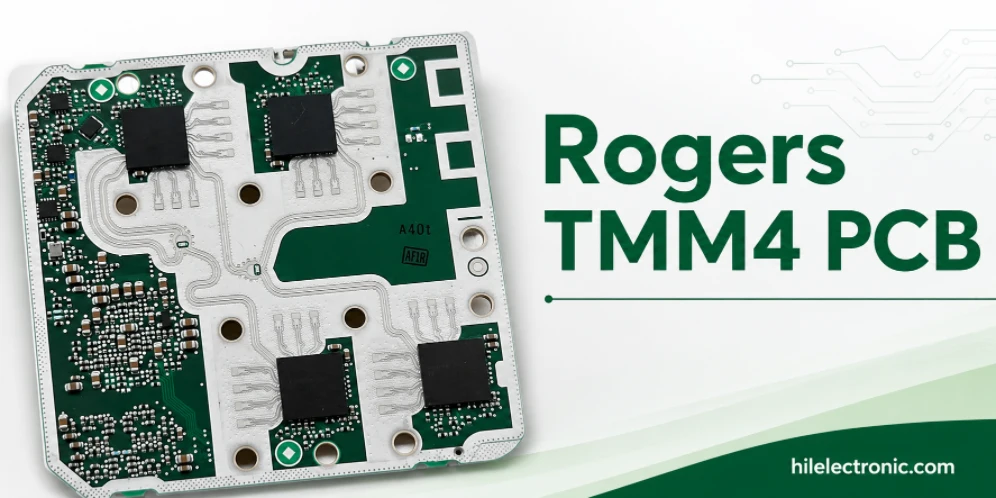
Rogers TMM4 PCB Manufacturer for Compact Microwave Filters
TMM4 is most useful when a microwave circuit must become...
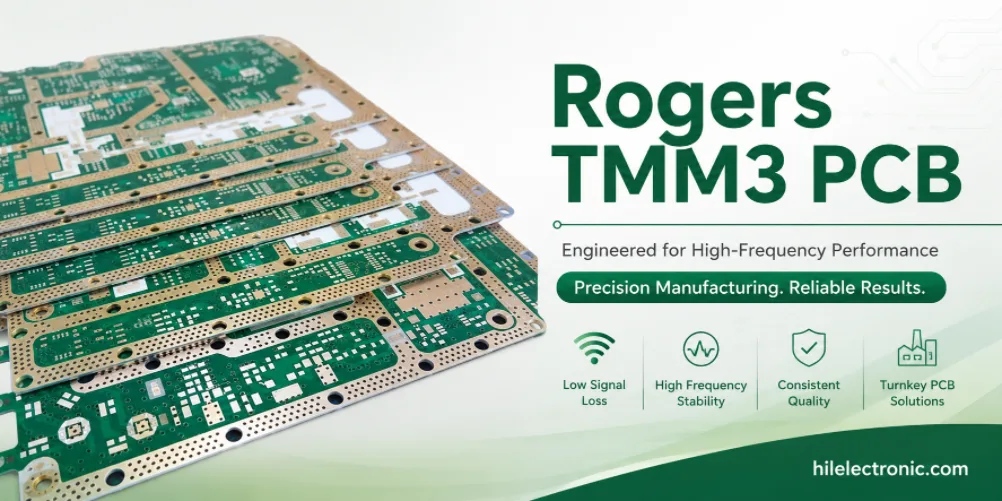
Rogers TMM3 PCB Manufacturer for Mechanical RF Modules
TMM3 is selected when an RF circuit must behave as part of...
Rogers TMM6 PCB Fabrication for Dk 6.0 Thermoset Microwave Boards
Figure 1. Rogers TMM6 PCB fabricationRogers TMM6 PCB...
Rogers TMM10 PCB Manufacturing for RF Designs
Table of contentsHow TMM10 Shrinks RF StructuresTMM10 vs...
How to get a quote for PCBs
Let’s run DFM/DFA analysis for you and get back to you with a report. You can upload your files securely through our website. We require the following information in order to give you a quote:
-
- Gerber, ODB++, or .pcb, spec.
- BOM list if you require assembly
- Quantity
- Turn time
For PCBA services, please provide your BOM (Bill of Materials) and any specific assembly instructions. We also offer DFM/DFA analysis to optimize your designs for manufacturability and assembly, ensuring a smooth production process.