
High Quality USB-C Connectors Manufacturing Solutions
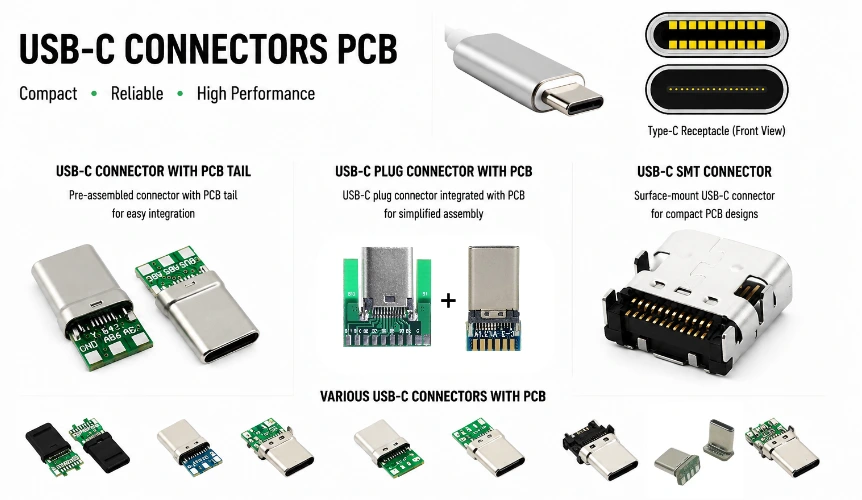
Figure 1. Usb C connectors PCB
USB-C carries 40 Gbps data, delivers 240 W power, and negotiates protocols on 24 pins at 0.5 mm pitch — all reversible. Getting USB-C onto a PCB without signal integrity failures, power delivery problems, or EMC issues requires specific layout rules, protection circuits, and fabrication tolerances that this guide documents pin-by-pin.
Table of Contents
- USB-C Pin Map: What Each Group Requires from the PCB
- SuperSpeed Differential Routing: Impedance, Length Matching and Layer Strategy
- VBUS Power Delivery: Copper Sizing from 15 W to 240 W
- CC Pin Configuration for Source, Sink and Dual-Role Ports
- Protection Circuits: ESD, EMI and Mechanical Durability
- Fabrication and Assembly for USB-C PCBs
1. USB-C Pin Map: What Each Group Requires from the PCB
| Pin Group | Count | Function | PCB Routing Requirement |
|---|---|---|---|
| VBUS + GND | 8 | Power delivery (5 V–48 V, up to 5 A) | Wide copper, multiple vias, thermal management |
| D+ / D− | 4 | USB 2.0 (480 Mbps) | 90 Ω differential, length match ±50 mil |
| TX1/RX1 + TX2/RX2 | 8 | SuperSpeed lanes (5–40 Gbps) | 90 Ω ±3–5%, stripline, ≤5 mil match |
| CC1 / CC2 | 2 | Orientation detect, PD negotiation | Short traces to controller, 5.1 kΩ pull-down (sink) |
| SBU1 / SBU2 | 2 | Sideband (DisplayPort AUX, audio) | Route only if Alt Mode is used |
The symmetric 24-pin layout (12 per side) enables plug reversibility but doubles the PCB routing density. Both TX1/RX1 and TX2/RX2 lane sets must be routed — the USB-C controller detects plug orientation via CC pins and activates the correct lane set. For USB 2.0-only designs, only one D+/D− pair needs full routing; the other is shorted to it at the connector pad.
The 0.5 mm pad pitch demands precise PCB manufacturing. Pad-to-pad clearance is only 0.15–0.2 mm — below the capability of many standard PCB fabrication processes. HDI PCB capability with 3 mil trace/space is required for clean USB-C fanout in dense multi-layer designs.
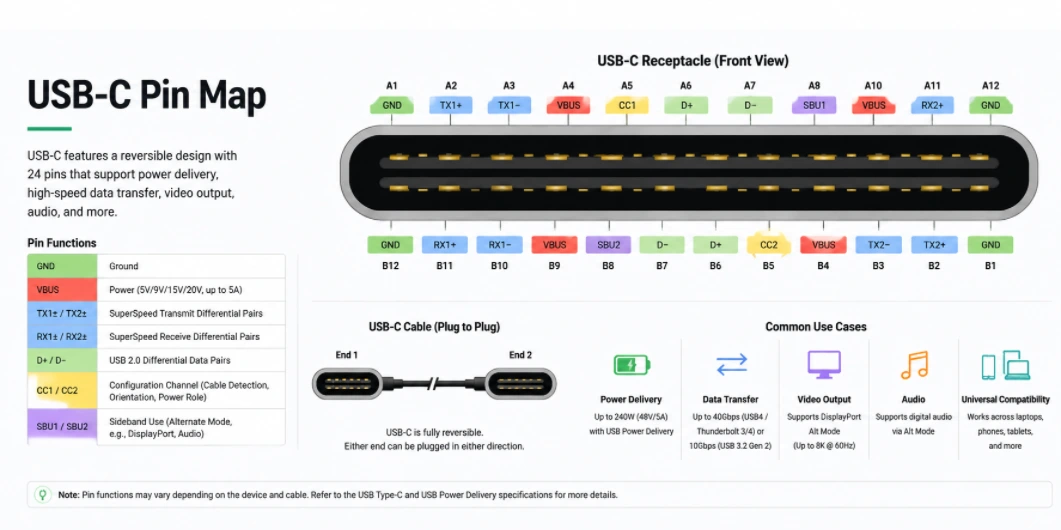
Figure 2. Technical USB-C pin map diagram showing 24-pin receptacle pinout and signal functions for hardware engineering and PCB layout.
2. SuperSpeed Differential Routing: Impedance, Length Matching and Layer Strategy
At 10 Gbps (USB 3.2 Gen 2), each differential pair is an RF transmission line. Layout rules that work for USB 2.0 fail at SuperSpeed.
Impedance: 90 Ω differential, ±5% for USB 3.x, ±3% for USB4. On FR-4 with 4 mil prepreg: ~0.18 mm trace width, ~0.18 mm gap. These values must be calculated with the manufacturer’s actual stackup — do not copy values from a different material or thickness.
Length matching: Intra-pair (two traces of one pair): ≤5 mil for USB 3.x, ≤2 mil for USB4. Use smooth serpentine tuning, not tight zigzags — sharp corners create impedance bumps at multi-GHz frequencies.
Layer strategy: Route SuperSpeed pairs on inner layers sandwiched between GND planes (stripline) for maximum shielding. USB 2.0 pairs can route on outer layers. Minimum 6 layers for USB 3.2 Gen 2; 8 layers for USB4. On 4-layer boards, SuperSpeed pairs route on outer layers as microstrip — acceptable for USB 3.0 (5 Gbps) but not recommended above that speed.
Vias: Each via on a SuperSpeed pair adds ~0.2–0.5 nH inductance and creates a stub that degrades the eye diagram. Target zero layer transitions per pair. When a transition is unavoidable, place GND stitching vias within 1 mm and consider back-drilling unused via stubs for USB4 designs. For PCBs requiring back-drilling, see our back-drilling technology guide.
AC coupling capacitors: USB 3.x TX lines require 100 nF AC coupling caps (0402 or 0201). Place them symmetrically between the two traces of each pair, near the transmitter side, with minimum stub length.
3. VBUS Power Delivery: Copper Sizing from 15 W to 240 W
USB-C VBUS carries 5 V (default), 9 V, 15 V, 20 V (USB PD 3.0, up to 100 W), or 28 V / 36 V / 48 V (USB PD 3.1 Extended Power Range, up to 240 W). The PCB copper must handle the worst-case current at the negotiated voltage.
| PD Profile | Voltage | Current | Power | Copper Width (1 oz, 10°C rise) |
|---|---|---|---|---|
| Default USB | 5 V | 0.9 A | 4.5 W | 27 mil (0.7 mm) |
| PD 15 W | 5 V | 3 A | 15 W | 90 mil (2.3 mm) |
| PD 60 W | 20 V | 3 A | 60 W | 90 mil |
| PD 100 W | 20 V | 5 A | 100 W | 150 mil (3.8 mm) or inner plane |
| PD 3.1 EPR 240 W | 48 V | 5 A | 240 W | 150 mil + 2 oz copper recommended |
All 4 VBUS pins must connect together on the PCB (same for GND) — the plug is reversible, so both sides carry power. For 100 W+ designs, a dedicated VBUS plane on an inner layer is standard. Heavy copper PCB with 2 oz inner layers supports 240 W PD without excessive temperature rise.
Protection: OVP (over-voltage protection) and OCP (over-current protection) are typically integrated into the USB PD controller IC (TI TPS65987, Cypress CYPD3177, Infineon CYPD6227). External TVS on VBUS handles surge transients that exceed the controller’s capability.
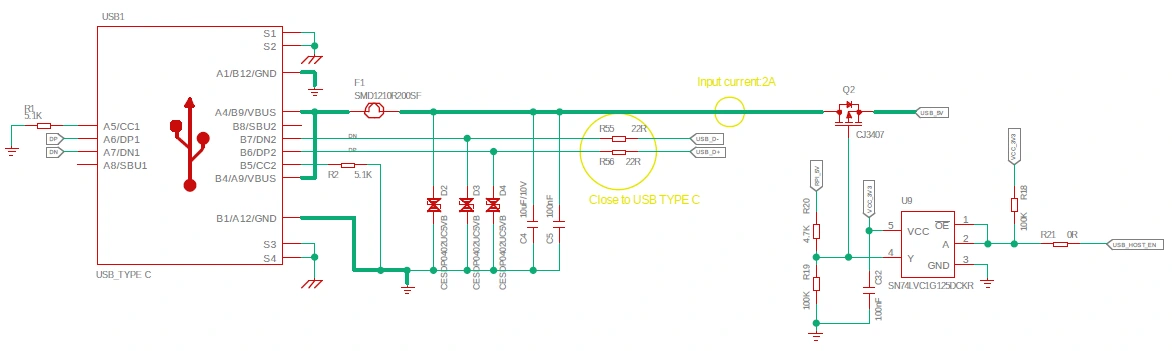
Figure 3. USB C Connector Circuit Schematic
4. CC Pin Configuration for Source, Sink and Dual-Role Ports
CC1 and CC2 are the intelligence of USB-C. They detect cable insertion, determine plug orientation, identify source/sink role, and negotiate PD voltage and current. The PCB configuration depends on the device’s role:
Sink (device receiving power): Each CC pin pulled to GND through 5.1 kΩ Rd resistor. Signals “I am a device, provide me power.” For PD-capable sinks, an active PD controller replaces the resistors and handles PD message negotiation via BMC encoding on the CC line.
Source (device providing power): Each CC pin pulled to VCONN or 3.3 V through Rp resistor. The Rp value advertises current capability: 56 kΩ = default USB (500 mA), 22 kΩ = 1.5 A, 10 kΩ = 3 A. For PD sources, an active controller replaces Rp and negotiates voltage/current contracts.
Dual-Role Port (DRP): Alternates between Rp and Rd, scanning for a partner. The PD controller handles the DRP state machine, Try.SRC/Try.SNK logic, and PR_Swap (power role swap). DRP is used in laptops, USB-C hubs, and docking stations that can both source and sink power.
PCB layout: keep CC traces under 50 mm to minimise capacitance. Add 0.1 µF decoupling to GND near the connector. Route CC traces away from SuperSpeed differential pairs — the BMC signaling on CC can couple into high-speed lanes if spacing is inadequate.
For products implementing DisplayPort or Thunderbolt Alt Mode, the SBU1/SBU2 sideband pins connect to the Alt Mode controller. These need ESD protection but no controlled impedance.
5. Protection Circuits: ESD, EMI and Mechanical Durability
ESD protection placement order (connector → hub IC):
- TVS diode arrays on SuperSpeed TX/RX — ≤0.3 pF (TI TPD4S214, Diodes Inc DT1452-02)
- TVS on D+/D− — ≤3 pF (TI TPD4S012, Nexperia PESD5V0U4BF)
- TVS on VBUS — bidirectional, rated for PD voltage (Bourns CDSOT23-SM712)
- TVS on CC and SBU — typically integrated in PD controller
All ESD components within 1.5 mm of connector pins. This is a non-negotiable rule — the protection device is only effective if it intercepts the ESD pulse before it reaches the controller IC.
EMI mitigation: Common-mode chokes on SuperSpeed pairs (Murata DLW32SH for USB 3.0, TDK ACT45B for USB 2.0). Connector shield tied to chassis GND through multiple stitching vias within 2 mm of the shell pads. For products targeting medical, automotive, or military EMC standards, high-frequency PCB design techniques including shielding planes and controlled-impedance vias are applied.
Mechanical reliability: USB-C is rated for 10,000 insertion cycles. Surface-mount connectors with through-hole holding tabs (the most common type) provide adequate mechanical strength. Pure SMT connectors are weaker — acceptable for stationary products, not portable. Mid-mount connectors (recessed into the board edge) suit ultra-thin devices but require precision CNC routing of the board outline.
6. Fabrication and Assembly for USB-C PCBs
USB-C PCBs demand tighter fabrication tolerances than standard boards. Verify these capabilities with your manufacturer before design finalisation:
Trace/space: 3 mil / 3 mil minimum for USB-C fanout regions. Standard 5 mil / 5 mil is insufficient for the 0.5 mm pitch contact pads.
Impedance control: ±5% on 90 Ω differential for USB 3.x; ±3% for USB4. Requires field-solver simulation on the actual production stackup and TDR coupon verification on every batch. Impedance-controlled fabrication at Highleap supports these tolerances on FR-4 and low-loss laminates.
Surface finish: ENIG (electroless nickel/immersion gold) is standard for USB-C pad soldering — the flat surface provides consistent solder paste deposition across the dense pad array. ENIG surface finish with controlled gold thickness ensures reliable connector attachment over the product lifetime.
Assembly: The USB-C connector has 24 signal pads plus 4 shield/mounting pads at 0.5 mm pitch. Solder paste stencil aperture design is critical — over-deposit causes bridges; under-deposit causes opens. Assembly partners with USB-C production experience use specific stencil aperture reductions (typically 80–90% of pad area) validated on test boards before production.
Highleap Electronics fabricates USB-C PCBs from 4 to 12 layers with HDI capability. Submit your USB-C PCB design for a quote.
Related: USB hub PCB design guide · USB hub PCB manufacturer selection · USB converter products · USB port expander guide

Recommended Posts
Optical Transceiver PCB Assembly Services in China
Highleap Electronics provides optical transceiver PCB...
Precision Press Fit PCB Manufacturing with Tight Tolerances
Press-fit PCB manufacturing requires close coordination...
8 Layer HDI PCB Manufacturer in China
Highleap Electronics provides 8 layer HDI PCB...
8 Layer Rigid-Flex PCB Manufacturing and Cost Guide
An 8 layer rigid-flex PCB combines multilayer rigid...
How to get a quote for PCBs
Let‘s run DFM/DFA analysis for you and get back to you with a report. You can upload your files securely through our website. We require the following information in order to give you a quote:
-
- Gerber, ODB++, or .pcb, spec.
- BOM list if you require assembly
- Quantity
- Turn time
In addition to PCB manufacturing, we offer a comprehensive range of electronic services, including PCB design, PCBA, and turnkey solutions. Whether you need help with prototyping, design verification, component sourcing, or mass production, we provide end-to-end support to ensure your project’s success.
For PCBA services, please provide your BOM (Bill of Materials) and any specific assembly instructions. We also offer DFM/DFA analysis to optimize your designs for manufacturability and assembly, ensuring a smooth production process.