
Arlon 85N PCB Manufacturing Service
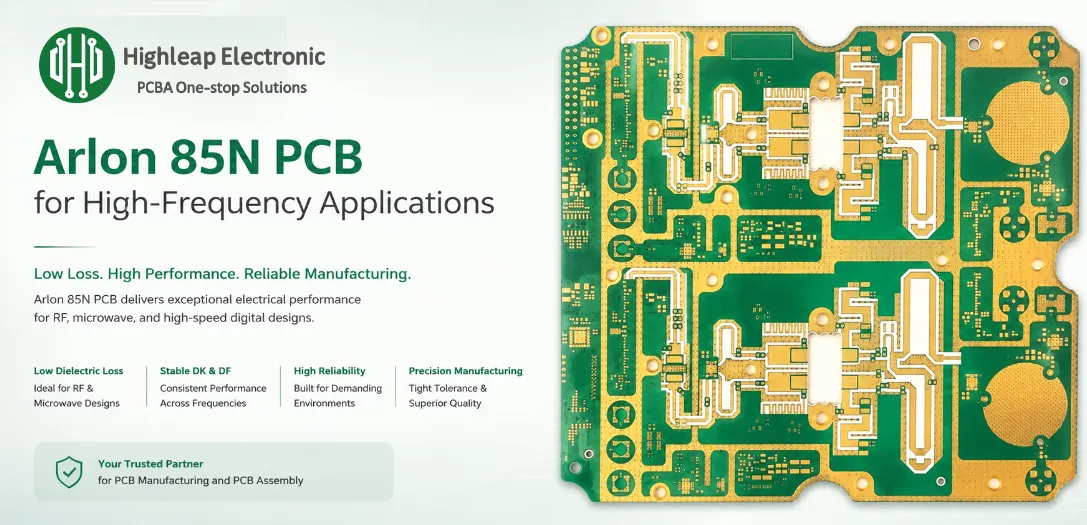
Figure 1. arlon 85n PCB manufacturing
Arlon 85N PCB is a high-frequency laminate designed for RF, microwave and high-speed digital applications requiring low loss, stable electrical performance and reliable signal integrity. It is widely used in RF amplifiers, wireless infrastructure, aerospace electronics and advanced communication systems.
Highleap provides Arlon 85N PCB fabrication and assembly with engineering review, controlled impedance manufacturing and worldwide delivery support.
Table of Contents
- Arlon 85N Properties — What Each Datasheet Number Controls in Manufacturing
- How We Manufacture Arlon 85N PCBs — The Process Steps That Define Reliability
- Reliability Testing, Documentation, and Traceability
- Where 85N Fits — Applications, Alternatives, and Material Selection
- One Factory for Every Board in Your Product — Plus IP Protection
- Starting an Arlon 85N PCB Project with Highleap
1. Arlon 85N Properties — What Each Datasheet Number Controls in Manufacturing
Most pages that discuss 85N reproduce the datasheet. This section connects each property to its manufacturing consequence — what it costs, what it controls, and what goes wrong when the factory ignores it.
Thermal properties
- Tg: 250°C (DSC). Stays rigid through lead-free reflow at 260°C peak. The catch: developing full Tg requires cure at 218°C+ for 120 minutes measured at the product — not the press platen. Under-cured 85N has lower effective Tg and compromised via reliability.
- Td: 407°C (5% weight loss). Comfortable margin above any process temperature. Boards survive 5–10 lead-free reflow cycles without degradation — critical for aerospace field repair.
- T260 / T288 / T300: >60 min each. Validates void-free lamination. Any void reduces these numbers sharply; we use T260 coupon testing per production lot to confirm bond quality.
- Z-axis CTE: 50 ppm/°C below Tg; ~2.5% total expansion 50–260°C. Lower than FR-4 (60–70 ppm/°C). Still meaningful on thick boards with high-aspect-ratio holes — we model barrel stress during DFM and flag at-risk designs.
- X/Y CTE: 12–16 ppm/°C. Close to copper (17 ppm/°C). Reduces registration drift during lamination and pad-lifting risk during thermal excursions.
Electrical and mechanical properties
- Dk ~4.0, Df ~0.012 at 1 MHz. Comparable to high-Tg FR-4. Not a low-loss material — designers needing mmWave performance should look at Isola Astra MT77 (Dk 3.0, Df 0.0017) or a specialty low-loss laminate instead.
- Moisture absorption: 0.5%. Higher than epoxy (~0.1–0.2%). Every panel must be baked 60 min at 107–121°C immediately before lay-up, and again before lead-free assembly. Skipping this step is the leading root cause of delamination in polyimide multilayers.
- Toughened formulation. Modified to be less sensitive to drilling and routing variations than older polyimides; melt rheology closer to FR-4 for better resin fill on complex multilayer stackups.
- Peel strength. Excellent when the lamination is run correctly. Drops if moisture is trapped during pressing — a defect that typically surfaces only at thermal cycling testing.
For broader background, see our polyimide PCB and Arlon 85N material pages.
2. How We Manufacture Arlon 85N PCBs — The Process Steps That Define Reliability
The three most common root causes of field failure on polyimide PCBs are moisture-induced delamination, under-cure, and incomplete desmear. All three are manufacturing process failures, not material defects. This section documents our process controls against each.
Lamination
- Pre-bake: inner layers racked (not stacked) at 107–121°C for 60 min. Prepreg vacuum-desiccated 8–12 hours. Storage below 30% RH. These steps are not optional — they prevent the moisture-driven voids that cause in-service delamination.
- Press cycle: heat ramp 4–6°C/min to 218°C cure plateau. 120 minutes at temperature. We verify cure temperature with embedded thermocouples on first-article builds — platen temperature can lead product temperature by 10–15°C on thick stacks.
- Cool-down: ≤5°C/min under pressure, followed by post-cure at 200°C for 1–2 hours to develop full mechanical properties.
- Vacuum lamination preferred over standard press — removes trapped gas that creates micro-voids invisible to visual inspection but detectable by IST.
Drilling
- 400–500 SFM per Arlon’s recommendation. Undercut bits for vias ≤0.018″. Fresh micro-grain tungsten carbide only — no re-use of FR-4-worn bits.
- Feed rate 25–35 in/min. Slower than FR-4 to control hole-wall roughness (Ra target <20 μm).
- Bit life 1,500–2,500 hits. Aggressive retirement. A new bit costs cents; a via failure in a downhole tool at 4,000 meters costs the operator tens of thousands of dollars per hour.
Desmear and plating
- Plasma desmear (CF₄/O₂): our preferred process. Removes polyimide smear without aggressive attack on the laminate. Alkaline permanganate as alternative with tighter process control. Hole-wall microsection on every lot to verify complete smear removal.
- Electroless copper: 0.5–1.5 μm. Standard chemistry — no sodium etch required (unlike PTFE laminates).
- Electrolytic copper: pulse plating to 30 μm hole-wall target (IPC Class 3 minimum is 25 μm). We target the upper specification band because polyimide vias see more thermal stress than FR-4 vias in the same design.
- Surface finish: ENIG dominant on aerospace and defense programs. ENEPIG for mixed wire bond / solder. Hard gold on edge contacts. Finish selection reviewed during DFM — the wrong choice can surface as a solderability issue months after delivery. See ENIG surface finish.
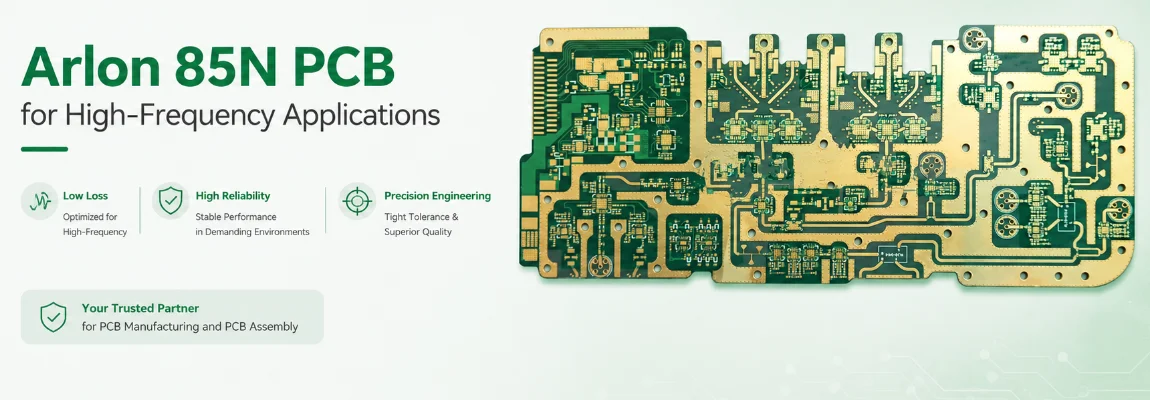
Figure 2. Arlon 85N PCB
3. Reliability Testing, Documentation, and Traceability
On polyimide programs, the reliability test data is as important as the board itself. Customers need evidence that the manufacturing process will produce boards surviving 15–25 years in the field.
Tests available on Arlon 85N production
- Thermal cycling: −65°C to +150°C, 1,000–2,000 cycles. Pass criterion: <10% via-chain resistance shift.
- IST (interconnect stress test): per IPC-TM-650 2.6.26. Catches marginal plating, incomplete desmear, and lamination voids that electrical test cannot detect.
- CAF resistance: per IPC-TM-650 2.6.25.
- Time-to-delamination: T260, T288, T300 per IPC-TM-650. 85N routinely exceeds 60 min at 300°C.
- Lead-free reflow simulation: 5–10 cycles at 260°C peak. Inspected for delamination, via cracks, pad lift.
- Peel strength: per IPC-TM-650 2.4.8, after thermal stress and after process solutions.
- Accelerated aging: for downhole applications, aging at 175°C+ to demonstrate sustained reliability.
Documentation delivered with each lot
- Certificate of Conformance with Arlon material lot number and mill certificate.
- 100% electrical test report (continuity and isolation).
- Cross-section microsection report per IPC-A-600 Class 3.
- Impedance coupon report (when controlled impedance specified).
- Solderability per J-STD-003 and ionic cleanliness per IPC-TM-650 2.3.25.
- IST coupon data and peel strength report (when program requires).
- RoHS / REACH declaration.
- First-article inspection per AS9102 (when required).
Test coupons from every production panel are preserved for the program lifecycle. If a field issue arises years later, the retained coupons allow retrospective testing — each linked to its production lot through an auditable traceability chain.
4. Where 85N Fits — Applications, Alternatives, and Material Selection
Applications where 85N is the right choice
- Downhole oil and gas: MWD/LWD tools, formation sensors, downhole telemetry. Continuous operation at 175–200°C for weeks. Failure cost extreme — tens of thousands of dollars per hour of lost drilling time.
- Aerospace engine controllers (FADEC): 125–150°C continuous, 20–30 year service life, multiple lead-free rework cycles. See aerospace PCB.
- Military electronics: missile guidance, EW, radar. MIL-PRF-31032 requirements, long-term magazine storage at temperature extremes. See military PCB.
- Spacecraft: severe eclipse/sun thermal cycling; repair impossible after launch; missions lasting years to decades.
- Industrial high-temperature: process control near furnaces, burn-in test boards for semiconductor qualification.
When to choose 85HP instead
Arlon 85HP uses the same polyimide resin with spread glass and micro-fine fillers, delivering roughly twice the thermal conductivity of 85N and lower Z-axis expansion (<1% vs ~2.5% at 50–260°C). Choose 85HP for thick copper, high layer count, or high-density via designs that need better heat dissipation through the laminate. Same press cycle discipline applies.
When to choose a different material
- Below 125°C continuous: high-Tg FR-4 is sufficient and far cheaper. See high-Tg PCB.
- RF or mmWave: 85N’s Dk 4.0 / Df 0.012 are too high. Use Isola Astra MT77 or a specialty low-loss laminate.
- High-speed digital above 56G PAM4: Megtron 6R or 7N — signal integrity drives selection, not temperature.
- Thermal conductivity critical: specialty low-loss laminate a thermally conductive ceramic-filled PTFE laminate at 1.44 W/mK vs polyimide’s ~0.3 W/mK.
85N vs Ventec VT-901
Both are high-Tg polyimide multilayer laminates with comparable Tg and Td. Process windows overlap but require separate press cycle qualification. Selection is most often AVL-driven — some aerospace primes have qualified 85N, others VT-901, and switching requires formal requalification. We manufacture both at Highleap and can advise based on availability, lead time, and cost at the required construction.
5. One Factory for Every Board in Your Product — Plus IP Protection
A downhole MWD tool typically needs a polyimide sensor board, an FR-4 digital board, a heavy-copper power board, and a flex-rigid interconnect — all inside one pressure housing. Sourcing each from a different supplier creates misaligned schedules, inconsistent documentation, and no single accountability when a system-level problem spans boards.
Board types we manufacture alongside 85N
- FR-4 and high-Tg FR-4: 2- to 40+ layer digital, control, and power boards.
- Other polyimides: VT-901, 85HP, 33N low-flow — for products using multiple polyimide grades.
- specialty low-loss laminate and Taconic RF: when the product has an RF front-end alongside a high-temperature board. See specialty low-loss laminate PCB manufacturing.
- Megtron: high-speed digital processing boards. See Megtron 6 material.
- Heavy copper (3–12 oz), flex-rigid, metal-core: power supply, motor drive, space-constrained interconnects. See heavy copper PCB.
All boards ship together, managed by one project engineer, with consistent documentation and one NDA covering the entire product.
IP protection
Aerospace, defense, and downhole designs represent years of engineering investment. We sign a mutual NDA before receiving files. Design data is stored on access-controlled servers — only the assigned project engineer and direct production staff can access it. We do not subcontract critical processes; drilling, plating, etching, and lamination stay in-house. All employees sign confidentiality agreements. After the agreed retention period, customer data is securely deleted per instruction. Customers can audit our IP practices during supplier qualification.
6. Starting an Arlon 85N PCB Project with Highleap
What to send
- Gerber and drill files (or preliminary stackup for budgetary estimate if design is not finalized).
- Stackup notes: dielectric thickness, copper weight, material callout (85N core, 85N prepreg, glass style).
- Quality requirements: IPC Class 2 or 3, AS9102 FAI, MIL-PRF-31032 if applicable.
- Reliability test scope: IST, thermal cycling, T260/T288, peel strength — or reference to a customer specification.
- Assembly scope (if turnkey): BOM, Pick-and-Place, conformal coating or potting requirements.
What to expect
- Quote: 48h standard; 72h for complex multilayer or non-stock thicknesses.
- DFM review: included — stackup, drill aspect ratio, copper balance, moisture management plan.
- Prototype: 10–15 working days for 6–10 layer polyimide; shorter for 4-layer.
- Volume: 20–25 working days. Blanket releases for predictable-demand programs.
- MOQ: 5 pcs prototype; 25 pcs production (lower for sustainment).
- Sustainment: tooling preserved, documentation retained 10+ years, proactive material obsolescence monitoring, last-time-buy coordination.
If you are deciding between 85N, 85HP, VT-901, or high-Tg FR-4, our application engineering team can provide a material recommendation with preliminary stackup at no charge. If your product needs multiple board types, send all designs together — we manage them as a project set with synchronized delivery.
Submit files through our online quote portal, or contact us directly for projects with specific qualification requirements. For related reading: polyimide PCB, high-Tg PCB, aerospace PCB, military PCB, multilayer PCB manufacturing.

Recommended Posts
TMM4 Filter PCB Manufacturing
TMM4 filter PCB manufacturing is controlled by the...
TMM3 PCB Manufacturing for RF Modules
TMM3 PCB manufacturing is most useful where the RF module...
TMM6 PCB Fabrication
TMM6 fabrication is the process-control page for a mid-Dk...
TMM10 PCB Manufacturing for Compact RF Designs
Table of contentsHow TMM10 Shrinks RF StructuresTMM10 vs...
How to get a quote for PCBs
Let‘s run DFM/DFA analysis for you and get back to you with a report. You can upload your files securely through our website. We require the following information in order to give you a quote:
-
- Gerber, ODB++, or .pcb, spec.
- BOM list if you require assembly
- Quantity
- Turn time
For PCBA services, please provide your BOM (Bill of Materials) and any specific assembly instructions. We also offer DFM/DFA analysis to optimize your designs for manufacturability and assembly, ensuring a smooth production process.