
uBGA PCB Assembly Services for High-Density Electronics
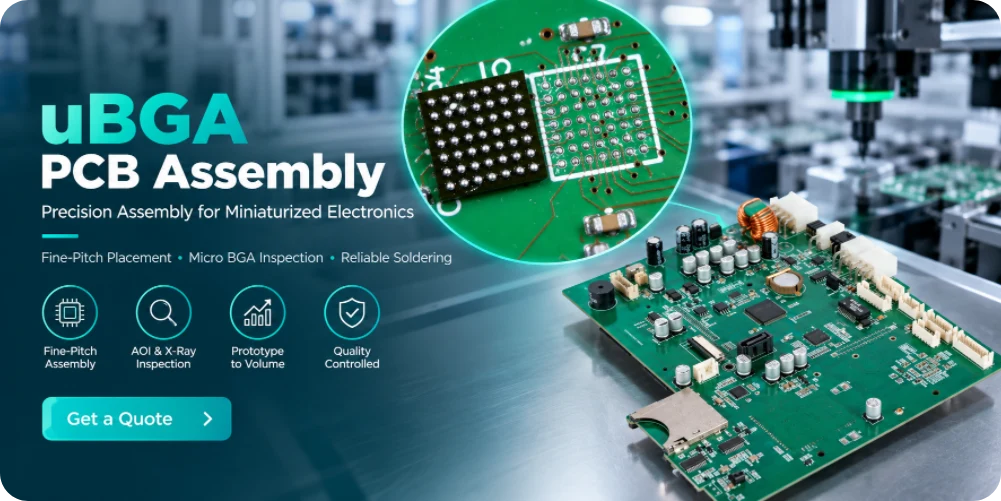
Need a uBGA PCB assembly supplier for a board that is already designed and ready to move toward production? Highleap Electronics handles both PCB fabrication and PCBA manufacturing, so the uBGA package, bare board and assembly process can be reviewed within one production route. This is especially useful when the board combines a uBGA with other dense SMT devices, connectors, power components or through-hole parts.
For an RFQ, send the released PCB files, BOM, centroid/XY data, exact uBGA part number, assembly drawing and required quantity. We can then review the actual board rather than giving you a generic package-level answer. The quotation can be based on the real PCB construction, component population, assembly requirements, inspection scope and production volume.
- Get a uBGA PCB Assembly Quote Based on the Complete Board
- uBGA Package Data, PCB Layout and Fabrication Requirements
- How the uBGA Assembly Process Is Built Around the Board
- uBGA Inspection, X-Ray and Production Testing
- Mixed uBGA Assembly With QFN, CSP, Fine-Pitch ICs and Small Passives
- Prototype, NPI and Repeat-Order uBGA Production
- Why Use Highleap for uBGA PCB Manufacturing and Assembly?
Get a uBGA PCB Assembly Quote Based on the Complete Board
A supplier can quote a uBGA part very quickly; the useful question is whether the supplier can quote your PCBA correctly. uBGA projects are normally affected by the complete component population, board construction, quantity, sourcing status, inspection requirements and any special assembly or test instructions.
What should I send for a uBGA PCB assembly RFQ?
- Released PCB fabrication files: Gerber or equivalent production data, board thickness, layer information and specified finish.
- BOM: manufacturer part numbers, quantities per board and approved alternates where applicable.
- Centroid/XY data: placement coordinates, rotation and reference designators for SMT components.
- uBGA information: exact manufacturer part number and package drawing when available.
- Assembly drawing: polarity, special notes, do-not-populate positions and customer-specific instructions.
- Test requirements: electrical, functional or other inspection and acceptance requirements.
- Quantity: prototype, NPI, pilot or recurring production volume.
Highleap’s PCB DFM review and PCB assembly file requirements provide a practical starting point when the manufacturing package needs to be checked before the order is released.
What does a factory need to determine before pricing?
The quotation team needs enough information to distinguish the uBGA package from the manufacturing job around it. For example, two boards can use the same uBGA component while having very different PCB layer structures, component density, assembly quantities and testing requirements. A meaningful quote therefore needs to reflect the actual board rather than a package name alone.
If you are comparing suppliers, ask whether the quoted scope covers only SMT placement or includes the complete path from PCB assembly services, component sourcing and inspection through finished PCBA delivery. This can make supplier comparison much clearer when the project is moving beyond prototype quantities.
HIGHLEAP ELECTRONICS • PCB MANUFACTURING & PCBA
Share the released PCB files, BOM, centroid data, uBGA part number and quantity. Highleap can review the board fabrication and assembly scope together and return a quotation based on the actual project.
uBGA Package Data, PCB Layout and Fabrication Requirements
Once the project enters engineering review, the uBGA package has to be considered together with the PCB on which it will be assembled. The package drawing establishes the component geometry, while the PCB design determines how the lands, routing, vias, stack-up and surrounding circuitry support the finished board.
Which uBGA PCB layout details affect manufacturing?
The important items include the approved land pattern, ball map, escape routing, via structure, board stack-up, surface finish and clearance from nearby components. The correct combination depends on the released design. A uBGA does not automatically require a particular PCB technology, and it should not be treated as an automatic requirement for HDI or via-in-pad.
Where the package escape area creates a dense routing problem, Highleap’s HDI PCB manufacturing and HDI via design resources can be considered as part of the board-level engineering review.
| uBGA project input | Manufacturing review focus | Possible production impact |
|---|---|---|
| Package and land pattern | Approved footprint, pad geometry and ball arrangement | Defines the PCB-to-package solder interface. |
| Escape routing | Feasible signal and power breakout for the released ball map | May influence layer count, via structure and fabrication complexity. |
| Board construction | Stack-up, thickness, copper and specified finish | Affects fabrication and the thermal behavior of the assembly. |
| Component clearance | Spacing around the uBGA and access for manufacturing operations | Can affect printing, placement, inspection and rework. |
| Panelization | Orientation, rails and tooling features | Supports repeatable board handling during assembly. |
What if the PCB already uses HDI?
Then the uBGA assembly review should be connected to the existing board technology rather than treated as a separate package exercise. Layer transitions, microvias, component density and the available inspection or rework access all need to be understood from the released fabrication data.
Why should the PCB and PCBA supplier communicate on footprint changes?
A late footprint revision can propagate into routing, stencil data, assembly programming and inspection documentation. Keeping the PCB and assembly revisions synchronized reduces the risk of quoting one configuration and building another. This is one reason a supplier covering both fabrication and assembly can simplify the manufacturing handoff.
How the uBGA Assembly Process Is Built Around the Board
The assembly route should be established from the complete PCBA, not from the uBGA component in isolation. Printing, placement and reflow have to work for the package while also accommodating the rest of the board population.
- Prepare the production data: confirm the released PCB, BOM, centroid file, assembly drawing and package information.
- Develop the stencil: translate the approved land pattern into a production stencil while accounting for the surrounding component population.
- Print solder paste: apply the specified paste to the uBGA lands and the other SMT pads on the board.
- Verify the print: use solder-paste inspection where required to identify printing variation before placement.
- Place components: populate the uBGA and remaining SMT devices from the controlled assembly data.
- Reflow the board: use a process appropriate to the solder material, PCB construction and component requirements.
- Inspect and test: select visible-joint inspection, X-ray, electrical or functional testing according to the production requirements.
Highleap provides solder paste inspection and reflow soldering as part of the manufacturing process used to build customer PCBA designs.
How is solder paste managed around a uBGA?
The goal is a controlled and repeatable paste deposit across the package array and the rest of the board. Stencil design and print settings should be established from the actual pad geometry and component mix. If a board contains several package styles, the stencil must support the complete population rather than optimizing one footprint while creating problems elsewhere.
How is the reflow process selected?
The thermal process should be matched to the solder material, PCB construction and component requirements. It should not be presented as one fixed temperature recipe for every uBGA board. The approved production profile should remain associated with the board and process configuration so that significant changes can trigger an appropriate review.
For BGA-family packages, Highleap also provides a reflow soldering resource that can be referenced when reviewing the thermal side of the assembly process.
uBGA Inspection, X-Ray and Production Testing
The defining inspection issue with uBGA is access. After reflow, the solder connections are beneath the package, so a top-side visual check cannot directly expose every joint. The inspection plan should therefore be based on what the customer needs to verify and which failure modes matter to the product.
Can AOI replace X-ray for a uBGA?
AOI remains useful for accessible assembly features, including visible component placement and solder joints elsewhere on the board. It does not provide the same view of concealed uBGA joints. Where hidden connections are important to the production acceptance plan, X-ray inspection can be incorporated into the inspection route.
What should be checked besides the uBGA?
A uBGA board can still fail because of a polarity error, missing component, open connection, incorrect connector or functional fault elsewhere on the assembly. Highleap’s AOI inspection can address visible assembly conditions, while electrical and product-specific testing can address behavior that visual inspection cannot establish.
When should electrical or functional testing be included?
If the product has defined electrical limits or an approved functional test, those requirements should be supplied with the RFQ so the factory can include them in the manufacturing plan. Electrical testing and functional testing answer different questions from X-ray and should be used according to the released test specification.
For production programs, it is also useful to define which inspection results are recorded by lot, which defects require rework or rejection, and which tests are mandatory before shipment. That turns inspection from a list of machines into a controlled acceptance process.
Mixed uBGA Assembly With QFN, CSP, Fine-Pitch ICs and Small Passives
Most uBGA assemblies are not single-package boards. The same PCBA may contain QFN or CSP devices, fine-pitch ICs, small passive components, connectors, shielding, power components and through-hole hardware. The production route therefore has to be optimized for the complete component population. Package terminology alone is insufficient; micro-BGA footprint and solder-process planning still needs the exact ball pitch, land pattern and inspection requirements.
Can uBGA be assembled on a board with QFN and CSP?
Yes, when the released PCB design and assembly process support the combined population. The packages are not interchangeable from a process perspective, so their footprint geometry, soldering behavior, inspection access and surrounding clearances need to be considered individually within the same board-level process.
Highleap’s CSP package resource is relevant when a CSP and uBGA share the same dense assembly. Where very small passive components are also present, the assembly data should make the component sizes and placement requirements unambiguous.
What changes when the board also contains very small passive components?
The stencil and placement strategy must work across different pad sizes and component geometries. A dense uBGA area should not be engineered independently from the rest of the SMT population. The same production board may require fine control around the uBGA while also maintaining reliable solder-paste deposits for smaller passive components and larger thermal-mass parts.
What if the uBGA board includes connectors or through-hole components?
Then the assembly sequence needs to account for mechanical components and any operations that occur after SMT reflow. Highleap can combine SMT production with through-hole assembly when the released design uses mixed technology.
Prototype, NPI and Repeat-Order uBGA Production
The best supplier for a uBGA prototype is not necessarily the supplier that can support repeat production, and the transition between those stages should be planned from the beginning. A prototype can expose footprint, sourcing, assembly, inspection or test issues that need to be resolved before the same board becomes a recurring order.
- Prototype build: use the controlled design package to establish the first assembly configuration.
- Engineering feedback: document manufacturing findings, component issues, inspection observations and required design changes.
- NPI release: align PCB, BOM, assembly, stencil and test revisions before regular production.
- Production qualification: confirm the agreed inspection and test route against the released product requirements.
- Repeat production: manufacture future lots against controlled revisions and approved component sourcing information.
Highleap supports prototype PCB assembly and first-article inspection for projects moving from engineering builds toward repeat manufacturing.
What should remain controlled after the first uBGA build?
The production baseline should identify the PCB revision, BOM revision, uBGA manufacturer part number, approved alternates, stencil revision, assembly data, inspection criteria and test instructions. If any of those change, the impact should be assessed before the next production lot rather than assuming the previous manufacturing setup is still valid.
Can Highleap support customer-supplied components?
Yes. If the customer supplies the components, consigned PCB assembly can be used for the agreed scope. If Highleap is responsible for sourcing, the BOM and manufacturer part numbers should be included in the RFQ so sourcing can be evaluated together with the assembly requirement.
Why Use Highleap for uBGA PCB Manufacturing and Assembly?
For a uBGA project, supplier selection is about more than having a placement machine capable of handling a small package. You need a manufacturing partner that can take the released board data, fabricate the PCB, assemble the complete component population, inspect the finished PCBA and work from the customer’s defined test and acceptance requirements.
Highleap Electronics provides PCB manufacturing and PCB assembly for customer-designed products. That allows a uBGA project to move through one coordinated manufacturing path instead of separating the bare-board supplier from the assembly supplier and then reconciling the two processes.
- PCB + PCBA in one manufacturing route: the board construction and assembly requirements can be reviewed together.
- Package-specific engineering review: the actual uBGA part, footprint, PCB and complete component population are considered before production.
- Inspection matched to the board: AOI, X-ray, electrical and functional testing can be selected according to the released requirements.
- Prototype through repeat production: manufacturing support can continue as the project moves from initial builds to recurring orders.
- Clear RFQ handoff: production decisions can be based on the released PCB data, BOM, assembly files, quantity and customer specifications.
If your uBGA board is already designed, the most useful next step is not another general package discussion. Send the production files and quantity. Highleap can review the actual PCBA requirements and determine the appropriate manufacturing route for your project.
HIGHLEAP ELECTRONICS • uBGA PCB ASSEMBLY
Send your PCB fabrication data, BOM, centroid file, uBGA part information, assembly requirements and quantity. Highleap can evaluate the complete PCB and PCBA scope for your next build.

Recommended Posts
Taconic RF 35 vs RO4350B PCB
Table of contentsRF-35 vs RO4350B Procurement and...
TMM4 Filter PCB Manufacturing
TMM4 filter PCB manufacturing is controlled by the...
TMM3 PCB Manufacturing for RF Modules
TMM3 PCB manufacturing is most useful where the RF module...
TMM6 PCB Fabrication
TMM6 fabrication is the process-control page for a mid-Dk...
How to get a quote for PCBs
Let’s run DFM/DFA analysis for you and get back to you with a report. You can upload your files securely through our website. We require the following information in order to give you a quote:
-
- Gerber, ODB++, or .pcb, spec.
- BOM list if you require assembly
- Quantity
- Turn time
For PCBA services, please provide your BOM (Bill of Materials) and any specific assembly instructions. We also offer DFM/DFA analysis to optimize your designs for manufacturability and assembly, ensuring a smooth production process.