
FR408HR PCB Manufacturing for High-Reliability Multilayer Designs
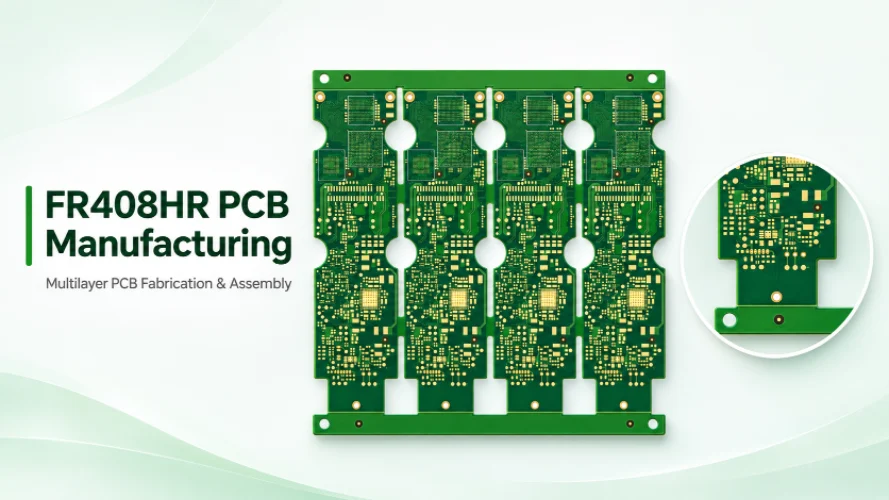

FR408HR PCB Manufacturing & Assembly: Stackup, Impedance and DFM
When your design specifies Isola FR408HR, successful production depends on more than the laminate grade. The approved stackup, dielectric construction, copper weights, lamination, drilling, impedance requirements and inspection plan must work together. Highleap Electronics manufactures the finished PCB and provides PCB assembly to the customer’s approved material and design requirements. We do not manufacture FR408HR laminate.
Lead-Free Assembly Compatible
Multilayer PCB
PCB + PCBA
Build FR408HR Into a Production-Ready PCB, Not Just a Material Callout
FR408HR is an Isola laminate and prepreg system. Highleap Electronics does not manufacture FR408HR material. Our role is to manufacture the finished printed circuit board from the customer-approved material specification and then support PCB assembly when required.
That distinction matters commercially and technically. A reliable RFQ should identify the exact FR408HR construction, finished thickness, copper weights, layer count, impedance requirements, surface finish, drilling requirements, and production quantity. Highleap can then review the design against the manufacturing process before production release.
- Material verification: Confirm the specified FR408HR construction, laminate/prepreg requirements, copper configuration and approved alternatives before fabrication.
- Manufacturing engineering: Translate the supplied design into a manufacturable stackup, drilling plan, lamination process, imaging, plating and inspection flow.
- PCBA continuity: Where assembly is required, continue from fabricated bare boards into SMT/through-hole assembly, inspection and testing according to the project specification.
What FR408HR Brings to the PCB Manufacturing Decision
Isola currently describes FR408HR as a lead-free, mid-loss laminate and prepreg for multilayer PCB applications where thermal performance and reliability are important. Its published typical values include Tg 190°C by DSC, Td 360°C, Dk 3.68 and Df 0.0092. The same current product information lists FR-4 process compatibility, CAF resistance, lead-free assembly compatibility, multiple lamination cycles, and via-filling capability.
| FR408HR property | Published typical value / product information |
|---|---|
| Glass transition temperature (Tg, DSC) | 190°C |
| Decomposition temperature (Td) | 360°C |
| Dielectric constant (Dk) | 3.68 |
| Dissipation factor (Df) | 0.0092 |
| Assembly compatibility | Lead-free assembly compatible; Isola product information lists 6 × 260°C reflow capability |
| Processing features | FR-4 process compatibility, CAF resistance, multiple lamination cycles and via-filling capability |
Note: These are typical values and product features stated in the source article. Confirm the applicable Isola datasheet, test method, frequency and construction-specific data before using them for design calculations or production acceptance.
Those published values are useful for engineering review, but they should not be treated as universal design constants for every FR408HR construction. Isola provides construction-specific Dk/Df data, and the actual electrical behavior of a finished PCB depends on the selected glass style, resin content, dielectric thickness, copper geometry, frequency, and finished fabrication tolerances.
The manufacturing takeaway
Do not quote a project from the material name alone. Quote the complete PCB construction. That gives Highleap’s engineering team enough information to evaluate manufacturability, impedance targets, lamination requirements, and production risk before the order is released.
FR408HR Stackup Review Before Fabrication
For multilayer FR408HR boards, stackup definition is one of the most important steps before fabrication. A stackup determines dielectric spacing, reference planes, copper distribution, overall thickness, controlled-impedance geometry, and the way the board behaves during lamination.
Highleap can review the customer’s stackup against the actual PCB requirements instead of treating the layer count as the entire specification. If the design includes controlled-impedance traces, the stackup should identify the relevant signal layers, reference planes, dielectric thicknesses, copper thicknesses, trace widths, and impedance targets.
For projects where the stackup is not yet finalized, our high-speed PCB stackup engineering resources can be used alongside the production RFQ. The objective is not to redesign the customer’s circuit unnecessarily; it is to make sure the proposed construction can be fabricated consistently.
| Stackup item | Why Highleap reviews it | RFQ information to provide |
|---|---|---|
| Layer count | Determines lamination sequence and routing/reference-plane relationships. | Total layers and any sequential-build requirement. |
| Dielectric construction | Influences finished thickness and controlled impedance. | Core/prepreg construction or approved stackup. |
| Copper weight | Affects etching geometry, impedance, current capacity and finished dimensions. | Inner/outer copper weights and any heavy-copper areas. |
| Impedance targets | Requires coordination between material construction and trace geometry. | Single-ended/differential targets, layers and tolerances. |
| Finished thickness | Must remain compatible with fabrication and mechanical constraints. | Nominal thickness and allowable tolerance. |
Controlled Impedance on FR408HR PCBs
FR408HR can be used in high-performance multilayer designs, but specifying the material does not automatically guarantee a particular impedance. Controlled impedance is a system-level manufacturing requirement involving dielectric thickness, Dk, copper thickness, trace width, trace spacing, reference planes, and fabrication tolerances.
For impedance-controlled FR408HR boards, Highleap reviews the customer’s target values and stackup before production. Where applicable, impedance testing can be incorporated into the quality plan. Our controlled impedance PCB manufacturing guidance explains the information a fabricator needs to execute impedance requirements accurately.
- Provide target impedance: State the single-ended or differential requirement rather than using a generic “high speed” note.
- Identify the layer: Tie each impedance requirement to the actual signal layer and reference-plane arrangement.
- Define tolerance: State the acceptable impedance range in the fabrication documentation.
- Align stackup and fab notes: Ensure drawings, stackup tables and impedance tables do not contradict one another.
FR408HR Lamination and PCB Fabrication Control
FR408HR is designed to remain compatible with FR-4 processing, and Isola lists multiple lamination cycles and via-filling capability among its processing advantages. Highleap’s responsibility is to translate the approved construction into a repeatable PCB fabrication process, with attention to lamination, drilling, copper plating, imaging, etching, solder mask, surface finish and final inspection.
For multilayer production, the process should be established around the approved board construction rather than a generic FR-4 recipe. Material thickness, copper distribution, resin content, finished board thickness, layer registration and thermal exposure all contribute to production results.
For a deeper manufacturing workflow, see Highleap’s high-speed PCB manufacturing capability. This is particularly relevant when FR408HR is selected because the board’s performance depends on the relationship between material, stackup and fabrication accuracy—not on the laminate name alone.
Drilling, Via Structure and Backdrilling
FR408HR projects can involve dense multilayer routing, via transitions and demanding signal paths. The correct drilling strategy should therefore be decided from the actual stackup and routing requirements. Conventional through vias may be sufficient for one design, while another may require blind/buried structures, via filling or backdrilling.
Backdrilling is not a default requirement for every FR408HR PCB. It becomes relevant when unused via stubs could interfere with high-speed signal performance. If your design includes backdrilled vias, identify the affected nets, layers and drilling requirements in the fabrication documentation. Highleap’s PCB backdrilling service can then be evaluated as part of the manufacturing plan.
For HDI constructions, the via technology, laser drilling, copper filling and sequential lamination requirements should be reviewed together. This prevents the common mistake of selecting a material first and trying to force the entire HDI construction around it later.
DFM Review for FR408HR Production
A production-ready FR408HR board still has to meet the basic manufacturability rules of the selected PCB process. Before fabrication, Highleap can review the supplied Gerber/ODB++ files, drill data, stackup and fabrication notes for issues that may affect yield, cost or delivery.
- Trace and spacing: Check specified geometry against copper weight, etching capability and the actual layer construction.
- Drill strategy: Review hole sizes, aspect ratio, via types, backdrilling and filled-via requirements.
- Annular ring: Verify pad and via dimensions against registration and drilling tolerances.
- Board thickness: Confirm the stackup can achieve the required finished thickness within tolerance.
- Copper distribution: Identify major copper-density differences that could influence plating, etching or dimensional stability.
- Assembly interface: When PCBA is included, review pads, footprints, fiducials and assembly constraints before bare-board release.
Use DFM before the purchase order becomes a production problem
Highleap’s PCB design-for-manufacturing review is intended to identify practical fabrication issues early, when changes are less expensive and less disruptive.
From FR408HR Bare PCB to Finished PCBA
If the project requires both bare boards and assembly, keeping PCB fabrication and PCBA requirements connected can simplify the manufacturing process. Highleap Electronics can manufacture the PCB using the approved FR408HR construction and then provide PCB assembly services. For larger repeat builds, our high-volume PCB assembly capability can also be evaluated according to the production requirements according to the customer’s BOM, component specifications and assembly requirements.
Assembly planning should be considered before PCB fabrication is finalized. Component packages, BGA escape routing, pad design, solder-mask requirements, fiducials, thermal pads and test access can all influence the bare-board design. A combined PCB + PCBA review helps reduce the risk of discovering an assembly constraint after the boards have already been fabricated.
- SMT assembly: For dense surface-mount designs with fine-pitch and mixed-package requirements.
- DIP / through-hole: For designs combining surface-mount and through-hole components.
- Inspection and testing: AOI, X-ray and electrical/functional testing can be included according to project requirements.
Where FR408HR Makes Commercial Sense
The strongest reason to specify FR408HR is usually not the material name itself. It is the combination of thermal performance, electrical performance, reliability and manufacturing familiarity required by a particular multilayer design. Isola positions FR408HR for multilayer applications and lists automotive, industrial, medical and telecom-related markets in its product information. When evaluating other high-Tg laminate options, see our related NP-175F multilayer build validation should use the required thermal exposure and reliability evidence rather than the high-Tg label alone.
For Highleap customers, the practical question is whether FR408HR is the right approved material for the actual board requirements and whether the complete construction can be produced consistently. If the design needs a different electrical-loss profile, thermal target or cost structure, Highleap can review the material requirement with the engineering team rather than making an unsupported substitution.
| Project situation | What to review before RFQ approval |
|---|---|
| Multilayer high-reliability board | Tg, thermal requirements, layer stackup, lamination sequence and finished thickness. |
| Controlled-impedance design | Construction-specific dielectric data, impedance targets, copper geometry and tolerances. |
| Lead-free assembly | Assembly profile, board construction and the customer’s reliability requirements. Isola lists FR408HR as lead-free assembly compatible. |
| Dense via structure | Drill sizes, aspect ratio, via filling, sequential lamination and registration requirements. |
| PCB + PCBA project | Combine bare-board DFM with component, SMT/DIP, inspection and testing requirements. |
What to Send Highleap for an FR408HR PCB Quote
A complete RFQ allows our engineering team to assess the project accurately and reduces unnecessary back-and-forth. If the material is mandatory, state that clearly rather than asking the factory to select an equivalent without approval.
- PCB fabrication files: Gerber or ODB++ data plus NC drill files.
- Stackup: Layer count, material construction, dielectric thickness and copper weights.
- FR408HR requirement: Specify Isola FR408HR and identify any approved construction or alternates.
- Electrical requirements: Impedance targets, tolerances and controlled layers.
- Mechanical requirements: Finished thickness, board dimensions, holes, slots and tolerances.
- Finish and quality: Surface finish, solder mask, silkscreen, inspection and test requirements.
- Volume: Prototype quantity, pilot run and expected production volume.
- PCBA data: BOM, centroid/pick-and-place files and assembly drawings when assembly is required.
Why Use Highleap for an FR408HR PCB Project?
Highleap Electronics is a PCB manufacturer and PCB assembly provider. We do not manufacture FR408HR laminate. Instead, we manufacture finished PCBs from customer-specified or approved materials and support the engineering work required to turn the supplied design into a production-ready board.
Our value is therefore in the manufacturing execution: material verification, stackup review, DFM, multilayer lamination, drilling and plating, controlled-impedance requirements, inspection, and—when requested—PCB assembly and testing. Highleap’s broader PCB laminate material services also support projects that require customer-specified specialty laminates or sourcing assistance subject to project requirements.
For designs where electrical performance is more demanding than standard FR-4, our high-speed PCB material selection service can help evaluate whether the specified construction is appropriate before fabrication. The goal is a manufacturable PCB that meets the customer’s documented requirements—not an unnecessary material change.
FR408HR PCB Manufacturing FAQ
Does Highleap manufacture FR408HR material?
No. FR408HR is an Isola laminate and prepreg product. Highleap Electronics manufactures PCBs using customer-specified or approved materials and can support material sourcing subject to project requirements.
Can Highleap manufacture multilayer PCBs using FR408HR?
Yes. FR408HR is specified by Isola for multilayer PCB applications, and Highleap can review the supplied construction, stackup, fabrication data and manufacturing requirements before production.
Is FR408HR suitable for lead-free assembly?
Isola lists FR408HR as lead-free assembly compatible and provides 6x 260°C reflow capability in its published product information. Actual assembly conditions should still be established against the complete PCB and component assembly requirements.
Can Highleap also assemble FR408HR PCBs?
Yes. Highleap provides PCB assembly, including SMT and through-hole processes, with inspection and testing options according to project requirements.
Should I specify only “FR408HR” on the PCB drawing?
For an accurate quotation and controlled production, it is better to provide the complete stackup or construction information in addition to the material grade. Construction-specific electrical properties and finished PCB geometry matter to the final board.
Need FR408HR PCB Manufacturing or PCBA?
Send Highleap Electronics your PCB files, stackup and FR408HR requirement. Our engineering team can review the construction, manufacturing requirements and assembly scope, then provide a project-specific quotation.
Material trademarks belong to their respective owners. FR408HR is an Isola product designation; Highleap Electronics is a PCB manufacturing and PCB assembly provider and does not claim ownership or manufacture of the laminate material.

Recommended Posts
TMM PCB Fabrication
Table of Contents TMM PCB Fabrication Scope for RF and...

RT duroid 6002 PCB Quote and Stackup
This page owns the quotation and stackup-definition task...
TMM6 Filter PCB Manufacturing
Table of contentsWhy Microwave Filter Designers Use...
Taconic RF 35 vs RO4350B PCB
Table of contentsRF-35 vs RO4350B Procurement and...
How to get a quote for PCBs
Let’s run DFM/DFA analysis for you and get back to you with a report. You can upload your files securely through our website. We require the following information in order to give you a quote:
-
- Gerber, ODB++, or .pcb, spec.
- BOM list if you require assembly
- Quantity
- Turn time
For PCBA services, please provide your BOM (Bill of Materials) and any specific assembly instructions. We also offer DFM/DFA analysis to optimize your designs for manufacturability and assembly, ensuring a smooth production process.