
Rogers PCB Prototype Manufacturing

A Rogers prototype should answer a defined engineering or manufacturing question before the design moves into repeat production. The build can therefore be organized around the specific RF geometry, stackup, test method, dimensional checks and change-control information that need to be proven. Once the prototype route is approved, estimating repeat-order Rogers board costs should use the final panel, material and inspection assumptions.
Figure 1. Rogers PCB Prototypes
Rogers PCB prototyping is most valuable when the prototype answers a defined engineering question. That may be RF insertion loss, impedance repeatability, a new stackup, an antenna geometry or the manufacturability of a difficult multilayer construction. High-quality Rogers PCB prototypes from China, supporting small and large volume production for high-frequency applications. Prototype lead time is quote-specific. Material availability, layer count, hybrid construction, tooling, inspection and RF test can each affect the schedule, and material procurement can become the main bottleneck on less common grades or thicknesses.
Table of Contents
- Why Rogers PCB Prototypes Take Longer Than FR4
- Rogers Material Availability and Prototype Lead Time
- Rogers PCB Prototype Lead Times by Material Series
- How to Speed Up Your Rogers PCB Prototype Order
- What Files Does a Rogers PCB Manufacturer Need?
- Moving from Rogers Prototype to Volume Production
- Rogers PCB prototype Prototyping at Highleap
1. Why Rogers PCB Prototypes Take Longer Than FR4
FR4 and Rogers prototype schedules should not be treated as fixed benchmarks. Rogers timing depends on the specified grade, thickness, process route, engineering review and current material availability; an unstocked construction can add procurement time. Four structural factors drive the difference:
Material availability. FR4 is universally stocked in every thickness. Rogers materials are specialty products — most factories carry only RO4350B and RO4003C in common thicknesses. Uncommon grades or thicknesses may require additional material procurement time; confirm current sourcing status before the prototype schedule is frozen.
Process setup. Rogers boards need adjusted drill speeds, modified lamination profiles, plasma treatment (for PTFE materials), and impedance coupon design — parameters that differ from the factory’s FR4 baseline.
Impedance verification. Most Rogers orders require TDR-verified controlled impedance, adding coupon fabrication and measurement to the schedule — typically 0.5–1 day.
Scheduling priority. Prototype orders (5–25 pcs) generate less revenue than production runs. Some factories queue them after higher-value jobs. Choosing a manufacturer that prioritizes prototypes avoids this delay.
2. Rogers Material Availability and Prototype Lead Time
If the required material is available, fabrication can be scheduled after engineering review. If procurement is required, the material arrival date becomes part of the project schedule, and rush fabrication cannot remove that sourcing dependency.
| Material | Commonly Stocked Thicknesses | Availability |
|---|---|---|
| RO4350B | 6.6, 10, 20, 30, 60 mil | Widely stocked — most Rogers manufacturers carry it |
| RO4003C | 8, 10, 20, 32, 60 mil | Widely stocked — second most common |
| RO4835 | 10, 20, 30 mil | Stocked by automotive-focused manufacturers |
| RO4450F bondply | 3.5, 4 mil | Stocked alongside RO4000 cores |
| RO3003 | 5, 10, 20, 30 mil | Stocked by RF-specialty manufacturers |
| RT/duroid 5880 | 10, 20, 31, 62 mil | Stocked by aerospace/defense-focused manufacturers |
| RT/duroid 6002 | 10, 20, 30 mil | Less commonly stocked — order lead time typical |
| RO3006, RO3010, TMM series | Varies | Specialty — rarely stocked, 3–6 week procurement |
Confirm the exact grade and thickness during quotation before the prototype schedule is frozen. Where the requested construction is not immediately available, procurement becomes a separate schedule item and should be shown explicitly in the quotation.
3. Rogers PCB Prototype Lead Times by Material Series
| Configuration | Typical Material | Layers | Main scheduling factor |
|---|---|---|---|
| 2-layer all-Rogers | RO4350B / RO4003C | 2L | Material availability + 2-layer fabrication |
| 4-layer Rogers/FR4 hybrid | RO4350B + FR4 | 4L | Hybrid lamination + fabrication |
| 6-layer hybrid | RO4350B / RO4835 + FR4 | 6L | Multilayer tooling + lamination |
| 2-layer PTFE | RO3003 / RT/duroid 5880 | 2L | Hybrid lamination + fabrication |
| 4-layer PTFE hybrid | RO3003 + FR4 | 4L | Multilayer tooling + lamination |
| Any — material NOT available for the specified RFQ | Any Rogers | Any | Confirm material procurement status before scheduling |
Rush fabrication can reduce manufacturing time only after material availability is confirmed. The quotation should show material procurement, fabrication, engineering review and testing as separate schedule inputs.
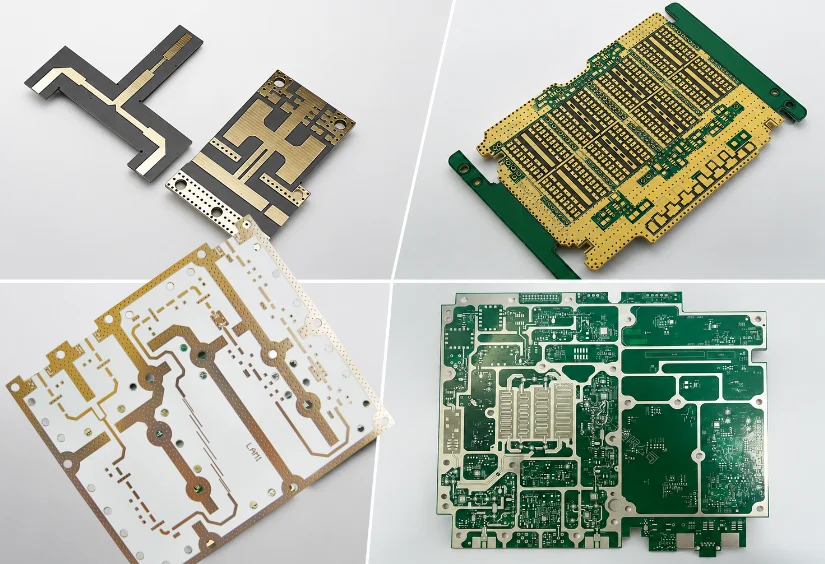
Figure 2. Rogers PCB Prototypes
Material scope: Highleap Electronics manufactures and assembles the finished PCB. The Rogers grade named on this page identifies the specified laminate; Highleap does not manufacture or sell Rogers laminates.
4. How to Speed Up Your Rogers PCB Prototype Order
Step 1: Confirm the exact material construction before finalizing the prototype schedule. Ask the manufacturer to confirm the grade [material], thickness [thickness], copper construction and current sourcing status.
Step 2: Freeze the electrical construction before tooling. Select the dielectric thickness and copper construction from the RF model, then let the manufacturer confirm whether that exact construction is available or requires procurement.
Step 3: Submit complete design files on the first attempt. Incomplete files cause engineering queries that pause production. Rogers boards need more fabrication notes than FR4 — see the next section for the full checklist.
Step 4: Minimize special processes for the first prototype. Blind/buried vias, sequential lamination, and controlled-depth milling each add time. For a first prototype validating RF performance, use through-hole vias and ENIG finish. Save complex processes for the production revision.
Step 5: Set the prototype quantity from the validation plan. Include enough boards for RF tuning, assembly trials or any destructive inspection that is part of qualification; the economical quantity depends on panel utilization and test scope.
5. What Files Does a Rogers PCB Manufacturer Need?
| File / Specification | Details Required |
|---|---|
| Gerber files (RS-274X or Gerber X2) | All copper layers, solder mask, silkscreen, board outline |
| Drill files (Excellon) | PTH and NPTH with tool table |
| Stackup specification | Exact Rogers grade (e.g., “RO4350B”), core thickness, copper weight per side, prepreg/bondply type, target total board thickness |
| Impedance requirements | Target impedance, tolerance (±5 % or ±3 %), controlled layers/nets, reference ground plane, differential pair targets |
| Surface finish | ENIG (most common for Rogers RF), immersion silver, or OSP. Bare copper for mmWave > 40 GHz |
| Fabrication notes | Solder mask openings over antennas, copper pour requirements, VLP/rolled copper if needed, IPC class |
Submitting everything above in the first email eliminates back-and-forth. Missing stackup details or impedance specs are the most common quoting delays on Rogers boards.
6. Moving from Rogers Prototype to Volume Production
Material supply chain. Prototype builds can use available sheet or panel material, while production may require planned purchasing for the same grade and thickness. For recurring programs, a material forecast and approved alternate strategy can reduce procurement risk without assuming permanent stock. The validated construction and test results should carry into Rogers board production after prototype approval with controlled revisions and material identification.
Impedance process capability. A prototype confirms the released stackup against the agreed test method. For production, define the required capability, sampling and acceptance criteria in the quality plan and keep the qualified stackup stable across lots.
Panel utilization. At prototype stage, panel utilization can be secondary to engineering timing; at volume it becomes a unit-cost driver. Review panel format, board outline, coupon placement and breakaway method with the fabricator before production release. See the Rogers PCB cost guide for additional cost-control factors.
Test plan. Prototype testing should answer the specific engineering question. The production plan can then formalize electrical test, impedance verification, visual acceptance, microsection or RF measurement as required by the released drawing and quality agreement.
7. Rogers PCB prototype Prototyping at Highleap
Highleap Electronics provides prototype Rogers PCB prototyping with engineering review and material availability confirmed during quotation.
Material planning: Common constructions may be available for faster scheduling, while non-standard grades or thicknesses may require procurement. Exact availability is confirmed against the RFQ.
Schedule: Confirmed after DFM review, material availability, layer count, tooling, inspection and any RF test requirements are reviewed. Rush fabrication cannot remove a material-procurement dependency.
Prototype quantity: Quote the required quantity and acceptance testing. Engineering setup, impedance coupon design and RF verification scope are confirmed in the quotation.
Prototype-to-production continuity. Your prototype is built on the same equipment, by the same team that handles production. No re-qualification needed. Stackup, impedance data, and process parameters are archived as the production baseline. Highleap treats the first build as a production-learning step. The prototype can be used to validate stackup assumptions, drilling, finish, impedance coupons and assembly interfaces before the design is frozen for repeat orders. Exact material property values should be checked against the current supplier documentation for the specified grade and construction.
Request a prototype quote — include Rogers material, layer count, board dimensions, impedance targets, quantity, and delivery date. For a prototype prototype quote, send the released fabrication package, quantity, target date and the specific validation items that matter. This keeps the prototype focused and makes the transition to production much cleaner.

Recommended Posts
TMM4 Filter PCB Manufacturing
TMM4 filter PCB manufacturing is controlled by the...
TMM3 PCB Manufacturing for RF Modules
TMM3 PCB manufacturing is most useful where the RF module...
TMM6 PCB Fabrication
TMM6 fabrication is the process-control page for a mid-Dk...
TMM10 PCB Manufacturing for Compact RF Designs
Table of contentsHow TMM10 Shrinks RF StructuresTMM10 vs...
How to get a quote for PCBs
Let’s run DFM/DFA analysis for you and get back to you with a report. You can upload your files securely through our website. We require the following information in order to give you a quote:
-
- Gerber, ODB++, or .pcb, spec.
- BOM list if you require assembly
- Quantity
- Turn time
For PCBA services, please provide your BOM (Bill of Materials) and any specific assembly instructions. We also offer DFM/DFA analysis to optimize your designs for manufacturability and assembly, ensuring a smooth production process.