
Back to blog
Understanding Aluminum Substrate PCB: Types and Advantages

Aluminum Substrate PCB
PCBs, or printed circuit boards, are essential components in almost all electronic devices. To enhance your understanding of PCBs, this guide will introduce the types of PCB aluminum substrates and common obstacles in PCB copying. If you’re interested in PCBs or the content of this article, feel free to continue reading.
What Makes Aluminum Substrate PCBs Stand Out?
Earlier, we discussed the pros and cons of ceramic PCBs, noting that one drawback is their high cost and fragility. Standard fiberglass PCBs lack good heat dissipation, while ceramic PCBs are stable and resistant to deformation in high-temperature and high-humidity environments, but they are expensive and mainly used in high-end products. If your product isn’t high-end, such as large-area, high-power LED light boards that require good heat dissipation but are cost-effective, is there a material that fits the bill?
The answer is yes, and that’s where aluminum substrate PCBs come in. Aluminum, being a metal with conductivity, might seem an odd choice for PCB material, but aluminum substrate PCBs consist of three layers: copper foil, an insulation layer, and a metal aluminum layer. Since there is an insulation layer, can other materials besides aluminum be used for the metal layer? Materials like copper, stainless steel, iron, silicon steel, etc.? When selecting the metal substrate, factors such as thermal expansion coefficient, thermal conductivity, strength, hardness, weight, surface condition, and cost need to be considered.
In general, considering cost and technical performance, aluminum is an ideal choice. Common choices for aluminum boards include 6061, 5052, 1060, etc. If there are higher requirements for thermal conductivity, mechanical performance, electrical performance, and other special properties, copper, stainless steel, iron, and silicon steel can also be used.
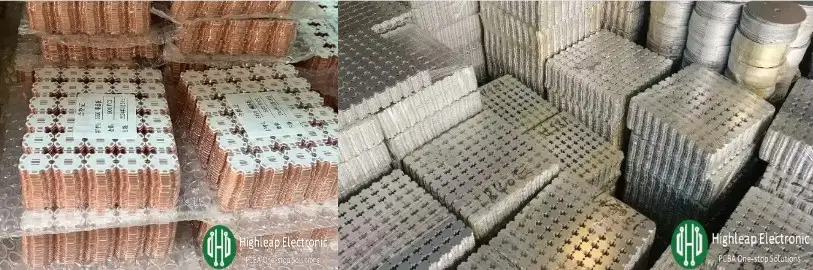
Common in LED lighting products, aluminum substrate PCBs have two sides: one white side for soldering LED pins, and the other side is natural aluminum color, typically coated with thermal paste to contact the heat-conducting part. They are mainly used in LED luminaires, audio equipment, power equipment, etc., with the main advantage being fast heat conduction and excellent heat dissipation performance.
Compared to traditional FR-4, aluminum substrate PCBs can minimize thermal resistance, providing excellent heat conduction; compared to ceramic substrates, they have excellent mechanical properties.
Types of PCB Aluminum Substrates
1.Flexible Aluminum Substrates: One of the latest developments in IMS materials is flexible dielectrics. These materials offer excellent electrical insulation, flexibility, and thermal conductivity. When applied to materials like 5754 or similar flexible aluminum, they can be shaped to achieve various shapes and angles, eliminating the need for expensive fixtures, cables, and connectors. Although these materials are flexible, they are designed to bend into place and remain in position.
2.Hybrid Aluminum Substrates: In a “hybrid” IMS structure, non-thermal substances are independently processed and then bonded to the aluminum substrate with a thermal material. The most common structure consists of 2 or 4 layers of subcomponents made from traditional FR-4, which are then bonded to the aluminum base with a thermally conductive dielectric. This can help with heat dissipation, improve rigidity, and act as shielding. Other benefits include:
-
- Lower cost than constructing all thermal materials.
- Better thermal performance than standard FR-4 products.
- Elimination of expensive heat sinks and related assembly steps.
- Suitable for RF applications requiring PTFE surface layers for RF loss characteristics.
- Use of component windows in aluminum to accommodate through-hole components, allowing connectors and cables to pass through the board while soldering round corners to create a seal, without the need for special washers or other expensive adapters.
3.Multi-layer Aluminum Substrates: In the high-performance power supply market, multi-layer IMS PCBs are made from multiple layers of thermal dielectric. These structures have one or more layers of circuits embedded in the dielectric, with blind vias used as thermal vias or signal paths. While single-layer designs are more expensive and less efficient at transferring heat, they provide a simple and effective heat dissipation solution for more complex designs.
4.Through-hole Aluminum Substrates: In the most complex structures, a layer of aluminum can form the “core” of multi-layer thermal structures. Before lamination, the aluminum is pre-plated and filled with dielectric. Thermal materials or subcomponents can be laminated to both sides of the aluminum using a thermal adhesive layer. Once laminated, the completed component is similar to a traditional multi-layer aluminum substrate drilled through the aluminum. Plated through-holes pass through the gaps in the aluminum to maintain electrical insulation. Alternatively, copper cores can allow for direct electrical connections as well as insulated through-holes.
Advantages of PCB Aluminum Substrates
In addition to its excellent heat dissipation performance, aluminum substrate PCB has the following advantages:
- Compliance with RoHS environmental requirements.
- More suitable for SMT process.
- Higher current-carrying capacity.
- Effective handling of heat diffusion in circuit design, reducing module operating temperature, extending service life, increasing power density, and improving reliability.
- Reduction in the assembly of heat sinks and other hardware (including thermal interface materials), shrinking product size, reducing hardware and assembly costs, and optimizing the combination of power circuits and control circuits.
- Replacement of fragile ceramic substrates for better mechanical durability.
Compared with ordinary FR-4 boards, aluminum substrate PCB has a major advantage in that it can carry higher current. Like FR-4, the circuit layers use copper foil as conductors for connection. Compared with traditional FR-4, with the same thickness and line width, aluminum substrate PCB can carry higher current.
The core technology of aluminum substrate PCB lies in the intermediate insulation layer material, which mainly serves the functions of bonding, insulation, and thermal conduction. The insulation layer of aluminum substrate PCB is the largest thermal barrier in the structure of power modules. The better the thermal conductivity of the insulation layer, the more conducive it is to the diffusion of heat generated during device operation, which in turn is conducive to reducing the operating temperature of the device, achieving higher power load of the module, reducing size, extending life, and increasing power output. While meeting the requirement of good thermal conductivity, it should also have high voltage insulation capability.
Differences between Aluminum Base and FR-4 Board
Heat Dissipation
The biggest difference between aluminum-based copper-clad laminate (CCL) and conventional FR-4 CCL lies in their heat dissipation properties. For example, compared to a 1.5mm-thick FR-4 CCL, the thermal resistance of an aluminum-based CCL is 20-22 ℃ for the former and 1.0-2.0℃ for the latter, which is significantly lower.
Coefficient of Thermal Expansion
Typically, FR-4 boards suffer from thermal expansion issues, where high temperatures can cause changes in thickness and flatness, especially in the thickness direction, affecting the quality of metal-plated holes and circuits. This is mainly due to the differing coefficients of thermal expansion in the material thickness direction: copper has a coefficient of 17×10^-6 cm/cm℃, while FR-4 board base material is 110×10^-6 cm/cm℃, which can easily lead to thermal expansion effects. The coefficient of thermal expansion of aluminum-based boards is 50×10^-6 cm/cm℃, smaller than that of general FR-4 boards, and closer to that of copper foil. This helps ensure the quality and reliability of printed circuit boards.
Main Applications
FR-4 boards are suitable for general circuit design and ordinary electronic products. Aluminum-based boards are suitable for circuits with special requirements, such as thick film hybrid integrated circuits, heat dissipation for power circuits, cooling of components in circuits, large-scale substrates that ceramic substrates cannot handle, and circuits where ordinary heat sinks cannot solve reliability issues.
Machinability
Aluminum-based boards have high mechanical strength and toughness, which is superior to FR-4 boards. Therefore, large-area printed boards can be manufactured on aluminum-based boards, and heavy components can be installed on such substrates.
Electrical Performance
Compared with FR-4 boards, aluminum-based boards have higher thermal conductivity, leading to a significant increase in the current-carrying capacity of conductors. This indicates the high thermal conductivity of aluminum-based boards. The heat dissipation of aluminum-based boards is related to the thickness of their insulation layer and thermal conductivity. Thinner insulation layers result in higher thermal conductivity of aluminum-based boards (but lower withstand voltage performance). In order to ensure the performance of electronic circuits, some components in electronic products need to prevent electromagnetic radiation and interference. Aluminum-based boards can act as shielding plates to shield electromagnetic waves.
Insulation Performance
Under general conditions, the breakdown voltage of aluminum-based boards is determined by the thickness of the insulation layer, with a breakdown voltage generally around 500V. If you need to test the breakdown voltage of an LED fluorescent lamp aluminum-based board, you just need to perform a high-voltage test on the input port housing. The UL and CE certification values should be 2500V, and the 3C certification should be around 3750V.
PCB & PCBA Quick Quote
Related Articles
Rogers PCB Manufacturing Challenges
A practical guide to top pain points in rogers pcb manufacturing, covering material control, RF stackup decisions, fabrication checks, inspection evidence, an
Rogers PCB Prototype Manufacturing
Review rogers pcb prototyping – fast turn, small batch with material properties, application limits, design considerations, and PCB manufacturing guidance for
Rogers LoPro PCB Fabrication and Assembly
A practical guide to rogers lopro pcb fabrication and assembly services, covering material control, RF stackup decisions, fabrication checks, inspection evide