
KB-6165 PCB Laminate: Specs, Applications & Design Guide

1. Introduction to KB-6165 Laminate
KB-6165 laminate is a high-Tg FR-4 material engineered for high-density, multilayer PCB applications requiring lead-free assembly compatibility. This guide examines the critical electrical, thermal, and mechanical parameters that determine whether KB-6165 fits your design requirements.
We cover dielectric properties, thermal reliability thresholds, manufacturing considerations, and practical verification checkpoints to help engineers, designers, and procurement teams make informed material decisions.
2. KB-6165 Key Parameters at a Glance
The following table summarizes the essential specifications from the KB-6165 datasheet. Use this for rapid assessment before diving into detailed analysis.
| Parameter | Unit | Specification | Typical Value |
| Dielectric Constant (Dk) @ 1MHz | — | ≤5.4 | 4.5 |
| Loss Tangent (Df) @ 1MHz | — | ≤0.035 | 0.018 |
| Glass Transition (Tg) | °C | ≥150 | 153 |
| Decomposition Temp (Td) | °C | ≥325 | 335 |
| T-260 (Time to Delamination) | min | ≥30 | 50 |
| T-288 (Time to Delamination) | min | ≥5 | 23 |
| Z-axis CTE (below Tg) | ppm/°C | ≤60 | 55 |
| Z-axis Expansion | % | ≤3.5% | 3.1% |
| Moisture Absorption | % | ≤0.80 | 0.30 |
| CAF Resistance | hrs | ≥1000 | 1000 |
| Flammability | Rating | UL94 V-0 | V-0 |
| Peel Strength (1 oz @ 125°C) | N/mm | ≥0.70 | 1.35 |
| Flexural Strength (Warp) | N/mm² | ≥415 | 560 |
| Dielectric Breakdown | kV | ≥40 | 48 |
2.1 Recommended Applications
Multilayer boards (4–16 layers), telecom equipment, industrial controllers, consumer electronics requiring lead-free assembly, and designs operating below 3 GHz where standard FR-4 dielectric performance is acceptable.
2.2 Use with Caution or Avoid
Millimeter-wave RF front-ends (>10 GHz), applications requiring ultra-low loss (Df <0.005), extreme thermal cycling beyond 260°C sustained exposure, or designs where signal integrity demands controlled Dk tolerance at high frequencies.
3. Why These KB-6165 Parameters Matter
Understanding what each specification means for your PCB design helps bridge the gap between datasheet values and real-world performance decisions.
3.1 Electrical Performance: Dk and Df
The dielectric constant (Dk = 4.5 typical @ 1 MHz) directly affects impedance calculations and trace geometry. For controlled-impedance designs, use the manufacturer’s specified Dk value rather than generic FR-4 assumptions (often 4.2–4.8). The loss tangent (Df = 0.018 typical) influences signal attenuation—acceptable for sub-GHz digital and moderate-speed interfaces, but engineers working on multi-gigabit SerDes links should verify performance at their operating frequency, as Df tends to increase with frequency.
3.2 Thermal Reliability: Tg, Td, and Reflow Compatibility
KB-6165’s Tg of 153°C ensures dimensional stability through standard lead-free reflow profiles (peak ~245–260°C). The Td of 335°C provides margin before material decomposition begins. T-260 (50 min typical) and T-288 (23 min typical) indicate how long the laminate withstands elevated temperatures without delamination—critical metrics for multiple reflow cycles, rework scenarios, and wave soldering. Designs requiring repeated thermal excursions or extended high-temperature operation benefit from these generous thresholds.
3.3 Mechanical Properties and Z-axis CTE
Z-axis CTE (55 ppm/°C typical below Tg, 3.1% total expansion) affects via reliability in multilayer stackups. Lower Z-axis expansion reduces stress on plated through-holes during thermal cycling, minimizing barrel cracking and pad lifting risks. The flexural strength values (560 N/mm² warp, 430 N/mm² fill) indicate good rigidity for handling and assembly. For high-aspect-ratio vias (depth-to-diameter >8:1), the controlled CTE behavior of KB-6165 becomes particularly relevant.
3.4 Surface Finish Compatibility
KB-6165 is compatible with standard surface finishes including ENIG, OSP, immersion tin, and HASL. ENIG provides excellent planarity for fine-pitch BGA and consistent solderability over extended storage. OSP offers cost efficiency for designs with shorter shelf-life requirements. The 1.35 N/mm peel strength (1 oz copper @ 125°C) indicates reliable copper adhesion across these finish processes.
3.5 Environmental Resilience and Certifications
With UL94 V-0 flammability rating and RoHS compliance, KB-6165 meets baseline regulatory requirements for most commercial and industrial applications. The low moisture absorption (0.30% typical) and 1000-hour CAF resistance make it suitable for humid environments. Automotive or medical applications may require additional qualification testing beyond standard IPC-4101E/21 compliance.

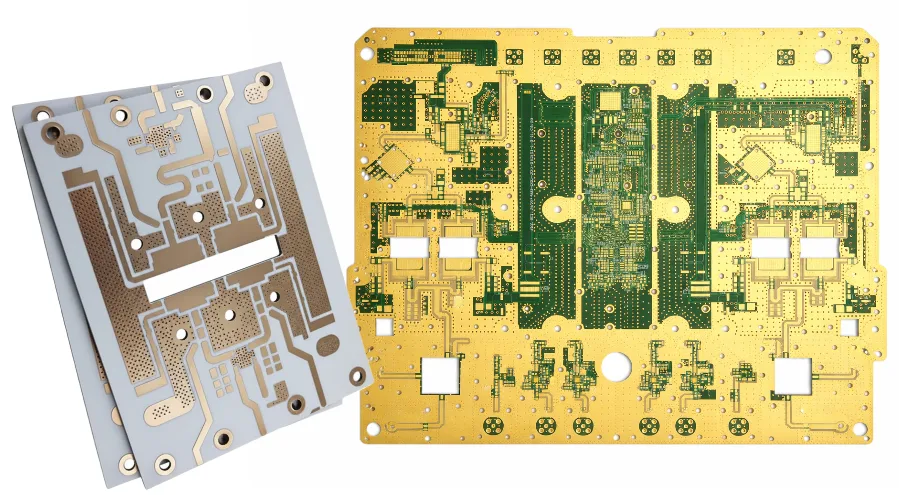
Figure 1. KB-6165 PCB
4. KB-6165 Application Scenarios
4.1 Ideal Use Cases for KB-6165
- Telecom Infrastructure: Base station controllers, network switches, and routing equipment operating at frequencies where Dk=4.5 and Df=0.018 provide acceptable signal integrity margins.
- Industrial Control Systems: PLCs, motor drives, and automation boards benefit from the thermal reliability (Tg 153°C) and mechanical robustness in factory environments with temperature fluctuations.
- Consumer Electronics: High-density multilayer boards for computing, audio equipment, and IoT devices where cost-performance balance matters more than ultra-low-loss RF performance.
- LED Lighting & Power Electronics: Applications requiring moderate thermal dissipation and reliable lead-free assembly processes.
4.2 When to Consider Alternatives
For 10+ GHz RF designs, 56 Gbps+ high-speed channels, or applications requiring Df <0.010, evaluate low-loss or very-low-loss laminates. Extreme thermal environments (sustained operation above 200°C) or automotive AEC-Q100-qualified designs may require specialized high-Tg materials with additional certifications.
4.3 Practical Example: 8-Layer Control Board
Consider an 8-layer industrial controller with 4-mil trace/space, 100Ω differential impedance requirements, and mixed analog/digital sections operating up to 1 GHz. KB-6165’s Dk=4.5 allows predictable impedance matching with standard stackup calculators. The Z-axis CTE (55 ppm/°C) supports reliable 0.3mm via structures, while Tg 153°C handles lead-free assembly without special process adjustments.
6. KB-6165 vs. Alternative Laminates
Selecting a laminate involves balancing electrical performance, thermal capability, manufacturability, and cost. The following comparison positions KB-6165 relative to common alternatives.
| Property | KB-6165 | Standard FR-4 | Low-Loss FR-4 | High-Tg/High-Perf |
| Dk @ 1MHz | 4.5 | 4.2–4.8 | 3.8–4.2 | 4.0–4.5 |
| Df @ 1MHz | 0.018 | 0.020–0.025 | 0.008–0.012 | 0.010–0.020 |
| Tg (°C) | 153 | 130–140 | 150–180 | 170–210 |
| Td (°C) | 335 | 300–320 | 340–360 | 350–400 |
| Z-CTE (ppm/°C) | 55 | 60–70 | 45–55 | 40–55 |
| Relative Cost | Medium | Low | Medium-High | High |
| Processability | Excellent | Excellent | Good | Moderate |
Selection Matrix
- Cost-sensitive, ≤2 GHz: Standard FR-4 may suffice.
- Balanced performance, lead-free assembly: KB-6165 offers the optimal trade-off.
- High-speed digital (5+ Gbps): Consider low-loss alternatives.
- Extreme thermal or automotive: Evaluate high-Tg specialty materials.
7. Procurement and Sample Ordering
7.1 Specification Checklist for Orders
When ordering KB-6165-based PCBs, specify: laminate thickness and tolerance, copper weight (typically 0.5–2 oz), surface finish (ENIG, OSP, etc.), solder mask color, impedance requirements with target values, IPC class (Class 2 or 3), and any special testing requirements (AOI, X-ray, flying probe). Request UL certification documentation if required for your end application.
7.2 Prototype-to-Production Workflow
For new designs, we recommend a phased approach: order 5–10 prototype panels for design validation, conduct first-article inspection and functional testing, address any DFM issues identified, then proceed to pilot production (50–100 units) before full-scale manufacturing. This reduces risk and allows process optimization at each stage.
7.3 Documentation to Request
With sample or production orders, request: material certificate of conformance (CoC), impedance test report (for controlled-impedance designs), cross-section microsection report (for critical reliability applications), and IPC-A-600 compliance documentation. These records support quality assurance and provide traceability for regulatory requirements.
8. Conclusion
KB-6165 delivers a practical combination of thermal reliability, manufacturing consistency, and cost-effectiveness for multilayer PCB designs. If your application operates below 3 GHz, requires lead-free assembly compatibility, and demands proven process stability, this laminate merits serious consideration.
For designs pushing higher frequencies or thermal extremes, evaluate the alternatives outlined above. I recommend requesting material samples and conducting validation testing aligned with your specific performance requirements before committing to production volumes.
9. Frequently Asked Questions
Q1: What is the typical Dk value for KB-6165 at different frequencies?
The datasheet specifies Dk=4.5 typical at 1 MHz. For higher frequencies, contact the manufacturer or your fabricator for characterized data, as Dk may vary slightly with frequency.
Q2: Does KB-6165 support ENIG surface finish?
Yes. KB-6165 is compatible with ENIG, OSP, immersion tin, HASL, and other standard finishes.
Q3: Is KB-6165 suitable for automotive electronics?
KB-6165 provides a baseline for automotive applications, but AEC-Q100/200 qualification or IATF 16949 compliance may require additional testing and documentation beyond standard IPC specifications.
Q4: What is the maximum operating temperature for KB-6165?
Continuous operating temperature should remain below Tg (153°C) for optimal dimensional stability. Short-term excursions during reflow (up to 260°C) are acceptable within T-260 limits.
Q5: How does moisture absorption affect impedance?
KB-6165’s low moisture absorption (0.30% typical) minimizes Dk drift. For humidity-sensitive applications, pre-baking before assembly and conformal coating can further stabilize performance.
Q6: Can KB-6165 be used for HDI designs with microvias?
Yes. The material supports laser drilling for microvias. Consult your fabricator regarding specific via fill requirements and sequential lamination processes.
Q7: What layer counts are practical with KB-6165?
KB-6165 is commonly used for 4–16 layer boards. Higher layer counts (20+) are achievable but require careful stackup planning and fabricator capability verification.
Q8: Is KB-6165 halogen-free?
Standard KB-6165 is not halogen-free. If halogen-free compliance is required, specify this requirement and request alternative material options from your supplier.
Q9: What CAF resistance does KB-6165 provide?
KB-6165 is tested to 1000 hours CAF resistance under 85°C/85% RH at 50V DC, making it suitable for applications with fine-pitch spacing in humid environments.
Q10: How do I verify the material used in my boards?
Request a material certificate of conformance (CoC) with your order. For critical applications, cross-section analysis and Tg verification testing can confirm material identity.

Recommended Posts
PCB Materials Database: Laminate Grades & Properties
How to get a quote for PCBs Let‘s run DFM/DFA analysis for...
Optical Transceiver PCB Manufacturer for Custom Pluggable Modules
Highleap Electronics manufactures and assembles custom...
Optical Module PCB Manufacturer for 400G, 800G and 1.6T Programs
Highleap Electronics provides optical module PCB...
Optical Communication PCB Manufacturer for Fiber Network Equipment
Highleap Electronics manufactures and assembles optical...
How to get a quote for PCBs
Let‘s run DFM/DFA analysis for you and get back to you with a report. You can upload your files securely through our website. We require the following information in order to give you a quote:
-
- Gerber, ODB++, or .pcb, spec.
- BOM list if you require assembly
- Quantity
- Turn time
In addition to PCB manufacturing, we offer a comprehensive range of electronic services, including PCB design, PCBA, and turnkey solutions. Whether you need help with prototyping, design verification, component sourcing, or mass production, we provide end-to-end support to ensure your project’s success.
For PCBA services, please provide your BOM (Bill of Materials) and any specific assembly instructions. We also offer DFM/DFA analysis to optimize your designs for manufacturability and assembly, ensuring a smooth production process.