
Common DFM Issues in PCB Design and Manufacturing

Introduction to DFM Issues
Design for Manufacturability (DFM) refers to the practice of identifying and resolving potential manufacturing problems during the PCB design phase. By addressing DFM issues early, engineers can improve yield rates, reduce production costs, and enhance product reliability. Neglecting DFM often results in costly redesigns, delayed time-to-market, and increased scrap rates.
Why DFM Matters in PCB Production
DFM serves as a critical bridge between design intent and manufacturing reality. When designers overlook manufacturability constraints, fabricators must either reject the design or attempt production with elevated risk. This disconnect leads to iterative feedback loops that consume time and resources. Effective DFM analysis prevents these inefficiencies by validating designs against real-world process capabilities before production begins.
The Cost of Ignoring DFM Issues
Undetected DFM issues propagate through the entire production chain, multiplying costs at each stage. A trace width violation caught during fabrication requires design revision, new file generation, and production restart. If the same issue reaches assembly or field deployment, the financial impact increases exponentially. Proactive DFM checking eliminates these risks at the source.
Classification of DFM Issues
DFM issues can be systematically categorized based on the manufacturing stage they affect. This classification framework helps engineers prioritize their design reviews and allocate attention to the most critical areas. The four primary categories are fabrication, assembly, testing, and documentation.
Fabrication vs. Assembly DFM Issues
Fabrication-level DFM issues concern the physical creation of the bare board, including copper patterning, drilling, and layer lamination. Assembly-level DFM issues relate to component placement, soldering processes, and mechanical fit. Understanding this distinction enables targeted review strategies that address stage-specific manufacturing constraints.
Testing and Documentation Concerns
Beyond fabrication and assembly, DFM analysis must also consider testability and documentation clarity. Inadequate test point access or unclear reference designators create downstream quality control problems. A comprehensive DFM review addresses all four categories to ensure smooth production flow from raw materials to final inspection.
Fabrication-Level DFM Issues
The fabrication phase presents numerous opportunities for DFM issues to emerge. These problems typically stem from design parameters that exceed or approach the limits of manufacturing equipment capabilities. Understanding common fabrication DFM issues enables designers to create more robust and producible layouts.
Dimensional and Spacing Specification Violations
Trace width, trace spacing, and drill-to-copper clearances must align with fabricator capabilities. When minimum feature sizes fall below process limits, etching inconsistencies and registration errors become likely. Designers should obtain and adhere to manufacturer-specific design rules to prevent these fundamental DFM issues from occurring.
Acid Traps in Copper Routing
Acid traps form when trace routing creates acute angles below 90 degrees. During etching, chemical solutions become trapped in these sharp corners, causing localized over-etching and potential open circuits. Routing traces at 45-degree angles or using curved transitions eliminates acid trap formation and ensures consistent copper definition.
Copper Slivers and Islands
Slivers are narrow copper fragments that result from inadequate clearance definitions or polygon pour artifacts. Islands are isolated copper features disconnected from any net. Both create reliability risks, as loose copper debris can cause shorts during assembly or field operation. DFM checks should flag features below minimum width thresholds.
Insufficient Copper-to-Edge Clearance
Copper features positioned too close to board edges risk damage during depanelization. Routing, scoring, and breaking operations require clearance margins to prevent copper delamination or trace fracture. Most fabricators require minimum 0.25mm to 0.5mm clearance from board edges for outer layer copper.
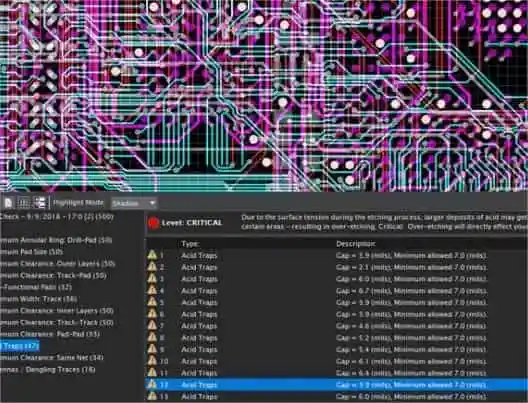
PCB DFM Check
Assembly-Level DFM Issues
Assembly processes introduce a distinct set of DFM issues related to component mounting, soldering, and mechanical integration. These issues directly impact solder joint quality, placement accuracy, and long-term reliability. Careful attention to assembly DFM prevents defects that are costly to rework after components are attached.
Pad and Hole Size Mismatch
When pad dimensions do not properly correspond to component lead sizes or drill holes, solder joint integrity suffers. Undersized pads provide insufficient solder fillet area, while oversized pads can cause tombstoning in small passive components. IPC standards provide guidelines for optimal pad-to-hole ratios across component types.
Solder Paste Stencil Aperture Errors
Stencil aperture design directly controls solder paste volume deposited on each pad. Oversized apertures cause bridging and solder balls, while undersized openings result in insufficient solder and weak joints. Aperture reduction ratios and aspect ratios must be calculated based on pad geometry and component requirements.
Via-in-Pad Design Problems
Vias placed within component pads create pathways for solder to wick away during reflow. Without proper filling and capping, via-in-pad configurations cause insufficient solder volume on the pad surface and potential voiding beneath components. Filled and plated-over vias are mandatory for reliable via-in-pad implementations.
Solder Mask Design Issues
Solder mask openings that are too large expose copper that should remain covered, increasing the risk of solder bridging between adjacent features. Conversely, mask that encroaches onto pads reduces solderable area and can cause wetting problems. Proper solder mask expansion values prevent both failure modes.
Silkscreen Placement Errors
Silkscreen legends that overlap pads, vias, or exposed copper interfere with soldering and inspection processes. Obscured reference designators complicate assembly verification and rework operations. DFM rules should enforce minimum clearances between silkscreen and all solderable features.
Testing-Related DFM Issues
Testability considerations are frequently overlooked during initial design but significantly impact production efficiency. Insufficient test access forces manufacturers to rely on visual inspection alone or develop costly custom test fixtures. Integrating test requirements into the design phase prevents these complications.
Test Point Insufficiency and Layout Problems
Functional test and in-circuit test strategies require accessible test points on critical nets. Points must be adequately sized for probe contact and positioned with sufficient spacing to avoid probe interference. Grid-aligned test point placement simplifies fixture design and improves test coverage.
DFM Check Process and Best Practices
Systematic DFM verification requires defined checkpoints throughout the design cycle. Rather than treating DFM as a final gate before release, progressive checking catches issues when they are easiest to resolve. Establishing clear procedures ensures consistent and thorough design validation.
When to Perform DFM Checks
Initial DFM review should occur after preliminary placement and routing to identify fundamental violations early. A second review follows layout completion to catch issues introduced during optimization. Final DFM verification precedes file release and confirms compliance with all manufacturing requirements.
DRC vs. DFM Analysis
Design Rule Checking (DRC) verifies internal design consistency against user-defined rules. DFM analysis extends beyond DRC by evaluating designs against actual manufacturing process capabilities. Both checks are necessary, as DRC ensures design intent while DFM ensures producibility.
Establishing Manufacturing Communication
Direct communication with fabrication and assembly partners yields specific capability data that generic design rules cannot provide. Process limits vary between manufacturers and evolve with equipment upgrades. Maintaining current capability documentation prevents DFM issues that arise from outdated assumptions.
Conclusion
Comprehensive DFM analysis spans every aspect of PCB design, from trace geometry and via structures to solder mask definitions and test point placement. Each layer and feature type presents potential DFM issues that, if unaddressed, will surface as production problems. Early and iterative DFM checking minimizes costly design revisions and manufacturing delays.
The relationship between design and manufacturability is inherently collaborative. Designers who understand fabrication and assembly constraints create more producible layouts. Manufacturers who communicate their capabilities clearly enable optimized designs. This partnership, facilitated by thorough DFM processes, delivers higher quality products with improved efficiency.

Recommended Posts

Electronic Compass PCB Manufacturing & PCBA for Digital Heading Products
An Electronic Compass PCB converts magnetometer data—and...
Smart Bracelet PCB Manufacturing and Assembly
A smart bracelet PCB can support very different products:...

Server Motherboard PCB Manufacturing and Assembly
Server motherboard PCB manufacturing is becoming more...
TMM PCB Fabrication
Table of Contents TMM PCB Fabrication Scope for RF and...
How to get a quote for PCBs
Let‘s run DFM/DFA analysis for you and get back to you with a report. You can upload your files securely through our website. We require the following information in order to give you a quote:
-
- Gerber, ODB++, or .pcb, spec.
- BOM list if you require assembly
- Quantity
- Turn time
In addition to PCB manufacturing, we offer a comprehensive range of electronic services, including PCB design, PCBA, and turnkey solutions. Whether you need help with prototyping, design verification, component sourcing, or mass production, we provide end-to-end support to ensure your project’s success.
For PCBA services, please provide your BOM (Bill of Materials) and any specific assembly instructions. We also offer DFM/DFA analysis to optimize your designs for manufacturability and assembly, ensuring a smooth production process.