
Flexible PCB for Foldable Phones | Engineering the Future of Mobile Technology

The emergence of foldable phones represents one of the most significant innovations in mobile technology since the smartphone revolution. At the core of these devices lies flexible PCB technology, enabling seamless folding mechanisms that transform how we interact with our devices. These specialized circuit boards must endure 200,000+ fold cycles while maintaining electrical integrity and performance standards exceeding traditional rigid PCBs.
Understanding Flexible PCB Architecture in Foldable Phones
Flexible PCBs serve as the critical interconnect system in foldable phones, bridging the device’s two halves through the hinge mechanism. Unlike conventional rigid boards, these flexible PCB solutions accommodate dynamic bending with radii as tight as 1.5mm while supporting high-speed data transmission at 50-ohm impedance. The architecture typically employs multilayer flex designs optimized for foldable phone applications.
The placement of flexible PCBs within foldable phones requires precise engineering to manage stress distribution. Engineers position these circuits along the neutral axis to minimize tensile and compressive forces during folding operations. This strategic placement extends operational lifespan significantly, enabling devices to achieve industry-standard requirements.
Modern foldable phones PCB designs incorporate specialized routing through hinge areas where mechanical stress concentrates. The flexible PCB must maintain signal integrity while bending thousands of times daily. Advanced simulation tools help engineers predict stress points and optimize trace layouts before prototype production.
Material Selection for Flexible PCB in Foldable Phones
Substrate Materials and Properties
Reliable flexible PCBs in foldable phones rely on high-performance polyimide substrates known for their strength, heat resistance, and flexibility. Key considerations include:
- Material type – Polyimide (PI) films, typically 12.5–25 μm thick, provide an excellent balance of flexibility and dimensional stability for precise circuit registration.
- Thermal performance – Withstands temperatures up to 400°C, ensuring stability during soldering and device operation.
- Adhesiveless variants – Advanced polyimide grades eliminate adhesive layers, reducing total thickness by about 25% and improving bending reliability.
- Environmental durability – Qualified through 1,000+ thermal cycles from -40°C to +125°C, maintaining consistent mechanical and electrical properties.
- CTE compatibility – A coefficient of thermal expansion (CTE) closely matched to copper minimizes stress during temperature fluctuations.
Conductor Selection and Optimization
Copper conductors play a decisive role in the mechanical endurance and signal reliability of foldable phone PCBs. Engineering considerations include:
- Copper type
- Rolled Annealed (RA) Copper – Preferred for its elongated grain structure, offering ~40% higher fatigue resistance than electrodeposited (ED) copper.
- Electrodeposited (ED) Copper – More economical but less suited for high-flex regions.
- Copper thickness – Commonly 12–35 μm, with 18 μm as an ideal balance between flexibility and current-carrying capability.
- Surface finishes
- OSP (Organic Solderability Preservative) – Provides excellent flatness for fine-pitch assembly while maintaining high flexibility.
- ENEPIG (Electroless Nickel Electroless Palladium Immersion Gold) – Offers superior durability and corrosion resistance for high-reliability designs.
This structured material strategy ensures foldable phone PCBs achieve both mechanical flexibility and electrical stability over extensive folding cycles.
Advanced Manufacturing Process for Foldable Phones PCB
Manufacturing flexible PCBs for foldable phones demands exceptional precision at every stage. The process differs significantly from rigid PCB manufacturing due to unique material handling requirements and flexibility considerations. Here’s the detailed breakdown of critical manufacturing stages:
1. Material Preparation and Handling
The process begins with careful selection and preparation of polyimide films and copper foils for flexible PCB production. Materials are conditioned at 23°C and 50% relative humidity for 24 hours before processing. Specialized clean rooms with Class 10,000 standards prevent contamination that could cause defects in foldable phones PCB applications.
2. Circuit Formation Through Photolithography
Laser direct imaging systems create circuit patterns with 25-micrometer precision on flexible PCB substrates. The photoresist application requires specialized spray coating to ensure uniform thickness across flexible materials. Chemical etching parameters are optimized for rolled annealed copper, maintaining ±10% tolerance on critical dimensions.
3. Multilayer Lamination Process
Multiple layers of flexible PCB materials undergo precise lamination at 185°C and 250 PSI pressure. Specialized vacuum lamination prevents air entrapment between layers, ensuring void-free construction. Registration accuracy maintains ±25 micrometers between layers, critical for high-density foldable phones PCB designs.
4. Via Formation and Metallization
UV laser drilling creates microvias as small as 50 micrometers diameter in flexible PCB substrates. Electroless copper deposition followed by electrolytic plating builds via barrels to 20 micrometers thickness. The plating chemistry accommodates polyimide’s thermal expansion, preventing barrel cracks during thermal cycling.
5. Surface Finish Application
Protective coverlays shield flexible PCB circuits from environmental damage while maintaining bendability. Photo-imageable coverlays offer 10-micrometer registration accuracy compared to 75 micrometers for traditional film coverlays. The coverlay material matches the base substrate’s flexibility to prevent delamination during folding.
6. Quality Testing and Validation
Every flexible PCB for foldable phones undergoes comprehensive electrical and mechanical testing before shipment. Automated optical inspection identifies defects down to 25 micrometers, while flying probe testing verifies electrical continuity. Dynamic bend testing validates performance through 1000 initial cycles as production screening.
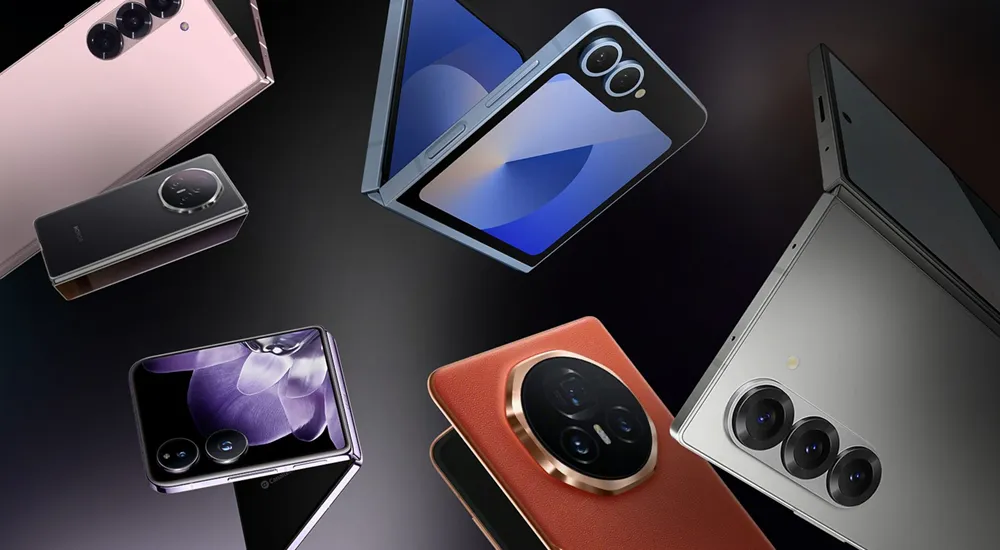
Foldeable Phones
Reliability Engineering for Flexible PCB in Foldable Phones
Dynamic Bending Test Protocols
Comprehensive testing validates flexible PCB durability under real-world foldable phone usage conditions. Testing equipment applies controlled bending at 60 cycles per minute, simulating years of use within days. Parameters include bend radius (1.5-5mm), bend angle (0-180 degrees), and cycle frequency calibrated to actual user patterns.
Electrical monitoring tracks resistance changes in critical circuits during bending, with acceptance criteria requiring less than 5% change after 200,000 cycles. Advanced protocols incorporate temperature cycling from -20°C to +60°C simultaneously with bending. These combined stress tests reveal failure modes invisible under single-stress conditions.
Environmental Stress Validation
Flexible PCBs for foldable phones undergo extensive environmental testing beyond mechanical validation. Temperature cycling spans -40°C to +85°C for 1000 cycles, confirming solder joint integrity and material stability. Humidity testing at 85°C/85% RH for 1000 hours simulates five years of typical use.
Salt spray exposure for 96 hours validates corrosion resistance of exposed conductors in foldable phones PCB assemblies. Thermal shock testing with rapid transitions between temperature extremes confirms resistance to delamination. These comprehensive tests ensure reliable operation across diverse global environments.
Design Optimization Strategies for Foldable Phones PCB
Stress Reduction Through Intelligent Routing
Optimizing trace routing through bend areas significantly impacts flexible PCB reliability in foldable phones. Traces crossing perpendicular to the fold axis distribute stress more evenly than parallel routing. Implementing gradual trace width transitions eliminates stress concentration points that initiate failures.
Serpentine trace patterns in high-stress zones extend operational life by 40% compared to straight routing. These features add minimal cost while providing substantial reliability improvements for foldable phones PCB designs. Strategic copper balancing on both sides of the flexible PCB prevents curl and reduces assembly challenges.
Impedance Control in Dynamic Applications
Maintaining signal integrity through flexing zones requires careful impedance modeling for flexible PCB designs. The dielectric environment changes as the PCB bends, potentially causing impedance variations exceeding 10%. Advanced simulation predicts these variations, enabling design adjustments before prototype production.
Differential pair routing with tight coupling minimizes impedance variation during bending in foldable phones PCB applications. Ground plane cutouts beneath bend zones reduce stiffness while maintaining adequate shielding. These techniques ensure high-speed signals maintain integrity through millions of fold cycles.
Future Innovations in Flexible PCB for Foldable Phones
Next-Generation Substrate Materials
Liquid crystal polymer (LCP) substrates are emerging as a key material for future foldable phones. They deliver superior high-frequency performance ideal for 5G and upcoming 6G technologies, featuring: – Dielectric constant: around 2.9 – Loss tangent: below 0.002 These properties enable efficient millimeter-wave transmission with minimal signal loss.
Stretchable and Printed Electronics
Next-stage flexible PCB research explores stretchable and printed electronic technologies: – Stretchable PCBs may allow multi-directional or complex folding patterns, supporting innovative device form factors. – Printed electronics using conductive inks can lower production costs while improving design flexibility. Together, these developments could push foldable phone lifespans beyond 500,000 fold cycles.
Integration and Advanced Packaging
Integrating flexible PCBs directly with flexible displays eliminates connectors, improving mechanical reliability and reducing overall device thickness. Additionally, direct chip attachment on flex substrates through advanced packaging technologies simplifies assembly and enhances electrical performance.
These innovations collectively pave the way for thinner, more reliable foldable phones with enhanced functionality and longer service life.
Conclusion
Flexible PCB technology is the foundation of modern foldable phone design, enabling compact form factors, high-speed data transmission, and long-term mechanical durability. Its development requires a multidisciplinary approach—integrating materials science, mechanical flexibility, and precision manufacturing. As foldable devices continue evolving toward thinner, lighter, and more powerful configurations, flexible PCB performance and reliability will remain key to innovation.
At Highleap Electronics, we deliver complete flexible PCB manufacturing solutions for next-generation foldable devices. Our capabilities include:
-
Polyimide and advanced substrate processing for ultra-thin, high-reliability flex circuits
-
Precision multilayer flex and rigid-flex PCB fabrication with tight impedance control
-
Laser drilling and fine-line etching for compact, high-density interconnect designs
-
Comprehensive reliability testing to ensure long cycle life under repeated folding
-
Engineering collaboration from DFM to mass production for optimized yield and performance

Recommended Posts
Hard Gold Finger PCB Manufacturing: Plating and Beveling
Hard gold finger PCB manufacturing is used when a circuit...
Small PCB Panelization: Array Design and Depaneling
Imagine a 26 × 18 mm circuit that must pass through...
PCB Panelization for Volume Production: Cost and Yield
A fabrication panel that holds more boards is not...
PCB SET Delivery and Panelization: Quantities and Acceptance
A purchase order for “500 SET” looks straightforward until...
How to get a quote for PCBs
Let‘s run DFM/DFA analysis for you and get back to you with a report. You can upload your files securely through our website. We require the following information in order to give you a quote:
-
- Gerber, ODB++, or .pcb, spec.
- BOM list if you require assembly
- Quantity
- Turn time
In addition to PCB manufacturing, we offer a comprehensive range of electronic services, including PCB design, PCBA, and turnkey solutions. Whether you need help with prototyping, design verification, component sourcing, or mass production, we provide end-to-end support to ensure your project’s success.
For PCBA services, please provide your BOM (Bill of Materials) and any specific assembly instructions. We also offer DFM/DFA analysis to optimize your designs for manufacturability and assembly, ensuring a smooth production process.