
Comprehensive Guide to Hybrid Lamination: Controlling Warpage in High-Frequency and FR-4 Materials

The hybrid lamination of high-frequency materials, such as CORE (e.g., a hydrocarbon-ceramic low-loss laminate, RF-35A), and conventional FR-4 materials has become an integral process in PCB (Printed Circuit Board) manufacturing. A hybrid PCB laminate combines the superior electrical properties of high-frequency laminates with the affordability and mechanical stability of FR-4. This makes hybrid laminate PCBs an ideal solution for high-speed, RF, and microwave applications where cost efficiency and performance must be balanced.
However, manufacturing hybrid laminate PCBs presents significant challenges due to the inherent differences in material properties, such as the coefficient of thermal expansion (CTE), dielectric constant (Dk), and thermal stability. These disparities often result in mechanical stresses during the lamination process and subsequent thermal cycling, which can lead to warpage, delamination, or mechanical failure. Such issues not only compromise the PCB’s structural and electrical reliability but can also reduce production yields and increase overall manufacturing costs.
This article provides a detailed set of recommendations and best practices to optimize hybrid PCB laminate processes, with a focus on controlling warpage and ensuring reliability. The discussion includes strategies for four-layer hybrid laminate PCB stackups, typically designed as CORE (high-frequency material) + PP (prepreg) + CORE (FR-4), and explores how proper material selection, stackup symmetry, and process control can significantly enhance production outcomes.
Challenges in Hybrid Lamination
The integration of high-frequency materials, such as a hydrocarbon-ceramic low-loss laminate and RF-35A, with FR-4 in hybrid PCB laminations is essential for applications requiring high-speed and RF performance. However, the differing material properties create challenges that must be addressed to ensure reliable and manufacturable PCBs. One of the primary concerns is thermal expansion mismatch. High-frequency materials often have a lower coefficient of thermal expansion (CTE) than FR-4. This mismatch generates significant mechanical stress during lamination and thermal cycling processes, potentially leading to warpage, delamination, or even cracking of vias and microvias. Careful material selection and stackup optimization are critical to addressing this issue.
Thermal Expansion Mismatch
One of the most significant challenges in hybrid lamination is the mismatch in the coefficients of thermal expansion (CTE) between high-frequency materials and FR-4. High-frequency materials generally exhibit lower CTE values compared to FR-4, which creates mechanical stress during both the lamination process and subsequent thermal cycling (e.g., during solder reflow). This stress can lead to severe issues, such as warpage of the final PCB, delamination at material interfaces, and microvia cracking. These problems can compromise the mechanical integrity and electrical performance of the PCB. Material selection and careful stackup design are essential to mitigating the effects of thermal expansion mismatch.
Prepreg Selection and Symmetry
Prepregs (PP) play a crucial role in hybrid laminations, serving as the adhesive and dielectric layers between laminates. However, poor selection or improper use of prepregs can cause significant stress imbalances, leading to warpage. Unsymmetrical prepreg stackups often result in uneven resin flow during lamination, which exacerbates stress and mechanical deformation. Symmetrical stackup designs are recommended to ensure uniform resin distribution and stress balance. Proper resin content and prepreg thickness selection are also essential to maintain mechanical stability and minimize internal distortions.
Surface Finish-Related Stress
The choice of surface finish can significantly impact the warpage and mechanical stability of hybrid PCBs. Processes such as tin spraying (HASL) involve high temperatures that can introduce additional thermal stress to the laminated board. This is particularly problematic for hybrid laminations, where the CTE mismatch between high-frequency materials and FR-4 makes them highly sensitive to such stresses. As a result, HASL is generally not recommended for hybrid boards. Instead, alternative finishes like ENIG (Electroless Nickel Immersion Gold) or OSP (Organic Solderability Preservatives) are preferred, as they impose less thermal stress and are more suitable for hybrid applications.
Material Variability
Material variability is another significant challenge in hybrid laminations. Even within the same material category, FR-4 products from different manufacturers can exhibit variations in key properties, such as resin content, glass transition temperature (Tg), and thermal stability. These inconsistencies can lead to delamination, increased warpage, and reduced mechanical integrity in the final PCB. Using validated FR-4 materials, such as Shengyi S1141 and S1170, which have been tested for compatibility with high-frequency materials, ensures reliable and consistent performance in hybrid laminations.
Hybrid laminations of high-frequency materials and FR-4 face several challenges, including thermal expansion mismatch, prepreg selection and symmetry, surface finish-related stress, and material variability. Addressing these challenges requires careful material selection, validated prepreg designs, and proper process controls during manufacturing. By following best practices and adopting optimized designs, manufacturers can produce reliable and high-performance hybrid PCBs with minimal warpage and long-term durability.
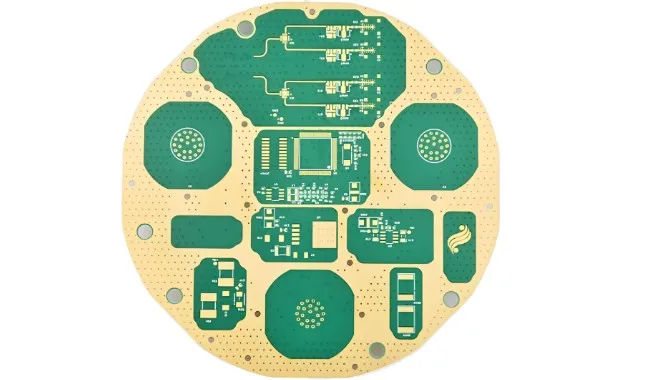
Hybrid Lamination PCB
Recommendations for Hybrid Lamination Design
1. Material Selection
Proper material selection is essential to minimize warpage in hybrid laminations. Based on practical experience and empirical data, the following guidelines are recommended:
-
For 20mil 25FR + FR-4 Laminations: Replace 25FR with a hydrocarbon-ceramic low-loss laminate. a hydrocarbon-ceramic low-loss laminate offers better mechanical and thermal compatibility with FR-4 and performs exceptionally well in high-frequency applications.
-
For 20mil a hydrocarbon-ceramic low-loss laminate + FR-4 Laminations: Select FR-4 materials with thicknesses of 0.51mm, 0.36mm, or 0.18mm. Among these, 0.51mm and 0.36mm are preferred due to their superior mechanical stability and lower warpage rates.
-
For 20mil RF-35A + FR-4 Laminations: Use FR-4 materials with thicknesses of 0.10mm, 0.18mm, or 1.0mm. These options have been shown to reduce stress mismatches effectively, minimizing warpage.
2. Symmetrical Prepreg Stackup Design and Order-Specific Adjustments
Prepreg (PP) plays a vital role in balancing mechanical stresses in the laminated structure. An unsymmetrical prepreg design often results in uneven stress distribution, leading to significant warpage and mechanical instability. To address this issue, the following symmetrical prepreg stackup designs are recommended as guidelines to ensure optimal resin flow and stress balance during lamination:
- 1080 + 2116 + 1080
- 3313 + 7628 + 3313
- 2116 × 2
These configurations help to minimize internal stress imbalances, reduce warpage, and maintain mechanical stability across hybrid laminations.
However, it’s important to note that each specific order may require adjustments based on engineering material inventory, impedance requirements, and production progress. For instance, orders involving impedance control may require additional stackup or process modifications to meet precise electrical specifications. The recommendations provided here are general suggestions for four-layer hybrid laminations and may not cover the unique requirements of all designs.
For a detailed evaluation of the specific process and material requirements for your order, we encourage you to contact our team. Our engineers will optimize the stackup design and process parameters to align with the actual manufacturing conditions and ensure the best possible outcome for your PCB.
3. Surface Finish Recommendations
Tin Spraying (HASL):
-
- Tin spraying is generally not recommended for hybrid boards combining high-frequency materials with FR-4 due to the thermal stress it introduces, which can lead to increased warpage.
- If tin spraying is unavoidable, it is acceptable only for a hydrocarbon-ceramic low-loss laminate + FR-4 hybrid laminations. The thermal and mechanical properties of a hydrocarbon-ceramic low-loss laminate make it more resistant to the stresses introduced by this surface finish.
4. Expected Warpage Performance
By adhering to the above guidelines, the expected warpage performance for hybrid laminations is as follows:
- For a hydrocarbon-ceramic low-loss laminate + FR-4 Hybrid Laminations: Warpage can be controlled within 0.7%.
- For RF-35A + FR-4 Hybrid Laminations: Warpage can be kept below 1.0%.
These results significantly improve mechanical stability and align with industry standards for reliable PCB production.
5. Approved FR-4 Materials
Only specific FR-4 materials have been tested and validated for hybrid laminations with high-frequency materials. The following FR-4 materials are recommended:
- S1141
- S1170
Both materials, manufactured by Shengyi Technology, exhibit excellent compatibility with high-frequency materials, ensuring reliable results with minimized warpage.
6. Custom Solutions for Other Materials
For hybrid laminations involving high-frequency materials other than a hydrocarbon-ceramic low-loss laminate and RF-35A, the above recommendations may not be universally applicable. Each case should be evaluated based on the specific properties of the materials involved, such as:
- Coefficient of Thermal Expansion (CTE)
- Glass Transition Temperature (Tg)
- Dielectric Constant (Dk)
- Resin Content
Manufacturers are advised to collaborate with material suppliers and conduct thorough trials to determine the optimal stackup design and lamination process for these scenarios.
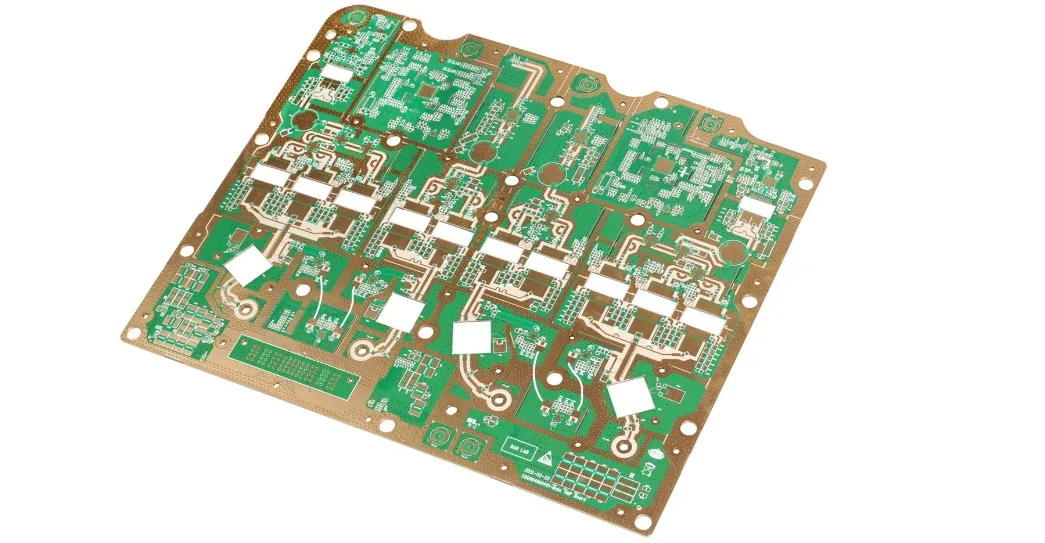
High-Frequency and FR-4 Hybrid PCB
Process Considerations for Hybrid Lamination
1. Post-Lamination Stress Relief
The lamination process of hybrid PCBs, particularly those involving high-frequency materials like 25FR combined with FR-4, requires meticulous thermal and mechanical control to prevent warpage and ensure reliability. Post-lamination baking is a critical step to release internal stresses generated during the lamination process. It is essential to allow the board to stabilize in a controlled thermal environment without applying additional pressure. This avoids further deformation and allows the resin system to fully cure, which significantly reduces residual mechanical stress. Uniform heating and slow thermal cooling during this stage help maintain the board’s dimensional stability and structural balance, especially when dealing with materials with differing thermal expansion coefficients, such as high-frequency laminates and FR-4.
2. Final Inspection Corrective Baking
In cases where warpage is detected during the final inspection stage, corrective baking can effectively realign the board and restore flatness. Baking the hybrid board at 150°C for 2 hours without applying pressure allows the laminate layers to relax and redistribute stresses evenly. During this controlled heat exposure, the laminate resin softens slightly, facilitating stress relief between layers. To prevent reoccurring deformation, immediate and uniform cooling is critical. Placing the board on a marble surface for cooling ensures a flat and stable platform, allowing the laminate to solidify evenly while maintaining its corrected flatness. This step is particularly important for hybrid stackups, as uneven cooling can exacerbate warpage due to varying material properties between the high-frequency core and FR-4.
3. Ensuring Dimensional Stability and Long-Term Reliability
Both the post-lamination and corrective baking processes play an essential role in ensuring the reliability and precision of hybrid PCBs. By following these procedures, manufacturers can achieve controlled stress relief, enhance dimensional stability, and prevent delamination or mechanical failure during subsequent assembly stages. These technical refinements are particularly vital for applications demanding high-frequency performance, as they ensure that the hybrid stackup maintains its mechanical and electrical integrity throughout the product’s lifecycle.
Achieving Optimal Hybrid Lamination: Key Benefits and Industry-Validated Practices
By implementing the above material selection, stackup design, and process control recommendations, PCB manufacturers can achieve the following benefits:
- Reduced Warpage: Hybrid boards with a hydrocarbon-ceramic low-loss laminate + FR-4 can achieve warpage levels within 0.7%, while RF-35A + FR-4 boards can maintain warpage below 1.0%. These levels are well within industry standards and ensure reliable performance.
- Enhanced Reliability: Minimizing warpage reduces the risk of mechanical failures, such as delamination or cracking, during assembly and operation.
- Improved Electrical Performance: Ensuring flatness and mechanical stability preserves the integrity of high-frequency signals, leading to better electrical performance.
- Higher Yield: Reduced warpage leads to fewer rejected boards, improving manufacturing yields and reducing costs.
- Material Compatibility: Using approved FR-4 materials and symmetrical stackup designs ensures compatibility between high-frequency materials and conventional FR-4.
These guidelines are tailored to address the specific challenges of hybrid lamination and are based on extensive industry experience and validation. For any additional questions or custom requirements, manufacturers are encouraged to collaborate with material suppliers and PCB fabricators to develop optimized solutions for their specific needs.
Get a Free PCB & PCBA Quote

Recommended Posts
5G Small Cell PCB Manufacturing for RF and Telecom Infrastructure
Table of Contents 5G Small Cell PCB Requirements Depend on...
Custom 65% Keyboard PCB and PCBA Manufacturing
Table of contents 1. From Design Files to Production-Ready...
RFSoC Board PCB Manufacturing and Assembly One-Stop Service
Table of contentsReference RFSOC Board Project: 115 × 175...
How to Reduce PCB Costs in 2026
Table of contents Why 80% of PCB Cost Is Locked in at...
How to get a quote for PCBs
Let us run DFM/DFA analysis for you and get back to you with a report.
You can upload your files securely through our website.
We require the following information in order to give you a quote:
-
- Gerber, ODB++, or .pcb, spec.
- BOM list if you require assembly
- Quantity
- Turn time
In addition to PCB manufacturing, we offer a comprehensive range of electronic services, including PCB design, PCBA (Printed Circuit Board Assembly), and turnkey solutions. Whether you need help with prototyping, design verification, component sourcing, or mass production, we provide end-to-end support to ensure your project’s success. For PCBA services, please provide your BOM (Bill of Materials) and any specific assembly instructions. We also offer DFM/DFA analysis to optimize your designs for manufacturability and assembly, ensuring a smooth production process.