
Best Soldering Flux for Electronics
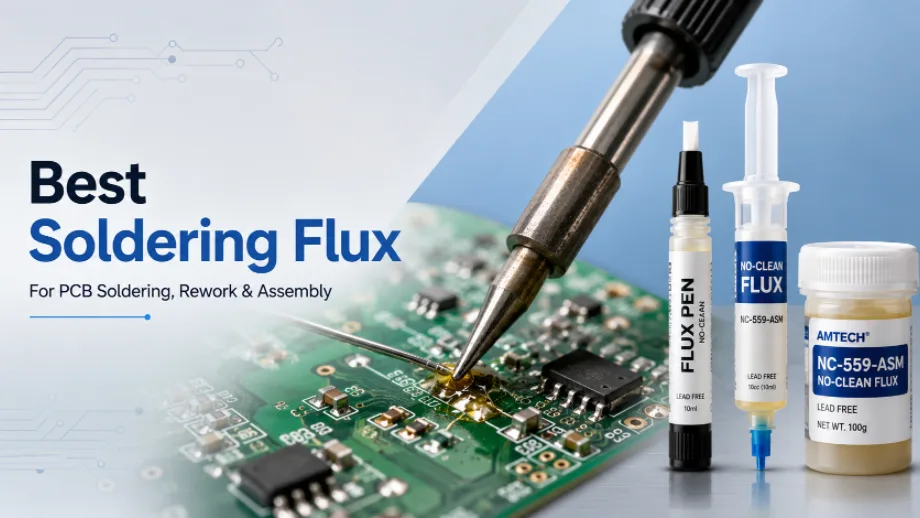
Figure 1. best soldering flux
There is no single “best soldering flux” — the best one is the type matched to your job. For most electronics work, the right choice is a no-clean or a rosin (RMA) flux: both are mild, non-corrosive once used correctly, and safe on circuit boards. Water-soluble flux is stronger and used where you can wash the board thoroughly afterward. The one thing to avoid completely is acid or “plumbing” flux, whose corrosive residue will damage electronics. This guide explains the flux types, the forms they come in, how to pick the best one for hand soldering, SMD rework, or production, and how flux is controlled in real PCB assembly.
What soldering flux does and why type matters
Flux has one core job: to strip the thin oxide layer off metal surfaces so molten solder can wet and bond to them. Heated copper oxidizes almost instantly, and solder will not stick to oxide. Flux chemically removes that oxide, keeps it from re-forming during the few seconds the joint is hot, and lowers surface tension so the solder flows into a smooth fillet.
The reason “type” matters is residue. After soldering, every flux leaves something behind, and how corrosive or conductive that residue is — and whether it must be cleaned — is exactly what separates a flux that’s safe on a circuit board from one that will slowly destroy it. Choosing the best flux is really about choosing the right activity level and residue behavior for your board and your ability to clean it.
Types of soldering flux (rosin, no-clean, water-soluble)
Three families cover almost all electronics soldering. They are formally classified by the J-STD-004 standard, which encodes the base chemistry and activity (for example ROL0 means a rosin base, low activity, no halides).
| Flux type | Activity & residue | Cleaning | Best for |
|---|---|---|---|
| Rosin (R / RMA / RA) | Natural pine rosin; mild to moderately active; non-conductive residue when not over-activated | Often cleaned (RMA can be left for many uses) | Hand soldering, prototyping, beginners |
| No-clean | Low halide (≤0.05%); leaves minimal, electrically safe residue by design | Designed to be left on | Production, rework, most general electronics |
| Water-soluble (organic acid / OA) | High activity; strong oxide removal; residue is corrosive/conductive if left | Must be washed off with water and dried before power | Heavily oxidized parts, high-reliability builds |
| Acid / “plumbing” flux | Zinc/ammonium chloride; very aggressive; corrosive, conductive residue | — (not for electronics) | Copper pipe and sheet metal only — never PCBs |
For most readers the decision is simple: a rosin (RMA) or no-clean flux is the safe, best all-round choice. Reach for water-soluble only when you need its extra cleaning power and can wash the board thoroughly.
Flux forms and when to use each
The same chemistry comes in several physical forms, and the form often matters more day to day than the exact chemistry.
- Flux-core solder wire — flux is built into the centre of the wire. Convenient for general hand soldering; for many through-hole and tinning jobs no extra flux is needed.
- Liquid flux / flux pen — thin liquid applied with a pen or brush. Good for drag-soldering, tinning, and refreshing oxidized pads.
- Gel / paste flux (syringe) — thick, controllable, stays where you put it. The go-to for SMD and fine-pitch rework.
- Tacky flux — a sticky gel that also helps hold small parts in place. Ideal for BGA and QFN rework and reballing.
- Solder paste — flux blended with powdered solder, printed through a stencil for surface-mount assembly (not a standalone flux, but the same flux chemistry inside).
How to choose the best flux for your job
Rather than a single winner, match the flux to the task in front of you.
| Task | Best flux choice |
|---|---|
| General hand soldering / through-hole | Flux-core wire, plus rosin (RMA) or no-clean if extra is needed |
| SMD / fine-pitch rework | No-clean gel flux in a syringe |
| BGA / QFN reballing | No-clean tacky flux |
| Lead-free soldering | Flux rated for lead-free / higher temperatures (more active) |
| High-reliability / aerospace | Qualified no-clean, or water-soluble with full cleaning |
| Heavily oxidized or hard-to-wet metal | Water-soluble (organic acid), then wash thoroughly |
| Beginners | Rosin (RMA) — forgiving and easy to use |
Two rules cut through most of the choice: use the least aggressive flux that produces a sound joint, and if you use an active water-soluble flux, plan to clean the board completely before it’s powered.
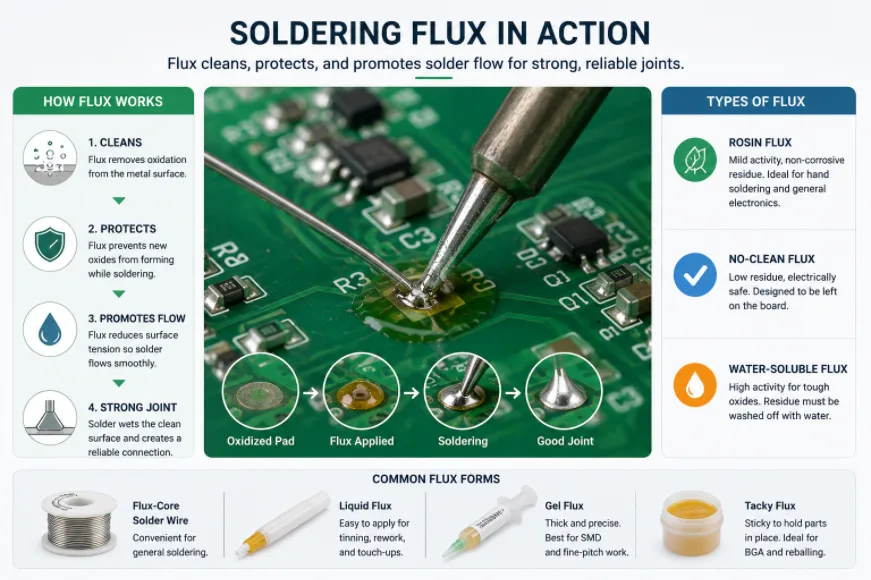
Figure 2. best soldering flux details
Understanding flux labels (the J-STD-004 code)
Datasheets describe flux with a short J-STD-004 code rather than just “no-clean.” Reading it tells you the chemistry, how active the flux is, and whether it contains halides — useful when you need to match a flux to a process or a reliability requirement.
| Code part | Meaning |
|---|---|
| First letters — base | RO = rosin, RE = resin (synthetic, most no-clean), OR = organic (water-soluble), IN = inorganic |
| Activity level | L = low, M = moderate, H = high — higher means stronger oxide removal but more aggressive residue |
| Final digit — halide | 0 = no halides (≤0.05%), 1 = contains halides |
So ROL0 is a low-activity rosin flux with no halides — a typical, gentle hand-soldering flux — while ORH1 is a high-activity organic (water-soluble) flux with halides that must be cleaned off. For most electronics, an L0 or M0 flux is the safe range.
Commonly used flux products
Specific “best flux” lists change often, and the right product depends on your task, so treat the following as widely used, well-regarded examples rather than a single definitive pick:
- No-clean paste/gel flux (e.g. MG Chemicals 8341) — a popular general-purpose no-clean rosin paste for repair and SMD work.
- No-clean tacky flux (e.g. ChipQuik SMD291) — a common choice for SMD/BGA rework and reballing.
- Rosin paste flux (e.g. SRA, Kester rosin) — traditional rosin flux for hand soldering and tinning.
- No-clean liquid flux / flux pens (e.g. Kester 951, MG Chemicals) — for drag soldering and refreshing pads.
Whatever you buy, check that it’s intended for electronics (not plumbing), that its activity suits leaded or lead-free solder as needed, and that the residue behavior matches whether you’ll clean the board.
Cleaning flux residue and safety
How you handle residue depends on the flux:
- No-clean residue is designed to be left in place and is electrically safe. It can still be cleaned for cosmetic reasons or where it would interfere with conformal coating or test-probe contact.
- Rosin residue is non-conductive but can become tacky and is often cleaned with isopropyl alcohol (IPA) for a tidy, inspectable board.
- Water-soluble residue must be removed with water (ideally deionized) and the board dried fully before power, because the residue is corrosive and conductive if left.
Safety: always solder in a ventilated area or with fume extraction — flux fumes are an irritant — and wash hands after handling flux. And to repeat the most important point: acid/plumbing flux (zinc-chloride based) is never used on circuit boards; its residue will corrode tracks and create leakage paths.
How flux is managed in PCB assembly
In volume manufacturing, flux isn’t chosen by feel — it’s specified and controlled. The flux inside the solder paste is matched to the alloy and reflow profile, no-clean chemistries are used where residue can safely remain, and water-soluble or higher-activity fluxes are paired with an inline wash step.
Highleap Electronics, a China-based PCB and PCBA manufacturer, controls flux and residue as part of the assembly process: paste and flux selected for the alloy, cleaning where the chemistry or the customer’s reliability requirement calls for it, and verification by AOI and X-ray. Where boards face moisture or contamination in service, conformal coating is applied over a properly cleaned surface. A DFM review can flag cleaning and coating needs before assembly begins.
Best soldering flux FAQ
What is the best flux for soldering electronics?
For most electronics, a no-clean or rosin (RMA) flux is the best all-round choice — mild, non-corrosive when used correctly, and safe on boards. For SMD and BGA rework specifically, a no-clean tacky gel flux works best.
What is the best flux for SMD and BGA rework?
A no-clean tacky gel flux in a syringe. It stays exactly where you place it, holds small parts during placement, and leaves a safe residue, which is why it’s the standard for fine-pitch and BGA reballing.
Is no-clean or rosin flux better?
Both are good for electronics. No-clean is convenient because its residue can be left in place and is electrically safe, making it the production standard. Rosin (RMA) is forgiving and great for hand soldering, though its residue is more often cleaned for a tidy board.
Do I have to clean flux off after soldering?
It depends on the flux. No-clean can be left on. Rosin is non-conductive but often cleaned for appearance and inspection. Water-soluble flux must be washed off with water and dried before power, because its residue is corrosive and conductive.
Can I use plumbing or acid flux on a circuit board?
No. Acid/plumbing flux (zinc-chloride based) leaves a corrosive, conductive residue that damages tracks and components. Only use flux made for electronics — rosin, no-clean, or water-soluble.
What flux should I use for lead-free solder?
A flux rated for lead-free or higher-temperature use, which is generally a bit more active to handle the higher melting point. Many no-clean and rosin fluxes are formulated to work with both leaded and lead-free solder — check the label.
Does flux-core solder need extra flux?
Often not for straightforward through-hole and tinning work, since the flux is already inside the wire. For SMD rework, fixing oxidized joints, or BGA work, adding a dedicated gel or liquid flux gives much better results.

Recommended Posts
TMM4 Filter PCB Manufacturing
TMM4 filter PCB manufacturing is controlled by the...
TMM3 PCB Manufacturing for RF Modules
TMM3 PCB manufacturing is most useful where the RF module...
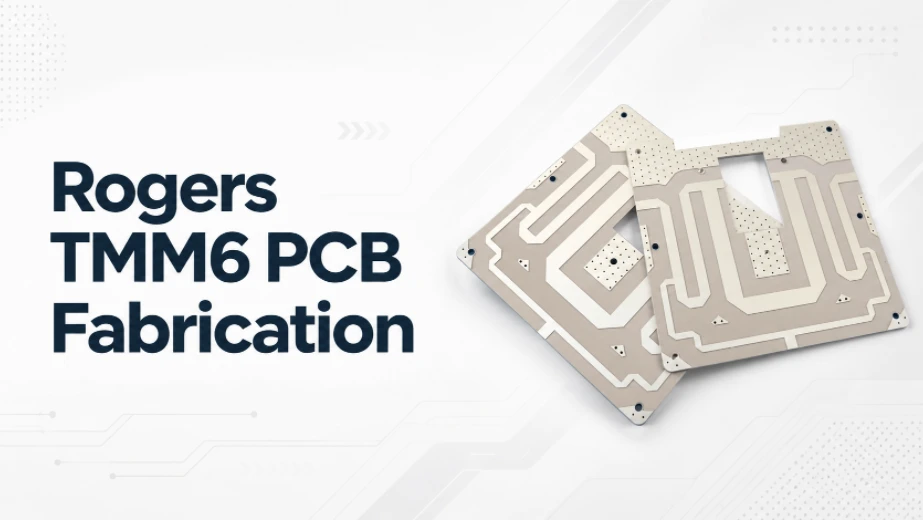
TMM6 PCB Fabrication
TMM6 fabrication is the process-control page for a mid-Dk...

TMM10i PCB Fabrication and DFM
TMM10i PCB fabrication has a stronger DFM emphasis because...
How to get a quote for PCBs
Let‘s run DFM/DFA analysis for you and get back to you with a report. You can upload your files securely through our website. We require the following information in order to give you a quote:
-
- Gerber, ODB++, or .pcb, spec.
- BOM list if you require assembly
- Quantity
- Turn time
For PCBA services, please provide your BOM (Bill of Materials) and any specific assembly instructions. We also offer DFM/DFA analysis to optimize your designs for manufacturability and assembly, ensuring a smooth production process.