
Ceramic PCB Material Comparison: Alumina, AlN, Si₃N₄, SiC, BeO

Introduction
Ceramic substrates have become indispensable in modern electronics where thermal management, dimensional stability, and reliability are critical. In high-power LED systems, automotive inverters, aerospace avionics, and RF amplifiers, traditional FR-4 boards cannot adequately dissipate heat or maintain performance under extreme conditions.
This ceramic PCB material comparison examines five mainstream materials: aluminum oxide (Al₂O₃), aluminum nitride (AlN), silicon nitride (Si₃N₄), silicon carbide (SiC), and beryllium oxide (BeO). Each material offers distinct advantages in thermal conductivity, coefficient of thermal expansion (CTE), mechanical strength, and cost.
Whether your priority is achieving maximum heat dissipation, matching silicon device CTE for flip-chip assemblies, or balancing performance against budget constraints, this guide provides the technical data and application insights to inform your material selection.
Quick Overview: Top 5 Ceramic PCB Materials at a Glance
The following table summarizes the essential characteristics of each ceramic PCB material to facilitate rapid comparison:
Material
Chemical Formula
Thermal Conductivity (W/m·K)
Electrical Insulation
Mechanical Strength
Cost Level
Primary Applications
Material
Chemical Formula
Thermal Conductivity (W/m·K)
Electrical Insulation
Mechanical Strength
Cost Level
Primary Applications
Material
Chemical Formula
Thermal Conductivity (W/m·K)
Electrical Insulation
Mechanical Strength
Cost Level
Primary Applications
Material
Chemical Formula
Thermal Conductivity (W/m·K)
Electrical Insulation
Mechanical Strength
Cost Level
Primary Applications
Material
Chemical Formula
Thermal Conductivity (W/m·K)
Electrical Insulation
Mechanical Strength
Cost Level
Primary Applications
This ceramic PCB material comparison table reveals that no single material dominates across all parameters. Aluminum oxide serves as the economical baseline, while aluminum nitride and beryllium oxide deliver superior thermal performance at elevated costs.
Detailed Analysis of Each Ceramic PCB Material
1. Aluminum Oxide (Al₂O₃): The Industry Standard
Material Overview and Key Properties
Aluminum oxide represents the most widely adopted ceramic substrate material due to its favorable balance of performance, manufacturability, and cost. With thermal conductivity ranging from 20 to 30 W/m·K, Al₂O₃ substrates effectively dissipate heat in moderate-power applications where silicon or FR-4 would fail.
The material exhibits excellent electrical insulation with dielectric strength exceeding 10 kV/mm and volume resistivity above 10¹⁴ Ω·cm. Its coefficient of thermal expansion (approximately 6.5–7.5 ppm/K) reasonably matches common semiconductor materials, reducing thermal stress in solder joints during temperature cycling.
Manufacturing and Processing Characteristics
Manufacturing aluminum oxide PCBs involves well-established techniques including tape casting, screen printing of metallization pastes, and co-firing at temperatures around 1600°C. Flexural strength typically reaches 300–400 MPa, providing adequate mechanical robustness for standard assembly processes.
The mature supply chain and straightforward processing contribute to its cost advantage. Typical applications include general LED lighting arrays, low-to-medium power converters, and hybrid microelectronic circuits where extreme thermal performance is not required.
Performance Limitations
The primary limitation of Al₂O₃ in this ceramic PCB material comparison is its relatively modest thermal conductivity, which becomes insufficient for densely packed high-power devices or applications exceeding 5–10 W/cm² power density.

Alumina PCB
2. Aluminum Nitride (AlN): High Thermal Conductivity Champion
Superior Thermal and Electrical Performance
Aluminum nitride has emerged as the preferred material for applications demanding both excellent thermal conductivity and electrical insulation. With thermal conductivity values ranging from 170 to 230 W/m·K, AlN substrates provide nearly an order of magnitude better heat dissipation than aluminum oxide while maintaining superior dielectric properties.
The material’s coefficient of thermal expansion (approximately 4.5 ppm/K) closely matches silicon (2.6 ppm/K), making AlN particularly suitable for flip-chip assemblies, direct die attach applications, and high-reliability power modules where CTE mismatch can lead to premature failure.
Electrical Characteristics and RF Applications
Electrical insulation remains excellent, with dielectric constant around 8.8 and loss tangent below 0.001 at RF frequencies. This combination enables aluminum nitride to excel in both power electronics and high-frequency applications.
Manufacturing Considerations
Processing aluminum nitride requires careful control of sintering atmospheres and temperatures (typically 1700–1900°C) to achieve optimal thermal conductivity. The material is sensitive to moisture during firing, and metallization processes must be compatible with its chemistry.
Despite these manufacturing complexities, AlN has become commercially viable for volume production of high-power LED packages, RF power amplifiers, laser diode submounts, and automotive power electronics. The main considerations are its moderate cost premium over Al₂O₃ and slightly lower mechanical strength compared to silicon nitride.

Aluminum Nitride PCB
3. Silicon Nitride (Si₃N₄): Superior Mechanical Reliability
Exceptional Strength and Thermal Shock Resistance
Silicon nitride distinguishes itself through exceptional mechanical strength and thermal shock resistance, making it ideal for applications subjected to severe thermal cycling or mechanical stress. The material achieves flexural strength exceeding 700–900 MPa, approximately double that of aluminum oxide, while maintaining thermal conductivity in the 70–90 W/m·K range.
The coefficient of thermal expansion for Si₃N₄ (approximately 3.2 ppm/K) provides excellent compatibility with silicon devices, reducing stress at die attach interfaces. This CTE matching, combined with high fracture toughness, enables silicon nitride substrates to survive repeated thermal excursions from -40°C to +150°C or higher without cracking.
Manufacturing Process and Design Benefits
Manufacturing silicon nitride PCBs typically employs hot pressing or gas pressure sintering to achieve dense microstructures with optimal properties. The material’s high strength allows thinner substrate designs, reducing thermal resistance while maintaining structural integrity.
Metallization processes are well-established, using tungsten or molybdenum-based systems that can withstand the severe thermal processing. In this ceramic PCB material comparison, silicon nitride serves as the reliability-focused option for automotive traction inverters, industrial motor drives, and avionics power systems.

Silicon Nitride Ceramic PCB
4. Silicon Carbide (SiC): High Temperature Specialist
Unique Properties and Fundamental Limitations
Silicon carbide offers exceptional thermal conductivity (120–200 W/m·K) and can operate at temperatures exceeding 600°C, but presents a critical limitation: the material itself is electrically conductive rather than insulating. This characteristic fundamentally differentiates SiC from other materials in this ceramic PCB material comparison.
To function as a PCB substrate, silicon carbide requires additional dielectric layers or specialized structures to provide electrical isolation between circuit traces. Common approaches include depositing silicon dioxide or aluminum nitride insulation layers on the SiC base, creating a composite structure.
Application Scenarios and Manufacturing Complexity
The material’s high thermal conductivity, low thermal expansion (approximately 4.0 ppm/K), and extreme temperature stability make it attractive for specialized applications such as high-temperature sensors, power device test fixtures, and certain aerospace systems where operating temperatures exceed the limits of standard ceramic materials.
However, the added complexity of insulation layer integration, combined with SiC’s inherent material cost, limits its use to niche applications. Manufacturing considerations include careful interface engineering between SiC and insulation layers, specialized metallization compatible with the composite structure, and rigorous quality control to ensure dielectric integrity.
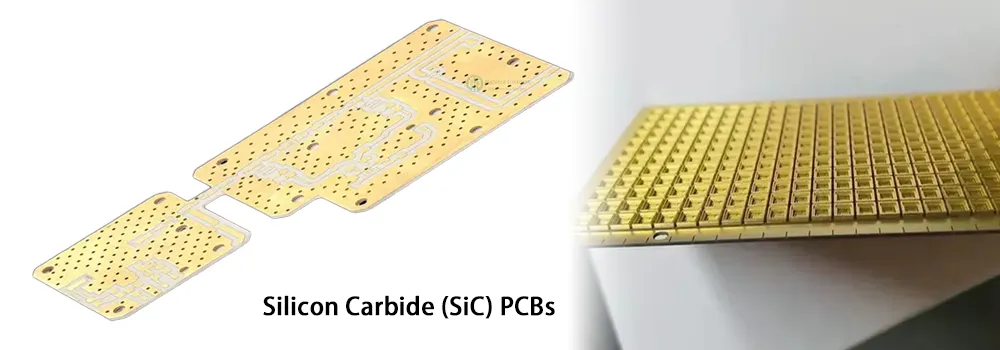
SiC Ceramic PCBs
5. Beryllium Oxide (BeO): Ultimate Performance with Critical Constraints
Outstanding Thermal Performance
Beryllium oxide represents the pinnacle of thermal conductivity among ceramic PCB materials, achieving values from 250 to 300 W/m·K while maintaining excellent electrical insulation. This combination of properties is unmatched by any other ceramic substrate material in this ceramic PCB material comparison.
The material’s CTE (approximately 7.5 ppm/K) is comparable to aluminum oxide but with vastly superior heat dissipation capability. In applications requiring maximum thermal performance, BeO can enable power densities and thermal designs impossible with alternative materials.
Critical Toxicity and Safety Concerns
However, beryllium oxide carries a significant toxicity concern that severely restricts its use. Beryllium dust generated during machining, handling, or substrate breakage poses serious health risks, including chronic beryllium disease, a potentially fatal lung condition.
Stringent occupational safety regulations govern BeO manufacturing and handling, requiring specialized facilities, protective equipment, and disposal procedures. Due to these safety and regulatory constraints, beryllium oxide substrates are primarily limited to military, aerospace, and certain high-performance communication systems.
Practical Alternatives
In most commercial applications within this ceramic PCB material comparison, aluminum nitride has largely displaced beryllium oxide, offering 70–80% of BeO’s thermal performance without toxicity concerns, making AlN the preferred choice for high-thermal-conductivity requirements.
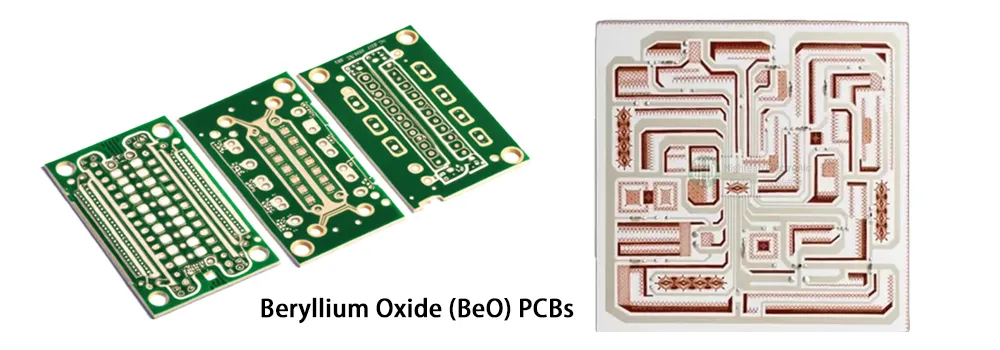
BeO Ceramic PCBs
Performance Comparison: Thermal Conductivity Analysis
1. Thermal Conductivity Hierarchy
Thermal conductivity represents the most critical differentiator in this ceramic PCB material comparison, as it directly determines heat dissipation capability and maximum sustainable power density. The performance hierarchy follows this order:
- Beryllium oxide – 250–300 W/m·K delivers maximum heat dissipation but with severe toxicity restrictions
- Aluminum nitride – 170–230 W/m·K provides excellent thermal performance without safety concerns
- Silicon carbide – 120–200 W/m·K offers high conductivity but requires insulation layers
- Silicon nitride – 70–90 W/m·K balances thermal performance with superior mechanical strength
- Aluminum oxide – 20–30 W/m·K serves as the economical baseline for moderate power applications
2. Power Density Application Guidelines
For applications requiring power densities above 15 W/cm², aluminum nitride or beryllium oxide becomes necessary to maintain junction temperatures within acceptable limits. Silicon nitride serves applications in the 5–15 W/cm² range where its superior mechanical reliability adds value beyond pure thermal performance.
Aluminum oxide remains adequate for power densities below 5 W/cm² or where device spacing allows effective heat spreading. These thresholds provide practical guidance for material selection based on thermal requirements.
3. Coefficient of Thermal Expansion Matching
Beyond absolute thermal conductivity, CTE matching with silicon devices significantly impacts long-term reliability. Aluminum nitride (4.5 ppm/K) and silicon nitride (3.2 ppm/K) provide superior CTE matching to silicon (2.6 ppm/K) compared to aluminum oxide (6.5–7.5 ppm/K) or beryllium oxide (7.5 ppm/K).
This closer match reduces thermomechanical stress accumulation during temperature cycling, a critical consideration for automotive and industrial applications with 50,000 or more thermal cycles over product lifetime. Silicon nitride’s exceptional mechanical strength and thermal shock resistance complement its moderate thermal conductivity, enabling reliable operation through severe thermal transients.
Cost, Availability, and Manufacturing Considerations
1. Material Cost Structure
Material cost and manufacturing complexity vary significantly across the options in this ceramic PCB material comparison. Aluminum oxide represents the most cost-effective option, with established supply chains, multiple qualified vendors, and straightforward manufacturing processes enabling high-volume production at competitive prices.
Aluminum nitride and silicon nitride occupy the medium-high cost range, typically priced at two to four times the cost of equivalent aluminum oxide substrates. This premium reflects more challenging sintering processes, tighter process control requirements, and somewhat limited supplier bases.
2. Specialized Materials and Supply Chain
Silicon carbide substrates with integrated insulation layers command premium pricing due to material costs and the additional processing required for dielectric layer deposition and interface engineering. Limited supplier availability further constrains supply, making SiC appropriate primarily for specialized applications.
Beryllium oxide faces the most severe cost and availability constraints. Beyond the inherent material expense, specialized manufacturing facilities, stringent safety protocols, and limited supplier base result in lead times measured in months and pricing that may exceed ten times the cost of aluminum oxide.
3. Manufacturing Yield Impact
Manufacturing yield considerations also impact effective cost. Aluminum oxide achieves the highest yields due to mature processes, while aluminum nitride and silicon nitride require more careful process control. Silicon carbide composite structures and beryllium oxide processing present greater yield challenges, contributing to their cost premiums.

Ceramic PCBs
Safety, Environmental, and Regulatory Considerations
1. Beryllium Oxide Toxicity Concerns
Environmental and safety factors represent critical decision criteria in this ceramic PCB material comparison, particularly for beryllium oxide. The toxicity of beryllium compounds creates substantial occupational health risks during manufacturing, machining, and handling of BeO substrates.
Inhalation of beryllium dust can cause acute pneumonitis and chronic beryllium disease, leading to progressive lung deterioration. Consequently, many jurisdictions impose strict regulations on BeO use, requiring specialized ventilation systems, personal protective equipment, medical monitoring programs, and controlled disposal procedures.
2. Alternative Material Safety Profile
These safety requirements create liability concerns and operational complexities that have driven most commercial applications toward aluminum nitride as a safer alternative with comparable thermal performance. Organizations considering beryllium oxide must carefully evaluate whether the incremental thermal performance justifies the regulatory burden.
The remaining materials in this ceramic PCB material comparison present minimal health or environmental concerns beyond standard ceramic handling precautions. Aluminum oxide, aluminum nitride, silicon nitride, and silicon carbide do not present significant toxicity issues, though standard dust control measures during machining remain appropriate.
3. Environmental Impact and Disposal
All ceramic substrates require high-temperature sintering processes consuming substantial energy, a consideration for organizations with environmental sustainability goals. End-of-life disposal options vary by material.
Aluminum oxide substrates can often be recycled or disposed through standard industrial waste streams. Aluminum nitride, silicon nitride, and silicon carbide may require specialized disposal due to their refractory nature but do not present hazardous waste concerns. Beryllium oxide requires controlled hazardous waste disposal, adding to lifecycle costs.
Application Scenario Recommendations
1. High-Power LED Lighting Systems
For general commercial LED lighting where cost efficiency matters, aluminum oxide substrates provide adequate thermal performance at optimal cost. Applications requiring higher light output densities benefit from different materials.
Automotive headlamps, stadium lighting, and high-bay industrial fixtures benefit from aluminum nitride’s superior thermal conductivity, enabling smaller form factors and extended LED lifetime through lower junction temperatures. The material choice directly impacts both performance and total cost of ownership.
2. Power Electronics and Motor Drives
Automotive traction inverters and industrial motor drives demand materials that survive tens of thousands of thermal cycles across wide temperature ranges. Silicon nitride’s combination of moderate thermal conductivity (70–90 W/m·K) and exceptional mechanical strength makes it the preferred choice in this ceramic PCB material comparison.
For lower-power DC-DC converters and general power supplies, aluminum oxide provides adequate performance at lower cost. The key differentiation lies in the severity of the operating environment and required lifetime.
3. RF and Microwave Amplifiers
Radio frequency power amplifiers operating at frequencies above 1 GHz benefit from aluminum nitride’s combination of high thermal conductivity, low dielectric loss, and good thermal expansion matching to gallium nitride or gallium arsenide devices.
The material enables efficient heat removal from densely packed RF transistors while maintaining signal integrity. For lower-power RF applications, aluminum oxide remains viable and cost-effective.
4. Aerospace and Defense Systems
Military and aerospace applications often specify materials from this ceramic PCB material comparison based on maximum performance requirements rather than cost optimization. Aluminum nitride serves most high-reliability avionics and communication systems effectively.
Beryllium oxide remains specified for certain legacy military systems and extreme thermal management scenarios where toxicity risks can be managed through controlled manufacturing and handling protocols. However, new designs increasingly favor aluminum nitride to avoid BeO’s complications.

Ceramic Circuit Board Manufacturing
Design and Manufacturing Guidelines
1. Thermal Path Design Considerations
Engineers selecting materials from this ceramic PCB material comparison should consider several design factors beyond basic thermal and electrical specifications. Thermal path design must account for the substrate’s thermal conductivity, incorporating adequate copper spreading areas and via structures to conduct heat from devices to heat sinks.
The substrate thickness must balance mechanical rigidity, thermal resistance, and manufacturing constraints, typically ranging from 0.25 mm to 1.5 mm depending on board size and application. Thinner substrates reduce thermal resistance but require careful handling during assembly.
2. Metallization Selection and Processing
Metallization selection impacts both performance and reliability. The following options serve different requirements:
- Thick-film metallization – Tungsten, molybdenum, or copper pastes provide cost-effective solutions with layer thicknesses from 10 to 25 microns for most ceramic substrates
- Direct bonded copper (DBC) – Applications requiring low electrical resistance employ DBC processes, achieving copper layer thicknesses of 200–400 microns with excellent adhesion
- Active metal brazing (AMB) – Alternative high-conductivity metallization method providing similar performance to DBC with different process characteristics
3. Assembly Process Adaptation
Soldering and assembly processes must accommodate ceramic substrates’ higher thermal mass compared to organic boards. Reflow profiles may require extended preheat zones and slightly elevated peak temperatures to ensure adequate solder melting and wetting.
Silicon nitride’s high strength enables aggressive handling, while aluminum oxide and aluminum nitride require more careful fixture design to prevent edge chipping during assembly. Process development should account for material-specific characteristics.
4. Special Material Handling Requirements
For silicon carbide substrates with insulation layers, designers must verify dielectric integrity through high-voltage testing and ensure metallization patterns maintain adequate creepage and clearance distances. The composite structure requires additional validation beyond standard ceramic substrates.
Beryllium oxide substrates demand specialized handling procedures, dedicated manufacturing areas, and comprehensive worker safety protocols that should be established before material selection. The operational complexity typically outweighs the thermal performance benefits for most commercial applications.
Ceramic PCB Material Selection Summary
This ceramic PCB material comparison demonstrates that optimal material selection depends on application-specific priorities rather than universal superiority. The following decision framework provides practical guidance:
- Aluminum oxide – Select for cost-sensitive applications with moderate power densities below 5 W/cm² where proven reliability matters more than ultimate thermal performance
- Aluminum nitride – Specify when thermal conductivity above 150 W/m·K is required, particularly for high-power LEDs, RF amplifiers, or applications requiring CTE matching to silicon devices
- Silicon nitride – Choose for automotive and industrial applications where mechanical strength, thermal shock resistance, and long-term reliability through severe thermal cycling justify the medium-high cost
- Silicon carbide – Consider only for specialized high-temperature applications exceeding 300°C operating temperatures where the complexity of integrated insulation layers and premium cost are acceptable
- Beryllium oxide – Avoid unless no alternative material meets thermal requirements and organizational capability exists to manage toxicity, regulatory compliance, and specialized handling protocols
In most cases, aluminum nitride provides sufficient thermal performance without beryllium oxide’s safety and regulatory burden, making it the practical choice for high-thermal-conductivity requirements.
Partner with Highleap Electronics for Ceramic PCB Manufacturing
At Highleap Electronics, we specialize in manufacturing high-reliability ceramic PCBs across aluminum oxide, aluminum nitride, and silicon nitride substrates. Our engineering team provides material selection guidance, thermal simulation, and design-for-manufacturing support to optimize your ceramic PCB designs for performance, reliability, and cost.
Contact us to discuss your specific thermal management requirements and receive expert recommendations based on this ceramic PCB material comparison analysis. We deliver precision ceramic substrates that meet the demanding requirements of power electronics, RF systems, and high-reliability applications.
Frequently Asked Questions
1. Which ceramic PCB material offers the highest thermal conductivity?
Beryllium oxide provides the highest thermal conductivity at 250–300 W/m·K among ceramic PCB materials. However, its toxicity and regulatory restrictions limit practical use. Aluminum nitride represents the preferred high-thermal-conductivity option at 170–230 W/m·K without toxicity concerns, making it suitable for commercial applications requiring excellent heat dissipation.
2. What is the most cost-effective ceramic PCB material?
Aluminum oxide (Al₂O₃) offers the best cost-performance ratio for general applications, with thermal conductivity of 20–30 W/m·K adequate for power densities below 5 W/cm². Its mature manufacturing processes and established supply chain enable competitive pricing for volume production, making it the baseline choice when thermal requirements are moderate.
3. Which material best suits automotive power electronics?
Silicon nitride (Si₃N₄) provides optimal performance for automotive applications through its exceptional mechanical strength and thermal shock resistance. The material reliably survives the severe thermal cycling inherent in automotive environments while offering adequate thermal conductivity of 70–90 W/m·K. This combination addresses both thermal management and long-term reliability requirements for traction inverters and motor drives.
4. Can silicon carbide be used directly as a PCB substrate?
Silicon carbide is electrically conductive and cannot function as an insulating substrate without additional dielectric layers. Applications using SiC require deposited insulation layers such as silicon dioxide or aluminum nitride on the SiC base, creating a composite structure that leverages SiC’s thermal properties while providing necessary electrical isolation between circuit traces.
5. How does aluminum nitride compare to aluminum oxide?
In this ceramic PCB material comparison, aluminum nitride delivers six to eight times higher thermal conductivity (170–230 W/m·K versus 20–30 W/m·K) and better CTE matching to silicon devices (4.5 ppm/K versus 6.5–7.5 ppm/K). However, AlN costs two to four times more than Al₂O₃. The premium is justified for high-power-density applications exceeding 10 W/cm² where superior heat dissipation directly impacts performance and reliability.

Recommended Posts
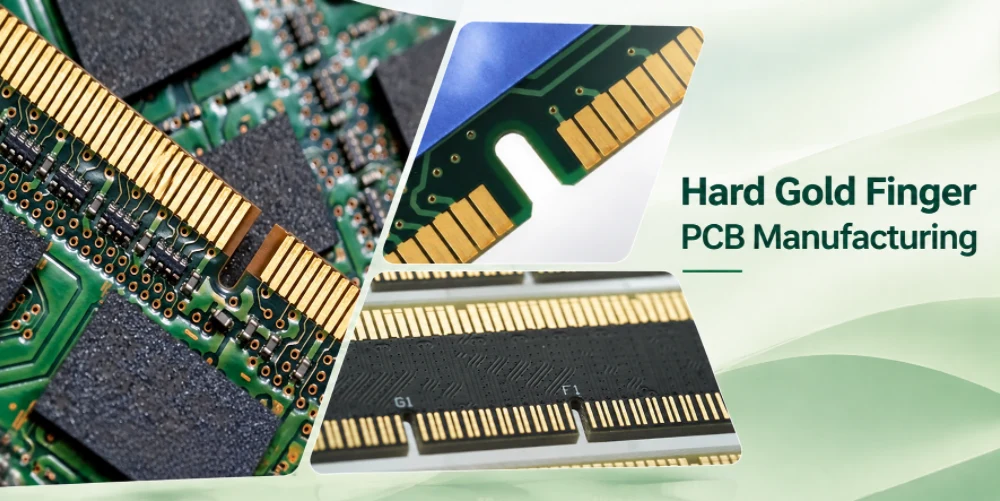
Hard Gold Finger PCB Manufacturing: Plating and Beveling
Hard gold finger PCB manufacturing is used when a circuit...
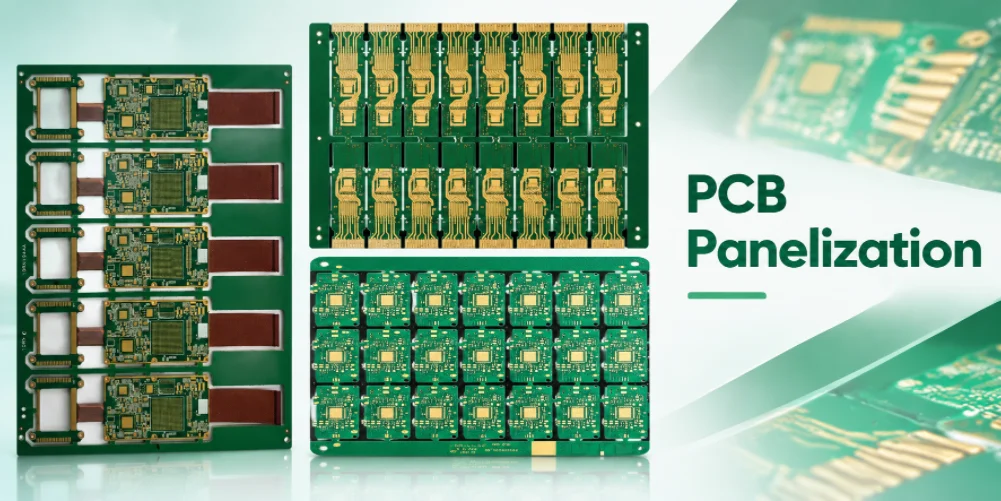
Small PCB Panelization: Array Design and Depaneling
Imagine a 26 × 18 mm circuit that must pass through...
PCB Panelization for Volume Production: Cost and Yield
A fabrication panel that holds more boards is not...
PCB SET Delivery and Panelization: Quantities and Acceptance
A purchase order for “500 SET” looks straightforward until...
How to get a quote for PCBs
Let‘s run DFM/DFA analysis for you and get back to you with a report. You can upload your files securely through our website. We require the following information in order to give you a quote:
-
- Gerber, ODB++, or .pcb, spec.
- BOM list if you require assembly
- Quantity
- Turn time
In addition to PCB manufacturing, we offer a comprehensive range of electronic services, including PCB design, PCBA, and turnkey solutions. Whether you need help with prototyping, design verification, component sourcing, or mass production, we provide end-to-end support to ensure your project’s success.
For PCBA services, please provide your BOM (Bill of Materials) and any specific assembly instructions. We also offer DFM/DFA analysis to optimize your designs for manufacturability and assembly, ensuring a smooth production process.