
EMI Resistant Drone PCB Manufacturing and PCBA Services

An EMI resistant drone PCB is not just a board with better shielding. It is a UAV circuit platform built to maintain signal integrity, power stability, and system reliability in electrically noisy operating conditions. For modern drone electronics, EMI resistance affects communication performance, GNSS stability, sensor consistency, video transmission, and overall flight control reliability.
Highleap Electronics provides EMI resistant drone PCB manufacturing and PCB assembly services for UAV applications, supporting customers from engineering prototypes to repeat production. With integrated support for PCB fabrication, PCBA, component sourcing, and design-for-manufacturing review, Highleap helps turn EMI-sensitive drone designs into boards that are easier to build, assemble, and scale.
Table of Contents
- What an EMI Resistant Drone PCB Must Achieve in Real UAV Applications
- PCB Manufacturing Requirements for EMI Resistant Drone Boards
- PCB Assembly and Engineering Support for EMI-Sensitive UAV Electronics
- Prototype Validation and Volume Production for EMI Resistant Drone PCB Projects
- Why Highleap Electronics Is a Strong Manufacturing Partner for EMI Resistant Drone PCB Programs
- FAQ
What an EMI Resistant Drone PCB Must Achieve in Real UAV Applications
In drone electronics, EMI resistance is measured by stable system behavior rather than by a single design feature. A well-built EMI resistant drone PCB must support clean communication, dependable navigation, and repeatable sensor performance when multiple subsystems are active at the same time.
- GNSS and positioning circuits must remain stable while motors, ESCs, and switching power sections are operating.
- Telemetry, RF links, and video transmission circuits must maintain signal integrity under full system load.
- Flight-control, IMU, and mixed-signal sections must be protected from power noise and high-speed digital interference.
- PCB structure, grounding, stackup, shielding compatibility, and assembly quality must work together as one system.
For this reason, EMI-resistant drone boards are usually associated with stronger stackup planning, better impedance control, more disciplined grounding, cleaner routing regions, and manufacturing support that can preserve the original design intent through fabrication and assembly.
PCB Manufacturing Requirements for EMI Resistant Drone Boards
For an EMI resistant drone PCB, manufacturing quality directly affects electrical behavior. Even a strong layout can lose performance if material control, impedance execution, copper balance, layer registration, or shielding-related features are not manufactured consistently.
Key fabrication requirements typically include:
- Controlled impedance for RF traces, antenna feeds, high-speed data lines, and other EMI-sensitive interconnects.
- Stable multilayer stackup execution to support cleaner return paths, reference planes, and power-distribution behavior.
- High-frequency and RF material support when the design requires better signal performance than standard FR-4 can provide.
- Shielding-compatible fabrication for ground rings, via fences, shield can soldering regions, and compartmentalized EMI control structures.
- Rigid, flex, or rigid-flex options where the UAV product architecture requires weight reduction, tighter packaging, or more integrated internal routing.
Manufacturing for this type of board is not only about whether the PCB can be built. It is about whether it can be built with enough consistency to support RF behavior, power integrity, assembly precision, and long-term repeatability across prototypes and production batches. Highleap supports this through dedicated drone PCB production and broader rigid-flex fabrication capability.
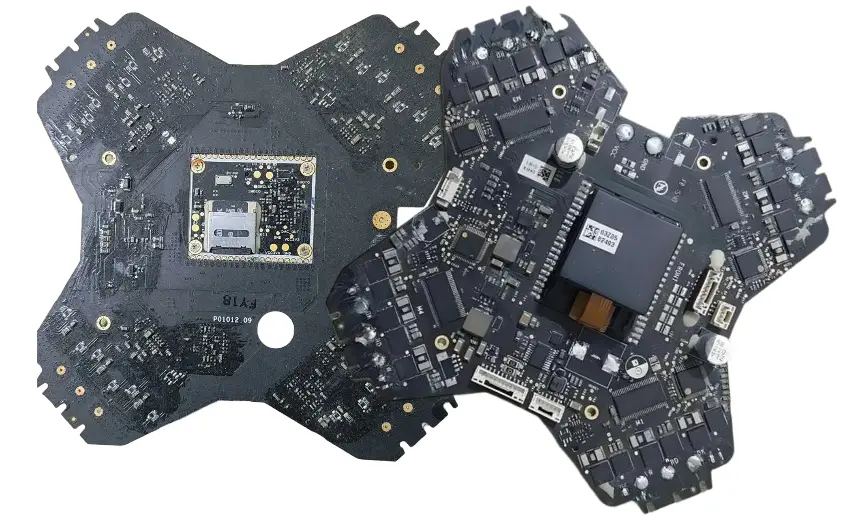
PCB Assembly and Engineering Support for EMI-Sensitive UAV Electronics
For EMI-sensitive drone projects, PCB assembly is part of the electrical performance chain. Placement accuracy, soldering quality, component sourcing, testing strategy, and manufacturability review can all influence whether the final product performs like the original design.
That is why EMI resistant drone PCB projects often benefit from integrated PCBA and engineering support, including:
- DFM, DFA, and DFT review to reduce manufacturing risk before the first build.
- PCB layout and impedance-related support for designs that require controlled interconnect behavior.
- Turnkey or partial PCBA for customers that need fabrication, sourcing, and assembly under one supplier.
- Functional testing and inspection to improve build consistency for UAV electronics.
- Fine-pitch and mixed-technology assembly capability for dense drone control and communication boards.
Integrated assembly is especially valuable when the board includes RF modules, sensor arrays, compact interconnect structures, or rigid-flex sections that require tighter process coordination. A supplier that handles fabrication and PCBA together can usually reduce communication gaps, shorten response loops, and improve project control during engineering changes. For projects that include lightweight interconnect structures, Highleap also offers flex PCB assembly support.
Prototype Validation and Volume Production for EMI Resistant Drone PCB Projects
EMI resistant drone PCB programs rarely stop at one sample run. Most move through multiple stages, including engineering prototypes, validation builds, pilot production, and repeat manufacturing. The ability to support this full path is important because EMI-related issues are often discovered and refined during real hardware testing.
A strong manufacturing flow for this type of project should support:
- Rapid prototype fabrication and assembly for early validation of grounding, RF behavior, shielding, and signal integrity.
- Pilot builds that confirm whether the design remains stable when transferred from engineering release to repeatable manufacturing.
- Production continuity so that validated EMI performance is not lost when order volume increases.
- Supply chain coordination for sourcing, scheduling, and delivery across recurring UAV programs.
For drone companies, this is one of the most practical advantages of working with a one-stop manufacturing partner. It reduces vendor switching, shortens iteration cycles, and helps keep fabrication, assembly, and logistics aligned as the project grows. Project files and requirements can be submitted through the quotation portal for review and production planning.
Why Highleap Electronics Is a Strong Manufacturing Partner for EMI Resistant Drone PCB Programs
Highleap Electronics is positioned as a one-stop electronic manufacturing supplier with support for PCB fabrication, component sourcing, PCB assembly, and broader EMS workflows. For EMI resistant drone PCB projects, that creates a more practical supply structure than separating fabrication, assembly, and sourcing across multiple vendors.
Highleap’s advantages for this type of project include:
- One-stop service covering PCB fabrication, PCBA, sourcing, and manufacturing coordination.
- Engineering-related support including DFM, DFA, DFT, and impedance control capabilities.
- Board-type flexibility across rigid PCB, flex PCB, rigid-flex PCB, high-frequency PCB, and RF-related structures.
- Production flexibility from prototypes and low-volume builds to repeat and larger-scale manufacturing.
- Application relevance through dedicated UAV-focused service pages and drone-related manufacturing content.
For customers developing EMI-sensitive UAV electronics, this means better coordination between design intent and manufacturing execution, fewer project handoff points, and a more scalable path from prototype verification to production supply. You can explore Highleap’s mission-critical drone manufacturing solutions and rigid-flex board options for UAV platforms for more application-specific support.
FAQ
What is an EMI resistant drone PCB?
An EMI resistant drone PCB is a UAV circuit board designed and manufactured to maintain stable electrical performance in the presence of radiated and conducted interference. It typically relies on controlled stackup, clean grounding, impedance control, shielding-compatible structures, and stable fabrication and assembly processes.
Why is PCB manufacturing quality important for EMI-resistant drone boards?
Because EMI performance depends not only on schematic and layout, but also on how accurately the board is built. Variations in stackup, impedance, copper balance, layer registration, or assembly quality can directly affect signal integrity and RF behavior.
Do EMI resistant drone PCB projects usually need PCB assembly support?
Yes. Many of these boards include RF modules, compact layouts, mixed-signal circuits, or fine-pitch components. Integrated PCBA helps improve coordination between fabrication, sourcing, assembly, and testing.
Can one supplier support prototypes and production for EMI-resistant UAV boards?
Yes. This is often the preferred model because it helps preserve validated performance as the project moves from engineering builds to repeat production, while also simplifying supply chain management.
Can Highleap Electronics support rigid, flex, and rigid-flex drone PCBs?
Yes. Highleap supports multiple PCB structures, including rigid PCB, flex PCB, and rigid-flex PCB, which is useful for UAV products with different packaging, weight, and routing requirements.
Highleap Electronics provides EMI resistant drone PCB manufacturing and assembly support for UAV electronics that require stable performance, cleaner production control, and a more efficient path from prototype validation to repeat manufacturing. For projects that combine EMI sensitivity with higher assembly and sourcing demands, integrated support across PCB fabrication, PCBA, and supply coordination can deliver stronger long-term results.

Recommended Posts
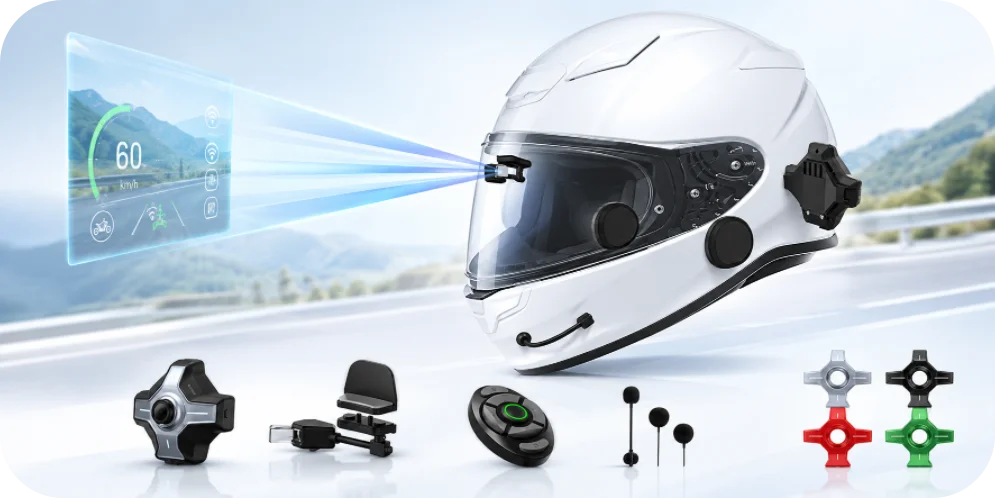
Custom Smart Motorcycle Helmet PCB for Connected Riding
A smart motorcycle helmet may combine an intercom,...
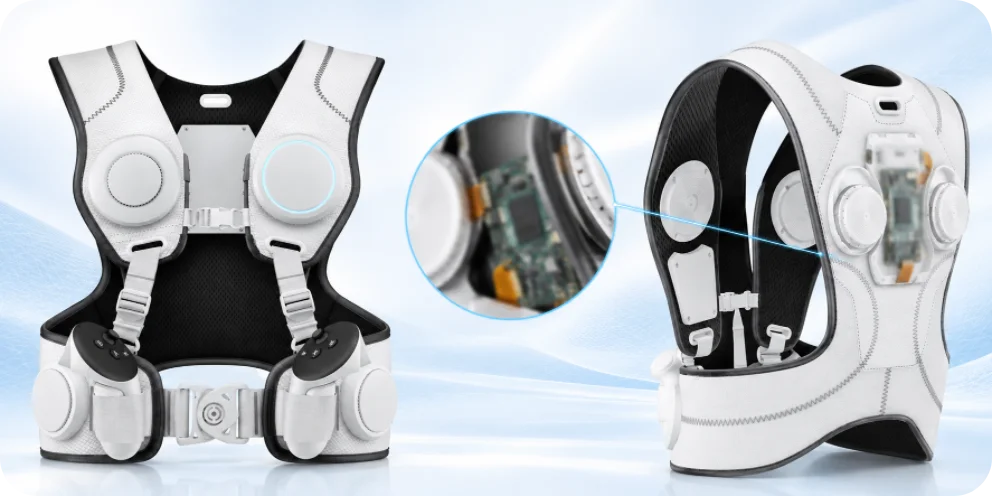
Wearable Haptic Vest PCB Manufacturing & Assembly for Multi-Zone Haptic OEMs
In a wearable haptic vest, the wearer notices the...
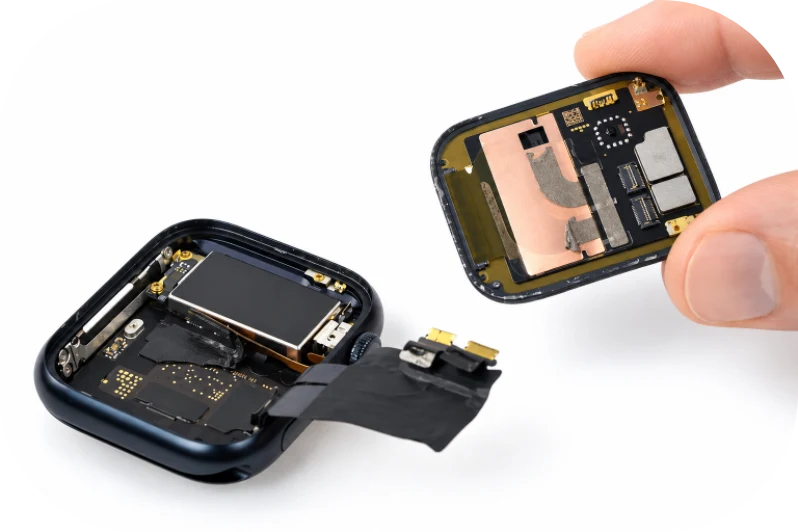
Wearable Temperature Logger PCB Manufacturing & Assembly for BLE Sensor OEMs
A wearable temperature logger PCB is the electronic board...
Connected Safety Helmet PCB Manufacturing & Assembly for Industrial IoT OEMs
A Connected Safety Helmet PCB is an industrial IoT...
How to get a quote for PCBs
Let us run DFM/DFA analysis for you and get back to you with a report.
You can upload your files securely through our website.
We require the following information in order to give you a quote:
-
- Gerber, ODB++, or .pcb, spec.
- BOM list if you require assembly
- Quantity
- Turn time