
Choosing the Right Substrate for High Frequency PCB Design

Why Substrate Choice Matters in High Frequency PCB Design
Signal Integrity and Material Influence
The high frequency PCB substrate directly determines electromagnetic parameters governing signal quality. Dielectric loss tangent affects insertion loss through energy dissipation, while propagation delay varies with the square root of dielectric constant. Impedance control depends on consistent dielectric properties across the frequency spectrum, as even minor Dk variations can shift characteristic impedance by several ohms, degrading matching networks and causing reflections.
Distinction Between High-Speed and High-Frequency Design
High-speed digital design focuses on edge rate and reflection management through impedance discontinuity control. High frequency RF and microwave circuits prioritize insertion loss minimization, phase stability, and controlled dielectric constant across operating bandwidth. While a 10 Gbps digital link may tolerate moderate substrate losses, a 28 GHz phased array demands dissipation factors below 0.002 to maintain acceptable gain and noise figure.
Common Design Challenges
Improper high frequency PCB substrate selection manifests as excessive insertion loss reducing link budget and system range. Phase drift with temperature creates beam-steering errors in phased arrays and timing jitter in sampling systems. Impedance mismatch from unstable dielectric properties generates standing waves degrading return loss, while high loss tangent materials convert signal energy to heat, compromising both electrical performance and thermal management. When selecting AD300 substrates for RF circuit boards, confirm the exact material designation, available thickness and processing route before approving the stackup.
Key Material Parameters for High Frequency PCB Substrates
Dielectric Constant (Dk) and Its Frequency Stability
The dielectric constant determines transmission line geometry required to achieve target impedance. A 50-ohm microstrip on Dk 3.5 material requires different width-to-height ratios than the same impedance on Dk 10 ceramic substrates. Premium high frequency PCB substrate materials specify Dk tolerance within ±0.05 and frequency coefficients below 50 ppm/GHz to ensure predictable performance from DC through millimeter-wave frequencies.
Dissipation Factor (Df or Loss Tangent)
Dissipation factor quantifies dielectric loss through the ratio of imaginary to real permittivity components. At 10 GHz, a substrate with Df of 0.004 exhibits roughly twice the dielectric loss compared to Df 0.002 material. Modern high frequency PCB substrates achieve dissipation factors as low as 0.0009 in PTFE-based materials, enabling millimeter-wave circuits with acceptable insertion loss budgets.
Thermal and Mechanical Properties
Critical thermal parameters for high frequency PCB substrate reliability:
- CTE matching – Coefficient within 5-10 ppm/°C of copper prevents barrel cracking through temperature cycling
- Glass transition temperature – Tg above 180°C withstands lead-free assembly with adequate margin
- Thermal conductivity – Values exceeding 1 W/mK enable power amplifier designs without hotspots
- Thermal stability – Minimal electrical parameter drift across -40°C to +125°C operating range
Copper Surface Roughness and Conductor Losses
At frequencies above 5 GHz, skin effect concentrates current where roughness peaks increase effective resistance significantly. Standard electrodeposited copper with 5-7 micrometer RMS roughness can double conductor loss compared to sub-micrometer smooth foils. Premium high frequency PCB substrate materials employ reverse-treated foils to minimize this effect, as roughness penalty scales with the square root of frequency.
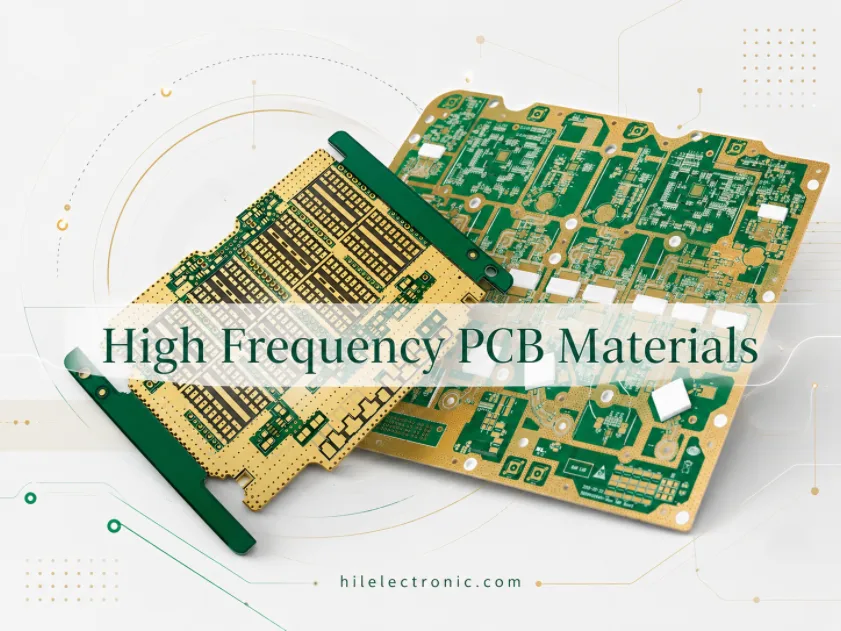
Rogers RO4350B and FR4 Mixed Delectrics PCB
Overview of Common High Frequency PCB Substrate Materials
PTFE (Teflon) and Ceramic-Filled PTFE
Pure PTFE substrates deliver exceptionally low dissipation factors around 0.0010 and excellent dielectric stability across temperature and frequency. Ceramic fillers modify dielectric constant from PTFE’s native 2.1 to engineered values between 2.2 and 10.2, enabling controlled impedance designs. These materials excel in millimeter-wave applications including satellite transceivers, radar modules, and 5G massive MIMO antenna arrays.
Rogers RO4000 / RO4350B Series
The RO4000 family employs hydrocarbon-ceramic laminates maintaining compatibility with standard FR-4 processing equipment. RO4350B achieves Dk of 3.48 with dissipation factor around 0.0037 at 10 GHz, delivering substantially better performance than enhanced FR-4. This balance makes it the preferred high frequency PCB substrate for 5G base stations, automotive radar, and high-speed backplane applications requiring multilayer complexity.
Ceramic-Based and Hydrocarbon-Ceramic Laminates
Alumina and aluminum nitride ceramic substrates provide thermal conductivity exceeding 20 W/mK alongside dielectric constants from 9 to 10, ideal for high-power RF amplifiers. Hydrocarbon-ceramic composites offer intermediate solutions with thermal conductivity around 0.6-0.8 W/mK, sufficient for moderate power densities. These high frequency PCB substrate options enable compact layouts while managing thermal dissipation in power amplifier applications.
Modified Epoxy and Hydrocarbon Materials
Panasonic Megtron 6 and similar hydrocarbon-based materials achieve dissipation factors around 0.002-0.004 at 10 GHz through polymer engineering. These substrates serve mid-range high frequency PCB applications from 2 to 20 GHz where cost sensitivity precludes pure PTFE solutions but performance requirements exceed FR-4 capabilities. Compatible with standard multilayer processing, they suit data center interconnects and automotive radar modules.
Enhanced FR-4 and High-Tg FR-4 Variants
Standard FR-4 dissipation factors around 0.020 at 1 GHz limit usable bandwidth to below 3 GHz for critical signal paths. High-Tg variants with improved resin systems reduce Df to 0.010-0.015 range, extending useful frequency to 5-6 GHz. Enhanced FR-4 serves as acceptable high frequency PCB substrate material for clock distribution and memory interfaces where cost constraints dominate.
Comparison Table: Dielectric and Loss Properties
| Material Type | Dk @ 10 GHz | Df @ 10 GHz | Thermal Conductivity (W/mK) | Processing | Cost | Frequency Range |
| PTFE (Pure) | 2.1 | 0.0010 | 0.25 | Complex | 4-5× | DC-110 GHz |
| Ceramic-PTFE | 2.2-10.2 | 0.0009-0.0020 | 0.3-0.6 | Complex | 3-6× | DC-77 GHz |
| Rogers RO4350B | 3.48 | 0.0037 | 0.69 | Standard | 2-3× | DC-40 GHz |
| Megtron 6 | 3.6 | 0.002 | 0.37 | Standard | 1.5-2× | DC-20 GHz |
| Taconic TLY | 2.2-2.5 | 0.0009 | 0.6 | Complex | 3-4× | DC-50 GHz |
| Enhanced FR-4 | 4.2-4.4 | 0.010-0.015 | 0.3 | Standard | 1× | DC-6 GHz |
Practical High Frequency PCB Substrate Selection Process
Step 1 – Define Operating Frequency and Bandwidth
Identify the highest frequency component in your signal spectrum, whether the fundamental carrier frequency in RF circuits or highest significant harmonic in digital designs. A 10 GHz local oscillator requires substrate evaluation at 10 GHz, while a 10 Gbps NRZ signal demands material characterization through the fifth harmonic near 25 GHz. This frequency definition immediately eliminates unsuitable materials.
Step 2 – Evaluate Signal Loss and Dielectric Stability
Establish insertion loss budgets by allocating acceptable attenuation within your link budget analysis. High frequency PCB substrate materials with Df below 0.002 become necessary when total dielectric loss must stay under 0.5 dB across a 10-inch trace at 28 GHz. Applications demanding better than -20 dB return loss require substrates with Dk stability within ±2% across temperature and frequency.
Step 3 – Consider Thermal Management and Power Handling
Power amplifiers dissipating more than 5 watts per square inch demand high frequency PCB substrate materials with thermal conductivity exceeding 1 W/mK or metal-backed constructions. Calculate junction temperature rise ensuring Tg margins accommodate worst-case operating conditions. Dense digital designs may generate sufficient heat flux that thermal considerations override pure electrical performance metrics.
Step 4 – Assess Manufacturability and Cost Constraints
Manufacturing considerations for high frequency PCB substrate selection:
- Process compatibility – PTFE requires specialized drilling and routing versus standard RO4000 processing
- Supplier availability – Premium substrates restrict fabricator options and extend lead times
- Design complexity – Multilayer stackups and tight tolerances demand experienced manufacturing partners
- Feature capabilities – Minimum trace widths, via aspect ratios, and layer counts vary by material type
Example Scenarios: Millimeter-Wave vs High-Speed Digital
A 28 GHz phased array antenna demands ceramic-filled PTFE with Dk 3.0 and Df below 0.0015 to minimize feed network insertion loss, where each 0.1 dB improvement directly enhances array range. A 56 Gbps PAM-4 backplane tolerates higher loss tangent around 0.004, making Rogers RO4350B or Megtron 7 viable high frequency PCB substrate choices balancing electrical performance with multilayer manufacturability.

High-Frequency PCB
Design and Manufacturing Considerations for High Frequency PCB Substrates
Impedance Control and Stack-up Optimization
Achieving ±10% impedance tolerance requires precise control of dielectric thickness, copper weight, and trace geometry. High frequency PCB substrate materials with tight Dk specifications enable predictable impedance calculation, but actual values depend on stackup symmetry, prepreg flow during lamination, and copper plating uniformity. Employ differential signaling for critical paths and maintain consistent dielectric layer thickness within ±10%. For thin-core RO4835T RF construction, handling, lamination and finished dielectric thickness should be reviewed together before the multilayer structure is approved.
Surface Finish and Copper Foil Selection
Electroless nickel immersion gold introduces slight insertion loss increase but provides excellent shelf life and wire bonding compatibility. Immersion silver and organic solderability preservative finishes minimize additional loss while requiring careful handling. Specify reverse-treated foil or ultra-low-profile copper for frequencies above 10 GHz, where standard electrodeposited roughness introduces 20-40% additional conductor loss.
Via Design and Transition Management
Plated through-holes create impedance discontinuities from capacitive pad loading and inductive barrel effects. Mitigate via impacts through back-drilling to remove unused stubs, or employ blind and buried vias to eliminate through-hole stubs entirely. Ground via fences spaced less than one-twentieth wavelength prevent parallel-plate resonances in high frequency PCB substrate stackups.
Measurement and Validation Techniques
Essential validation methods for high frequency PCB substrate performance:
- S-parameter analysis – Vector network measurements validate insertion loss, return loss, and phase linearity
- Time-domain reflectometry – Identifies impedance discontinuities at specific physical locations
- Thermal cycling – 500-1000 cycles between -40°C and +125°C verify reliability through via resistance monitoring
- Dielectric characterization – Split-post resonator measurements confirm Dk and Df of fabricated boards
Balancing Performance, Cost, and Manufacturability
Trade-off Between Electrical Performance and Processing Cost
Ultra-low-loss high frequency PCB substrate materials justify their 3-5× cost premium when insertion loss directly limits system range, data rate, or power efficiency. Short trace lengths under 2 inches and frequencies below 10 GHz often achieve specifications with mid-tier materials costing half as much. Quantify the value proposition by calculating system-level impact rather than optimizing component cost in isolation.
Supply Chain and Availability Factors
Specialty high frequency PCB substrate materials sometimes face allocation constraints during supply disruptions. Dual-source material specifications where electrical performance permits, qualifying both Rogers and Taconic alternatives or Megtron and Isola options to maintain production flexibility. Long-term production programs benefit from early engagement with material distributors to secure capacity allocation and negotiate volume pricing.
Collaborative Design with PCB Manufacturer
Engage fabrication partners during material selection and stackup definition rather than completing designs in isolation. Experienced manufacturers provide design-for-manufacturing guidance on minimum feature sizes, via aspect ratios, and impedance tolerances achievable with specific high frequency PCB substrate materials. Request impedance test coupons and material characterization samples early in prototyping to validate electrical models. Carry the selected laminate grade and dielectric thickness into a material-specific RF PCB quotation so procurement evaluates the construction validated by your design.
Summary and Quick Reference Guide
Frequency Range vs Recommended Material Table
| Frequency Range | Digital Applications | RF/Microwave Applications | Cost-Optimized | Premium Performance |
|---|---|---|---|---|
| DC – 6 GHz | Megtron 6, Enhanced FR-4 | Rogers RO4000, Taconic RF-35 | Enhanced FR-4 | Rogers RO4350B |
| 6 – 20 GHz | Megtron 7, Nelco N4000-13 | Rogers RO4003C, Taconic TLY | Megtron 7 | Rogers RO4003C |
| 20 – 40 GHz | Rogers RO4835 | Rogers RO3003, PTFE-ceramic | Rogers RO4835 | Rogers RO3003 |
| 40 – 77+ GHz | Rogers RO3003 | PTFE-ceramic (Dk 2.2-3.0) | Rogers RO3003 | Ceramic-PTFE |
Key Takeaways for Designers
Successful high frequency PCB substrate selection prioritizes stable dielectric constant across temperature and frequency, minimizes dissipation factor to preserve signal integrity, and ensures thermal properties support reliable operation. Match material capabilities to manufacturing process requirements early in design cycles, recognizing that optimal electrical performance requires achievable fabrication yields. Validate assumptions through prototyping and measurement rather than relying solely on simulation.
Partnering with Professional PCB Manufacturer
Complex high frequency PCB substrate selection and implementation benefit significantly from manufacturer expertise in material handling, process optimization, and test validation. Highleap Electronics specializes in high frequency PCB fabrication across Rogers, Taconic, and advanced laminate systems, offering design consultation, controlled-impedance manufacturing, and comprehensive electrical testing.
Our engineering team collaborates with designers to optimize stackups, qualify materials, and establish manufacturing processes that deliver consistent results from prototype through production volumes.

Recommended Posts
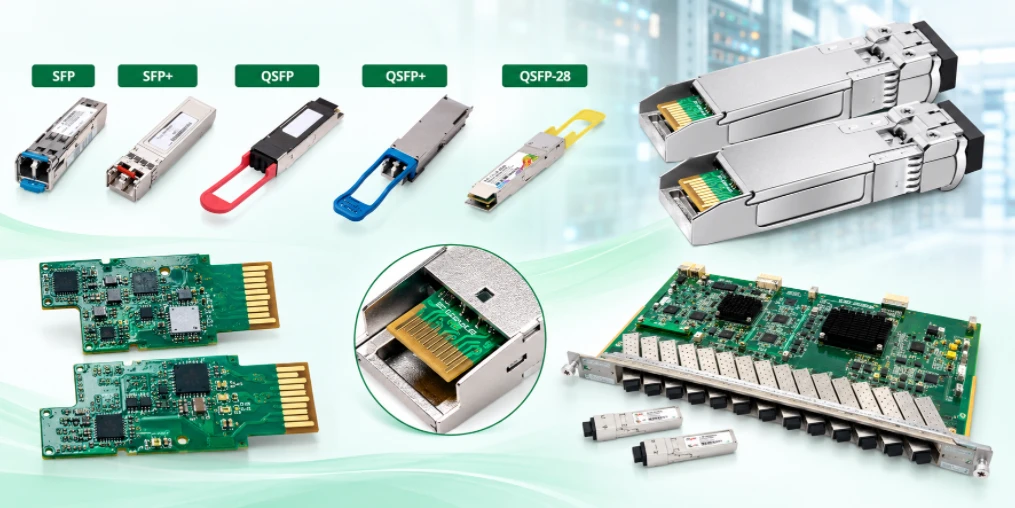
Optical Transceiver PCB Assembly Services in China
Highleap Electronics provides optical transceiver PCB...
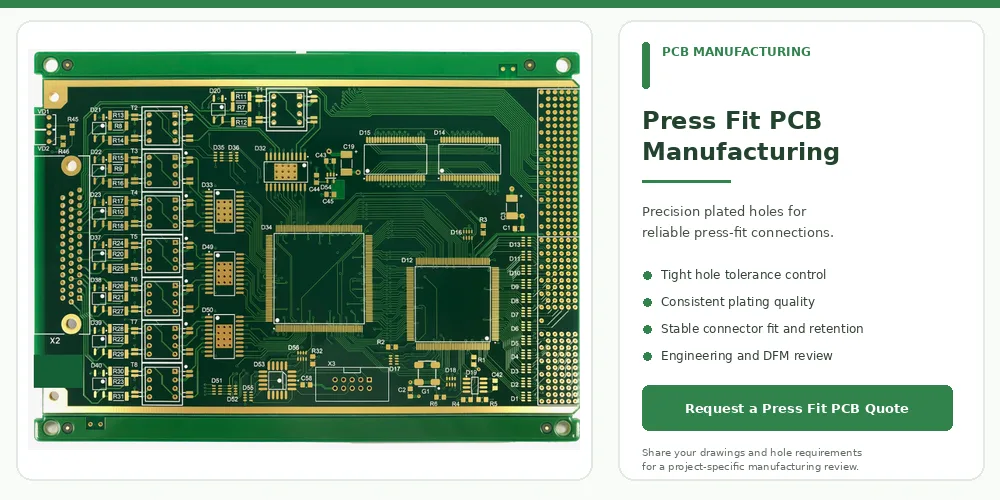
Precision Press Fit PCB Manufacturing with Tight Tolerances
Press-fit PCB manufacturing requires close coordination...
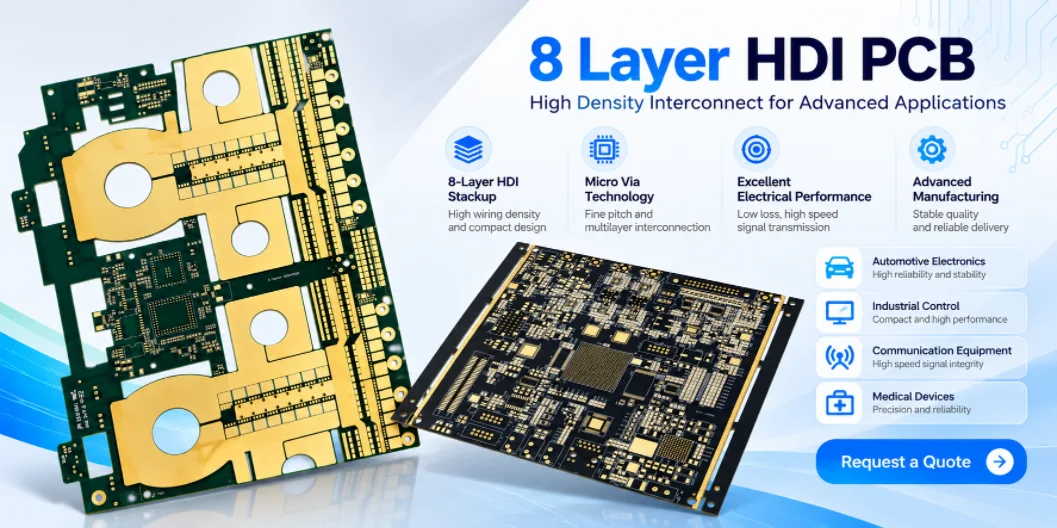
8 Layer HDI PCB Manufacturer in China
Highleap Electronics provides 8 layer HDI PCB...
8 Layer Rigid-Flex PCB Manufacturing and Cost Guide
An 8 layer rigid-flex PCB combines multilayer rigid...
How to get a quote for PCBs
Let‘s run DFM/DFA analysis for you and get back to you with a report. You can upload your files securely through our website. We require the following information in order to give you a quote:
-
- Gerber, ODB++, or .pcb, spec.
- BOM list if you require assembly
- Quantity
- Turn time
In addition to PCB manufacturing, we offer a comprehensive range of electronic services, including PCB design, PCBA, and turnkey solutions. Whether you need help with prototyping, design verification, component sourcing, or mass production, we provide end-to-end support to ensure your project’s success.
For PCBA services, please provide your BOM (Bill of Materials) and any specific assembly instructions. We also offer DFM/DFA analysis to optimize your designs for manufacturability and assembly, ensuring a smooth production process.