
MCPCB Cost Reduction: A Strategic Guide for Buyers

Why Cost Optimization Matters in MCPCB Manufacturing
Cost optimization in metal core PCB manufacturing has become a key concern for buyers seeking high thermal performance without overspending. Metal core printed circuit boards are widely adopted in high-power LED lighting, power supplies, automotive electronics, and industrial equipment due to their superior heat dissipation capabilities.
However, MCPCB manufacturing costs typically exceed traditional FR4 boards by 30 to 50 percent, driven by specialized materials and processing requirements. This guide explores practical strategies for mcpcb cost reduction through design refinement, materials selection, and production efficiency improvements that help procurement teams achieve better value without compromising performance.
Understanding Major Cost Drivers in Metal Core PCB
Identifying where expenses accumulate in MCPCB production is essential for targeting effective mcpcb cost reduction initiatives. The cost structure breaks down into distinct categories that each present optimization opportunities.
Material Cost Components
The metal substrate represents the largest single expense, accounting for 40 to 50 percent of total material costs depending on thickness and composition. The dielectric insulation layer adds significant cost, particularly when high-performance polymers are specified. Copper foil thickness and type contribute additional material expenses that vary based on current-carrying requirements.
Processing and Quality Costs
Key processing expenses that impact overall mcpcb cost reduction potential include:
- Specialized tooling – Drilling through metal substrates requires carbide or diamond-coated tools that wear faster than standard PCB bits, increasing replacement costs.
- Precision etching control – Tightly managed etching prevents shorts on thermally conductive substrates, demanding rigorous quality monitoring.
- Premium surface finishes – ENIG commands higher pricing than HASL while offering superior planarity and shelf life for demanding applications.
- Engineering setup – Design rule verification, tooling preparation, and electrical testing fixtures must be amortized across production volumes.
Yield rates directly impact unit economics, as metal core boards prove less forgiving of process variations. Production batch size creates significant economies of scale since setup costs remain relatively fixed regardless of order quantity.
Design Strategies for MCPCB Cost Reduction
The design phase represents the most impactful opportunity for cost-effective metal core pcb development, as early decisions determine 60 to 70 percent of final manufacturing expenses.
Optimizing Substrate and Copper Specifications
Selecting substrate and copper thickness based on actual thermal and electrical needs can significantly reduce material costs. Many designs perform well with 1.0 mm or 1.5 mm aluminum substrates instead of default 2.0 mm options. Thermal analysis ensures thinner bases still meet performance targets.
Similarly, copper weight should align with current requirements—1 oz or 2 oz copper typically suffices, while heavier options increase cost and processing complexity. Evaluating current density allows simultaneous optimization of trace width and copper thickness for effective MCPCB cost reduction.
Standardization and Panelization Techniques
Board dimensions and contours significantly affect manufacturing efficiency. Key standardization practices that enable cost-effective metal core pcb production include:
- Rectangular board profiles – Standard dimensions maximize material utilization compared to irregular shapes requiring custom tooling.
- Consistent corner radii – Uniform radius specifications reduce routing complexity and minimize tool wear across production runs.
- Simplified internal cutouts – Avoiding tight internal features eliminates specialized machining operations that increase processing time.
- Strategic panelization – Arranging multiple boards within production panels increases throughput and reduces per-unit handling costs.
Component Layout Optimization
Distributing heat-generating components across the board surface prevents localized thermal stress that can cause delamination. Proper spacing between high-power devices allows efficient heat spreading through the metal core, potentially enabling thinner dielectric layers that cost less.
Design for manufacturability reviews conducted with fabricators during prototyping typically identify cost savings equivalent to 5 to 15 percent of production expenses. This collaborative approach to mcpcb cost reduction catches issues before tooling commitments lock in design specifications.
Material Selection for Cost-Effective MCPCB
Strategic material selection balances thermal performance with cost to achieve optimal value in metal core PCB manufacturing.
Substrate Material Comparison
- Aluminum dominance – Aluminum offers the best cost-performance ratio, typically 40–60% cheaper than copper while providing sufficient thermal conductivity for most designs.
- Copper justification – Copper is reserved for extreme heat flux or applications demanding superior dimensional stability under thermal cycling.
- Alloy optimization
- 5052 alloy: good thermal conductivity and formability at the lowest cost.
- 6061 alloy: higher mechanical strength for structural applications, at a modest premium.
- Cost tip – Specify only the minimum alloy grade that meets requirements to avoid unnecessary expense.
Dielectric Layer Selection
- Thermal range selection – Standard dielectrics with 1–2 W/mK conductivity meet most LED and power supply needs at the lowest cost.
- Premium materials – High-performance dielectrics (3–4 W/mK or more) should be used only when thermal analysis proves necessity.
- Optimization insight – Over-specifying dielectric performance is common and often increases cost without real thermal benefit.
Copper Cladding Considerations
- Material choice – Standard electrodeposited copper provides equivalent electrical performance to rolled annealed types at lower cost.
- Thickness standardization – Use standard 1 oz or 2 oz copper thicknesses to simplify procurement and minimize expense.
- Cost efficiency – Avoid custom copper specifications unless critical for performance, supporting overall MCPCB cost reduction goals.
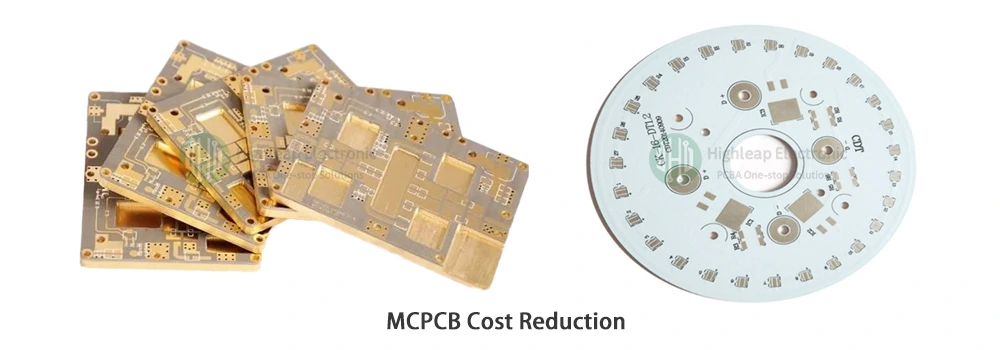
Manufacturing Process Efficiency for Cost Reduction
Production methods and volume directly influence unit cost in metal core PCB fabrication. Optimizing these factors enables effective MCPCB cost reduction through improved manufacturing efficiency.
Volume Economics and Batch Production
Larger batch sizes significantly lower per-unit costs by spreading setup expenses for drilling, lamination, and testing. Orders above 500–1000 units can reduce unit cost by 20–35%. Annual volume commitments also improve material procurement and scheduling, creating consistent savings for cost-effective metal core PCB production.
Process Standardization and Automation
Automated film application, registration, and laser routing reduce labor and scrap while improving consistency. Standardized, well-proven manufacturing processes deliver higher yields and shorter lead times, minimizing rework and overall cost.
Quality Integration for Yield Improvement
Integrating quality control throughout production identifies defects early, when corrections are least costly. Intermediate electrical testing prevents defective boards from reaching final assembly, improving yield and sustaining long-term MCPCB cost reduction.
Supply Chain Strategy for MCPCB Cost Reduction
Effective supply chain management goes beyond quoted prices to address total cost of ownership. Strategic procurement practices enable sustained MCPCB cost reduction.
Partnership and Volume Consolidation
Long-term partnerships with capable manufacturers reduce communication costs and enable process improvements. They also provide bulk order discounts and scheduling priority during high-demand periods.
Consolidating multiple designs into shared production runs enhances economies of scale. Key approaches include:
- Annual volume commitments – Allow manufacturers to optimize material purchasing and secure stable pricing.
- Blanket purchase orders – Improve production scheduling and share cost savings with buyers.
- Multi-design batching – Combine different boards in one run to spread setup costs.
- Collaborative forecasting – Enable better capacity and material planning for consistent supply.
These methods typically yield 10–20% lower costs compared to individual small orders.
Total Cost of Ownership Analysis
Comprehensive cost evaluation includes logistics, inventory, quality control, and rework—not just unit price. Assessing suppliers by delivery reliability, consistency, and technical support uncovers real cost differences.
A slightly higher piece price may offer better value if improved quality reduces assembly defects and field failures. Collaboration between engineering and procurement teams further enhances cost-effective metal core PCB sourcing through design and process optimization.
Typical MCPCB Cost Structure Breakdown
Understanding typical metal core PCB cost distribution provides useful context for prioritizing mcpcb cost reduction efforts. Material expenses represent approximately 55 to 65 percent of total costs, with the metal substrate alone accounting for 35 to 45 percent. Processing operations including drilling, imaging, etching, and surface finishing comprise 20 to 25 percent of expenses.
Testing, packaging, and quality assurance add 8 to 12 percent, while logistics and administrative overhead account for the final 5 to 8 percent. This distribution suggests that material selection and design optimization targeting substrate specifications offer the greatest cost reduction potential, with processing efficiency and quality yield enhancement delivering secondary but meaningful benefits.
Conclusion: Achieving Sustainable MCPCB Cost Reduction
Sustainable MCPCB cost reduction requires a holistic approach that integrates design optimization, material selection, efficient manufacturing, and strategic procurement. Eliminating unnecessary design margins, specifying materials based on real performance needs, and streamlining production processes all contribute to measurable savings without compromising reliability or thermal performance.
How Highleap Electronics Helps You Reduce MCPCB Costs
- Design Optimization – Our engineers analyze thermal and electrical requirements to eliminate over-specification and optimize stack-up and copper usage.
- Material Selection Guidance – We help clients choose cost-effective aluminum alloys and dielectric materials that meet performance targets at the lowest total cost.
- Scalable Manufacturing – Through standardized processes, automated production, and batch volume management, we ensure consistent quality with reduced per-unit cost.
- Strategic Procurement Support – We collaborate with purchasing teams to plan volume production, coordinate delivery schedules, and identify long-term cost-saving opportunities.
Partner with Highleap Electronics to develop cost-effective metal core PCB solutions that balance performance, quality, and budget. Our integrated engineering and manufacturing expertise helps you achieve lasting value in every production run.

Recommended Posts
Taconic RF 35 vs RO4350B PCB
Table of contentsRF-35 vs RO4350B Procurement and...
TMM4 Filter PCB Manufacturing
TMM4 filter PCB manufacturing is controlled by the...
TMM3 PCB Manufacturing for RF Modules
TMM3 PCB manufacturing is most useful where the RF module...
TMM6 PCB Fabrication
TMM6 fabrication is the process-control page for a mid-Dk...
How to get a quote for PCBs
Let‘s run DFM/DFA analysis for you and get back to you with a report. You can upload your files securely through our website. We require the following information in order to give you a quote:
-
- Gerber, ODB++, or .pcb, spec.
- BOM list if you require assembly
- Quantity
- Turn time
In addition to PCB manufacturing, we offer a comprehensive range of electronic services, including PCB design, PCBA, and turnkey solutions. Whether you need help with prototyping, design verification, component sourcing, or mass production, we provide end-to-end support to ensure your project’s success.
For PCBA services, please provide your BOM (Bill of Materials) and any specific assembly instructions. We also offer DFM/DFA analysis to optimize your designs for manufacturability and assembly, ensuring a smooth production process.