
Industrial Robot PCB for Servo Drives and Controllers

Industrial robot systems run 24/7 in electrically noisy, high-vibration factory environments. For OEMs and integrators, the real intent behind “industrial robot PCB” is not definitions—it’s how to build boards that stay stable under high current, fast comms, thermal stress, and long lifecycle requirements.
Highleap Electronics is a PCB manufacturing and PCB assembly factory delivering industrial-grade robot control and power boards from prototype to mass production. We support motion control, safety I/O, servo drive interfaces, vision & sensor hubs, and robot accessory electronics with production-ready DFM and rigorous verification.
Table of Contents
- What Industrial Robot PCBs Must Deliver
- Robot Electronics Architecture
- Design & Layout Priorities
- Power & Motor Drive PCB Considerations
- PCB Fabrication for Industrial Robotics
- PCB Assembly, Protection, and Integration
- Inspection & Testing for High Reliability
- Applications: Arms, AGVs/AMRs, and Robot Dogs
- RFQ Checklist
- Conclusion
What Industrial Robot PCBs Must Deliver
Industrial robot PCBs are built around three realities: high-current actuation, deterministic control, and harsh environments. Compared with general electronics, your PCB and PCBA must be designed for long duty cycles, electrical noise immunity, and predictable timing.
- Deterministic timing: stable clocking, clean power rails, and low-jitter signal paths for multi-axis coordination.
- EMI resilience: strong return-path control, filtering, shielding strategy, and separation of noisy power domains.
- Thermal robustness: controlled heat flow from drivers, regulators, and connectors; stable materials and stackups.
- Mechanical reliability: vibration-resistant assembly, reinforced heavy parts, connector robustness, and strain relief planning.
- Lifecycle support: traceability, consistent builds, and repeatable testing for long-term field supply.
If you’re selecting a supplier, align expectations early: PCB capability, PCBA yield strategy, and end-of-line testing. Highleap supports both fabrication and assembly through PCB assembly services and turnkey PCB assembly when you want a single responsibility chain.
Robot Electronics Architecture
Most industrial robots (and modern quadruped robot dogs) share a common electronics breakdown. These subsystems also reflect how OEMs and integrators typically define requirements and source boards:
- Main control / compute: real-time controller + high-speed interfaces to servo drives, safety I/O, and industrial networks.
- Vision subsystem: camera/ISP or vision compute with high-speed routing constraints and strict EMC discipline.
- Sensor hub: IMU, encoders, ToF/ultrasonic, force/torque, temperature, and condition monitoring inputs.
- Drive / actuation: servo/BLDC control, current sensing, gate drive loops, and thermal management.
- Power & charging: DC bus input, DC/DC rails, protection, and battery management for mobile platforms.
- Accessories & peripherals: teach pendant/remote controller, docking station, wireless links, I/O expansion, and safety modules.
In real procurement, buyers often search by the exact module they need (controller PCB, servo/drive PCB, sensor hub PCB, docking/charging PCB, safety I/O PCB) rather than using only broad terms—so it’s useful to define your board set in this subsystem language.
Design & Layout Priorities
Industrial robot PCB design is dominated by power integrity, EMC, and maintainability. Below are the layout priorities that most often determine field stability:
1) Domain partitioning and return paths
- Separate high di/dt motor/power regions from low-noise sensing and clocks.
- Design explicit return paths under high-speed traces; avoid split planes under critical links.
- Use star-point or controlled single-point strategies where isolation and safety require it.
2) High-speed interfaces and signal integrity
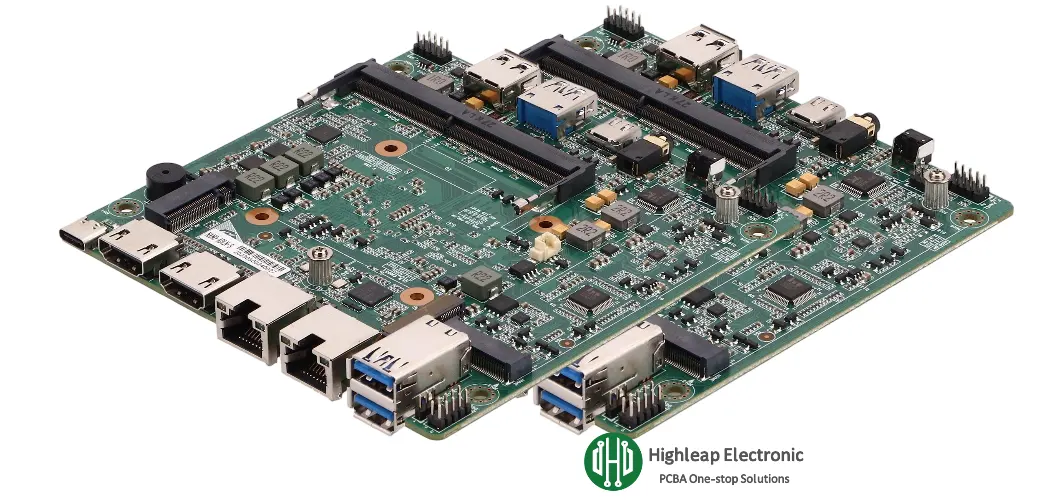
- Length matching and impedance control for camera, Ethernet, and fast memory interfaces.
- Connector selection and placement that preserves differential pair geometry.
- Stackup planning for stable reference planes and predictable impedance.
For designs with multi-gigabit links, follow proven routing practices from high-speed PCB design and validate early to avoid expensive respins.
3) Testability and serviceability
- Accessible test points for key rails, comms, and control loops.
- Clear labeling, programming headers, and consistent revision control.
- Connector anchoring and keep-outs to reduce rework damage.
4) Materials and stackup choices
For robotics, material choice is usually driven by temperature stability, CAF resistance, and reliability margin. When density or routing congestion is the limiter, consider HDI PCB manufacturing to escape fine-pitch BGAs and keep signal paths short.
Power & Motor Drive PCB Considerations
Power and drive electronics are the most failure-sensitive part of industrial robots. Heat, switching noise, and mechanical stress combine—so the PCB must be designed as part of the power stage, not just a carrier.
Motor drive loop fundamentals
- Gate-drive loop control: minimize loop inductance; keep driver-to-switch path short and symmetric.
- Current sensing integrity: Kelvin connections, proper shunt placement, and low-noise measurement routing.
- Thermal paths: copper pours, thermal vias, and heatsink interfaces that match real dissipation.
- EMI containment: snubbers, shielding strategy, and clean partitioning between power and logic.
For deeper production-oriented guidance, reference power electronics PCB design considerations and motor control layout pitfalls from motor driver PCB practices.
High-current distribution
Many industrial robot joints and servo stages demand robust copper and via reliability. When current density and temperature rise are the constraint, heavy copper PCB options can improve current carrying and thermal performance—when applied selectively and with assembly constraints considered.
PCB Fabrication for Industrial Robotics
Fabrication quality determines whether a design is manufacturable with stable yield. Industrial robotics commonly needs controlled impedance, consistent plating, and strong process traceability.
- Impedance control: stable dielectric and stackup repeatability for deterministic comms performance.
- Via reliability: plating integrity, aspect ratio control, and robust drill quality for vibration exposure.
- Solder mask & surface finish: suitable for fine pitch, high-reliability assembly, and shelf life.
- Process traceability: lot control, inspection records, and repeatability for long-term supply.
Highleap supports builds from quick-turn samples to volume production, with fabrication aligned to assembly requirements through PCB fabrication planning and DFM feedback.
PCB Assembly, Protection, and Integration
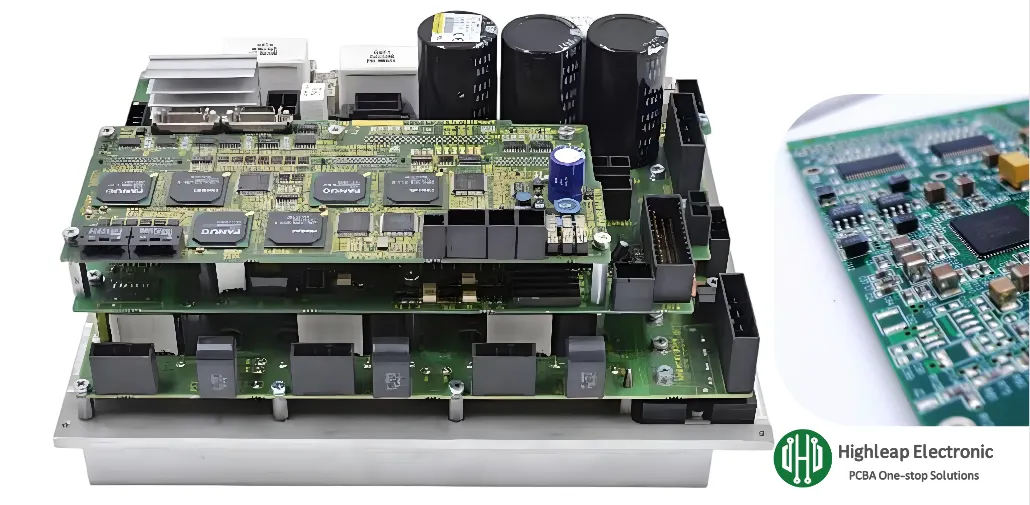
Industrial robot PCBA must survive vibration, dust, humidity, oil mist, and temperature swings. Assembly decisions (paste, profile, underfill, coating) matter as much as component selection.
Assembly process controls that protect reliability
- Profile control: correct thermal profile for mixed-mass boards (drivers + fine-pitch logic).
- BGA/QFN risk management: voiding control and verification for thermal pads and hidden joints.
- Mechanical reinforcement: staking/adhesives for tall parts, connectors, and inductors where needed.
Environmental protection
When robots work near coolant, dust, or condensation, coatings are common. Learn when to use acrylic/silicone/parylene from conformal coating practices to balance protection with reworkability.
From PCBA to full unit delivery
Many industrial robotics customers want more than a bare PCBA: harnesses, enclosure, labeling, and final integration. Highleap can extend delivery via turnkey box build assembly to reduce your vendor count and speed up ramp.
Inspection & Testing for High Reliability
To avoid field returns, inspection and testing should be layered—each stage catching the defect types it’s best at finding.
- SPI/AOI/AXI/ICT coverage: production screening to protect yield and consistency.
- X-ray inspection: critical for BGAs/QFNs and thermal pads where failures are hidden.
- ICT: fast electrical verification that components and nets behave as expected.
- Functional testing: verifies the assembled board behaves correctly under realistic operating conditions.
For production-grade screening, see comprehensive inspection. For hidden solder verification, use X-ray inspection. For electrical coverage, reference in-circuit testing (ICT). For end-use behavior validation, align with PCB functional testing methods.
Applications: Arms, AGVs/AMRs, and Robot Dogs
Industrial robot PCB demand spans more than robotic arms. Across different platforms, the “board set” typically includes control, drive, sensing, communications, and power-related modules—plus accessory electronics that ship with the system.
- Robot arms & cobots: servo drive boards, safety I/O, encoder interfaces, torque sensing, and controller backplanes.
- Welding/painting robots: power and EMC robustness; coatings and connector reliability in harsh exposure.
- AGVs/AMRs: battery management, motor control, sensor fusion hubs, and industrial comms for fleet operation.
- Quadruped robot dogs: joint drive boards, IMU/sensor hubs, vision boards, wireless links, and charging/docking electronics.
- Peripherals: teach pendants, remote controllers, docking/charging stations, safety modules, and I/O expanders—often ordered in volume.
If you also need broader industrial electronics build strategies, Highleap shares manufacturing considerations for industrial environments in industrial electronics manufacturing.
RFQ Checklist
To quote quickly and avoid back-and-forth, prepare the following (even for early prototypes):
- Gerber/ODB++, drill files, board thickness, copper weight, and stackup targets.
- BOM with manufacturer part numbers (and approved alternates if available).
- Assembly drawings, polarity notes, special process requirements (underfill, coating, staking).
- Test requirements: ICT needed or not, functional test method/fixtures, programming needs.
- Reliability expectations: environment, vibration, expected life, and any certification constraints.
Conclusion
Industrial robot PCBs are purchased for outcomes: stable motion control, clean comms, thermal survivability, predictable timing, and long service life. That requires a supplier who can align fabrication, assembly, inspection, and test into a repeatable production system.
Highleap Electronics delivers industrial robot PCB manufacturing and assembly with production-grade process control—from PCB fabrication to turnkey PCB assembly. If you’re building controllers, servo/drive electronics, sensor hubs, docking/charging accessories, or robot dog sub-assemblies, share your files and requirements and we’ll help you move from prototype to stable mass production.

Recommended Posts
Wearable Haptic Vest PCB Manufacturing & Assembly for Multi-Zone Haptic OEMs
In a wearable haptic vest, the wearer notices the...
Wearable Temperature Logger PCB Manufacturing & Assembly for BLE Sensor OEMs
A wearable temperature logger PCB is the electronic board...
Connected Safety Helmet PCB Manufacturing & Assembly for Industrial IoT OEMs
A Connected Safety Helmet PCB is an industrial IoT...
Mobile Wi-Fi Router PCB Manufacturing & Assembly for 4G/5G Hotspot OEMs
A Mobile Wi-Fi Router PCB is the production platform...
How to get a quote for PCBs
Let us run DFM/DFA analysis for you and get back to you with a report.
You can upload your files securely through our website.
We require the following information in order to give you a quote:
-
- Gerber, ODB++, or .pcb, spec.
- BOM list if you require assembly
- Quantity
- Turn time
In addition to PCB manufacturing, we offer a comprehensive range of electronic services, including PCB design, PCBA (Printed Circuit Board Assembly), and turnkey solutions. Whether you need help with prototyping, design verification, component sourcing, or mass production, we provide end-to-end support to ensure your project’s success. For PCBA services, please provide your BOM (Bill of Materials) and any specific assembly instructions. We also offer DFM/DFA analysis to optimize your designs for manufacturability and assembly, ensuring a smooth production process.