
Automotive MCPCB | Reliability Under Extreme Conditions
Introduction: Thermal Challenges in Automotive Electronics
Automotive electronic systems operate in exceptionally demanding environments where temperatures can exceed 125°C under hood conditions, while simultaneously enduring constant vibration, humidity fluctuations, and thermal cycling. These harsh conditions create significant thermal management challenges that directly impact component reliability and system longevity.
Automotive MCPCB technology has emerged as a critical solution, offering superior heat dissipation capabilities that maintain stable operation even when conventional circuit boards fail. The ability to efficiently transfer heat away from sensitive components has become essential as automotive electronics increase in power density and complexity, making metal core PCB solutions indispensable for thermal management automotive electronics applications.
Why Automotive MCPCB Outperforms Traditional PCB Materials
Metal Core Printed Circuit Boards feature a distinctive three-layer structure consisting of a copper circuit layer, a thermally conductive dielectric layer, and a metal substrate base typically made from aluminum or copper. This construction fundamentally differs from standard FR4 boards, which rely on fiberglass-epoxy materials with poor thermal conductivity of approximately 0.3 W/mK.
Automotive MCPCB designs achieve thermal conductivity ranging from 1.0 to 8.0 W/mK depending on the dielectric material selected, enabling heat to flow directly into the metal base layer where it dissipates rapidly. The performance advantages include:
- Thermal superiority – Heat dissipation rates up to 26 times faster than FR4, directly reducing component junction temperatures and extending operational life.
- Mechanical stability – The rigid metal substrate provides exceptional dimensional stability under thermal stress, reducing warpage and maintaining precise component alignment throughout the board’s operational life.
- Vibration resistance – Metal core construction prevents board flexure that typically causes solder joint failure in standard PCB materials under constant automotive vibration.
Core Automotive MCPCB Application Areas
Engine Control Units and Power Management
Engine Control Units (ECUs) operate in the vehicle’s highest temperature zones, where thermal management in automotive electronics is most demanding. Power transistors, regulators, and microcontrollers produce considerable switching heat, and insufficient dissipation can lead to thermal runaway or system failure.
Automotive MCPCB assemblies—typically aluminum-based—create a direct thermal path from components to the chassis or heatsink. A well-designed ECU using a 2.0 W/mK dielectric layer can achieve junction-to-case resistance below 2°C/W, compared to 8–10°C/W in FR4 designs.
Key advantages include:
- Shortest thermal path – Direct heat flow through aluminum base maintains safe junction temperatures.
- Extended component life – Lower thermal resistance prevents overheating and degradation.
- Higher power density – Improved heat transfer supports compact, high-reliability ECU designs.
Automotive Lighting Systems with MCPCB Technology
LED headlights, DRLs, and tail lamps demand strict thermal control to maintain brightness and color stability. Every 10°C rise in LED junction temperature can shorten lifespan by up to 50%, highlighting the importance of effective heat spreading.
Automotive lighting PCB designs using metal core technology ensure efficient heat transfer and optical consistency. Aluminum-based LED headlight MCPCB structures often employ a white solder mask to enhance light reflection while aiding thermal dissipation.
Design benefits:
- Stable optical performance – Controlled junction temperature maintains color and brightness.
- Integrated heatsink function – Metal substrate eliminates separate thermal interface layers.
- Simplified assembly – Fewer materials and interfaces improve long-term reliability.
Power Modules and Electric Drive Systems
Electric and hybrid vehicles rely on DC-DC converters, inverters, and drive modules that handle hundreds of amperes. These power modules demand exceptional heat spreading to sustain efficiency and prevent component stress.
Automotive MCPCB assemblies for power modules combine high-current copper circuits with thermally conductive metal bases. Copper-based MCPCB solutions deliver superior thermal performance for extreme power densities.
Performance highlights:
- High thermal conductivity – Copper cores reach up to 400 W/mK, far beyond aluminum alternatives.
- Enhanced current handling – Thick copper layers support heavy-load switching operations.
- Compact high-power design – Enables smaller, lighter, and more efficient drive systems despite higher cost.

Automotive MCPCB Reliability Under Extreme Conditions
Automotive environments expose electronic assemblies to intense heat, vibration, and humidity. Reliable metal core PCB solutions must maintain stable performance under these combined stress factors:
- Thermal cycling endurance – Survives -40°C to +150°C transitions through thousands of cycles without delamination or loss of conductivity.
- Mechanical durability – Withstands vibrations from 10 Hz to 2000 Hz up to 30g acceleration per ISO 16750.
- Environmental protection – Resists corrosion and moisture through advanced surface finishes and material integrity.
Thermal Cycling Performance
Automotive MCPCB assemblies endure continuous temperature cycling throughout vehicle life. Mismatched thermal expansion between materials can cause delamination or solder fatigue if unmanaged.
Metal core PCB structures minimize this risk through optimized material pairing. Aluminum substrates (≈23 ppm/°C) closely match copper circuits (≈17 ppm/°C), reducing CTE stress compared to FR4, which expands up to 70 ppm/°C along the Z-axis. AEC-Q200 qualification confirms stable thermal and electrical performance through 1000+ thermal cycles.
Key reliability factors:
- Optimized CTE alignment – Reduces expansion mismatch and prevents cracking or delamination.
- Thermal stability – Maintains electrical integrity under continuous -40°C to +150°C cycling.
- Proven automotive qualification – Tested per AEC-Q200 for long-term reliability compliance.
Mechanical Durability and Vibration Resistance
Automotive MCPCB designs provide structural rigidity that resists vibration-induced fatigue. Unlike FR4 boards, the metal base prevents flexing, which typically leads to cracked solder joints or trace fractures.
Testing to ISO 16750 shows that metal core assemblies endure full-spectrum vibration exposure without mechanical failure. The rigid base layer also eliminates the need for additional mechanical supports, simplifying design and reducing system weight.
Vibration-resistant design benefits:
- Rigid metal base – Prevents board flexure and solder fatigue.
- Reduced structural components – Minimizes mounting hardware and overall mass.
- Consistent reliability – Maintains mechanical integrity across vehicle lifespan.
- Environmental Protection
Automotive MCPCB construction offers strong defense against moisture and chemicals. Surface finishes such as OSP, ENIG, or conformal coatings protect copper traces and metal substrates from corrosion.
The metal base itself acts as a moisture barrier, preventing vapor penetration common in FR4 under high humidity. Production under IATF 16949 standards ensures material traceability, process control, and consistent product quality.
Environmental reliability measures:
- Moisture barrier base – Stops humidity-induced delamination and leakage paths.
- Protective finishes – ENIG, OSP, and coatings guard against oxidation and corrosion.
- Certified manufacturing – IATF 16949 compliance guarantees repeatable automotive-grade reliability.
Design and Manufacturing Considerations for Automotive MCPCB
Engineers developing automotive MCPCB assemblies must balance several competing factors to optimize thermal performance while meeting cost and manufacturing constraints. Critical design parameters include:
- Dielectric layer optimization – Thickness selection between 50 μm and 150 μm balancing thermal resistance against voltage isolation requirements.
- Substrate material selection – Choosing between aluminum for cost-effective solutions and copper for extreme thermal performance applications.
- Surface finish compatibility – Selecting ENIG for wire bonding capability or OSP for high-volume cost efficiency.
- Thermal path design – Component placement strategies that minimize thermal coupling and eliminate local hot spots.
Thermal simulation using finite element analysis should occur early in the design process to validate heat dissipation strategies before committing to prototypes. Critical components require careful placement analysis to ensure that local hot spots remain within acceptable limits.
Sample board validation under actual operating conditions confirms that the design meets reliability targets and identifies any necessary refinements before volume production begins. This validation phase proves essential for avoiding costly design iterations after tooling investment.
Conclusion: Ensuring Long-Term Reliability in Automotive Systems
Automotive MCPCB technology underpins reliable thermal management in modern vehicles, ensuring stable operation across power control, lighting, and electric drive systems. Its combination of high thermal conductivity, mechanical robustness, and environmental resistance enables consistent performance under extreme automotive conditions.
As power density and system complexity increase, advanced metal core PCB solutions become essential for maintaining reliability and meeting industry standards for durability and safety. Highleap Electronics delivers automotive-grade MCPCB solutions with:
- Proven reliability – IATF 16949 certified production with full material and process traceability.
- Thermal design expertise – Optimized stack-ups and dielectric configurations for efficient heat transfer.
- Comprehensive engineering support – From prototype evaluation to volume manufacturing.
- Application versatility – Solutions tailored for engine control, LED lighting, and power management modules.

Recommended Posts
Prototype PCB Assembly: From Design Files to Tested Boards
Highleap Electronics builds prototype PCB assemblies for...
Hard Gold Finger PCB Manufacturing: Plating and Beveling
Hard gold finger PCB manufacturing is used when a circuit...
Small PCB Panelization: Array Design and Depaneling
Imagine a 26 × 18 mm circuit that must pass through...
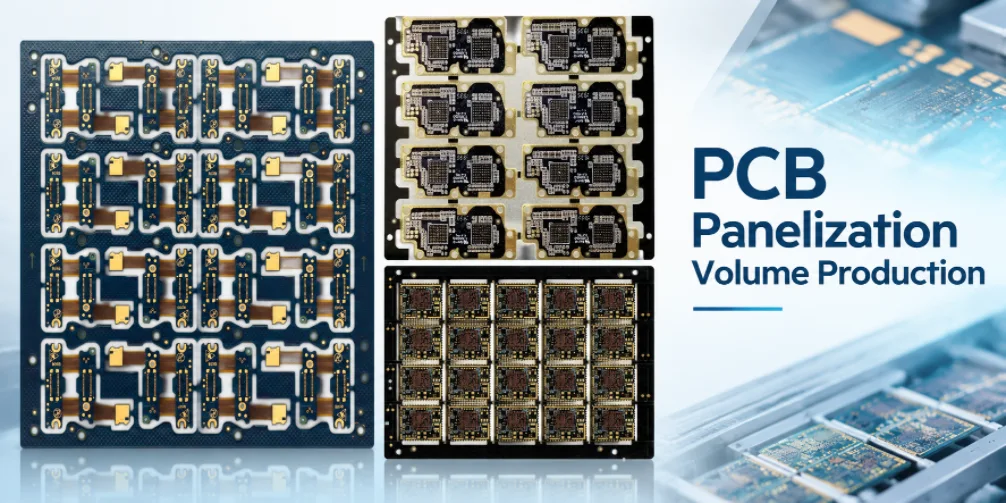
PCB Panelization for Volume Production: Cost and Yield
A fabrication panel that holds more boards is not...
How to get a quote for PCBs
Let‘s run DFM/DFA analysis for you and get back to you with a report. You can upload your files securely through our website. We require the following information in order to give you a quote:
-
- Gerber, ODB++, or .pcb, spec.
- BOM list if you require assembly
- Quantity
- Turn time
In addition to PCB manufacturing, we offer a comprehensive range of electronic services, including PCB design, PCBA, and turnkey solutions. Whether you need help with prototyping, design verification, component sourcing, or mass production, we provide end-to-end support to ensure your project’s success.
For PCBA services, please provide your BOM (Bill of Materials) and any specific assembly instructions. We also offer DFM/DFA analysis to optimize your designs for manufacturability and assembly, ensuring a smooth production process.