
Heavy Copper PCB for Electric Vehicles: Essential Guide for Power Electronics

Introduction
Electric vehicles demand exceptional electrical and thermal performance from their power electronics and charging systems. High current loads, elevated operating temperatures, and compact packaging create challenging conditions that conventional PCB technology cannot adequately address. Heavy Copper PCB for electric vehicles plays a vital role in handling high current loads, managing heat efficiently, and ensuring long-term reliability in power electronics and charging systems.
With copper thicknesses ranging from 3oz to 10oz or more, these specialized circuit boards provide the electrical conductivity, thermal dissipation capacity, and mechanical strength required for mission-critical EV applications. As electric vehicle adoption accelerates globally, heavy copper PCB technology has become indispensable for manufacturers seeking to deliver safe, efficient, and durable power management solutions.
Why Heavy Copper PCB is Essential for Electric Vehicles
High Current and Thermal Stress in EV Power Modules
Electric vehicle power systems operate under extreme conditions that standard PCBs cannot sustain. Battery packs deliver currents exceeding 200A during acceleration and fast charging, while power conversion modules handle continuous loads between 50A and 150A. These high current densities generate substantial heat within confined spaces, creating thermal stress that degrades conventional copper traces.
Heavy Copper PCB designs address these challenges through thicker copper layers that reduce electrical resistance, minimize voltage drops, and distribute heat more effectively across the board surface. The enhanced thermal mass of thick copper planes absorbs transient heat spikes while maintaining stable junction temperatures.
Limitations of Standard PCBs Under High Load Conditions
Traditional 1oz to 2oz copper thickness PCBs exhibit critical limitations in electric vehicle applications:
- Thermal failure – Thin copper traces overheat rapidly under sustained high current, accelerating solder joint fatigue and component degradation.
- Power loss – Increased resistance in standard copper layers causes measurable efficiency losses that directly impact vehicle range.
- Mechanical stress – Thermal expansion mismatches between thin copper and substrate materials lead to premature circuit failure.
Heavy Copper PCB for electric vehicles eliminates these constraints by incorporating copper planes up to ten times thicker than standard boards, ensuring stable operation even under peak load conditions while maintaining mechanical integrity throughout the vehicle’s operational lifespan.
Key Applications of Heavy Copper PCB in Electric Vehicles
Battery Management System (BMS)
Battery Management Systems require precise current monitoring and robust protection circuits to safeguard lithium-ion cell arrays. Heavy Copper PCB implementations in BMS applications reduce resistive losses in current sensing paths, improve short-circuit withstand capability, and ensure reliable operation of voltage sampling networks.
The thick copper layers support high-current MOSFET drivers and cell balancing circuits while maintaining thermal stability during rapid charge and discharge cycles. This configuration extends battery life and enhances system safety by preventing thermal runaway conditions that could compromise the entire battery pack.
DC-DC Converters and Inverters
DC-DC converters and three-phase inverters in electric vehicles must handle transient currents and pulsed loads without compromising efficiency. Heavy Copper PCB designs provide stable power paths that minimize electromagnetic interference and improve thermal conductivity to heat sinks.
The low-resistance copper planes reduce switching losses in power semiconductors, enabling higher conversion efficiencies and more compact module designs. This approach proves essential for 400V and 800V architectures where power density and thermal management directly impact vehicle range and performance.
On-Board Charger Control Boards
On-board chargers incorporate high-voltage rectification stages and power factor correction circuits that demand robust current-carrying capacity. Heavy Copper PCB technology prevents copper foil burnout during sustained charging operations while maintaining precise voltage regulation.
The enhanced thermal dissipation capabilities allow charger modules to operate at higher power levels without requiring oversized cooling systems. Typical OBC implementations utilize 4oz to 8oz copper thickness to safely handle input currents up to 32A at 240VAC single-phase or higher for three-phase configurations.
Motor Drive Controller Applications
Electric motor controllers combine high-frequency PWM drive signals with power switching devices in dense layouts. Heavy Copper PCB for electric vehicles ensures balanced current distribution across parallel IGBT or MOSFET arrays while managing the substantial heat generated during motor acceleration.
The thick copper planes serve dual purposes as both current-carrying conductors and thermal spreaders, reducing the need for external heat management components. This integration improves system reliability and enables more aggressive power output profiles without thermal limitations.
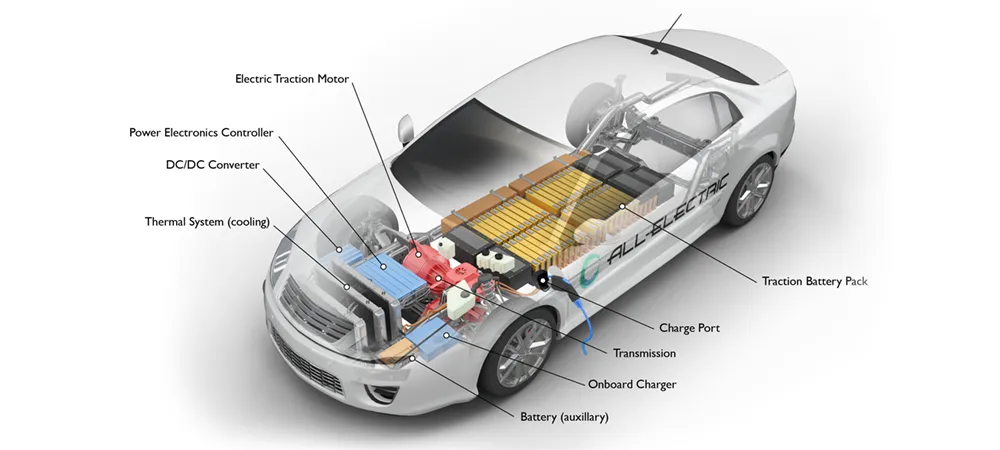
Electric Vehicles
Heavy Copper PCB for EV Charging Infrastructure
Fast Charging Station Power Modules
Electric vehicle charging infrastructure presents equally demanding requirements for heavy copper circuit boards. DC fast charging systems operating at 400V to 800V with currents exceeding 200A require PCBs with 3oz to 10oz copper thickness for safe, continuous operation.
Charging station power modules, contactor driver boards, and communication control units all benefit from the enhanced current capacity and thermal performance that heavy copper construction provides. The reduced electrical resistance in thick copper traces minimizes energy losses during power conversion, improving overall charging station efficiency.
Thermal Management in Charging Applications
Fast charging applications particularly benefit from Heavy Copper PCB technology due to the extreme thermal cycling these systems experience. Charging sessions generate significant heat buildup that must dissipate rapidly to prevent equipment degradation.
Heavy copper layers act as integrated heat spreaders, conducting thermal energy away from critical components and distributing it across larger board areas. This thermal management capability enables charging stations to maintain rated output power continuously without throttling, reducing charging times and improving user experience.
Design and Manufacturing Considerations for Heavy Copper PCB
Copper Thickness Selection and Current Capacity
Selecting appropriate copper thickness requires careful analysis of expected current levels, ambient temperatures, and allowable voltage drops. Heavy Copper PCB for electric vehicles typically employs the following specifications:
- 4oz copper – Moderate current applications handling 50A to 100A continuous load with good thermal performance.
- 6oz to 8oz copper – High-power modules exceeding 100A continuous operation requiring enhanced heat dissipation.
- 10oz copper – Extreme applications with peak currents above 200A demanding maximum thermal and electrical capacity.
Layer stackup design must account for impedance control, signal integrity requirements, and thermal via placement to optimize both electrical and thermal performance across all operating conditions.
Manufacturing Process Control
Manufacturing heavy copper boards demands precise electroplating control to achieve uniform copper distribution across panel surfaces and within plated through-holes. Advanced process monitoring ensures consistent copper thickness across production runs while maintaining tight dimensional tolerances.
Critical manufacturing parameters include plating bath chemistry control, current density optimization, and panel rotation scheduling to prevent thickness variations. Post-plating inspection verifies copper uniformity through cross-sectional analysis and microstructure examination.
Reliability Testing and Validation
Automotive-grade Heavy Copper PCB undergoes comprehensive reliability testing to verify performance under real-world conditions:
- Thermal cycling – Testing between -40°C and 125°C confirms solder joint integrity and material compatibility under temperature extremes.
- Vibration testing – Mechanical stress simulation validates thick copper feature stability under road-induced vibration profiles.
- Thermal imaging – Non-destructive testing identifies hot spots and verifies thermal distribution across populated assemblies.
Highleap Electronics implements rigorous quality controls including peel strength testing, microsectioning analysis, and electrical performance validation to ensure every board meets automotive reliability standards before shipment.
Conclusion
Heavy Copper PCB for electric vehicles delivers the electrical capacity, thermal management, and mechanical reliability that modern EV power systems and charging infrastructure demand. From battery management and motor control to fast charging stations, these specialized circuit boards enable the high-performance operation that defines electric mobility. The combination of thick copper layers, precision manufacturing, and rigorous testing ensures that critical automotive electronics function reliably throughout demanding operating conditions.
Highleap Electronics Advanced Manufacturing Capabilities:
- Copper thickness range – 3oz to 12oz copper with precise thickness control and uniform distribution across panel surfaces.
- Automotive-grade quality – IATF 16949 certified processes with comprehensive testing protocols for EV applications.
- Design optimization – Experienced engineering team collaborates on thermal simulation, current capacity analysis, and stackup design.
- Fast turnaround – Flexible production scheduling supports prototype development and volume manufacturing requirements.
Contact Highleap Electronics to discuss your Heavy Copper PCB requirements for electric vehicle projects. Our manufacturing capabilities and technical expertise help accelerate your development timeline while ensuring reliable, high-performance circuit boards for demanding automotive applications.

Recommended Posts
Hard Gold Finger PCB Manufacturing: Plating and Beveling
Hard gold finger PCB manufacturing is used when a circuit...
Small PCB Panelization: Array Design and Depaneling
Imagine a 26 × 18 mm circuit that must pass through...
PCB Panelization for Volume Production: Cost and Yield
A fabrication panel that holds more boards is not...
PCB SET Delivery and Panelization: Quantities and Acceptance
A purchase order for “500 SET” looks straightforward until...
How to get a quote for PCBs
Let‘s run DFM/DFA analysis for you and get back to you with a report. You can upload your files securely through our website. We require the following information in order to give you a quote:
-
- Gerber, ODB++, or .pcb, spec.
- BOM list if you require assembly
- Quantity
- Turn time
In addition to PCB manufacturing, we offer a comprehensive range of electronic services, including PCB design, PCBA, and turnkey solutions. Whether you need help with prototyping, design verification, component sourcing, or mass production, we provide end-to-end support to ensure your project’s success.
For PCBA services, please provide your BOM (Bill of Materials) and any specific assembly instructions. We also offer DFM/DFA analysis to optimize your designs for manufacturability and assembly, ensuring a smooth production process.