
Industrial Robot PCB for Controllers, Servo Drives, Safety and Certification
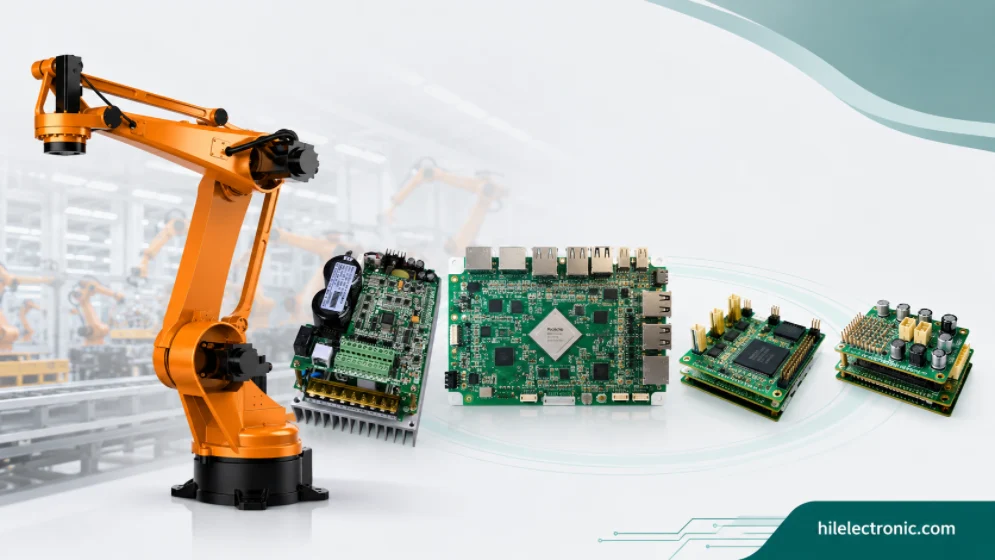
Industrial robot PCBs support fixed-base arms, gantry robots, collaborative industrial systems, welding robots, palletizing robots, and other factory automation platforms. They must survive high duty cycles, electrical noise, long service life, safety requirements, and maintenance expectations that are stricter than most consumer or office electronics.
This guide explains industrial robot PCBs from a system and manufacturing perspective: controller cabinets, distributed joint drives, industrial Ethernet, safety architecture, EMC, thermal design, documentation, and long-term support. It also corrects the original FAQ direction by replacing supplier-centered questions with industry questions that engineers, sourcing teams, and product managers actually search.
What Makes Industrial Robot Electronics Distinct
Role in the Robot System
Industrial robots — the fixed-base articulated arms that populate manufacturing lines — have specific electronics requirements that differ from other robot categories. High duty cycle, long service life, cabinet-mount controller with distributed drive electronics, and high reliability targets shape the electronics stack. What makes industrial robot electronics distinct:
- High duty cycle: many hours per day of continuous operation. Component derating and thermal design sized for continuous service.
- Long service life: 10-15 years typical for industrial arms. Component availability, capacitor life, and mechanical wear all sized for this life.
- Cabinet-mount controller: main compute lives in a control cabinet, not on the arm. Communication over cables to arm-mounted drives.
- Distributed drives: servo drives at each joint on the arm. Communication over EtherCAT, EtherNet/IP, or proprietary buses.
- Certification requirements: safety (ISO 10218), EMC (IEC 61000), and functional safety (IEC 62061). Documentation supports each.
- Retrofit and upgrade: industrial installations sometimes upgrade electronics on existing mechanical hardware. Compatible interfaces preserve upgrade paths.
Design Risks to Control
For industrial robot PCBs, manufacturability input should happen before connector placement, enclosure fit, fixture access, thermal paths, and harness routing are frozen. Late changes to these details usually trigger mechanical rework, test-fixture redesign, or reliability compromises that could have been avoided with early DFM review.
Component selection should include lifecycle status, approved alternates, package availability, temperature rating, and safety or isolation ratings where relevant. Industrial robot pcbs often stay in production or service longer than consumer electronics, so unresolved sourcing risk becomes a field-support issue, not only a purchasing issue.
At the system level, the board should be specified by function, environment, lifetime, and test coverage rather than by schematic alone. This prevents the common error of building a technically correct PCB that is difficult to fixture, hard to service, or insufficiently robust once installed in the robot.
Controller Architecture: Application, Motion, Safety
Architecture Choices for Controller Architecture
Industrial robot controller architecture typically separates high-level compute from real-time motion coordination. The main components are:
- Application processor: runs high-level robot program, teach pendant interface, and communication with plant systems. Linux or industrial OS.
- Motion coordinator: real-time coordination of the joints. Deterministic timing at kilohertz rates. Often on FPGA or dedicated processor.
- Safety controller: dedicated safety-rated processor handling stop functions and monitored operation. Independent from main controller.
- Communication interfaces: Ethernet to plant systems, industrial Ethernet (EtherCAT, PROFINET, EtherNet/IP) to peripheral equipment.
- Human-machine interface: teach pendant connection, service laptop connection, indicator lights.
- Power distribution: multiple rails for the various subsystems. Sequenced startup and shutdown.
Validation Requirements for Controller Architecture
Reliability depends on preserving the margins designed into the board: copper width, isolation spacing, thermal relief, connector retention, component derating, and inspection coverage. Manufacturing should verify these characteristics instead of treating the PCB as a generic assembly with a generic pass/fail test.
Serviceability should be considered through labelled connectors, accessible test points, clear board variants, and serial-number tracking. When a robot fails in the field, good board-level diagnostics let the service team isolate the problem quickly instead of replacing large assemblies or returning the whole robot.
The practical rule is to choose the simplest construction that still meets the signal, safety, thermal, and mechanical requirement. Over-specification raises cost, while under-specification creates rework during test or field deployment.
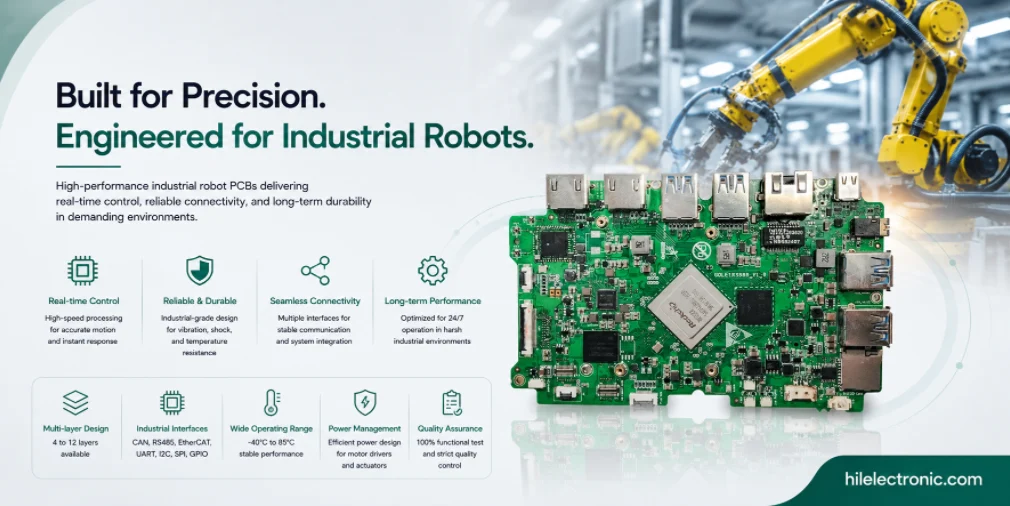
Distributed drive electronics should be reviewed with the motor driver PCB design and the robot PCB manufacturing support rather than treated as a generic control PCB.
Distributed Joint Drive Electronics
Key Design Choices for Distributed Joint Drive Electronics
Joint drive electronics on industrial arms typically live at each joint rather than in the controller cabinet. Advantages: shorter power wiring, faster motion loops, easier joint replacement. The main considerations are:
- Servo drive per joint: integrated servo drive electronics at each joint. Communication over motion bus to controller.
- Absolute encoder: position feedback surviving power cycles. Reduces startup homing sequence.
- Safety functions: Safe Torque Off, Safe Operating Stop, Safely Limited Speed as standard drive functions.
- Brake control: joint brake engagement on power loss or stop. Prevents arm drop under gravity.
- Thermal management: joint drives operate in the arm thermal environment. Sometimes constrained by arm structure cooling.
- Cable design: power plus communication plus safety signals in one cable per joint. Cable flex life matches arm service.
Manufacturing and Reliability Considerations
Test coverage discipline scales with reliability requirement. Consumer applications need less coverage than industrial; industrial less than medical; medical less than safety-critical. Matching test coverage to actual requirement preserves cost budget while providing the assurance the application needs.
Manufacturing documentation is often under-invested during design phase and expensive to construct retroactively. Per-unit test records captured during production support field investigation years later; component lot traceability supports post-mortem analysis of field returns. Programs that plan documentation early have the records they need; programs that add documentation later often lose the data they would have wanted.
Communication: EtherCAT, PROFINET, EtherNet/IP
Interface and Layout Requirements
Communication between controller cabinet and arm-mounted electronics uses industrial protocols with defined characteristics. The main options are:
- EtherCAT: deterministic Ethernet, sub-microsecond synchronisation. Standard for high-performance motion.
- PROFINET IRT: similar deterministic performance. Common in European market.
- EtherNet/IP: deterministic capability with CIP Motion. Common in North American market.
- Proprietary: vendor-specific protocols. Preserve integration but limit multi-vendor system design.
- Backup communication: some architectures use redundant communication paths for safety-related traffic.
EMC, Timing, and Test Considerations
Supply chain visibility during production affects both cost and reliability. Manufacturers with active sourcing capability absorb allocation cycles that would otherwise cause production stoppages; manufacturers without active sourcing pass through supply issues to customers. The value of active sourcing is highest during industry-wide shortages and lowest during stable supply conditions.
Design iteration cycles benefit from tight design-manufacturing feedback. A manufacturing partner who provides prompt DFM feedback enables rapid iteration; a partner who provides slow or superficial feedback slows iteration proportionally. Programs that select manufacturing partners partly on feedback quality typically move through prototype phase faster than programs that select on lowest-cost quote alone.
Industrial robot safety planning also links to the safety I/O interface, while cabinet communication depends on a robust industrial network PCB.
Safety Architecture per ISO 10218
Architecture Choices for Safety Architecture per ISO 10218
Safety architecture on industrial robots implements the requirements of ISO 10218. Main safety functions are:
- Emergency stop: category 0 or 1 stop from emergency stop devices. Redundant hardware paths.
- Protective stop: category 2 stop from safeguards. Robot stops but power maintained.
- Safe operating stop: robot maintains position under drive power. Enables manual work near stopped robot.
- Safely limited speed: speed limited during manual operation. Enables teach mode safety.
- Safe brake: brake engaged as safety function. Standalone verification of brake operation.
- Enabling device: operator input required to move robot in manual mode. Deadman functionality.
Validation Requirements for Safety Architecture per ISO 10218
Volume-band economics affect the right process choices differently at different production scales. Practices that pay back at 100,000 units per year rarely pay back at 500 units; practices that make sense at prototype rarely make sense at high volume. Matching manufacturing approach to actual production volume is what makes each volume band economically viable.
Regulatory certification obligations vary substantially by application and market. Manufacturing evidence supporting customer submissions can range from minimal (consumer products in unregulated markets) to extensive (medical devices with tight retention periods). Programs that specify certification requirements at quote get manufacturing set up correctly; programs that add certification requirements later sometimes need process changes.
Environmental and Long-Service-Life Considerations
Key Design Choices for Environmental and Long-Service-Life Considerations
Environmental and lifetime considerations shape industrial robot electronics. The main considerations are:
- Temperature range: typically 0-45 °C operational; -20 to +65 °C storage. Some applications need wider range.
- Humidity tolerance: industrial environments with condensation and washdown considerations.
- Vibration: arm-mounted electronics see acceleration during motion. Component and connector mounting sized for it.
- Cable flex life: joint cables flex millions of cycles over service life. Cable design and connector strain relief matter.
- Component derating: continuous operation for 10-15 years means components run below rated stress. Extends service life substantially.
- EMC in industrial environments: high-power adjacent equipment produces significant EMC stress. Immunity requirements demanding.
Manufacturing and Reliability Considerations
Consolidated production at one manufacturing partner preserves institutional knowledge that accumulates across product generations. A partner who has built multiple generations of similar products knows the specific issues that arise, the process tweaks that improve yield, the design patterns that manufacture well. This knowledge does not transfer to new partners without cost.
Continuing engineering-manufacturing dialogue improves both the products and the supplier relationship over time. Yield data flowing back to engineering informs design refinement; field return data flowing back informs both design and manufacturing improvements. Programs where this dialogue is active improve across product generations.
For adjacent design decisions, see the servo and BLDC controller PCB guide and the robot I/O and safety interface PCB guide.
For long-life production, Highleap can combine fabrication with robotics PCB assembly and box-build support.
Manufacturing Industrial Robot PCBs at Highleap
DFM Review Before Production
Highleap manufactures industrial robot electronics with the discipline long-service-life products need. The specific capabilities include:
- Industrial-grade component sourcing: long-availability components with defined product lifecycles. Preserves serviceability across product lifetime.
- Heavy copper for drive electronics: high-current joint drive electronics with appropriate thermal design.
- Communication interface manufacturing: EtherCAT, PROFINET, and EtherNet/IP interfaces with functional verification.
- Safety-rated production: manufacturing supporting ISO 10218 and IEC 62061 certification submissions.
- Environmental screening: thermal cycling and vibration testing on samples per production lot.
- Documentation: per-unit traceability and manufacturing records supporting customer certification and QMS integration.
Test, Traceability, and Build Handoff
The manufacturing process discipline for robotics blends practices from several traditional electronics categories. From consumer electronics — cost discipline and volume manufacturing. From industrial electronics — reliability engineering and long service life. From automotive electronics — vibration and environmental tolerance. From medical electronics — documentation and traceability. Robotics benefits from combining these.
Programs that treat manufacturing as strategic — investing in supplier relationships, sharing forecast information, coordinating on capacity — typically outperform programs that treat manufacturing transactionally. The transactional approach saves negotiation time but forfeits the compounding benefits of long-term supplier partnership.
Industrial Robot PCB FAQs
What makes an industrial robot PCB different from ordinary electronics?
Industrial robot PCBs must handle long service life, high duty cycle, motor-drive noise, cabinet or arm-mounted installation, industrial communication, safety functions, and documented traceability. They are usually designed with wider derating margins, stronger EMC protection, more robust connectors, and production records that support audits and field service.
Which PCBs are usually inside an industrial robot system?
A complete industrial robot system may include a main controller board, motion control board, servo drive boards, I/O and safety interface boards, communication boards, power distribution boards, teach pendant electronics, and sensor or encoder boards. Some are located in the controller cabinet; others are mounted in the robot arm or end effector.
Why are distributed joint drives common in industrial robots?
Distributed drives place power electronics closer to each joint, reducing cable length, improving current-loop performance, simplifying joint modules, and enabling easier replacement. They also increase requirements for thermal design, vibration resistance, communication reliability, and serviceable connectors because the electronics sit closer to the moving mechanical system.
Which communication protocols are common in industrial robots?
Common protocols include EtherCAT, PROFINET, EtherNet/IP, CANopen, standard Ethernet, and proprietary motion buses. The right choice depends on factory integration, timing requirements, installed equipment, safety architecture, and vendor ecosystem. High-performance motion usually requires deterministic communication with predictable latency and jitter.
How does ISO 10218 affect industrial robot electronics?
ISO 10218 defines safety requirements for industrial robot systems. The PCB design must support safety functions such as emergency stop, protective stop, enabling devices, monitored motion, and safe interfaces. Compliance is system-level, but the boards must provide the architecture, diagnostics, documentation, and reliable hardware paths needed for validation.
What EMC issues affect industrial robot PCBs?
Industrial robots operate near motors, welders, drives, relays, long cables, and plant power systems. PCBs must resist conducted and radiated noise while controlling their own emissions. Good EMC practice includes shielding, filtering, isolation, return-path control, surge protection, connector strategy, and validation under realistic cable and enclosure conditions.
How long should industrial robot PCBs be supported?
Industrial robots often remain in service for 10 to 15 years or longer, so PCB programs should plan component lifecycle, approved alternates, repair strategy, firmware version control, and documentation retention. Long-term support should be considered during initial design because late substitutions can trigger requalification or field-service complications.
What should be checked before choosing an industrial robot PCB manufacturer?
Check experience with servo drives, industrial communication, safety I/O, controlled impedance, heavy copper, functional test, documentation, traceability, and long-term sourcing. A suitable manufacturer should handle both the technical board construction and the production evidence needed for quality, service, and certification support.

Recommended Posts
TMM4 Filter PCB Manufacturing
TMM4 filter PCB manufacturing is controlled by the...
TMM3 PCB Manufacturing for RF Modules
TMM3 PCB manufacturing is most useful where the RF module...
TMM6 PCB Fabrication
TMM6 fabrication is the process-control page for a mid-Dk...
TMM10 PCB Manufacturing for Compact RF Designs
Table of contentsHow TMM10 Shrinks RF StructuresTMM10 vs...
How to get a quote for PCBs
Let’s run DFM/DFA analysis for you and get back to you with a report. You can upload your files securely through our website. We require the following information in order to give you a quote:
-
- Gerber, ODB++, or .pcb, spec.
- BOM list if you require assembly
- Quantity
- Turn time
For PCBA services, please provide your BOM (Bill of Materials) and any specific assembly instructions. We also offer DFM/DFA analysis to optimize your designs for manufacturability and assembly, ensuring a smooth production process.