
Laser Drilled PCB Vias Design Optimization and Costs
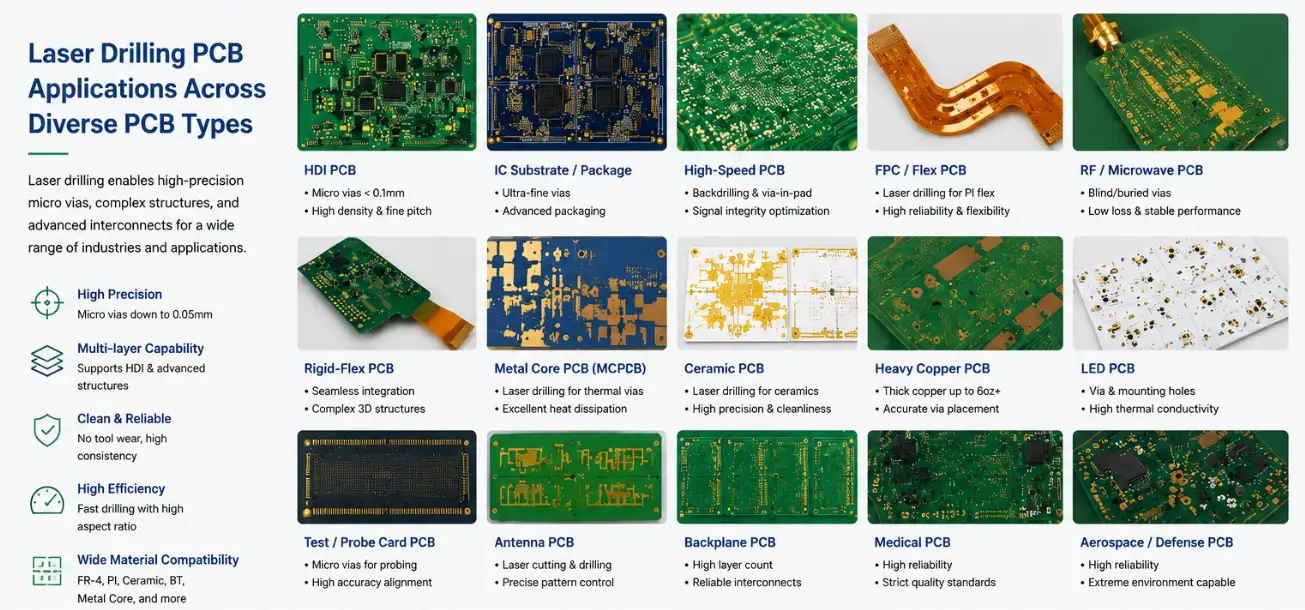
Figure 1. Laser drilling PCB
Table of Contents
- When Does Your PCB Design Actually Need Laser Drilling?
- Microvia Design Rules: The Exact Numbers That Control Cost and Yield
- Aspect Ratio: The Single Most Expensive Mistake in HDI Design
- Via-in-Pad Rules and the Assembly Failures Nobody Warns You About
- CO₂ vs UV Laser: Which One Your Stack-Up Requires
- How CAM Engineers Process Your Laser Drilling Files — and What Helps Them
- Laser Drilling Cost Factors: What Drives Your HDI Quote Up or Down
- The 8 Design Mistakes That Get Caught at DFM Review
Laser drilling PCB microvias is not a fabrication upgrade you choose for prestige — it is a specific solution to specific routing problems, and choosing it without understanding the design rules attached to it leads to quotes that come back 40% higher than expected, DFM flags that delay your prototype, and field failures that trace back to void-filled stacked vias that passed every factory test. This guide is written for PCB designers and hardware engineers who already know what a microvia is and need the actionable design rules, the cost levers, the CAM workflow realities, and the failure modes — not a primer on laser physics.
1) When Does Your PCB Design Actually Need Laser Drilling?
1.1 The Three Routing Problems Laser Drilling Solves
Confirm which of these three problems your design actually has before committing to an HDI build:
Problem 1 — BGA escape routing is geometrically blocked by through-holes. A 0.50mm-pitch BGA has 0.50mm center-to-center spacing. A mechanical through-hole via requires a 0.60mm pad diameter (0.30mm drill + 0.15mm annular ring each side). That is larger than the pitch — you physically cannot fit a through-hole via in each BGA row. A 0.15mm microvia with a 0.30mm land pad solves this. At 0.40mm pitch even 0.15mm becomes tight, and 0.10mm is necessary.
Problem 2 — Signal integrity above 5–10 GHz requires stub-free vias. A mechanical through-hole carrying a signal from L1 to L4 on a 16-layer board leaves an unused copper stub (L5–L16) that resonates at high frequencies. Back-drilling removes most of it, but residual stub length still creates reflections above 10 GHz. A laser-drilled blind via has zero stub by construction. For SerDes lanes, DDR5, or RF above 5 GHz on multilayer boards, blind vias may be a signal integrity requirement, not a density option.
Problem 3 — Board area must shrink but performance cannot. Dense boards sometimes route cleanly on standard multilayer but require 20% more area than the enclosure allows. An HDI build with microvia-in-pad density can recover that space. The HDI board costs more per square inch but total cost may fall if the area reduction is large enough.
| Design Condition | Laser Drilling Needed? | Rationale |
|---|---|---|
| BGA pitch ≤ 0.50mm | Yes | Dog-bone via fanout geometrically fails at and below 0.50mm |
| BGA pitch 0.65mm, board area unconstrained | No | Standard mechanical via fanout is viable and cheaper |
| Signal frequency > 10 GHz on multilayer | Yes | Through-hole stub degrades signal integrity above 5 GHz |
| Board thickness < 0.8mm total | Yes | Mechanical drills cannot achieve controlled blind depth at this thickness |
| 0.65mm BGA, small board, dense routing | Evaluate | Run routing trial first — HDI may not be justified |
1.2 When Laser Drilling Is the Wrong Choice
- Prototype only or <50 units: HDI lead time is 8–14 days vs. 5–7 for standard multilayer. For functional verification, standard builds get you there faster.
- Board that routes cleanly with through-holes: A 64-ball 0.50mm BGA with unconstrained board area can often escape with dog-bone vias and a 6-layer standard build — at half the cost of an HDI build.
- Designs where the density gain doesn’t offset the cost premium: Some HDI designs add 50–80% to bare-board cost for routing gains that could have been achieved by adding two standard layers instead.
2) Microvia Design Rules: The Exact Numbers That Control Cost and Yield
2.1 Via Diameter — Default Larger Unless Pitch Forces Otherwise
Most designers default to 0.10mm microvias because HDI reference designs show 0.10mm. That is a mistake — 0.10mm is a minimum driven by pitch constraints, not a default. Every 0.10mm via used where 0.15mm would work pays a drilling cost premium (roughly 1.6× the drilling cost of a 0.15mm via) for no routing benefit.
Diameter selection rule:
- 0.10mm: Only where BGA pitch ≤ 0.40mm forces it, or where inner-layer land area is critically limited
- 0.125mm: Practical middle ground for 0.40–0.45mm pitch fanout where spacing allows
- 0.15mm: Default for all other HDI routing — better yield, lower drilling cost, easier copper plating
2.2 Land Pad Size — The Number Most Often Wrong
The land pad surrounding a blind via must accommodate two sources of error: laser position accuracy (±25µm) and lamination registration (±50–70µm depending on build cycle count). These stack additively in the worst case.
| Via Diameter | Absolute Min Land Pad | Production-Recommended | Min Annular Ring |
|---|---|---|---|
| 0.10mm | 0.22mm | 0.28mm | 0.05mm |
| 0.125mm | 0.25mm | 0.30mm | 0.063mm |
| 0.15mm | 0.28mm | 0.35mm | 0.065mm |
Setting pads at the absolute minimum creates a design tolerant of nothing. Production-recommended pads add 0.06–0.07mm margin that survives normal process variation. The extra copper area costs nothing at fabrication.
2.3 Copper Foil Weight on Buildup Layers
HDI buildup layers must use ½ oz (17µm) copper foil — not 1 oz. For CO₂ drilling, a copper window (conformal mask) is chemically etched before laser drilling. With 1 oz copper, etch undercut shifts the effective minimum drillable via diameter from 0.10mm to 0.12–0.13mm. With ½ oz copper, 0.10mm is reliably achievable. Specify “½ oz copper on all HDI buildup layers” in your fabrication notes. Many designers copy non-HDI stack-ups that specify 1 oz throughout and don’t realize the impact.
3) Aspect Ratio: The Single Most Expensive Mistake in HDI Design
3.1 Why Aspect Ratio Controls Reliability — Not Just Yield
Microvia aspect ratio = dielectric thickness ÷ via diameter. As this ratio rises above 0.8:1, copper plating chemistry has increasing difficulty reaching the via bottom. The result is thin copper at the via knee — exactly where thermal stress concentrates during temperature cycling. The failure mode is not an immediate open. It is a via that passes factory test, passes incoming inspection, and fails after 200–400 thermal cycles in the field.
3.2 Cost and Reliability by Aspect Ratio
| Via Dia. | Dielectric | Aspect Ratio | Drilling Cost (relative) | 1st-Pass Yield | Thermal Cycle Life |
|---|---|---|---|---|---|
| 0.15mm | 75µm | 0.50:1 ✓ | 1.0× | 99%+ | >1,000 cycles |
| 0.10mm | 75µm | 0.75:1 ✓ | 1.6× | 97–98% | 800–1,000 cycles |
| 0.10mm | 100µm | 1.0:1 ⚠ | 2.8× | 93–95% | 400–600 cycles |
| 0.10mm | 110µm | 1.1:1 ✗ | 3.5× | 88–92% | 200–400 cycles |
How designers accidentally create bad aspect ratios: copying a stack-up where the buildup dielectric was 75µm, but the fabricator substitutes a slightly thicker prepreg variant — 100µm instead of 75µm. Same 0.10mm via: aspect ratio jumps from 0.75:1 to 1.0:1. Always specify dielectric cured thickness (e.g., “1080 prepreg, cured 60µm ±5µm”), not just the prepreg style number.
3.3 The Fix: Choose the Right Prepreg
- 1080 prepreg at 65–70% resin content: Cures to 55–65µm — ideal for 0.10mm via (aspect ratio 0.55–0.65:1)
- 1080 prepreg at 55% resin: Cures to 70–80µm — acceptable for 0.10mm (0.70–0.80:1)
- 2116 prepreg: Cures to 110–130µm — do not use as the sole buildup dielectric for 0.10mm vias
Most aspect-ratio DFM violations are caused by designers specifying 2116 prepreg in the buildup because it was the default in their stack-up tool. Switching to 1080 prepreg costs the same and fixes the problem entirely.
4) Via-in-Pad Rules and the Assembly Failures Nobody Warns You About
4.1 When Via-in-Pad Is Required vs. Optional
Via-in-pad places the microvia directly inside the BGA or QFN land pad rather than beside it. It is required when BGA pitch is 0.40mm or below and no routing channel exists between pads for a conventional escape. It is NOT automatically required for all HDI boards — many 0.50mm-pitch BGAs escape with blind vias placed between pads, not inside them. Via-in-pad adds cost through copper fill and planarization. Do not specify it without confirming routing genuinely requires it.
4.2 Why Unfilled Via-in-Pad Kills Assembly Yield
An open via-in-pad wicks solder paste into the hole during reflow. The solder does not return — it wets the hole walls and stays inside. The result is a solder-starved BGA joint: enough residual solder for continuity at room temperature, but insufficient mechanical strength to survive vibration or thermal cycling. This failure mode consistently passes electrical test and X-ray at room temperature, and surfaces only in field returns or accelerated life testing.
4.3 Copper Fill Specification — What Must Be in Your Fab Notes
Specify all four of these items explicitly or the fabricator will apply defaults that may be wrong:
- Via-in-pad locations: List by reference designator, net name, or callout on the fabrication drawing — not “all vias under BGAs” (too ambiguous)
- Fill method: “Copper electroplated fill” — not “filled via” (could mean resin-filled, which is insufficient for fine-pitch)
- Planarization: “CMP planarized, protrusion ≤15µm above surrounding copper” for 0.40mm pitch; ≤25µm acceptable for 0.50mm pitch
- Void specification: “≤10% cross-sectional void area per IPC-6012D” — ask for ≤8% for any application with >500-cycle thermal requirement
4.4 Stencil Aperture Must Be Reduced at Via-in-Pad Locations
The filled-via protrusion (even at ≤15µm) occupies solder paste volume. The solder paste stencil aperture at via-in-pad BGA pads should be 80–90% of nominal pad area to compensate. Your assembly engineer needs the via-in-pad location list to design the stencil aperture correctly — this information does not automatically flow from the PCB fab notes to the assembly team.
5) CO₂ vs UV Laser: Which One Your Stack-Up Requires
5.1 The Material Dependency
CO₂ laser (10.6µm infrared) ablates dielectric resin but reflects off copper — requiring a pre-etched copper window (conformal mask) before drilling the dielectric below. UV laser (355nm) ablates copper directly and drills copper and dielectric in a single operation.
| Dielectric Material | Required Laser | Min Via Diameter | Speed | Cost vs CO₂ Baseline |
|---|---|---|---|---|
| Standard FR4, high-Tg FR4, halogen-free FR4 | CO₂ (standard) | 0.10mm | 400–600 via/min | 1.0× |
| Polyimide flex layers in rigid-flex | UV preferred, CO₂ usable | 0.075mm (UV) | 200–400 via/min | 1.15–1.25× |
| a specialty low-loss laminate, PTFE-ceramic | UV required | 0.075mm | 200–350 via/min | 1.20–1.35× |
| Glass-core, ceramic substrates | Picosecond UV required | 0.025mm | 50–150 via/min | 2.5–4.0× |
Design implication: If your high-frequency PCB stack-up uses specialty low-loss or PTFE-based laminates in the buildup layers, confirm your fabricator has UV laser capability before finalizing the stack-up. Fabricators that only have CO₂ laser will either decline the order or substitute a different buildup dielectric.
5.2 Hybrid CO₂ + UV Panels
Some designs mix standard FR4 inner layers with specialty low-loss laminate or high-frequency material patches for the RF sections. If the HDI buildup dielectric in the RF zone is non-FR4, the fabricator needs zone-specific drilling recipes: UV in the specialty low-loss laminate zones, CO₂ elsewhere. This is feasible but requires explicit zone boundary callouts on the fabrication drawing. Vague notes like “specialty low-loss laminate patch in RF area” force the CAM engineer to guess — and they will use conservative settings that are optimal for neither zone.
6) How CAM Engineers Process Your Laser Drilling Files — and What Helps Them
6.1 The Four Things CAM Engineering Does With Your HDI Files
Understanding the CAM workflow lets you prepare files that go straight into production instead of triggering a 24–48 hour review cycle:
Step 1 — Stack-up verification. The CAM engineer checks whether the specified dielectric thicknesses produce the correct impedance values AND support the via aspect ratios in the design. If you specified prepreg by style number only (not cured thickness), the CAM engineer uses the factory default variant for that style — which may differ from what your EDA tool assumed for impedance calculation.
Step 2 — Blind via layer pair extraction. The laser drill program is built by extracting via shapes that appear on one layer but not the opposite. If your design has blind vias connecting non-adjacent layers (the most common HDI design error), this is where it gets caught — after you’ve waited a day for the quote.
Step 3 — Registration compensation map. Uneven copper density across inner layers causes non-uniform panel expansion during lamination, shifting the actual copper positions from the CAD coordinates. CAM computes a panel-wide distortion map and pre-offsets the laser drill positions to compensate. Inner layers with very uneven copper distribution (80% center, 20% edges) make this model less accurate, increasing position error.
Step 4 — Conformal mask window generation. For CO₂ drilling, CAM generates copper etch windows around each blind via site — window diameter = via diameter + 50–75µm on each side. If your outer-layer pad design doesn’t leave enough copper around these windows, CAM will flag marginal geometry.
6.2 What to Include in Your Files to Avoid Back-and-Forth
- Cured dielectric thickness per layer, not just prepreg style: “1080 prepreg, cured 60µm ±5µm” — not “1080.” This locks aspect ratio and impedance calculation simultaneously.
- Blind via layer pairs explicitly stated: “Blind vias Layer 1→Layer 2 (both faces)” in fabrication notes. CAM engineers have seen enough incorrectly-specified layer pairs that an explicit callout avoids a review request.
- Via-in-pad locations identified: List by refdes, net name, or marked-up PDF. Without this, CAM applies their standard fill process — which may be resin plug, not copper fill.
- Copper balance note for sparse layers: If a layer is intentionally sparse (30% copper for impedance reasons), note it explicitly so the CAM engineer doesn’t flag it as a possible design error.
6.3 What Causes the Most Review Delays
- Blind via drill file does not distinguish which vias stop at which layer — CAM must reconstruct from overlapping geometry
- Stack-up specifies prepreg by style only — fabricator must confirm which variant is stocked and whether it meets aspect ratio
- Via-in-pad and standard blind vias are not differentiated — fabricator cannot determine fill process requirements
- Impedance spec references a plane layer that doesn’t exist in the submitted stack-up
None of these require a design change. They require documentation that takes 30 minutes and saves 48 hours.
7) Laser Drilling Cost Factors: What Drives Your HDI Quote Up or Down
7.1 Five Variables That Move the Price
Variable 1 — Via count. Laser machine time is the HDI bottleneck. 6,000 blind vias per panel drills 3× longer than 2,000. Design optimization — using buried through-holes to replace stacked blind via chains, sharing vias between adjacent signal pairs — reduces via count and cost directly.
Variable 2 — Via diameter and shot count. A 0.10mm via needs 6–10 laser shots (trepanning pattern). A 0.15mm via needs 3–5. On a panel with 3,000 vias, switching those that don’t require 0.10mm to 0.15mm saves roughly 30–40% of laser machine time. Real, measurable cost reduction.
Variable 3 — Number of lamination cycles. Each cycle adds 2–3 days and proportionate cost. Type I (2 cycles) → Type II (3 cycles) → Type III (4+ cycles) each add approximately 25–35% per additional cycle.
Variable 4 — Copper fill requirement. Copper electroplating fill for stacked vias adds 18–30 hours per fill cycle. If staggered vias (≥0.20mm horizontal offset between adjacent pairs) work in your routing, eliminating the fill requirement saves 20–35% of the per-layer HDI cost.
Variable 5 — Laser type. CO₂ is standard cost. UV laser (required for non-FR4 dielectrics) adds 15–25%. Budget for this if your stack-up uses specialty low-loss or PTFE-based laminates in the buildup layers.
7.2 Cost Index by Build Type
| Build Type | Lamination Cycles | Cost vs Standard MLB | Typical Lead Time |
|---|---|---|---|
| Standard multilayer (no HDI) | 1 | 1.0× | 5–7 days |
| Type I (1+N+1), staggered vias | 2 | 1.5–1.8× | 8–11 days |
| Type I + via-in-pad copper fill | 2 | 1.8–2.2× | 9–12 days |
| Type II (2+N+2), staggered | 3 | 2.0–2.5× | 11–14 days |
| Type II, stacked copper-fill vias | 3 | 2.5–3.2× | 13–16 days |
| Type III / Anylayer HDI | 4+ | 3.5–5.0× | 14–21 days |
8) The 8 Design Mistakes That Get Caught at DFM Review
These appear most frequently in HDI DFM reviews. All are fixable before fabrication — none require a full re-route.
- Blind via connecting non-adjacent layers. A blind via from L1 to L3 in a Type I build is not manufacturable — the laser stops on the first copper it encounters (L2). Fix: two sequential blind vias through staggered or stacked configuration.
- Aspect ratio above 0.8:1 due to wrong prepreg. Typically caused by specifying 2116 prepreg (cures to 110–130µm) with 0.10mm vias. Fix: switch buildup prepreg to 1080-style at 60–70µm cured thickness.
- 1 oz copper on HDI buildup layers. Degrades conformal mask window quality and raises effective minimum via diameter to 0.12–0.13mm. Fix: specify ½ oz (17µm) copper on buildup layers in fabrication notes.
- Land pads sized at absolute minimum with no margin. Any registration variation at all causes breakout. Fix: use the production-recommended values in Section 2.2.
- Via-in-pad not identified in fabrication notes. Fabricator applies standard resin plug to all blind vias; via-in-pad locations get the wrong process. Fix: list via-in-pad locations explicitly with copper fill and CMP planarization specified.
- Stacked vias where staggered would work. Adding copper fill cost and 30+ hours of processing unnecessarily. Fix: check whether 0.20mm horizontal offset between via pairs is achievable — if yes, switch to staggered.
- Dielectric thickness not specified, only prepreg style. Fabricator uses their current-stock variant, which may differ from the 75µm assumed by your EDA tool. Fix: specify cured dielectric thickness per layer with tolerance.
- Copper density imbalance creating registration drift risk. Inner layers with <25% copper on one half cause non-uniform panel expansion and registration error accumulation across lamination cycles. Fix: add hatched copper fill to sparse regions — it does not need to connect to any net.
8.1 Highleap’s Laser Drilling Infrastructure
Highleap Electronics provides complete HDI production capability:
- CO₂ laser: 6 systems, 0.10mm minimum, 400–600 via/min, conformal mask process for FR4 and all FR4-compatible laminates
- UV laser: 2 systems, 0.075mm minimum, direct copper ablation — a specialty low-loss laminate, PTFE, polyimide-compatible
- Copper fill: Electroplated copper fill with CMP to ≤15µm protrusion; void spec ≤8% (exceeds IPC-6012D Class 3 ≤10%)
- Build types: Type I through Type III, anylayer HDI up to 4 buildup layers per face, rigid-flex HDI hybrid
- DFM review: Every HDI quote includes aspect ratio check, layer pair verification, and copper fill callout review within 24 hours — with specific fix recommendations, not rejection flags

Recommended Posts
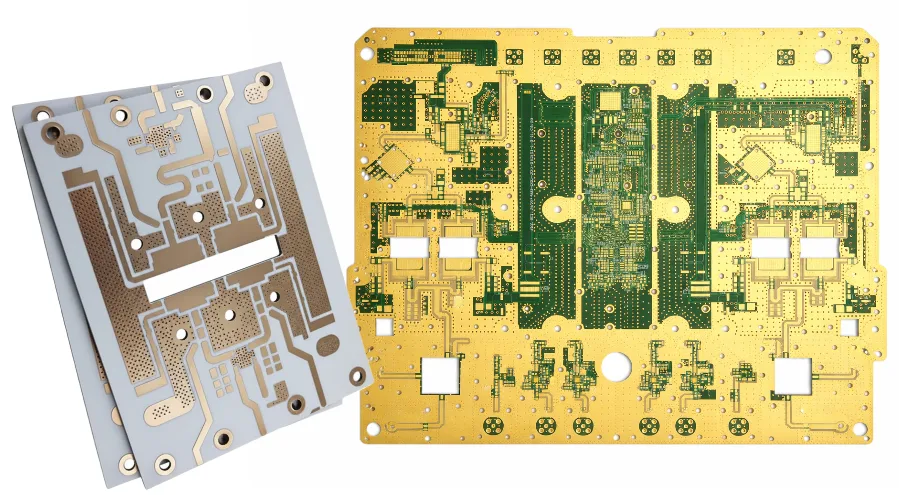
PCB Materials Database: Laminate Grades & Properties
How to get a quote for PCBs Let‘s run DFM/DFA analysis for...
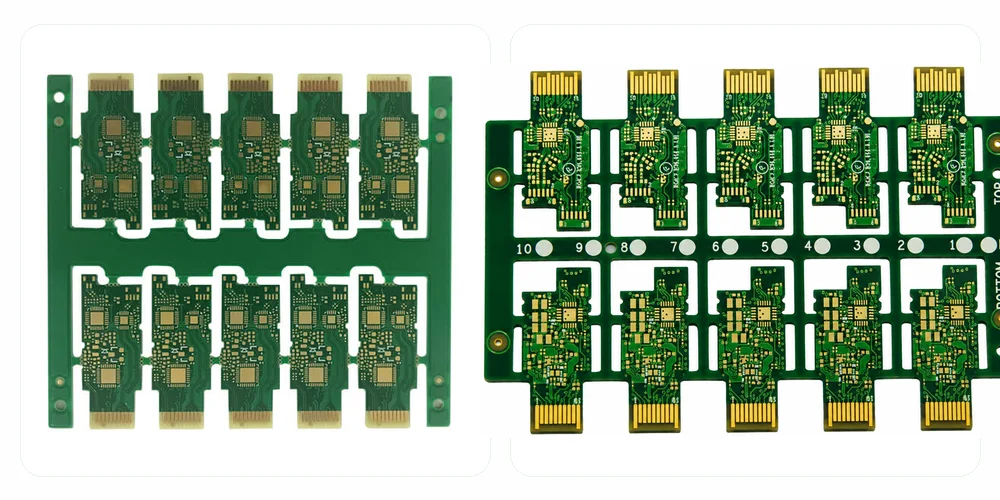
Optical Transceiver PCB Manufacturer for Custom Pluggable Modules
Highleap Electronics manufactures and assembles custom...
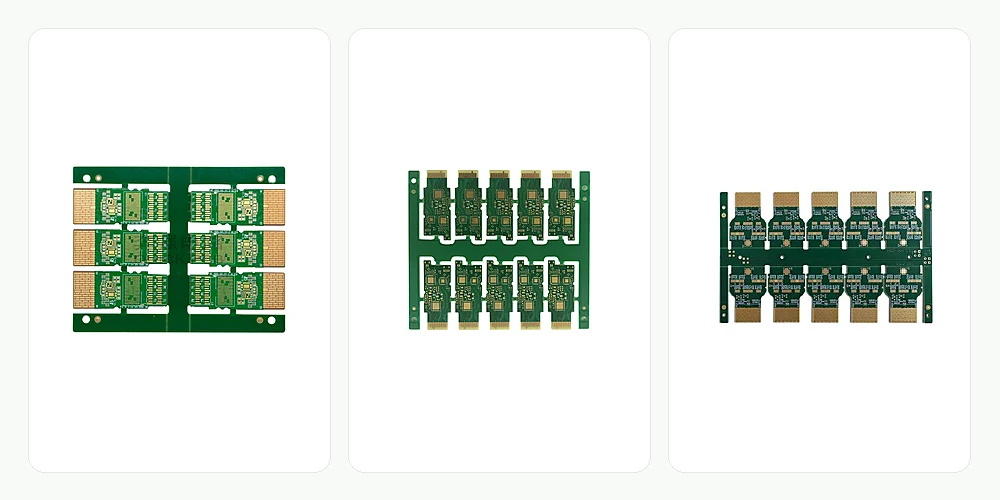
Optical Module PCB Manufacturer for 400G, 800G and 1.6T Programs
Highleap Electronics provides optical module PCB...
Optical Communication PCB Manufacturer for Fiber Network Equipment
Highleap Electronics manufactures and assembles optical...
How to get a quote for PCBs
Let‘s run DFM/DFA analysis for you and get back to you with a report. You can upload your files securely through our website. We require the following information in order to give you a quote:
-
- Gerber, ODB++, or .pcb, spec.
- BOM list if you require assembly
- Quantity
- Turn time
In addition to PCB manufacturing, we offer a comprehensive range of electronic services, including PCB design, PCBA, and turnkey solutions. Whether you need help with prototyping, design verification, component sourcing, or mass production, we provide end-to-end support to ensure your project’s success.
For PCBA services, please provide your BOM (Bill of Materials) and any specific assembly instructions. We also offer DFM/DFA analysis to optimize your designs for manufacturability and assembly, ensuring a smooth production process.