
PCB Power Distribution Network Design

Figure 1.Illustration of PCB power distribution network design, showing VRM, bulk and local decoupling, IC, and target impedance for stable power delivery.
The power distribution network (PDN) is the infrastructure that delivers stable voltage to every IC on your board. Designing a PDN that maintains target impedance from DC to several hundred MHz requires a systematic approach to VRM selection, capacitor sizing, and plane geometry — none of which can be done by intuition alone.
Table of Contents
- PDN Architecture and Frequency Regions
- Target Impedance Calculation
- VRM Selection and Bulk Capacitor Sizing
- Plane Capacitance and PDN Simulation
- PDN Measurement, Validation and FAQ
This guide covers the complete PCB power distribution network design process — from defining impedance targets through VRM selection, capacitor sizing, simulation, and post-fabrication validation. For the broader power integrity framework including decoupling placement and plane design, see the main PCB power integrity design guide.
1. PDN Architecture and Frequency Regions
A complete PDN spans multiple physical domains, each contributing inductance, resistance, and capacitance to the overall impedance. The critical insight is that no single component or design element controls impedance across the full frequency range. Each domain has a characteristic frequency range where it dominates, and each requires independent design attention.
| PDN Segment | Key Components | Dominant Frequency Range | Typical Inductance |
|---|---|---|---|
| VRM stage | Switching regulator, inductors, output capacitors | DC – 1 MHz | 1–10 µH |
| PCB bulk capacitors | Large MLCC, polymer capacitors near VRM | 10 kHz – 5 MHz | 0.5–5 nH |
| PCB power planes | Power and ground copper planes | 1 MHz – 500 MHz | 0.1–1 nH/square |
| Local decoupling | 0402/0201 MLCC at IC power pins | 10 MHz – 1 GHz | 0.1–0.5 nH |
| IC package | Package planes and vias | 100 MHz – 3 GHz | 10–100 pH |
| Die capacitance | On-die decoupling capacitors | 500 MHz+ | <10 pH |
The PDN bandwidth requirement is set by the fastest current transient the load can produce:
fmax = 0.5 / trise
For a processor with 1 ns current rise time: fmax = 500 MHz.
For DDR5 at 6400 MT/s with 100 ps edge rates: fmax extends to 5 GHz, requiring careful package and die capacitance management.
The design goal is to maintain Z < Ztarget continuously from DC through fmax. Any frequency gap where PDN impedance exceeds Ztarget is a potential source of voltage droop, oscillation, or logic failure at the corresponding switching frequency.
2. Target Impedance Calculation
Target impedance is the single most important PDN design specification. It converts the voltage ripple tolerance into a quantitative impedance budget that every component selection and layout decision must satisfy.
Ztarget = (Vsupply × ripple%) / Ipeak
Vsupply: nominal supply voltage | ripple%: maximum allowed ripple fraction | Ipeak: peak instantaneous current from IC datasheet
| Application | Vsupply | Ripple Spec | Ipeak | Ztarget |
|---|---|---|---|---|
| DDR5 DRAM VDD | 1.1 V | 3% | 5 A | 6.6 mΩ |
| FPGA core voltage | 0.9 V | 3% | 30 A | 0.9 mΩ |
| PCIe endpoint | 3.3 V | 5% | 3 A | 55 mΩ |
| High-speed SerDes | 1.8 V | 2% | 2 A | 18 mΩ |
| GPU core rail | 1.0 V | 2% | 200 A | 0.1 mΩ |
These numbers illustrate the extreme range of PDN requirements. A GPU core rail at 0.1 mΩ demands a near-perfect PDN — every milliohm of parasitic inductance in the PCB stackup, VRM output impedance, or via array has measurable impact. Getting these targets right before starting layout prevents costly respins.
Ipeak appears in the IC datasheet as maximum supply current, peak operating current, or as transient current waveforms in the application section. For FPGAs and processors, vendor power estimation tools (Xilinx Power Estimator, Intel VID) provide more accurate values than datasheet maximums. If no value is available, measure VRM output current with a current probe on a working system and add 20–30% margin for worst-case operation.
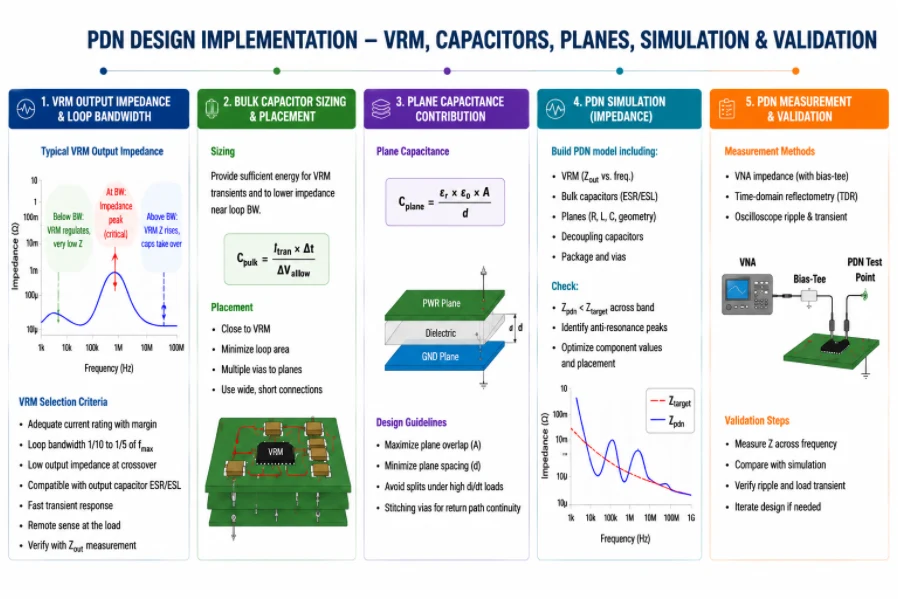
Figure 2. Key steps for implementing and validating a PCB power distribution network, including VRM selection, capacitor placement, plane capacitance contribution, PDN simulation, and measurement methods.
3. VRM Selection and Bulk Capacitor Sizing
The VRM dominates PDN impedance from DC to its feedback loop bandwidth. Below loop bandwidth, the VRM actively regulates output, presenting milliohm-range impedance. At the crossover frequency, impedance peaks — this is the most critical transition to manage. Above loop bandwidth, VRM output impedance rises and bulk capacitors take over.
| VRM Parameter | Requirement | Why It Matters for PDN |
|---|---|---|
| Loop bandwidth | > 200 kHz for DDR/CPU rails | Extends active regulation further into the frequency spectrum |
| Output impedance (closed loop) | < Ztarget below loop bandwidth | Must stay within impedance budget in its control region |
| Transient response | Recovery < 10 µs for 50% load step | Determines recovery speed from sudden load changes |
| Current sharing (multiphase) | < ±5% between phases | Unequal sharing increases effective output inductance |
High-current rails above 20–30 A require multiphase VRM configurations. Multiple phases interleave their switching cycles, reducing output current ripple by a factor equal to the number of phases, allowing smaller output inductors, and distributing thermal load across multiple power devices. For AI accelerator PCBs requiring 200+ A supplies, 8–16 phase VRM designs are standard.
Bulk Capacitor Sizing
Bulk capacitors bridge the impedance gap between VRM loop bandwidth and the frequency range where ceramic decoupling takes over. The minimum bulk capacitance to prevent the impedance from rising above Ztarget at the VRM crossover is:
Cbulk = 1 / (2π × fcrossover × Ztarget)
Example: Ztarget = 5 mΩ, fcrossover = 200 kHz → Cbulk = 159 µF minimum
| Capacitor Type | Typical ESR | Typical ESL | Best Use Case |
|---|---|---|---|
| Aluminum electrolytic | 50–500 mΩ | 5–20 nH | Cost-sensitive low-frequency bulk only — not recommended above 1 MHz |
| Polymer electrolytic | 5–20 mΩ | 3–10 nH | Better mid-frequency performance, compact footprint |
| Large MLCC (1210, 1206) | 1–5 mΩ | 1–3 nH | Preferred for high-current rails — best combination of low ESR and ESL |
| POSCAP / OSCON | 3–15 mΩ | 2–5 nH | High capacitance density in small footprint |
For high-speed digital designs, large MLCC arrays are preferred due to their combination of low ESR, low ESL, and stable capacitance versus frequency and temperature. A parallel array of multiple MLCC values — for example, one 100 µF in parallel with several 10 µF — provides broader effective decoupling bandwidth than a single large capacitor type of either value alone.
4. Plane Capacitance and PDN Simulation
PCB copper planes exhibit distributed capacitance between adjacent power and ground planes. This plane capacitance is effective above 100 MHz — exactly where discrete capacitors have become inductive and no longer contribute to PDN decoupling.
Cplane = ε0 × εr × A / d
ε0 = 8.854 × 10⁻¹² F/m | εr = 4.3 (FR-4) | A = overlapping plane area (m²) | d = dielectric thickness (m)
Example: 100×100 mm board, 4 mil FR-4 between GND and PWR planes → Cplane ≈ 3.8 nF
While 3.8 nF is small in absolute terms, it is distributed uniformly across the entire board area and presents very low inductance at high frequencies. To maximise plane capacitance: use 3–4 mil prepreg between GND and PWR planes (not 10+ mil core); maximise overlapping copper area and avoid unnecessary plane cutouts; and consider high-εr embedded capacitance materials (such as Sanmina C-Ply) for boards with Ztarget below 5 mΩ above 100 MHz — these materials can increase plane capacitance by 100× over standard FR-4.
PDN Simulation Methods
PDN simulation validates that the designed network achieves target impedance before fabrication. Three approaches are used in practice, in increasing order of accuracy:
- Spreadsheet-based lumped model: Models PDN segments as series R-L-C networks. Fast and identifies major design issues, but misses plane resonances and spatial effects. Best for initial VRM selection and bulk capacitor count estimation.
- S-parameter PDN simulation (Ansys SIwave, Cadence Sigrity, HyperLynx PI): Full EM simulation of PCB planes. Captures plane resonance peaks, anti-resonance nulls, effect of plane splits, and capacitor placement optimisation. Required when Ztarget is below 10 mΩ.
- Time-domain simulation: Uses realistic IC current profiles from IBIS power models or measured waveforms. Provides direct voltage droop predictions under actual switching conditions. Most accurate method for worst-case sign-off analysis.
5. PDN Measurement, Validation and FAQ
After PCB fabrication, verify PDN impedance before full system assembly to confirm that simulation results are achieved in hardware. Discrepancies between simulation and measurement most commonly arise from inaccurate component models, unmodelled parasitic inductance in vias or connectors, or plane resonances shifted by actual dielectric properties.
1-Port VNA Measurement
Measure S11 at the IC power pin location with VRM and decoupling capacitors populated, IC removed. S11 converts to impedance:
Z = Z0 × (1 + S11) / (1 − S11)
Z0 = 50 Ω (VNA port impedance). For Z < 100 mΩ, use 2-port shunt-through measurement for improved accuracy at low impedance values.
Time-Domain Validation
With the system fully assembled, use a power rail probe (20 MHz bandwidth minimum, 1 GHz preferred) at the IC power pin under full operating load. Verify: peak-to-peak voltage ripple is within the allowed ripple budget; no transient droop exceeds the minimum operating voltage specification; and switching regulator ripple frequency is visible and within expected amplitude.
Frequently Asked Questions
What causes an anti-resonance peak in PDN impedance?
An anti-resonance peak occurs where the impedance of one capacitor type (becoming inductive above its SRF) intersects the impedance of the next capacitor type (still capacitive). Impedances add instead of cancel at this intersection, creating a peak that can exceed Ztarget. Suppress it by using capacitors with slightly different values to spread the resonance frequency, adding resistive damping capacitors in parallel, or choosing capacitor types with higher ESR at the crossover frequency.
Can I use ferrite beads to isolate PDN sections?
Ferrite beads are appropriate for isolating sensitive analog or RF rails from digital switching noise above 10–100 MHz. Do not use ferrite beads in series with high-current digital supply paths — their impedance causes significant voltage drop under load, and non-linear behaviour can cause VRM instability.
How many VRM phases do I need?
A general guideline is 10–15 A per phase for standard integrated FET VRM designs. For a 60 A CPU rail, use 4–6 phases. For GPU or AI accelerator rails at 200 A+, 12–16 phases are typical. More phases reduce output ripple, allow smaller inductors, and improve transient response bandwidth at the cost of greater controller and FET count.
For related power integrity topics, see our guides on decoupling capacitor placement, power plane design techniques, simultaneous switching noise reduction, and multilayer PCB stackup design. Highleap Electronics provides PDN design review and high-speed PCB fabrication. Request a quote for your project.

Recommended Posts
Electronic Compass PCB Manufacturing & PCBA for Digital Heading Products
An Electronic Compass PCB converts magnetometer data—and...
Smart Bracelet PCB Manufacturing and Assembly
A smart bracelet PCB can support very different products:...
Server Motherboard PCB Manufacturing and Assembly
Server motherboard PCB manufacturing is becoming more...
TMM PCB Fabrication
Table of Contents TMM PCB Fabrication Scope for RF and...
How to get a quote for PCBs
Let‘s run DFM/DFA analysis for you and get back to you with a report. You can upload your files securely through our website. We require the following information in order to give you a quote:
-
- Gerber, ODB++, or .pcb, spec.
- BOM list if you require assembly
- Quantity
- Turn time
In addition to PCB manufacturing, we offer a comprehensive range of electronic services, including PCB design, PCBA, and turnkey solutions. Whether you need help with prototyping, design verification, component sourcing, or mass production, we provide end-to-end support to ensure your project’s success.
For PCBA services, please provide your BOM (Bill of Materials) and any specific assembly instructions. We also offer DFM/DFA analysis to optimize your designs for manufacturability and assembly, ensuring a smooth production process.