
TU-865 PCB Material: Complete Engineering Guide for High-Reliability Applications

Figure 1. TU-865 PCB Material
Introduction
TU-865 PCB material is a high-Tg, halogen-free laminate engineered for harsh environments and high-reliability applications. Manufactured by Taiwan Union Technology Corporation (TUC), this mid-loss epoxy-based material bridges the gap between standard FR-4 and premium high-frequency laminates. This guide addresses critical questions engineers face when specifying TU-865: electrical and thermal performance, stack-up design, manufacturing compatibility, and application suitability. For complete specifications, download the official TU-865 datasheet from TUC.
Core Physical and Electrical Properties of TU-865 PCB Material
Understanding the fundamental properties of TU-865 PCB material is essential for accurate design calculations and process planning. The table below summarizes key parameters from the manufacturer datasheet.
| Property | Typical Value | Test Condition/Standard |
|---|---|---|
| Glass Transition Temperature (Tg) | 200°C (DSC) / 220°C (DMA) | IPC-TM-650 |
| Decomposition Temperature (Td) | 370°C | TGA |
| Dielectric Constant (Dk) | 4.3 | @1GHz, 50% resin content |
| Loss Tangent (Df) | 0.010 | @1GHz, 50% resin content |
| Z-axis CTE | 1.8% | 50–260°C |
| T-260 / T-288 | >60 min / >60 min | Time to delamination |
| Moisture Absorption | 0.13% | D-24/23 |
| Flammability | UL 94 V-0 | — |
Engineering Implications: The 200°C Tg enables multiple lead-free reflow cycles without degradation—critical for BGA assembly and rework scenarios. The low Z-axis CTE (1.8%) minimizes barrel cracking in plated through-holes during thermal cycling. With Df at 0.010, TU-865 falls into the mid-loss category, suitable for frequencies up to several GHz while maintaining cost efficiency compared to ultra-low-loss alternatives.
Design Considerations for TU-865 PCB Material
Proper design practices maximize the performance advantages of TU-865 PCB material while ensuring manufacturability.
Stack-Up Structure and Material Pairing
TU-865 core and TU-865P prepreg form a matched system optimized for multilayer constructions. Recommended core thicknesses range from 0.05mm to 1.58mm, with copper weights from 1/3 oz to 12 oz available. For mixed-material stack-ups, pair TU-865 with prepregs of similar Tg and CTE to prevent warpage. Use symmetrical layer arrangements to maintain dimensional stability during lamination and reflow.
Drilling and PTH Process Compatibility
Standard mechanical drilling parameters apply to TU-865 with minor adjustments. Reduce spindle speeds by 10–15% compared to standard FR-4 to minimize resin smear from the high-Tg matrix. Desmear processes should use permanganate-based chemistry with extended etch times. The material’s dimensional stability supports aspect ratios up to 10:1 for through-hole drilling without reliability concerns.
Thermal Stress and Cycling Design
The low CTE of TU-865 reduces pad-to-barrel stress during temperature excursions. Design annular rings with minimum 5 mil (125μm) margins for Class 3 reliability. For BGA applications, match the TU-865 substrate CTE to the component package where possible. Stencil aperture designs should account for the material’s excellent wetting characteristics during lead-free assembly.
High-Frequency and Microwave Design Tips
While TU-865 PCB material targets thermal reliability rather than RF performance, its Dk of 4.3 provides predictable impedance control for digital designs up to 3–5 GHz. For microstrip and stripline structures, account for the ±0.15 Dk tolerance in impedance calculations. Above 10 GHz, consider hybrid stack-ups with dedicated RF layers using lower-loss materials.
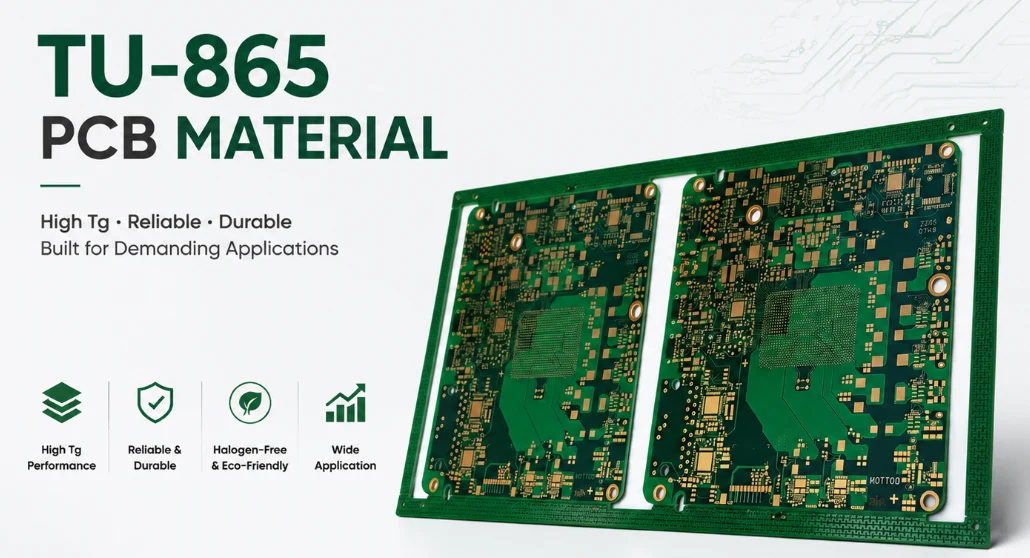
Figure 2. TU-865 PCB
Manufacturing Feasibility and Process Recommendations
TU-865 PCB material integrates seamlessly into standard FR-4 fabrication lines with targeted process optimizations.
SMT/BGA/HDI Compatibility: The material supports sequential lamination for HDI builds with microvias. Laser drilling at 355nm wavelength produces clean, consistent via formation. Mechanical microvia drilling is not recommended due to the high-Tg resin system.
Surface Finish Options: ENIG, immersion silver, OSP, and HASL (lead-free) all demonstrate excellent adhesion to TU-865. ENIG provides optimal results for fine-pitch BGA applications, offering consistent coplanarity and extended shelf life. OSP offers a cost-effective alternative for high-volume production with shorter storage requirements.
Reflow Parameters: Peak reflow temperatures should not exceed 260°C for profiles under 60 seconds above liquidus. The material’s T-260 rating of >60 minutes provides substantial margin for multiple reflow cycles and rework operations. Standard SAC305 solder paste profiles apply without modification.
Failure Prevention: Common failure modes include delamination from insufficient desmear and pad lifting from excessive thermal shock. Implement X-ray inspection for BGA voiding assessment, AOI for solder joint quality, and flying probe testing for electrical verification. IST (Interconnect Stress Testing) validates reliability for critical applications.
Reliability, Certifications, and Quality Control
TU-865 PCB material meets stringent industry standards for high-reliability applications.
Reliability Testing: The material passes 1000+ cycles of thermal cycling (-55°C to +125°C) per IPC-TM-650. Highly accelerated stress testing (HAST) confirms moisture resistance under 130°C/85% RH conditions. The anti-CAF (Conductive Anodic Filament) construction prevents electrochemical migration failures in high-density designs.
Industry Certifications:
- IPC-4101 Type Designations: /127, /128, /130
- IPC-4101E/130 Validation Services QPL Certified
- UL File Number: E189572
- ANSI Grade: FR-4.1
Incoming Inspection Checklist:
- Verify Dk/Df values per lot certification
- Measure thickness at 5 points per panel (±10% tolerance)
- Confirm copper peel strength (≥1.05 N/mm for 1 oz copper)
- Visual inspection for laminate voids and inclusions
- Impedance test coupons for controlled impedance orders
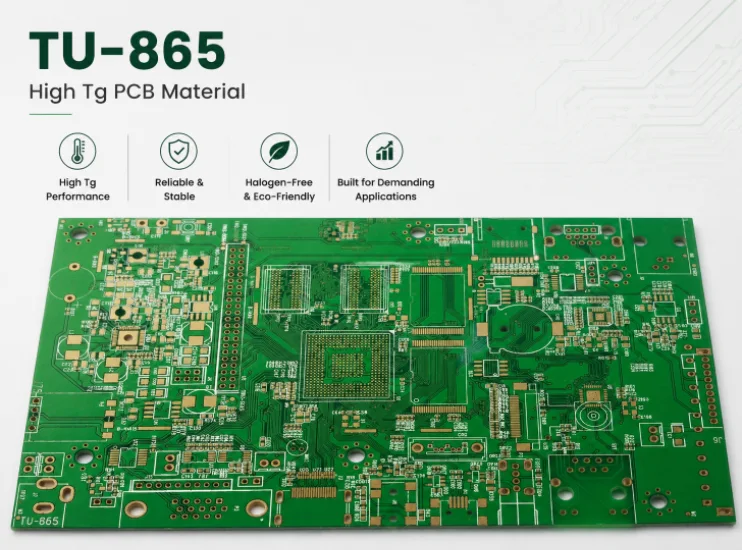
Figure 3. TU-865 PCB Board
Typical Applications and Industry Use Cases
TU-865 PCB material excels in demanding environments where thermal reliability and halogen-free compliance are mandatory.
Automotive Electronics: Engine control units, transmission controllers, and LED lighting modules benefit from the 200°C Tg during underhood temperature exposure. The halogen-free formulation meets automotive OEM environmental requirements including IMDS compliance.
Telecommunications Infrastructure: Base station power amplifiers and backhaul equipment leverage TU-865’s thermal cycling resistance for outdoor deployments. The mid-loss characteristics support digital signal paths while the high Td ensures long-term reliability.
Industrial Power Systems: Motor drives, inverters, and power conversion equipment require substrates that withstand sustained elevated temperatures. TU-865 maintains mechanical integrity through repetitive thermal loading from power cycling.
Medical Devices: Sterilizable electronics and imaging equipment benefit from the material’s chemical resistance and dimensional stability. The UL 94 V-0 rating satisfies safety requirements for patient-proximate applications.
TU-865 Compared to Common PCB Materials
The following comparison positions TU-865 PCB material against standard FR-4 and high-frequency alternatives.
| Parameter | Standard FR-4 | TU-865 | a specialty low-loss laminate |
|---|---|---|---|
| Tg (DSC) | 130–150°C | 200°C | 280°C+ |
| Dk @1GHz | 4.2–4.5 | 4.3 | 3.48 |
| Df @1GHz | 0.018–0.025 | 0.010 | 0.0037 |
| Z-CTE | 3.0–4.0% | 1.8% | 2.4% |
| Lead-Free Compatible | Limited | Yes | Yes |
| Relative Cost | 1× | 1.5–2× | 5–8× |
| Max Frequency (practical) | 1–2 GHz | 3–5 GHz | 10+ GHz |
| Halogen-Free | Varies | Yes | Yes |
Key Takeaways: TU-865 offers significant thermal and electrical improvements over standard FR-4 at moderate cost increases. For applications below 5 GHz requiring high thermal reliability, TU-865 provides optimal value. specialty low-loss laminate and similar PTFE-based materials remain necessary for true RF/microwave designs above 10 GHz.
How to Select TU-865 for Your Project: Quick Checklist
Use this decision framework to determine if TU-865 PCB material suits your application:
☐ Operating Frequency: Signal frequencies below 5 GHz? → TU-865 suitable
☐ Reflow Requirements: Multiple lead-free reflow cycles or rework needed? → TU-865 recommended
☐ Thermal Environment: Ambient temperatures exceeding 85°C or thermal cycling required? → TU-865 beneficial
☐ Compliance: Halogen-free, RoHS, or WEEE mandates apply? → TU-865 compliant
☐ BGA Density: Fine-pitch BGAs (≤0.8mm) with reliability concerns? → TU-865 provides CTE advantage
☐ Budget: Cost ceiling 2× standard FR-4? → TU-865 viable
☐ HDI Design: Blind/buried vias or sequential lamination? → TU-865 compatible
☐ Moisture Exposure: High-humidity operating environment? → TU-865’s 0.13% absorption advantageous
Decision Summary: If your design requires thermal reliability beyond standard FR-4 without the cost of specialty RF laminates, TU-865 PCB material delivers the optimal balance.
Conclusion
TU-865 PCB material provides engineers with a cost-effective solution for high-reliability applications demanding elevated thermal performance, halogen-free compliance, and mid-loss electrical characteristics. Its 200°C Tg, low CTE, and proven manufacturing compatibility make it the preferred choice for automotive, telecommunications, industrial, and medical electronics where standard FR-4 falls short.
Frequently Asked Questions (FAQ)
What is the maximum reflow temperature for TU-865 PCB material?
Peak temperatures up to 260°C are supported with T-260 ratings exceeding 60 minutes. Standard lead-free reflow profiles apply without modification.
Does TU-865 support ENIG surface finish?
Yes. ENIG, immersion silver, OSP, and lead-free HASL all provide excellent adhesion. ENIG is recommended for fine-pitch BGA applications.
How does TU-865 perform in high-humidity environments?
With moisture absorption of only 0.13%, TU-865 maintains electrical and mechanical properties in humid conditions. The material passes HAST testing at 130°C/85% RH.
Is TU-865 suitable for HDI and microvia designs?
Yes. TU-865 supports laser-drilled microvias, blind/buried vias, and sequential lamination processes. Its dimensional stability ensures registration accuracy in HDI builds.
What certifications does TU-865 hold?
TU-865 is IPC-4101 QPL certified (Types /127, /128, /130), UL recognized (File E189572), and rated UL 94 V-0 for flammability.
Can TU-865 be used for RF applications?
TU-865 is classified as mid-loss material (Df 0.010 @1GHz). It performs adequately for digital signals up to 3–5 GHz. For dedicated RF above 10 GHz, consider lower-loss alternatives like specialty low-loss laminate.
What is the typical lead time for TU-865 material?
Standard laminate thicknesses are typically stocked. Custom constructions may require 2–4 weeks lead time. Confirm availability with your fabricator during design phase.
How does TU-865 compare to FR-4 in cost?
TU-865 typically costs 1.5–2× standard FR-4, varying by thickness and copper weight. The premium is justified for applications requiring its thermal and reliability advantages.

Recommended Posts
Hard Gold Finger PCB Manufacturing: Plating and Beveling
Hard gold finger PCB manufacturing is used when a circuit...
Small PCB Panelization: Array Design and Depaneling
Imagine a 26 × 18 mm circuit that must pass through...
PCB Panelization for Volume Production: Cost and Yield
A fabrication panel that holds more boards is not...
PCB SET Delivery and Panelization: Quantities and Acceptance
A purchase order for “500 SET” looks straightforward until...
How to get a quote for PCBs
Let‘s run DFM/DFA analysis for you and get back to you with a report. You can upload your files securely through our website. We require the following information in order to give you a quote:
-
- Gerber, ODB++, or .pcb, spec.
- BOM list if you require assembly
- Quantity
- Turn time
In addition to PCB manufacturing, we offer a comprehensive range of electronic services, including PCB design, PCBA, and turnkey solutions. Whether you need help with prototyping, design verification, component sourcing, or mass production, we provide end-to-end support to ensure your project’s success.
For PCBA services, please provide your BOM (Bill of Materials) and any specific assembly instructions. We also offer DFM/DFA analysis to optimize your designs for manufacturability and assembly, ensuring a smooth production process.