
Rogers 4350B Alternatives for High-Speed PCB Designs

Introduction
The selection of PCB substrate materials has become increasingly critical as electronic devices push toward higher frequencies and faster data rates. Rogers 4350B has long been the industry standard for high-frequency applications, but today’s engineers face new challenges: extended lead times, supply chain uncertainties, and pressure to reduce costs without compromising performance.
This comprehensive guide examines viable alternatives to Rogers 4350B and provides practical insights for material selection based on real-world manufacturing experience. Whether you’re designing 5G infrastructure, automotive radar systems, or high-speed digital interfaces, understanding your material options is essential for project success.
Understanding Current Market Conditions
The high-frequency PCB material market has experienced significant changes in recent years. Lead times that were once predictable have become variable, and materials that were readily available now require advanced planning and strategic procurement. Understanding these dynamics is crucial for successful project execution.
Material Availability Overview
Currently, Rogers 4350B direct from the manufacturer requires 12-16 weeks lead time, though distributor stock can sometimes provide materials in 1-3 weeks for smaller quantities. This has led many design teams to explore alternatives that offer similar performance with better availability.
- Megtron 6 (Panasonic): 8-10 weeks lead time, superior electrical performance for ultra-high-speed digital applications.
- I-Tera MT40 (Isola): Comparable to Rogers with slightly better availability at 6-8 weeks.
- FR408HR: Widely available with minimal lead time for less demanding applications.
At Highleap Electronics, we maintain a strategic inventory of commonly used materials including Rogers 4350B in 4mil and 8mil thicknesses, Megtron 6 R-5775, and a full range of FR408HR options. This allows us to offer quick-turn services even when materials are scarce in the broader market.
Technical Performance Comparison
When evaluating alternative materials, understanding the relationship between electrical properties and real-world performance is essential. The key parameters that affect high-frequency performance include dielectric constant (Dk), dissipation factor (Df), and insertion loss.
Electrical Properties at 10 GHz
- Rogers 4350B: Dk = 3.48, Df = 0.0037, 0.32 dB/inch insertion loss at 10 GHz. Suitable for a wide range of RF and high-speed digital applications.
- Rogers 4003C: Df = 0.0027, lower Dk = 3.38, excellent for minimizing loss in applications requiring antenna designs and filters.
- I-Tera MT40: Dk = 3.45, Df = 0.0031, minimal design changes when switching from Rogers 4350B.
- Megtron 6: Df = 0.0020, preferred for data rates 56 Gbps and higher. Dk = 3.40 requires minor adjustments but offers superior signal integrity.
- Nelco N4000-13EP: Df = 0.0040, cost-effective for shorter interconnects but not suitable for long trace applications.
- FR408HR: Df = 0.0110, economical choice for applications below 10 Gbps with manageable trace lengths.
Application-Specific Recommendations
Different applications have varying requirements for electrical performance, thermal stability, and cost targets. Understanding these requirements helps narrow the material selection process.
- For 25-28 Gbps NRZ signaling, Megtron 6 offers the best signal integrity.
- For systems operating at 56 Gbps PAM4, Megtron 6 or Megtron 7 is ideal.
- For automotive radar at 77 GHz, Rogers RO3003 or RO3035 are required for temperature stability, with Taconic TLY-5 offering a cost reduction for high-volume applications.
Practical Stackup Configurations
The choice between using premium materials throughout the PCB or implementing a hybrid approach significantly impacts both cost and performance. Modern designs increasingly use hybrid stackups that place high-performance materials only where needed. For more information on high-speed PCB materials and to find the best solutions for your specific needs, visit our High-Speed Materials or reach out to us for expert guidance on material selection.
Full Premium Material Stackup
An 8-layer board using Rogers 4350B throughout provides optimal electrical performance but at maximum cost. This configuration uses 4mil Rogers cores for layers 1-2 and 7-8 where high-speed signals are routed, and 8mil cores for the inner layers. Standard prepreg materials provide appropriate spacing.
This approach yields a total board thickness of approximately 62mil with excellent signal integrity across all layers. However, the material cost alone can reach $125 per board in 100-piece quantities.
Hybrid Cost-Optimized Stackup
A more economical approach uses Rogers 4350B only for critical signal layers while employing FR408HR for power, ground, and low-speed signals. This can reduce material costs by approximately 45% while adding only 0.5dB of additional loss on the inner layers.
Budget-Conscious Design
When cost is the primary driver and electrical requirements are modest, using FR408HR or similar materials throughout the stackup provides the most economical solution. This approach works well for designs operating below 10 Gbps with manageable trace lengths.
Critical Design Considerations
Switching PCB materials requires more than simply substituting one laminate for another. Several design parameters must be recalculated to maintain proper functionality.
Impedance Control Adjustments
Changing materials impacts controlled impedance traces. For example, a 50-ohm trace designed for Rogers 4350B (Dk=3.48) requires a width of 7.0mil for a 4mil dielectric height. Switching to I-Tera MT40 (Dk=3.45) requires only a minor adjustment to 7.1mil.
Via Stub Resonance Effects
Material changes affect the resonant frequency of via stubs, potentially causing signal integrity issues at specific frequencies. For designs near 25 GHz, this may require back-drilling to remove the stub.
Thermal Management Considerations
Materials like Rogers 4350B (thermal conductivity: 0.69 W/m·K) provide better heat dissipation compared to others like FR408HR (thermal conductivity: 0.40 W/m·K), which becomes critical in high-power applications.
Manufacturing, Quality Assurance, and Decision-Making in PCB Material Selection
Successful implementation of high-frequency PCB materials depends on more than just selecting the right materials—it also requires manufacturing expertise, stringent quality control, and a careful decision-making process. At Highleap Electronics, we ensure that all factors are thoroughly considered to provide optimal solutions for your PCB needs, from PCB laminate material selection to end-to-end fabrication.
Manufacturing and Quality Control Requirements
Different materials require specific processing parameters to achieve optimal results. For instance, Rogers materials drill well at 60-80k RPM, while Megtron and I-Tera materials prefer higher speeds with reduced chip loads. The lamination cycles and surface preparation also vary depending on the material, and these factors must be precisely controlled to maintain material integrity and performance.
At Highleap Electronics, every high-speed PCB undergoes 100% electrical testing, impedance verification, and visual inspection. We also offer advanced testing, including S-parameter measurements and eye diagram analysis for critical applications. Our rigorous quality assurance process is integrated into every stage of PCB fabrication, ensuring that each board meets performance specifications and reliability requirements.
Optimizing Material Selection and Performance
The optimal material choice for your high-frequency PCB depends on balancing various factors, including electrical performance, material availability, cost considerations, and reliability requirements. We start by clearly defining your electrical requirements, such as the frequencies and data rates your design must support, along with practical constraints like production timelines and cost per board.
Risk factors, such as potential field failures and whether to explore alternative materials, are also carefully evaluated to ensure that the selected material performs reliably throughout its lifecycle. This systematic approach helps identify the best material that meets your specific needs while staying within your budget.
Comprehensive Support from Highleap Electronics
Our engineering team provides comprehensive support throughout the material selection process. We offer impedance modeling, stackup design services, and signal integrity analysis to ensure that your design will perform as expected. Whether you’re looking for a high-performance material or a cost-effective solution, we work with you every step of the way to ensure the success of your project.
Conclusion
The selection of high-frequency PCB materials has become more complex as supply chains tighten and performance requirements increase. At Highleap Electronics, we combine extensive material inventory, technical expertise, and manufacturing excellence to deliver high-quality PCBs that meet your specifications on schedule.
Whether you’re developing cutting-edge 5G equipment, automotive radar systems, or high-speed computing platforms, we’re here to support your project from concept to production.

Related Articles
BT Resin PCB: Properties, Uses, and Fabrication Controls
Figure 1. BT resin PCB image for PCB manufacturing...
PCB Potting Services: Compounds, Process, and Design Rules
Figure 1. PCB potting services image for Highleap...
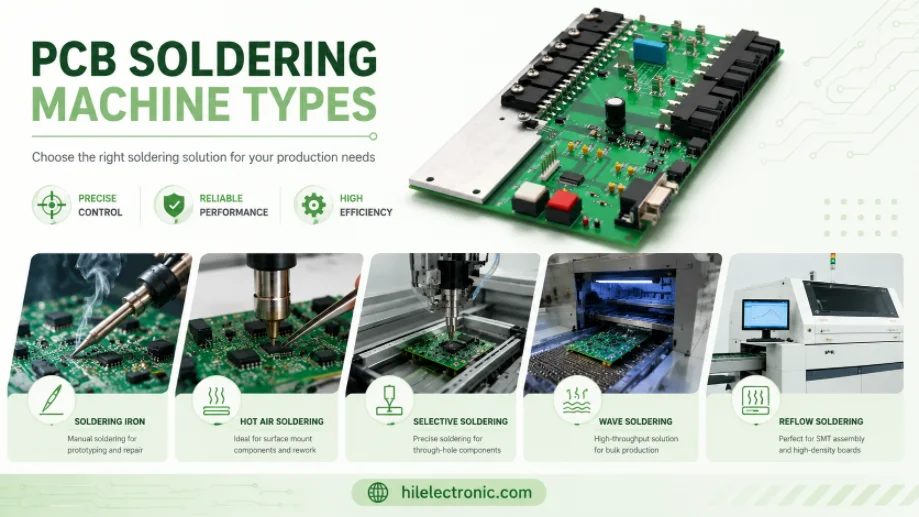
PCB Soldering Machine Types: Reflow, Wave, and Selective Equipment
Figure 1. PCB soldering machine types image for Highleap...
Clean Flux vs No-Clean Flux: Residue, Cleaning, and PCB Reliability
Figure 1. clean flux vs no-clean flux image for Highleap...
How to get a quote for PCBs
Let us run DFM/DFA analysis for you and get back to you with a report.
You can upload your files securely through our website.
We require the following information in order to give you a quote:
-
- Gerber, ODB++, or .pcb, spec.
- BOM list if you require assembly
- Quantity
- Turn time
In addition to PCB manufacturing, we offer a comprehensive range of electronic services, including PCB design, PCBA (Printed Circuit Board Assembly), and turnkey solutions. Whether you need help with prototyping, design verification, component sourcing, or mass production, we provide end-to-end support to ensure your project’s success. For PCBA services, please provide your BOM (Bill of Materials) and any specific assembly instructions. We also offer DFM/DFA analysis to optimize your designs for manufacturability and assembly, ensuring a smooth production process.