
Hot Plate Soldering: Process, Limits, and Reflow Comparison
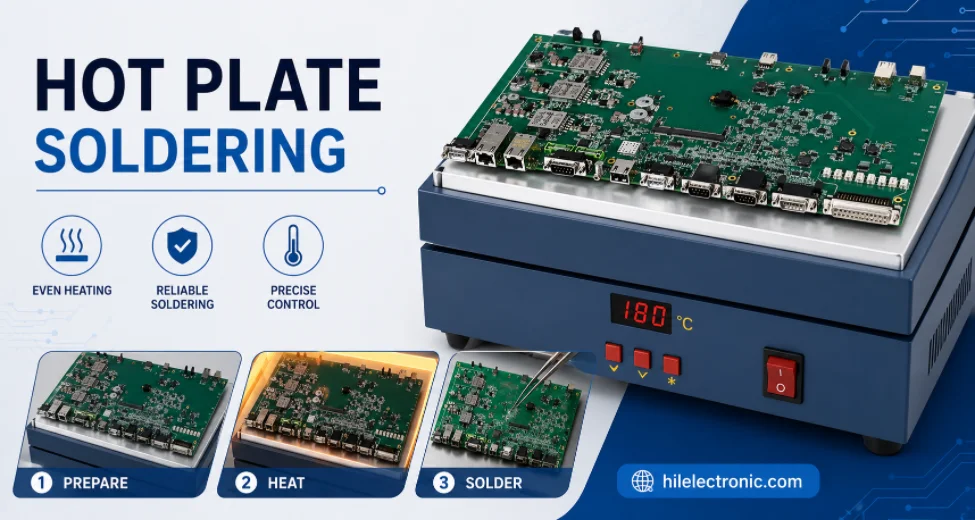
Figure 1. hot plate soldering image for Highleap Electronics PCB manufacturing and assembly review.
Hot plate soldering is a popular way to reflow surface-mount boards on a benchtop: you apply solder paste, place the parts, and heat the board from below on a temperature-controlled plate until the joints melt and form. It is cheap, fast for one or two boards, and ideal for prototyping — but it has real limits that make it the wrong tool for production. This guide explains what hot plate soldering is, how to do it properly, how it compares to a reflow oven, and when to move from the bench to a professional line at Highleap Electronics.
1. What is hot plate soldering?
Hot plate soldering is a reflow method that heats a PCB from below on a flat, temperature-controlled plate until the solder paste melts and forms every joint at once. It reproduces the chemistry of oven reflow — paste melts, flux activates, surface tension pulls parts into alignment — but delivers the heat by conduction through the bottom of the board rather than by hot air in a chamber.
It is a benchtop tool, popular with makers, labs, and prototype shops because a good controlled hot plate is inexpensive and heats up in minutes. The mechanism is the same as any reflow soldering process, so the same paste and the same general temperature targets apply. The catch, explored below, is that heating from one side only works well for certain board types and is fundamentally hard to scale.
2. How to solder a PCB on a hot plate (step by step)
To hot plate solder, apply solder paste to the pads, place the components into the wet paste, set the board on the plate, and ramp through preheat, soak, and reflow until the joints visibly wet out, then cool. Following a temperature profile rather than just blasting full heat is what produces clean joints and protects the parts. The method:
- Apply paste. Use a stencil for even, repeatable deposits, or a syringe for a few joints; too much paste is the usual cause of bridges.
- Place components into the wet, tacky paste, which holds them until reflow.
- Ramp through a profile. Preheat and soak so the whole board and parts warm evenly, then bring the surface above the alloy’s melting point so the joints reflow — watch for the paste turning shiny and the parts settling.
- Cool gently and inspect under magnification for wetting and bridges.
Two cautions matter. First, hot plate soldering only heats the bottom side, so it is meant for single-sided placement — flipping a board to do the second side risks reflowing the first side’s parts off. Second, a kitchen hob is not a substitute for a temperature-controlled plate; uncontrolled heat overshoots the profile and damages components. For the paste side of the equation, the broader principles of choosing and handling paste are the same as on any line, and a quick read on lead-free solder processes helps if you are matching paste to profile.
3. Hot plate vs reflow oven: which should you use?
Use a hot plate for single-sided prototypes and one-off boards, and a reflow oven for double-sided boards, repeatable quality, and any volume. The core difference is how heat is delivered and controlled: a hot plate conducts heat through the bottom of the board, while a reflow oven surrounds the whole board with a controlled hot-air profile that heats both sides and every component evenly.
| Hot plate | Reflow oven | |
|---|---|---|
| Heating | Conduction from below, one side | Hot air all around, both sides |
| Best for | Single-sided prototypes, one-offs | Double-sided boards, production |
| Profile control | Basic, surface-dependent | Precise, repeatable zones |
| Throughput | One board at a time | Continuous, high volume |
For a maker validating a layout, a hot plate is perfect. The moment you need consistent, documented joints across many boards, both sides populated, or fine-pitch and BGA parts that demand an exact profile, a reflow oven is the right tool — and the difference between the two methods is also a useful lens on reflow versus wave soldering at the production scale.
4. When a hot plate is the wrong tool
A hot plate is the wrong tool for double-sided boards, BGA and bottom-terminated parts, large or thick boards, and anything that needs repeatable, documented quality. Each limit comes from the same root cause — heat enters from one side and is hard to control precisely:
- Double-sided assembly — heating from below reflows the bottom side, so you cannot cleanly do both sides.
- BGA and hidden joints — these need an even, profiled reflow and X-ray inspection, which a hot plate cannot provide.
- Large or thick boards — they heat unevenly on a plate, leaving cold corners and over-cooked centers.
- Repeatable quality — production reliability depends on a controlled, documented profile per board, not bench judgment.
Pushing a hot plate past these limits is where prototype habits turn into yield problems, the same way many manufacturability issues only surface once a design leaves the bench. The fix is not a bigger hot plate; it is the right process.

Figure 2. Manufacturing details for hot plate soldering should be checked before quotation and production.
5. Reflow temperature profile: the part beginners skip
A reflow profile has four stages — preheat, soak, reflow, and cooling — and following it is what separates clean joints from damaged parts, whether you reflow on a hot plate or in an oven. The most common beginner mistake is to skip the profile and just crank the heat to maximum, which thermally shocks components, burns the flux before it can work, and produces cold or cracked joints. Each stage has a purpose:
- Preheat ramps the board up at a controlled rate (commonly a few degrees per second) to ease thermal shock and begin activating the flux.
- Soak holds a steady intermediate temperature so the whole board and all components reach a uniform temperature and the flux fully cleans the surfaces before melting.
- Reflow takes the joints above the alloy’s melting point — roughly 217–227°C for common lead-free pastes — for a short time so the solder coalesces and wets, then comes back down.
- Cooling brings the board down at a controlled rate to form a strong joint grain structure without thermally shocking the parts.
On a hot plate you approximate this by ramping the plate and watching the board, which works for simple single-sided boards but is inherently imprecise. A production reflow oven holds each stage in separate heated zones so large and small parts all hit the right temperature — the repeatability that bench reflow cannot match, and the reason the same paste behaves so differently on a controlled line. Matching the paste to the profile starts with the alloy, so a look at lead-free solder melting behavior is worth it before you set temperatures.
6. When to move from hot plate to production reflow
Move from a hot plate to production reflow once you need more than a couple of boards, both sides populated, BGA or fine-pitch parts, or verified, repeatable joints. That is the point where bench reflow stops saving time and starts costing yield, and a professional line pays for itself.
Highleap takes a design from that prototype stage into reliable volume through SMT PCB assembly with profiled reflow, AOI, and X-ray for hidden joints — so the joints you eyeballed on a hot plate are now built to a controlled profile and verified. Validating the layout first with a prototype PCB run keeps the transition smooth. When you request a quote, mention whether the board is single- or double-sided, the smallest pitch or any BGAs, and your quantity so the right process is applied.
7. Hot plate soldering FAQ
Can you use a kitchen hot plate or skillet to solder a PCB?
It is risky and not recommended. A kitchen hob has no fine temperature control, so it overshoots the profile and damages components, and food-surface plates are uneven. A purpose-built controlled soldering hot plate is inexpensive and far safer.
What temperature should a hot plate be set to for soldering?
The plate must bring the joints above the solder’s melting point — around 217–227°C for common lead-free paste — but you ramp up through preheat and soak rather than setting that peak from cold. The plate surface often runs somewhat hotter than the target joint temperature.
Can you reflow BGA chips on a hot plate?
Not reliably. BGAs need even heating from above and below and X-ray inspection to verify the hidden ball joints, neither of which a bottom-heating hot plate provides. BGA work belongs on a reflow oven or a proper rework station.
Do you need solder paste for hot plate soldering?
Yes — hot plate reflow melts pre-applied solder paste, so paste (ideally printed through a stencil) is essential. You cannot hot-plate reflow with solder wire, which is meant for iron soldering of individual joints.
Can a hot plate remove or rework surface-mount components?
Yes for the bottom side — heating the board reflows the joints so parts can be lifted off, which is useful for salvaging or reworking SMD components. It is less controlled than hot air for removing a single part among many.
Why are my hot plate joints dull or not melting evenly?
Usually uneven plate contact, a board that is too large or thick for the plate, or insufficient temperature. A flat board in full contact, a plate sized to the board, and a proper soak so heat spreads evenly all improve results.

Recommended Posts

Isola Astra MT77 PCB Manufacturing
Figure 1. Isola Astra MT77 PCB ManufacturingIsola Astra...

Nelco N4000-13 PCB Material and Manufacturing Guide | Highleap Electronics
Figure 1. Nelco N4000-13 PCBNelco N4000-13 PCB is a...

Copper Clad Laminate: Complete Material Selection Guide for PCB Engineers
Every electrical property that matters in a printed...

Inside a China Ceramic PCB Factory: Process Control Across Power/LED/RF/Medical
Table of Contents Inside a China Ceramic PCB Factory: How...
How to get a quote for PCBs
Let’s run DFM/DFA analysis for you and get back to you with a report. You can upload your files securely through our website. We require the following information in order to give you a quote:
-
- Gerber, ODB++, or .pcb, spec.
- BOM list if you require assembly
- Quantity
- Turn time
For PCBA services, please provide your BOM (Bill of Materials) and any specific assembly instructions. We also offer DFM/DFA analysis to optimize your designs for manufacturability and assembly, ensuring a smooth production process.