
Duroid 6035HTC PCB Fabrication and Assembly Service
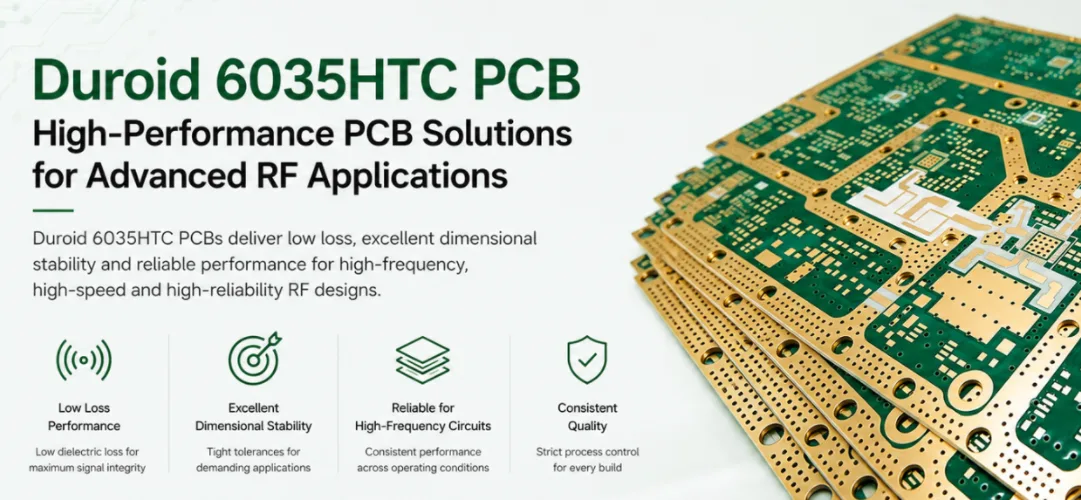
Figure 1. Duroid 6035HTC PCB
Duroid 6035HTC PCB is used when RF performance and heat dissipation must be controlled at the same time. With stable electrical properties and high thermal conductivity, RT/duroid 6035HTC is widely selected for RF power amplifiers, phased-array antennas, radar front-ends, 5G base stations, satellite communication modules and other high-power microwave circuits.
Highleap Electronics manufactures Duroid 6035HTC PCBs from prototype to production, including material selection, stackup review, controlled impedance, PTFE-compatible fabrication, surface finish selection and PCB assembly support. For projects using GaN devices, RF power stages, antenna modules or high-duty-cycle transmitters, our engineering team can review your Gerber files, stackup and assembly requirements before quotation.
What Is Duroid 6035HTC PCB?
RT/duroid 6035HTC is a ceramic-filled PTFE laminate developed for high-frequency circuits that require better heat dissipation than many conventional low-loss RF materials. Unlike general-purpose RF laminates, Duroid 6035HTC is usually selected when the circuit has a real thermal challenge, not only a signal-integrity requirement.
In RF power amplifier and microwave transmitter designs, heat generated by active devices must move efficiently from the package into the PCB, heat spreader, cold plate or housing. Duroid 6035HTC helps improve the thermal path through the dielectric layer while still maintaining stable RF electrical properties.
Key Material Properties
| Property | Typical Value | Why It Matters |
|---|---|---|
| Dielectric Constant | 3.50 | Supports predictable impedance and RF transmission-line design. |
| Dissipation Factor | 0.0013 at 10 GHz | Helps reduce insertion loss in microwave circuits. |
| Thermal Conductivity | 1.44 W/mK | Improves heat transfer from RF power devices through the PCB. |
| Material Type | Ceramic-filled PTFE | Requires special fabrication control compared with FR-4. |
| Typical Applications | RF power, radar, 5G, satellite, microwave modules | Suitable for circuits where both RF loss and thermal path matter. |
Compared with materials such as RT/duroid 5880 or RO4350B, Duroid 6035HTC is not chosen simply because it is a low-loss laminate. It is chosen when the design also needs a stronger thermal path, especially around power devices, amplifier stages or dense antenna modules.
Highleap Duroid 6035HTC PCB Manufacturing Capabilities
Highleap Electronics provides Duroid 6035HTC PCB fabrication and PCB assembly services for RF, microwave and high-frequency applications. Our role is not only to build the board, but also to help customers verify whether the stackup, copper weight, surface finish, via structure and assembly process are suitable for the intended RF and thermal performance.
| Capability | Highleap Support |
|---|---|
| PCB Type | Double-sided Duroid 6035HTC PCB, multilayer RF PCB and hybrid stackup PCB. |
| Material Options | RT/duroid 6035HTC, FR-4 hybrid, Rogers bondply and mixed RF material stackups. |
| Applications | RF power amplifier, phased array, radar, 5G base station, satellite and microwave module. |
| Impedance Control | 50-ohm and 75-ohm controlled impedance with test coupon option. |
| Copper Options | Standard copper, 2 oz copper, 3 oz copper and heavy copper structures depending on design. |
| Thermal Options | Thermal vias, copper coin, local heat-spreader structure and high-copper-density layout support. |
| Surface Finish | Immersion silver, ENIG, ENEPIG and selective hard gold depending on RF and assembly needs. |
| Assembly Service | SMT assembly, RF component assembly, BOM sourcing, soldering and conformal coating support. |
| Quality Support | Electrical test, impedance test, microsection report, material certificate and IPC Class 2 / Class 3 support. |
Common Stackup Options
Most Duroid 6035HTC PCB projects use one of the following stackup types:
- Double-sided Duroid 6035HTC PCB: used for simple RF transmission, amplifier or antenna circuits where the RF layer and ground layer must stay close and thermally efficient.
- Duroid 6035HTC + FR-4 hybrid stackup: used when the RF layer requires Duroid 6035HTC but the remaining layers are mainly for DC bias, control signals or mechanical support.
- Multilayer Rogers hybrid stackup: used for more complex RF modules where several high-frequency layers, controlled impedance lines and shielding structures are required.
- Duroid 6035HTC with heavy copper or copper coin: used when GaN, LDMOS or other high-power RF devices create concentrated heat near the active device area.
For cost-sensitive designs, a hybrid stackup is often more practical than building the entire board with Duroid 6035HTC. Highleap can review the electrical, thermal and manufacturing trade-offs before production.
Key Fabrication Challenges of Duroid 6035HTC PCB
Duroid 6035HTC is not processed like standard FR-4. The ceramic-filled PTFE structure brings several manufacturing challenges, especially during lamination, drilling, hole-wall activation and plating. These challenges are manageable, but they require a factory that understands RF laminate behavior and PTFE-compatible process control.
Lamination and Bonding
PTFE-based laminates do not bond like epoxy-based FR-4 materials. During multilayer or hybrid lamination, the bonding film, pressure, temperature ramp and cool-down profile must be controlled carefully. If the press cycle is not suitable, the board may suffer from voids, weak bonding, registration shift or warpage.
For Duroid 6035HTC hybrid PCB manufacturing, Highleap reviews the dielectric combination, copper distribution, bondply selection and CTE mismatch before production. This is especially important when Duroid 6035HTC is combined with FR-4 or other Rogers materials in the same stackup.
Drilling Ceramic-Filled PTFE
Duroid 6035HTC contains ceramic filler, so drilling behavior is different from standard FR-4. Tool wear is higher, hole-wall quality must be controlled more carefully, and drilling parameters should be adjusted to reduce smear, burrs and rough hole walls.
For high-reliability RF PCB fabrication, fresh carbide tools, suitable entry and backup materials, stable drilling conditions and proper inspection are important. Poor drilling quality can directly affect through-hole plating reliability and RF grounding performance.
Hole-Wall Activation and Plating
PTFE is chemically resistant, which means copper does not naturally adhere to the hole wall after drilling. Before electroless copper deposition, the hole wall needs suitable activation, such as plasma treatment or sodium-based etching, depending on the process route and design requirement.
After activation, electroless copper and electrolytic copper plating must provide reliable hole-wall coverage. For RF and microwave boards, via quality is especially important because vias are often used for grounding, shielding, thermal transfer and cavity control.
Surface Finish Selection
The surface finish of a Duroid 6035HTC PCB affects solderability, shelf life, RF conductor loss and wire-bonding compatibility. The best choice depends on frequency, assembly method and storage requirement.
| Surface Finish | Best Use | Consideration |
|---|---|---|
| Immersion Silver | Low-loss RF transmission lines and microwave boards. | Good RF performance, but storage and handling must be controlled. |
| ENIG | General soldering, long shelf life and mixed assembly. | Nickel layer may increase conductor loss at higher frequencies. |
| ENEPIG | Wire bonding and soldering on the same board. | Higher cost, but useful for advanced RF assemblies. |
| Hard Gold | Edge contacts or selected wear-resistant pads. | Usually used selectively, not as a full-board finish. |
For many high-frequency Duroid 6035HTC PCBs, immersion silver is preferred for RF performance, while ENIG or ENEPIG may be selected when assembly, shelf life or wire bonding is more important.
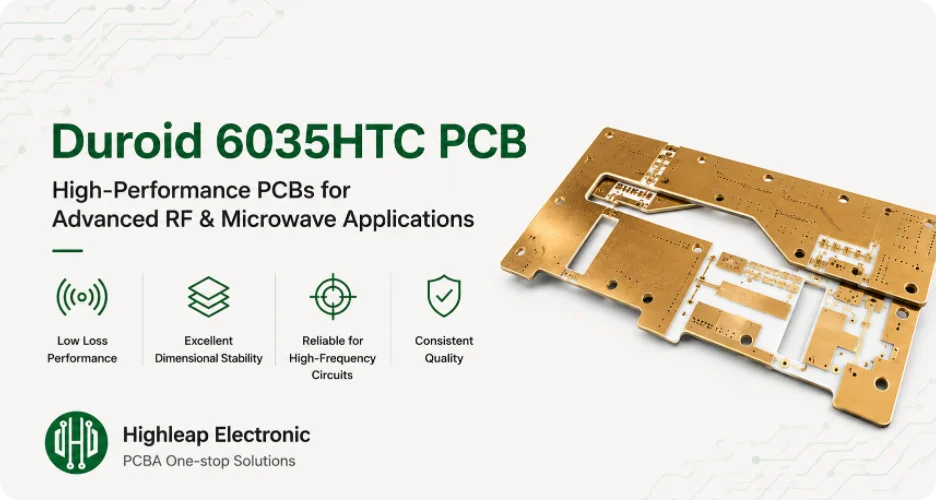
Figure 2. Duroid 6035HTC PCB
Duroid 6035HTC Stackup and Thermal Design Considerations
The main reason engineers choose Duroid 6035HTC is thermal performance. In RF power circuits, heat often comes from a small active device area, such as a GaN amplifier, driver stage or high-power transistor. If the heat cannot move efficiently into the PCB and housing, the device junction temperature rises and long-term reliability may be reduced.
Duroid 6035HTC improves the thermal path through the dielectric itself, but it does not eliminate the need for good thermal design. Thermal vias, copper thickness, copper coin structures, solder void control, housing contact and interface material still matter.
Thermal Vias, Heavy Copper and Copper Coin
Thermal vias can help move heat from the top device area to internal planes or the backside ground layer. For higher-power designs, heavy copper or copper coin structures may be used to reduce local thermal resistance. These structures need to be considered early because they affect drilling, plating, lamination, routing space and assembly flatness.
When reviewing a Duroid 6035HTC PCB design, Highleap checks whether the thermal path is consistent with the PCB stackup and assembly method. For example, a copper coin under a GaN device may require special cavity control, local planarity control and suitable soldering process design.
Solder Mask and RF Transmission Lines
Solder mask can change the effective dielectric environment around RF transmission lines. For this reason, many RF designers keep solder mask away from critical microstrip lines, RF launch areas, matching networks and antenna structures. In other areas, such as DC bias circuits and control regions, solder mask can still be applied for protection.
Highleap can review solder mask openings around RF traces, pads, ground areas and component footprints to reduce the risk of impedance shift or unexpected RF performance changes.
Duroid 6035HTC vs Other RF Materials
| Material | Main Advantage | Limitation | Typical Selection Reason |
|---|---|---|---|
| Duroid 6035HTC | High thermal conductivity with low RF loss. | More difficult and expensive to process than FR-4-compatible materials. | High-power RF and microwave circuits with thermal stress. |
| RT/duroid 5880 | Very low loss and low Dk. | Lower thermal conductivity. | Ultra-low-loss RF circuits where heat is less critical. |
| RO4350B | Good manufacturability and lower cost. | Higher loss and lower thermal performance than 6035HTC. | General RF designs and cost-sensitive high-frequency boards. |
| RO3003 | Stable Dk and good RF behavior. | Not as thermally conductive as 6035HTC. | Radar, antenna and high-frequency circuits with moderate thermal load. |
In simple terms, Duroid 6035HTC is not always the lowest-cost or easiest material to manufacture. It is the right choice when the RF circuit needs both low loss and a stronger thermal path.
Applications of Duroid 6035HTC PCB
Duroid 6035HTC PCBs are typically used in applications where RF power density, thermal dissipation and stable microwave performance are all important. Highleap supports both bare PCB fabrication and assembled RF PCB modules for these applications.
RF Power Amplifier PCB
RF power amplifiers often generate concentrated heat around GaN, LDMOS or other high-power devices. Duroid 6035HTC helps transfer heat from the active device region toward the ground plane, heat spreader or housing. Typical designs may include controlled-impedance RF lines, dense grounding vias, thermal vias, heavy copper or copper coin structures.
Phased Array Antenna PCB
Phased-array antenna modules require compact RF routing, stable dielectric behavior and heat management across many repeated channels. Duroid 6035HTC can be used for RF layers carrying antenna feeds, beamforming circuits, amplifier stages or microwave interconnects.
Radar and EW Transmitter PCB
Radar front-ends and electronic-warfare transmitter modules may operate at high duty cycles and high power levels. For these boards, Duroid 6035HTC provides a useful combination of microwave electrical performance and thermal conductivity, especially when paired with proper housing and heat-sink design.
5G and Satellite Microwave Modules
5G infrastructure, satellite communication modules and microwave transceivers often require controlled impedance, low insertion loss and compact high-density layouts. Duroid 6035HTC can be used when the module also has a higher thermal load than standard RF laminate designs can comfortably support.
Why Choose Highleap for Duroid 6035HTC PCB Manufacturing?
Highleap Electronics is a PCB manufacturing and PCB assembly factory supporting high-frequency PCB, RF PCB, microwave PCB and Rogers material PCB projects. For Duroid 6035HTC PCB manufacturing, we focus on manufacturability, stackup reliability, impedance control, thermal design and assembly compatibility.
- RF material experience: support for Rogers high-frequency materials, PTFE-based laminates and hybrid RF stackups.
- DFM review before production: stackup, drill, copper balance, via structure, surface finish and impedance requirements can be reviewed before fabrication.
- Controlled impedance support: 50-ohm and 75-ohm transmission-line control with test coupon option.
- Thermal design support: review of thermal vias, copper coin, heavy copper and heat-spreader requirements.
- PCB fabrication and assembly: bare PCB manufacturing, SMT assembly, RF component placement, BOM sourcing and conformal coating support.
- Documentation support: electrical test report, impedance report, microsection report, material certificate and compliance documents when required.
- Prototype to production: support for engineering prototypes, small-batch RF modules and scheduled production builds.
Quote Checklist
To get a faster and more accurate Duroid 6035HTC PCB quote, please provide the following files and requirements:
- Gerber files
- Drill files
- Layer stackup drawing
- Required Duroid 6035HTC thickness
- Copper weight
- Surface finish
- Controlled impedance requirements
- Minimum hole size and via type
- PCB quantity and expected delivery time
- BOM and Pick & Place file if PCB assembly is required
- Special RF test, inspection or documentation requirements
Duroid 6035HTC PCB FAQ
What is Duroid 6035HTC PCB used for?
Duroid 6035HTC PCB is used for high-power RF and microwave applications, including RF power amplifiers, phased-array antennas, radar modules, 5G base stations, satellite communication equipment and high-duty-cycle transmitter circuits.
What is the thermal conductivity of Duroid 6035HTC?
RT/duroid 6035HTC has a thermal conductivity of 1.44 W/mK, which makes it suitable for RF circuits where heat dissipation is a major design concern.
Is Duroid 6035HTC better than RO4350B?
Duroid 6035HTC offers higher thermal conductivity and lower RF loss than RO4350B, but it is more difficult and usually more expensive to fabricate. RO4350B is often better for cost-sensitive RF designs, while 6035HTC is better for high-power RF applications with stronger thermal requirements.
Can Duroid 6035HTC be used with FR-4?
Yes. Duroid 6035HTC can be used in hybrid PCB stackups with FR-4 layers. This approach can reduce cost while keeping the RF layer on a high-performance thermal RF laminate. However, the stackup should be reviewed carefully for bonding, CTE, impedance and reliability.
Does Highleap provide Duroid 6035HTC PCB assembly?
Yes. Highleap Electronics provides both Duroid 6035HTC PCB fabrication and PCB assembly services, including SMT assembly, RF component assembly, BOM sourcing, conformal coating and manufacturing documentation support.
Need Duroid 6035HTC PCB fabrication or assembly? Send your Gerber files, stackup, BOM and quantity requirements to Highleap Electronics. Our engineering team can review your design and provide a manufacturing quotation for prototype or production.

Recommended Posts

Taconic RF-35 PCB Manufacturing Service — Prototype Through Volume Production
Figure 1. Taconic RF-35 PCBTaconic RF-35 is the workhorse...

Isola Astra MT77 PCB Manufacturing
Figure 1. Isola Astra MT77 PCB ManufacturingIsola Astra...

Custom Rogers RO4835 PCB Fabrication & Assembly Services
Figure 1. Rogers RO4835 PCBRogers RO4835 PCB is a...

Nelco N4000-13 PCB Material and Manufacturing Guide | Highleap Electronics
Figure 1. Nelco N4000-13 PCBNelco N4000-13 PCB is a...
How to get a quote for PCBs
Let‘s run DFM/DFA analysis for you and get back to you with a report. You can upload your files securely through our website. We require the following information in order to give you a quote:
-
- Gerber, ODB++, or .pcb, spec.
- BOM list if you require assembly
- Quantity
- Turn time
For PCBA services, please provide your BOM (Bill of Materials) and any specific assembly instructions. We also offer DFM/DFA analysis to optimize your designs for manufacturability and assembly, ensuring a smooth production process.