
Choosing the Right HDI PCB Manufacturer: A Comprehensive Evaluation Checklist

Introduction
Selecting the right HDI PCB manufacturer directly impacts product reliability, time-to-market, and overall manufacturing costs. Unlike standard printed circuit boards, high-density interconnect technology demands precise process control, advanced equipment, and rigorous quality management. This evaluation checklist provides procurement teams and design engineers with a structured framework to assess potential suppliers across critical dimensions including certifications, technical capabilities, testing protocols, quality systems, and supply chain strength.
Why HDI PCB Manufacturer Selection Requires Extra Attention
Understanding HDI PCB Complexity
HDI PCB manufacturers must master specialized processes that standard PCB fabricators cannot reliably execute. These include laser-drilled microvias, sequential lamination cycles, and blind or buried via structures that enable higher circuit density. Poor manufacturing control leads to critical failure modes including microvia cracking, layer misregistration beyond acceptable tolerances, and impedance variations that compromise signal integrity.
Impact on Product Quality and Costs
Manufacturing defects create cascading problems throughout the production cycle. A single batch with microvia reliability issues can generate field failures months after deployment, triggering costly warranty claims. When an HDI PCB manufacturer lacks process stability, rework cycles and yield losses push delivery dates beyond committed timelines, creating hidden costs in quality sorting, engineering time, and market opportunity losses.

China Leading HDI PCB Manufacturing and Assembly Services
Essential Certifications for HDI PCB Manufacturers
Quality certifications provide the first screening layer when evaluating suppliers. ISO 9001 demonstrates fundamental quality management implementation, while industry-specific standards like IATF 16949 for automotive or ISO 13485 for medical devices indicate sector expertise. Environmental compliance through ISO 14001, RoHS, and REACH ensures regulatory alignment across global markets.
Key certification requirements include:
- Quality management standards – ISO 9001 foundation with industry-specific certifications proving sector experience and process maturity.
- Environmental compliance – RoHS and REACH directives ensuring regulatory alignment across global markets and sustainable manufacturing practices.
- Third-party validation – SGS or Intertek audit reports providing independent verification of claimed capabilities and process consistency.
Highleap Electronics maintains all key quality and environmental certifications, including ISO 9001, IATF 16949, ISO 13485, and ISO 14001, and regularly undergoes third-party audits to verify process consistency. These certifications support our ability to reliably manufacture HDI PCBs for automotive, medical, and other high-reliability applications.
Technical Capabilities Every HDI PCB Manufacturer Should Demonstrate
Process Capabilities
Technical assessment begins with understanding the HDI PCB manufacturer’s layer count range and microvia specifications. Confirm whether they offer stacked microvias, staggered microvias, or both configurations. Sequential lamination capability defines build-up layer limits, with advanced manufacturers handling six or more cycles. Design rule compatibility requires discussion around minimum line width and spacing, typically 75μm/75μm or finer.
Equipment and Facilities
Manufacturing equipment directly determines process capability and quality consistency. A qualified HDI PCB manufacturer operates CO2 or UV laser drilling systems for microvia formation with diameter control below ±5μm. Inspection infrastructure should include automated optical inspection for inner layers, flying probe testers for electrical continuity, and X-ray inspection for buried via verification.
Critical equipment indicators include:
- Laser drilling systems – CO2 or UV lasers providing microvia diameter control within ±5μm tolerance for reliable high-density interconnections.
- Sequential lamination presses – Vacuum systems with multi-zone temperature and pressure profiling ensuring precise layer-to-layer registration.
- Advanced inspection tools – Automated optical inspection, X-ray systems, and impedance testers validating critical HDI characteristics throughout production.
Highleap Electronics is equipped with state-of-the-art CO2 and UV laser drilling systems, sequential lamination presses with precise multi-zone control, and advanced inspection tools including AOI, X-ray, and impedance testers. These capabilities enable Highleap to consistently deliver high-density HDI PCBs with microvia diameters below 50μm and complex multi-layer build-ups, meeting the stringent requirements of automotive, medical, and high-speed electronics applications.
Testing and Quality Requirements for HDI PCB Manufacturers
Reliability Testing Protocols
Reliability testing separates competent HDI PCB manufacturers from those merely offering the service. Standard environmental testing includes thermal cycling across temperature extremes, combined humidity and temperature stress tests, and highly accelerated stress testing. HDI-specific validation should cover conductive anodic filament prevention testing, critical for long-term reliability in humid environments.
Quality Management Systems
Traceability systems enable rapid root cause analysis when quality issues emerge. Every HDI PCB manufacturer should demonstrate batch-level tracking with unique identifiers linking raw materials through process steps to final shipment. Statistical process control monitors critical parameters including copper plating thickness, microvia diameter distribution, and impedance values across production lots.

HDI PCB Manufacturing
Supply Chain and Capacity Evaluation
Production capacity assessment goes beyond quoted lead times to examine flexibility under demand fluctuations. Understand how the HDI PCB manufacturer allocates capacity between peak and normal periods, and whether backup production lines exist. Material sourcing strategies determine supply chain resilience, particularly for specialized substrates and high-reliability copper foils.
Essential supply chain metrics include:
- Delivery performance – On-time delivery percentage and average delay duration demonstrating schedule reliability and commitment fulfillment.
- Capacity flexibility – Backup production lines and peak period allocation proving ability to handle demand fluctuations without quality compromise.
Highleap Electronics maintains flexible production capacity with dedicated backup lines to manage peak demand periods without affecting quality. Our strategic sourcing of specialized substrates and high-reliability copper foils ensures consistent supply, while delivery performance metrics demonstrate reliable on-time fulfillment for both standard and urgent HDI PCB orders.
Auditing Your HDI PCB Manufacturer
Factory Assessment
Direct factory assessment validates claims made during initial discussions. Document the presence and condition of critical equipment including laser drilling systems, automated optical inspection stations, and impedance testing capability. Observe active production runs to evaluate process discipline, cleanliness standards, and operator training levels.
Sample Verification
Physical samples provide objective evidence of manufacturing capability. Visual inspection should reveal clean surface finish without discoloration and proper solder mask registration. X-ray inspection confirms microvia formation quality and checks for voiding in plated structures. Impedance measurement on test coupons verifies the HDI PCB manufacturer meets specified tolerances across different trace geometries.
Warning Signs in HDI PCB Manufacturer Selection
Certain indicators suggest a supplier lacks maturity for demanding applications. Absence of recognized quality certifications or reluctance to share certification documents signals fundamental process gaps. Missing critical inspection equipment, particularly X-ray systems and impedance testers, prevents verification of key HDI characteristics. Inability to provide batch traceability or statistical process control data indicates limited quality system sophistication.
Conclusion
Systematic evaluation enables evidence-based HDI PCB manufacturer selection rather than decisions driven primarily by cost. This checklist framework supports objective comparison across technical capabilities, quality systems, and operational performance. Investment in thorough supplier evaluation yields returns through reduced qualification time, fewer production disruptions, and higher end-product reliability.
Highleap Electronics brings proven HDI PCB manufacturing capabilities to demanding applications:
- Comprehensive certifications – ISO 9001, IATF 16949, and ISO 13485 compliance with regular third-party audits validating process maturity.
- Advanced equipment infrastructure – Laser drilling systems, sequential lamination presses, and complete inspection capabilities for HDI production.
- Rigorous testing protocols – Full environmental and HDI-specific reliability testing with transparent test report sharing and traceability systems.
- Proven delivery performance – Flexible capacity management and robust supply chain enabling consistent on-time delivery for both prototype and production volumes.

Recommended Posts
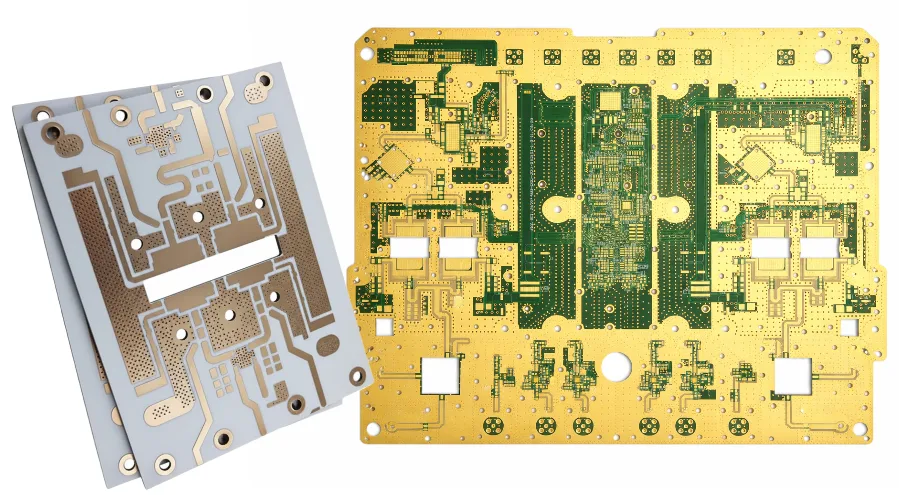
PCB Materials Database: Laminate Grades & Properties
How to get a quote for PCBs Let‘s run DFM/DFA analysis for...
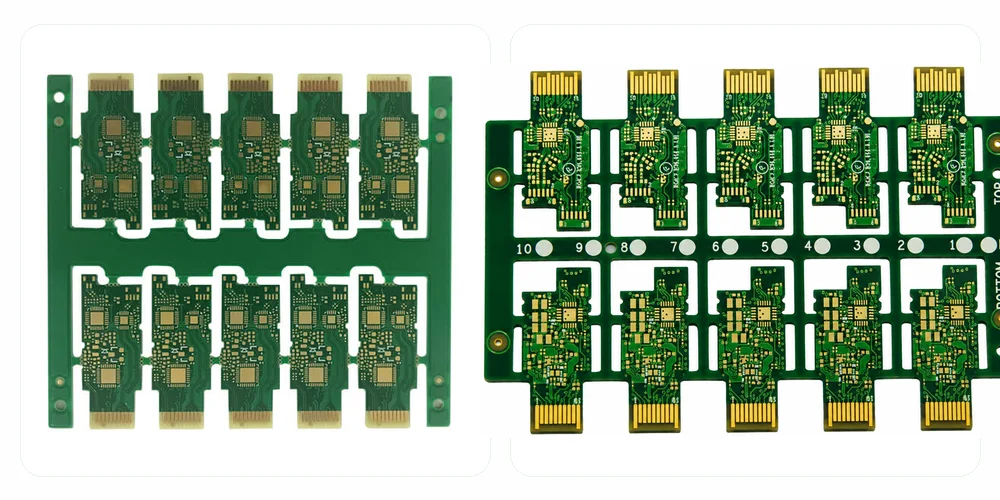
Optical Transceiver PCB Manufacturer for Custom Pluggable Modules
Highleap Electronics manufactures and assembles custom...
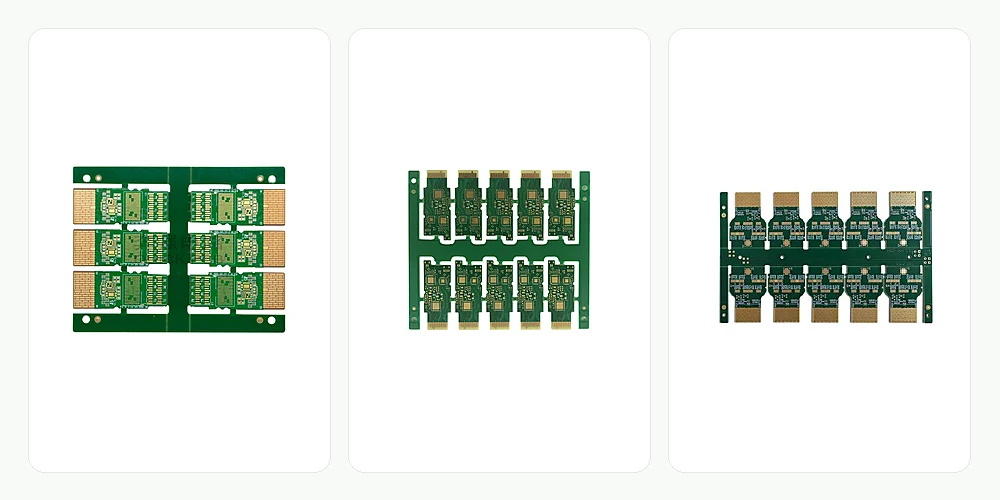
Optical Module PCB Manufacturer for 400G, 800G and 1.6T Programs
Highleap Electronics provides optical module PCB...
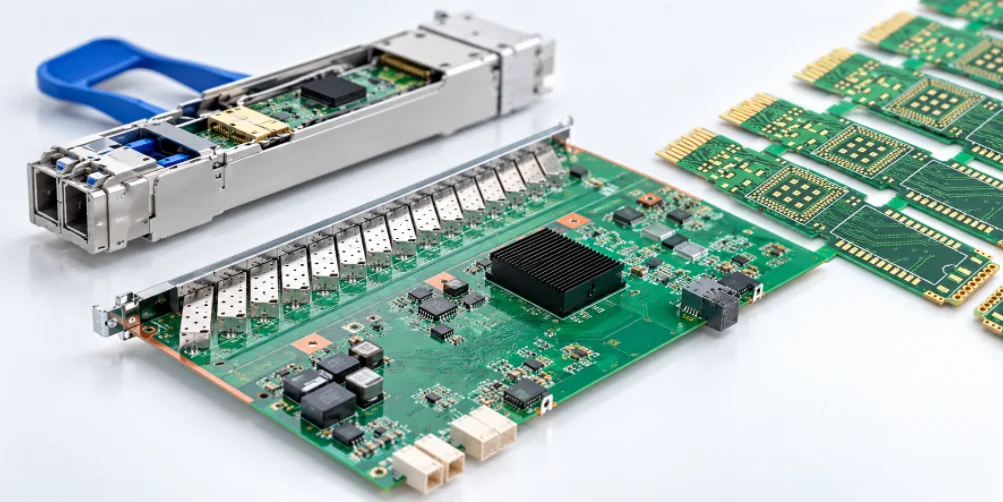
Optical Communication PCB Manufacturer for Fiber Network Equipment
Highleap Electronics manufactures and assembles optical...
How to get a quote for PCBs
Let‘s run DFM/DFA analysis for you and get back to you with a report. You can upload your files securely through our website. We require the following information in order to give you a quote:
-
- Gerber, ODB++, or .pcb, spec.
- BOM list if you require assembly
- Quantity
- Turn time
In addition to PCB manufacturing, we offer a comprehensive range of electronic services, including PCB design, PCBA, and turnkey solutions. Whether you need help with prototyping, design verification, component sourcing, or mass production, we provide end-to-end support to ensure your project’s success.
For PCBA services, please provide your BOM (Bill of Materials) and any specific assembly instructions. We also offer DFM/DFA analysis to optimize your designs for manufacturability and assembly, ensuring a smooth production process.