
PCA vs PCB vs PCBA: What Is the Difference?

Figure 1. PCA vs PCB vs PCBA
Last updated: May 2026 · A definitions guide for buyers, engineers, and anyone reading a quote
These three acronyms cause endless confusion, but the rule is simple. A PCB (Printed Circuit Board) is the bare board — the substrate with copper traces and no parts on it. A PCBA (Printed Circuit Board Assembly) is that same board after components have been soldered on, so it is a populated, functional assembly. And PCA (Printed Circuit Assembly) means the same thing as PCBA — it is simply the term with the word “Board” dropped. So the progression is: PCB → add components → PCBA (= PCA). Knowing which one you’re ordering changes the price, the lead time, and the files you need to supply.
PCB vs PCBA vs PCA: One-Sentence Definitions
- PCB — Printed Circuit Board: the bare, unpopulated board (laminate + copper traces, pads, vias, solder mask, silkscreen). No components.
- PCBA — Printed Circuit Board Assembly: a PCB with components mounted and soldered, making it a working assembly.
- PCA — Printed Circuit Assembly: an assembled board; functionally a synonym for PCBA, just without the “Board” in the name.
What Is a PCB? (The Bare Board)
A PCB is the foundation: a rigid (or flexible) insulating substrate — most commonly FR-4 fiberglass — with one or more layers of patterned copper that route signals and power, plus drilled and plated holes (vias), a solder mask, and silkscreen markings. On its own a PCB does nothing electrically useful; it is the wiring platform waiting for parts. PCB fabrication is the process that produces this bare board, and it is defined by parameters like layer count, copper weight, board thickness, surface finish, minimum line/space, and stackup.
What Is a PCBA? (The Assembled Board)
A PCBA is what you get after assembly populates the bare PCB with components — resistors, capacitors, ICs, connectors — and solders them in place, typically via surface-mount technology (SMT), through-hole, or both. The result is a functional board that can be powered, programmed, and tested. Producing a PCBA therefore requires more than the board geometry: it needs a bill of materials (BOM), a pick-and-place (centroid) file, and an assembly drawing, plus the components themselves. A PCBA may also include programming, inspection (AOI/X-ray), and functional test before it ships.
What Does PCA Mean, and Why It Equals PCBA
“PCA” stands for Printed Circuit Assembly. It refers to the assembled board — the same object as a PCBA. The only difference is the wording: PCBA spells out “Printed Circuit Board Assembly,” while PCA leaves out “Board.” In everyday use they are interchangeable; if a document says “PCA,” read it as “the assembled board.” (You may occasionally see “CCA,” Circuit Card Assembly, used the same way — see below.) Because the abbreviation is correctly written in capitals, it should appear as PCA, not “Pca.”
PCB vs PCBA vs PCA: Side-by-Side Comparison
| Aspect | PCB | PCBA | PCA |
|---|---|---|---|
| Full name | Printed Circuit Board | Printed Circuit Board Assembly | Printed Circuit Assembly |
| Components? | No (bare) | Yes (populated) | Yes (populated) |
| Functional? | No | Yes | Yes |
| Relationship | The starting board | PCB + assembly | Same as PCBA |
| Files needed | Gerber, drill, outline | + BOM, centroid, assembly drawing | + BOM, centroid, assembly drawing |
| Made by | Fabrication | Assembly | Assembly |
PCB, PCBA, PCA, and CCA: Where Each Term Is Used
Usage varies by industry and company, which is part of why the terms get muddled:
- PCB is universal for the bare board and for the fabrication business.
- PCBA is the most common term for the assembled board, especially among contract manufacturers and in supply-chain documents.
- PCA appears as a shorthand for the assembly, particularly where teams prefer “Printed Circuit Assembly.”
- CCA (Circuit Card Assembly) means the same as PCBA and is common in aerospace, defense, and some OEM documentation.
When in doubt, ask whether a document means the bare board or the assembled board; that single question removes nearly all ambiguity.
PCB vs PCBA: What You Order and How Cost Differs
The terms map directly to what you buy and what it costs:
| You want… | You order… | Cost & time drivers |
|---|---|---|
| Just the empty boards | PCB (fabrication) | Layers, size, finish, quantity — fastest and cheapest |
| Finished, working boards | PCBA / PCA (assembly) | Adds component cost, sourcing, SMT/THT, test — longer lead time |
| Everything handled end to end | Turnkey PCBA | Manufacturer sources parts, builds, tests, ships |
A bare PCB is usually the lowest-cost, quickest item. The moment you move to a PCBA/PCA, you add the price of components (often the largest line item), procurement time, assembly, and any test — which is why an assembled-board quote is more involved than a bare-board quote.
How a Bare PCB Becomes a Finished PCBA
The clearest way to feel the difference between the terms is to watch a bare PCB become a PCBA. Each step adds something the bare board doesn’t have:
- Start: the PCB. A bare board arrives from fabrication — copper, mask, silkscreen, plated holes. It is inert.
- Solder paste & placement. Paste is printed on the pads and SMT components are placed onto it. The board now carries parts but isn’t yet soldered.
- Reflow. The board passes through a reflow oven; the paste melts and forms permanent joints. At this point it has become a PCBA — a populated, electrically connected assembly.
- Through-hole & finishing. Connectors and other leaded parts are added by wave, selective, or pin-in-paste soldering.
- Programming & test. Firmware is loaded, and AOI, X-ray, in-circuit, or functional test confirm the assembly works.
- Result: the PCBA (= PCA). A finished, tested board ready to go into a product.
So the boundary is exactly the moment components are soldered on: before that you have a PCB; after it you have a PCBA — which is the same object a document might call a PCA or a CCA.
Related terms you may see nearby
- SMD / SMT: Surface-Mount Device / Technology — the parts and process used to populate most modern PCBAs.
- COB (Chip-on-Board): a bare die bonded directly to the board and encapsulated, rather than a packaged component.
- Box build / system integration: a stage beyond PCBA where the assembled board is fitted into an enclosure with cables, displays, and other hardware.
- Bare board / raw card: informal names for the PCB before assembly.
Why PCB vs PCBA Matters in an RFQ
Mixing up these terms in a quote request leads to mismatched expectations: you might receive a price for bare boards when you needed finished assemblies, or be asked for a BOM you didn’t expect to supply. Be explicit:
- For a PCB (bare board), provide Gerber files, an NC-drill file, the board outline, stackup, material, copper weight, surface finish, and quantity.
- For a PCBA / PCA (assembled board), provide all of the above plus a BOM, a pick-and-place/centroid file, an assembly drawing, and your inspection/test and programming requirements.
- State the deliverable plainly — “bare PCB” or “assembled PCBA” — and note whether you want turnkey (manufacturer sources parts) or consigned (you supply parts).
PCB and PCBA Manufacturing at Highleap
Highleap Electronics is a China-based manufacturer that handles both stages — bare-board fabrication and full assembly — for customers in the United States, Europe, and Asia-Pacific, so you can order exactly the deliverable you mean:
- PCB fabrication for bare boards, from prototype to production.
- PCB assembly (PCBA) with SMT and through-hole to produce finished, working boards.
- Turnkey PCBA covering component sourcing, assembly, inspection, and test end to end.
- DFM review to confirm the design is buildable before either stage begins.
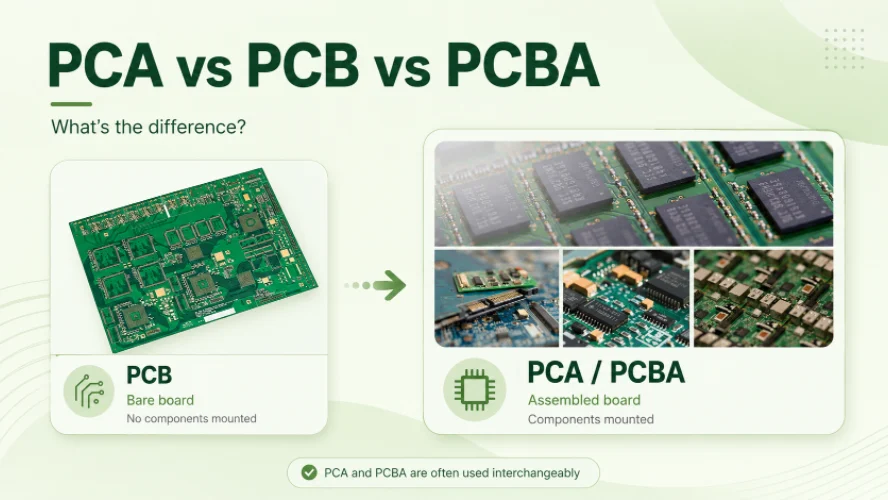
Figure 2. PCA vs PCB vs PCBA details
PCA vs PCB vs PCBA FAQ
What is the difference between PCB and PCBA?
A PCB is the bare board with no components on it. A PCBA is that board after components have been soldered on, making it a working assembly. PCB is what fabrication produces; PCBA is what assembly produces.
Is PCA the same as PCBA?
Yes. PCA (Printed Circuit Assembly) and PCBA (Printed Circuit Board Assembly) both refer to the assembled, populated board. PCA simply omits the word “Board.” Treat them as synonyms.
What does PCA stand for?
PCA stands for Printed Circuit Assembly — an assembled circuit board. It is written in capitals (PCA), and it means the same thing as PCBA.
What is CCA, and how does it relate?
CCA stands for Circuit Card Assembly. It is another synonym for PCBA, used most often in aerospace, defense, and certain OEM documents. It also refers to the assembled board.
Which costs more, a PCB or a PCBA?
A PCBA costs more and takes longer, because it adds the price of components (often the biggest cost), procurement, assembly labor, and test on top of the bare PCB. A bare PCB is the faster, lower-cost item.
What files do I need for a PCB vs a PCBA?
For a bare PCB: Gerber, NC-drill, board outline, and stackup/material details. For a PCBA: all of that plus a BOM, a pick-and-place (centroid) file, an assembly drawing, and any programming, inspection, or test requirements.
How do I avoid confusion when requesting a quote?
State the deliverable explicitly — “bare PCB” or “assembled PCBA/PCA” — and say whether you want turnkey (the manufacturer sources components) or consigned (you supply them). That single clarification prevents most quoting mix-ups.
At what exact point does a PCB become a PCBA?
The moment components are soldered onto the bare board. Once paste is reflowed (or through-hole parts are soldered) and the board carries functional components, it is a PCBA. Placing parts onto wet paste before reflow is an intermediate state; the finished joints are what make it an assembly.
What is the difference between PCB and PCBA in manufacturing?
In manufacturing, a PCB is the bare fabricated board (made by PCB fabrication), while a PCBA is that board after components are soldered on (made by PCB assembly). Quoting a PCBA also needs a BOM and pick-and-place file, and it costs more because it includes the components, assembly labour, and test on top of the bare board.

Recommended Posts
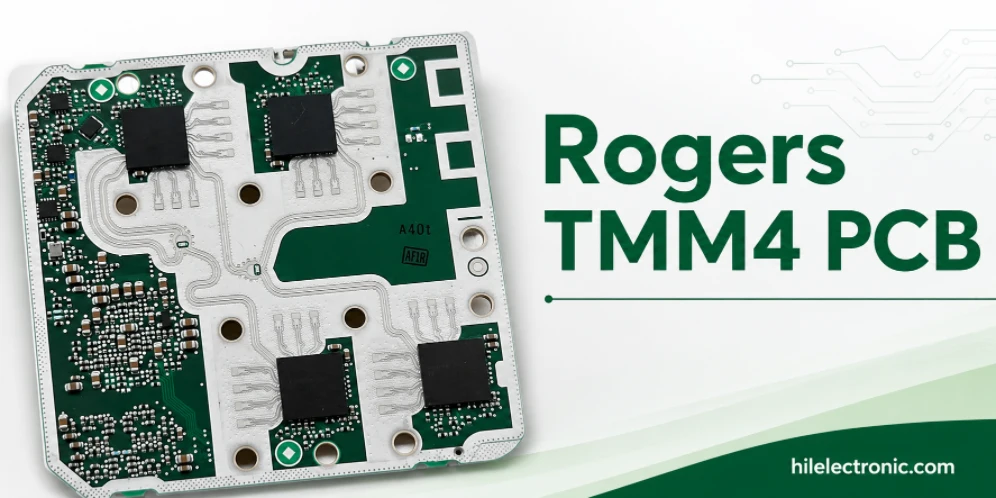
TMM4 Filter PCB Manufacturing
TMM4 filter PCB manufacturing is controlled by the...
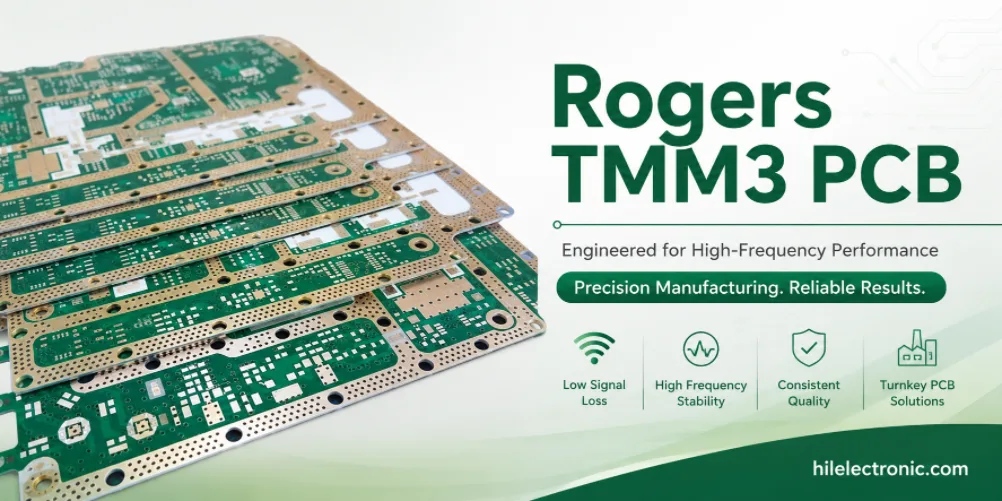
TMM3 PCB Manufacturing for RF Modules
TMM3 PCB manufacturing is most useful where the RF module...
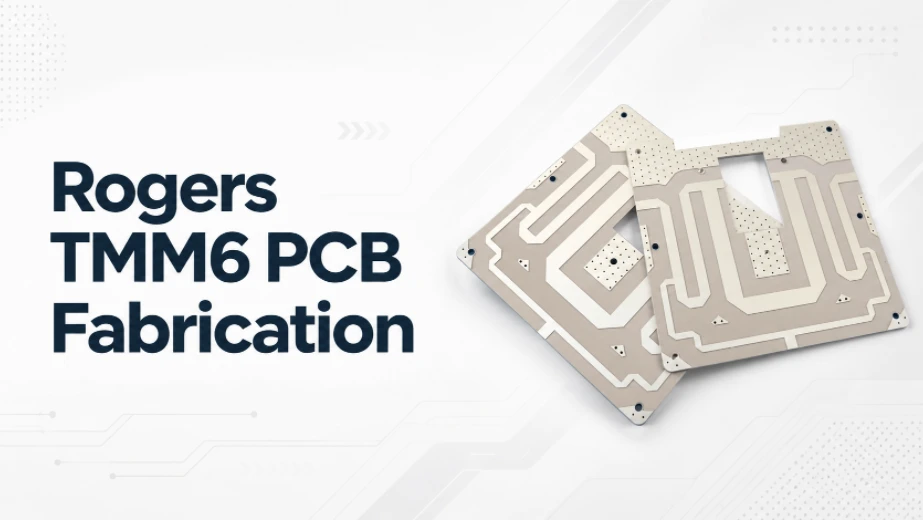
TMM6 PCB Fabrication
TMM6 fabrication is the process-control page for a mid-Dk...
TMM10 PCB Manufacturing for Compact RF Designs
Table of contentsHow TMM10 Shrinks RF StructuresTMM10 vs...
How to get a quote for PCBs
Let‘s run DFM/DFA analysis for you and get back to you with a report. You can upload your files securely through our website. We require the following information in order to give you a quote:
-
- Gerber, ODB++, or .pcb, spec.
- BOM list if you require assembly
- Quantity
- Turn time
For PCBA services, please provide your BOM (Bill of Materials) and any specific assembly instructions. We also offer DFM/DFA analysis to optimize your designs for manufacturability and assembly, ensuring a smooth production process.