
PCB Pin Headers: Selection and Mounting Guide
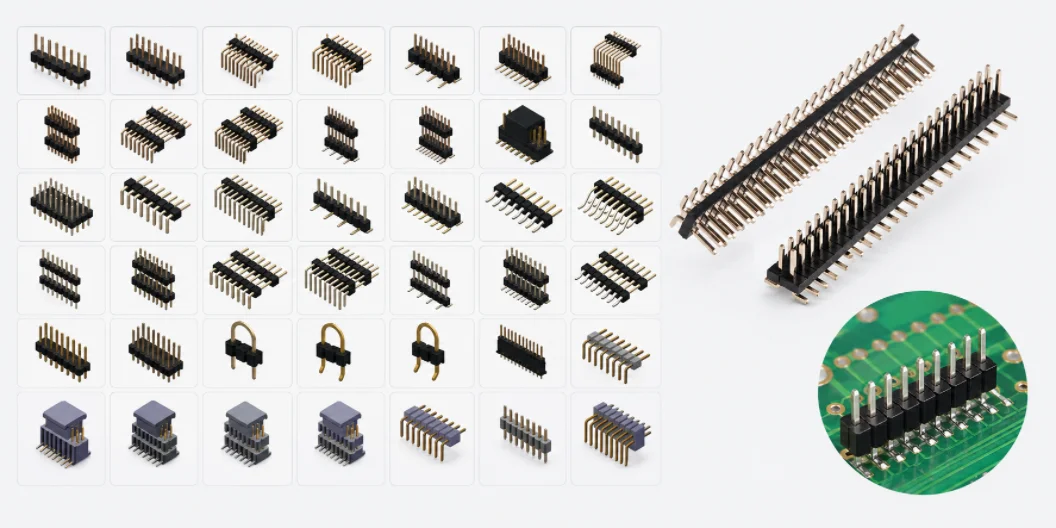
Figure 1. PCB pin headers
A PCB header, or pin header, is a row (or rows) of conductive pins on a fixed pitch, soldered to a board to provide connection points, jumper positions, or a way to stack boards together. They look trivial, but a header is a connector, and choosing the wrong gender, pitch, orientation, or mounting style is a common source of boards that will not mate, fail mechanically, or cannot be assembled cleanly. This guide explains what a PCB header is, the specifications that define one, the difference between through-hole and surface-mount types, and how to lay out and solder them reliably.
Key takeaways
- A header is specified by gender, pitch, number of pins and rows, orientation, mounting type, current rating, plating, and mating cycles.
- 2.54 mm (0.1 inch) is the most common pitch and the de-facto standard; finer pitches (2.00, 1.27, 1.00 mm) save space.
- Through-hole headers are mechanically strong; surface-mount headers save space but need a mechanical anchor for stress.
- Shrouded, keyed, and polarized headers prevent reversed or misaligned connections.
- The footprint (hole or pad size, courtyard, mechanical strength) and the soldering method must match the header you choose.
Table of Contents
- What a Pin Header Is and Where It Is Used
- The Specifications That Define a Header
- Current Rating: Power vs Signal Headers
- Pitch: Why 2.54 mm Is the Standard
- Through-Hole vs Surface-Mount Headers
- Shrouded, Keyed, and Polarized Headers
- Board-to-Board Stacking
- Footprint and Mechanical Design
- Soldering and Assembly Notes
- Frequently Asked Questions
What a Pin Header Is and Where It Is Used
A pin header provides a simple, repeatable electrical connection at a row of pins spaced on a regular pitch. Plastic insulation holds the pins in place and sets the spacing, and the pins solder into the board. Headers turn up almost everywhere:
- Board-to-board connections, mating a header on one board with a socket on another.
- Board-to-wire connections, where a cable with a matching housing plugs onto the header.
- Jumpers and configuration, where a shunt bridges two pins to set an option.
- Programming and debug ports, such as the headers used to flash a microcontroller.
- Expansion connectors, like the stacking headers on popular development boards.
Because a header is a mating interface, the choice is really about what it connects to. Decide that first, then the specifications below follow naturally.
The Specifications That Define a Header
A header is fully described by a handful of parameters. Getting all of them right is what makes two parts mate and stay reliable.
| Parameter | Options | What it affects |
|---|---|---|
| Gender | Male (pins) or female (sockets) | What it mates with |
| Pitch | 2.54, 2.00, 1.27, 1.00 mm | Size, density, mating partner |
| Pins and rows | Single, double, or multi-row; any pin count | Connections available, footprint size |
| Orientation | Straight (vertical) or right-angle | Mating direction relative to the board |
| Mounting | Through-hole (THT) or surface-mount (SMD) | Strength and assembly method |
| Current rating | Per-pin amperage from the datasheet | Suitability for power vs signal |
| Plating | Gold, tin, or selective plating | Contact reliability and cost |
| Mating cycles | Rated number of insertions | Life under repeated connection |
A useful habit is to specify the header and its mate together, confirming pitch, pin count, gender, and contact arrangement match. Most mating failures come from mixing parts that were never meant to fit.
Current Rating: Power vs Signal Headers
Not all headers carry the same load. One used purely for signals has very different requirements from one delivering power, and the current rating is what separates them.
What sets the current rating
- Contact size and the cross-section of the pins.
- Plating, which affects contact resistance and heating.
- How many adjacent pins are loaded at once, which calls for derating.
- The temperature rise the design can tolerate.
| Use | Typical approach |
|---|---|
| Signal | Standard small pins; current is minimal |
| Moderate power | Larger pins, or several pins paralleled to share current |
| High power | Dedicated power connectors rather than standard headers |
For signals, a standard 2.54 mm header is fine. For power, check the manufacturer’s per-pin current rating, derate for adjacent loaded pins and temperature, and either parallel several pins or move to a dedicated power connector at higher currents. Routing the supply traces to and from a power header is part of board-level current handling that is verified during PCB assembly, and it ties into the wider thermal and current decisions behind power electronics manufacturing.
Pitch: Why 2.54 mm Is the Standard
Pitch is the center-to-center spacing of the pins, and it is the first thing to get right because the header and its mate must share it exactly.
The common pitches
- 2.54 mm (0.1 inch) is the classic, ANSI/JEDEC-aligned standard. It is easy to hand-solder, robust, and matched by a vast range of cables, sockets, and prototyping hardware, which makes it the default for most general-purpose work.
- 2.00 mm trims size while staying easy to handle.
- 1.27 mm roughly doubles density and is common where space is tight.
- 1.00 mm and finer pitches pack the most connections into the least space but are harder to assemble and handle.
Choose the largest pitch that fits your space budget. A finer pitch buys density at the cost of mechanical robustness, assembly difficulty, and sometimes availability of matching parts.
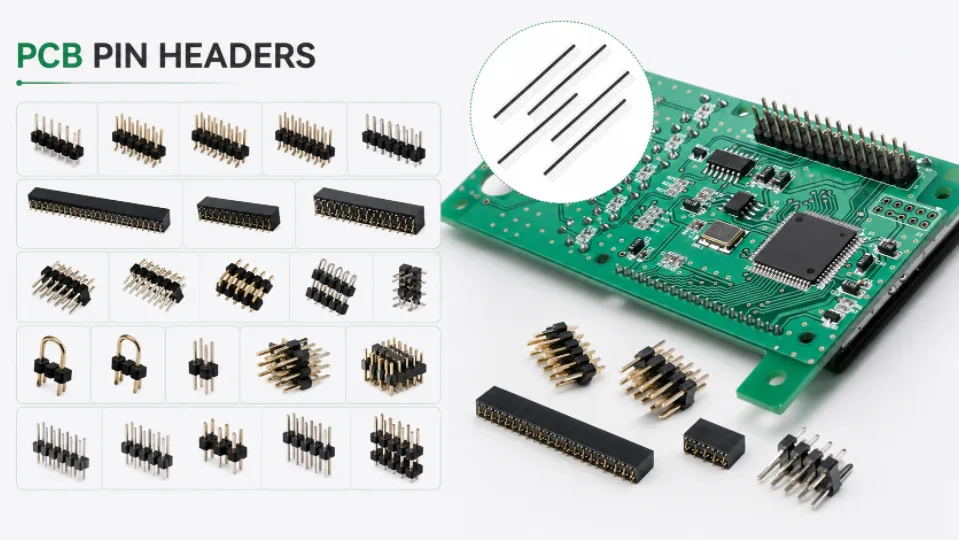
Figure 2. PCB pin headers details
Through-Hole vs Surface-Mount Headers
How the header attaches to the board is a structural decision as much as an electrical one.
| Aspect | Through-hole (THT) | Surface-mount (SMD) |
|---|---|---|
| Mechanical strength | High; pins anchored through the board | Lower; pads can lift under stress |
| Repeated insertion | Tolerates frequent mating well | Needs an anchor for heavy use |
| Assembly | Wave, selective, or hand soldering | Reflowed with the rest of the SMT parts |
| Board space | Holes occupy inner layers | No holes; frees routing space |
For a connector that is plugged and unplugged often, or one that takes mechanical load, through-hole is usually the safer choice because the pins are anchored through the board. Surface-mount headers keep a board single-process and free up inner-layer routing, but for anything that experiences repeated insertion or side loads, add a mechanical anchor, such as a through-hole peg or hold-down tab, so the stress does not land on the solder joints alone. Either way, the soldering happens during PCB assembly, and the mounting style determines which process is used.
Shrouded, Keyed, and Polarized Headers
A plain header offers no protection against being plugged in the wrong way. Several variants add that protection.
- Shrouded (box) headers surround the pins with a plastic wall, protecting them and guiding the mating connector.
- Keyed headers add a slot or notch so the mate fits only one way, preventing a reversed connection.
- Polarized layouts use a blocked pin or asymmetric feature to enforce orientation.
For any connection where reversing the plug would damage the board, a programming port, a power input, a ribbon cable, choose a shrouded and keyed header. The small extra cost is far cheaper than a field failure caused by a backwards connection.
Board-to-Board Stacking
Headers are a common way to stack boards, mating a male header on one board with a female socket on another to create a compact, separable assembly. The key parameters are the stack height (set by the header and socket geometry), alignment, and mechanical support.
Stacked boards put bending and vibration loads on the connectors, so mechanical support, standoffs or a frame, takes the strain off the pins. Where a stack would be tall, fragile, or subject to constant movement, a flexible interconnect is sometimes the better answer: a rigid-flex construction can replace board-to-board connectors entirely with an integrated flexible section, removing a mating interface that could loosen or fatigue. Whether to use stacking headers or an integrated flex link is a trade-off between modularity and reliability.
Footprint and Mechanical Design
A header only works if its footprint matches the part and the board can take the load.
Getting the land pattern right
Use the manufacturer’s recommended footprint. For through-hole headers, the hole diameter must suit the pin size with the right clearance, neither so tight the pin will not seat nor so loose the joint is weak, and the annular ring must be adequate. For surface-mount headers, the pad size and the courtyard must match the part and leave room for placement and inspection. A wrong hole or pad size is a frequent cause of headers that do not fit or solder poorly, and it is exactly the kind of error a DFM review catches before fabrication.
Mechanical robustness
Headers take handling forces, so place them where the board is supported, keep them away from flexing regions, and add mounting holes or standoffs near connectors that bear load. For high pin counts or heavy use, plated through-holes give the strongest mechanical bond, which is part of why through-hole headers remain popular for connectors. Hole and plating quality are themselves a function of PCB manufacturing quality, so the fab process and the header choice work together.
Soldering and Assembly Notes
The mounting style sets how the header is soldered, and a few practical points keep the joints reliable.
- Through-hole headers are soldered by wave, selective, or hand soldering, often after the surface-mount parts are reflowed. The pins anchor through the board, giving strong joints suited to repeated mating.
- Surface-mount headers are reflowed with the rest of the SMT assembly. Because the joint is only on the surface, a mechanical anchor is valuable for any header that will see stress.
- Mixed boards with both SMT and through-hole parts run the surface-mount process first, then add the through-hole headers, a routine hybrid flow.
Telling your assembler which headers are through-hole and which are surface-mount lets them plan the right process, which matters most at volume. A shop offering high-volume PCB assembly with both reflow and selective or wave soldering can build a mixed board cleanly and repeatably.
Specify the header by its full set of parameters, match it to its mate, give it a correct footprint and mechanical support, and choose the soldering process to suit. Doing so turns a humble component into a connection you can rely on. You can read more about Highleap Electronics and how we handle mixed through-hole and surface-mount assembly.
Frequently Asked Questions
What is the most common pin header pitch?
2.54 mm (0.1 inch) is the most common and the de-facto standard. It is easy to hand-solder and is matched by a huge range of cables, sockets, and prototyping hardware. Finer pitches such as 2.00, 1.27, and 1.00 mm save space but are harder to handle.
Should I use through-hole or surface-mount headers?
Use through-hole for connectors that are plugged in often or take mechanical load, because the pins anchor through the board for strength. Surface-mount headers save space and keep the board single-process, but add a mechanical anchor if the header will see stress.
How do I stop a connector from being plugged in backwards?
Use a shrouded and keyed header. The shroud protects and guides the pins, and the key (a slot or notch) lets the mate fit only one way. This is strongly recommended for power inputs, programming ports, and ribbon cables.
What hole size should a through-hole header footprint use?
Follow the manufacturer’s recommended land pattern. The hole must suit the pin diameter with proper clearance, with an adequate annular ring, neither too tight to seat nor too loose for a strong joint. A DFM review before fabrication confirms the holes are right.
Can I stack two boards with headers?
Yes. Mate a male header on one board with a female socket on the other, and set the stack height with the chosen geometry. Support the stack mechanically with standoffs or a frame so vibration and bending do not load the pins. For demanding cases, a rigid-flex link can replace the connectors.
Are SMD and through-hole headers soldered the same way?
No. Surface-mount headers are reflowed with the other SMT parts, while through-hole headers are wave, selective, or hand soldered, usually after reflow. On a mixed board the SMT process runs first, then the through-hole headers are added.
How much current can a pin header carry?
It depends on the contact size, plating, how many adjacent pins are loaded, and the allowable temperature rise, so check the manufacturer’s per-pin rating and derate for real conditions. Standard 2.54 mm headers are fine for signals; for power, parallel several pins or use a dedicated power connector, and size the supply traces accordingly during PCB manufacturing.

Recommended Posts
TMM4 Filter PCB Manufacturing
TMM4 filter PCB manufacturing is controlled by the...
TMM3 PCB Manufacturing for RF Modules
TMM3 PCB manufacturing is most useful where the RF module...
TMM6 PCB Fabrication
TMM6 fabrication is the process-control page for a mid-Dk...
TMM10 PCB Manufacturing for Compact RF Designs
Table of contentsHow TMM10 Shrinks RF StructuresTMM10 vs...
How to get a quote for PCBs
Let‘s run DFM/DFA analysis for you and get back to you with a report. You can upload your files securely through our website. We require the following information in order to give you a quote:
-
- Gerber, ODB++, or .pcb, spec.
- BOM list if you require assembly
- Quantity
- Turn time
For PCBA services, please provide your BOM (Bill of Materials) and any specific assembly instructions. We also offer DFM/DFA analysis to optimize your designs for manufacturability and assembly, ensuring a smooth production process.