
PCB Standoffs and Spacers Selection Guide

Figure 1. PCB standoffs
A PCB standoff is a small pillar, usually threaded, that holds a circuit board off a surface or another board, providing mechanical support, clearance, and often an electrical connection to ground. It is one of the most overlooked parts in a design, yet the wrong material, thread, or type causes short circuits, loose boards, and assembly headaches. This guide explains the difference between a PCB standoff and a spacer, how to choose the material and thread, the main types and configurations, and how to design the mounting hole so the hardware works reliably.
Key takeaways
- A standoff is typically threaded for fastening; a spacer is an unthreaded sleeve that a screw passes through.
- Nylon standoffs insulate and are the safe default near copper; metal standoffs conduct, ground, dissipate heat, and add strength.
- M3 is the most common thread; M2, M2.5, M4, M5 and imperial #4-40 / #6-32 are also widely used.
- Configurations include male-female, female-female, and male-male, in hex or round, plus snap-in and surface-mount types.
- The mounting hole’s size, clearance, keep-out, and plated-vs-non-plated choice decide whether the standoff fits and grounds correctly.
Table of Contents
Standoffs vs Spacers: What Is the Difference?
The two terms are often used loosely, but they describe different parts, and the distinction matters when you specify hardware.
- A standoff is usually threaded, internally, externally, or both, so a screw or another standoff fastens directly to it. It both separates parts and provides the fastening point.
- A spacer is an unthreaded sleeve or tube. A screw passes all the way through it into a threaded hole or a nut on the far side; the spacer only sets the gap.
In practice, a threaded standoff gives a cleaner, more secure mount because it provides its own fastening point, while a spacer is simpler and cheaper when a long through-bolt already does the fastening. Choose based on how the stack-up fastens together, then pick the material and thread to match.
Materials and When to Use Each
Material is the most consequential choice because it decides whether the standoff insulates or conducts, how strong it is, and how it handles heat. The table summarizes the common options.
| Material | Electrical | Strengths | Best for |
|---|---|---|---|
| Nylon | Insulating | Light, cheap, non-conductive | Mounting near copper without shorting |
| Brass | Conductive | Good conductor, easy to machine | Grounding and reliable electrical bonding |
| Aluminium | Conductive | Light, good thermal conductor | Heat paths and lightweight grounding |
| Steel | Conductive | High strength | Heavy loads and rugged assemblies |
| Stainless steel | Conductive | Strong, corrosion-resistant | Harsh or outdoor environments |
| Nylon + brass insert | Insulating body, metal thread | Durable thread, insulated body | Repeated fastening without shorting |
The simple rule
If the standoff sits near traces or pads and you do not want an electrical connection, use nylon, the insulating default that prevents accidental shorts. Use a metal standoff when you want to ground the board to the chassis, carry heat away, or take a mechanical load. Brass is the common conductive choice; aluminium adds a thermal path; steel and stainless add strength and durability. For thermally demanding boards, conductive standoffs are part of a wider heat-management strategy that also involves the substrate, as in metal-core assembly.
Thread Sizes and Standards
The thread must match the screw and any mating standoff, so it is worth getting exactly right.
| Thread | Type | Typical use |
|---|---|---|
| M2 | Metric | Small, dense boards |
| M2.5 | Metric | Common on compact electronics |
| M3 | Metric | The most common general-purpose size |
| M4 / M5 | Metric | Larger, heavier assemblies |
| #4-40 | Imperial | Common in North American designs |
| #6-32 | Imperial | Slightly larger imperial fastening |
M3 is the sensible default for most boards: widely available, strong enough for typical loads, and matched by a vast range of screws and standoffs. Drop to M2 or M2.5 on small or crowded boards, and step up to M4 or M5 for heavy assemblies. If your project follows imperial conventions, #4-40 and #6-32 are the equivalents. Whatever you choose, keep it consistent across the assembly so one screwdriver and one screw size serve the whole build.
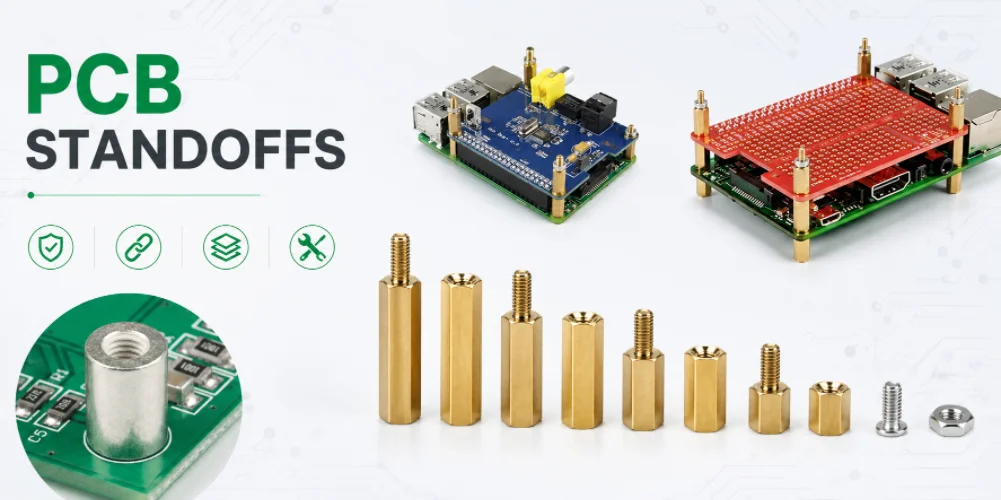
Figure 2. PCB standoffs details
Types and Configurations
Beyond material and thread, standoffs come in several shapes and end configurations.
Shape and ends
- Hex vs round body: hex bodies let a wrench grip them for tightening; round bodies are lower-profile.
- Male-female: a threaded stud on one end, a threaded hole on the other, ideal for stacking.
- Female-female: threaded holes at both ends, fastened with screws from each side.
- Male-male: studs at both ends, fastened with nuts.
Mounting styles
- Snap-in / push-in standoffs clip into a hole without tools, common for quick assembly.
- Self-clinching standoffs press permanently into the board or a chassis for a captive fastener.
- Locking features resist loosening under vibration.
- Surface-mount (SMT) standoffs are placed and reflowed with the other surface-mount parts, so the mounting hardware is added during PCB assembly rather than as a separate step.
Match the configuration to how the boards stack and how the product is built. Male-female standoffs are the workhorse for board-to-board stacks; snap-in and SMT types reduce manual assembly labor, which matters most at volume during high-volume PCB assembly.
Designing the Mounting Hole
A standoff only works if the board’s mounting hole is designed for it. Several details matter.
Size, clearance, and keep-out
The hole must suit the screw or stud with appropriate clearance, and a copper-and-component keep-out zone around it prevents the screw head, washer, or standoff body from shorting or crushing nearby parts. Leaving an adequate keep-out is a frequent oversight, and it is exactly the kind of thing a DFM review flags before fabrication.
Plated vs non-plated holes
This choice ties directly to grounding. A plated mounting hole connected to the ground plane, used with a metal standoff and screw, bonds the board to the chassis for grounding and EMI control. A non-plated hole electrically isolates the mount, which you want when using nylon hardware or when the mount must float. Decide the electrical role of each mounting point, then specify the hole, and remember that plating and hole quality are a function of PCB manufacturing quality.
Standoff Height and Board Spacing
The standoff’s height sets the gap between the board and whatever it mounts to. Choosing it well gives clearance for components and airflow without wasting space.
What the height has to clear
- The tallest components on the underside of the board.
- Any connectors, heatsinks, or hardware that protrude.
- Room for airflow where heat needs to escape.
| Typical height | Common use |
|---|---|
| 3–5 mm | Thin boards with low-profile parts |
| 6–11 mm | General-purpose spacing, the most common range |
| 15 mm and up | Tall components, stacked boards, or airflow needs |
Measure the tallest feature that must clear, add some margin, and choose a standoff at least that tall. For stacked boards, the height also sets the spacing between boards in the stack, which affects connector mating and cooling, an assembly detail worth confirming during PCB assembly. Where heat is a concern, generous spacing complements a thermally aware substrate such as metal-core construction.
Assembly, Torque, and Washers
Even correct hardware fails if it is assembled badly. A few practical points keep the joint sound.
- Torque to the right level. Overtightening, especially into nylon or thin boards, strips threads or cracks the laminate; undertightening lets the board work loose under vibration.
- Use washers where appropriate. A flat washer spreads the load; a shoulder or nylon washer can protect the board or maintain isolation.
- Consider vibration. In equipment that shakes, locking standoffs or thread-locking measures keep fasteners tight.
- Protect copper near the hardware. Make sure the keep-out and any washers prevent the metal from contacting traces it should not touch.
For boards that carry significant current or heat, the mechanical hardware and the thermal and grounding strategy work together, an area where experience with power electronics manufacturing helps get both right.
A Quick Selection Checklist
Run through these questions to land on the right standoff:
- Insulate or conduct? Nylon to insulate, metal to ground or carry heat.
- What thread? M3 by default; smaller for crowded boards, larger for heavy loads.
- What configuration? Male-female for stacks, female-female or male-male as the fastening requires.
- How is it mounted? Threaded, snap-in, self-clinching, or surface-mount to suit your assembly.
- Is the hole right? Correct size, clearance, keep-out, and plated or non-plated to match the electrical role.
Standoffs are small, but choosing the right material, thread, type, and mounting hole turns them into a reliable mechanical and electrical foundation for your board. Get the keep-out and plating decisions right at design time and the assembly goes together cleanly. You can read more about Highleap Electronics and our manufacturing and assembly services.
Frequently Asked Questions
What is the difference between a standoff and a spacer?
A standoff is usually threaded, providing its own fastening point, while a spacer is an unthreaded sleeve that a screw passes through into a thread or nut beyond it. A standoff gives a more secure mount; a spacer is simpler when a long through-bolt already fastens the stack.
Should I use nylon or metal standoffs?
Use nylon when the standoff sits near copper and you want to avoid any electrical connection, since it insulates and prevents shorts. Use metal (brass, aluminium, steel, or stainless) when you want to ground the board to the chassis, carry heat, or take a mechanical load.
What thread size is most common for PCB standoffs?
M3 is the most common general-purpose size, widely available and matched by many screws and standoffs. M2 and M2.5 suit small or crowded boards, M4 and M5 suit heavier assemblies, and #4-40 and #6-32 are the common imperial equivalents.
Should my mounting hole be plated or non-plated?
Use a plated hole tied to the ground plane with metal hardware when you want to ground the board to the chassis for EMI control. Use a non-plated hole to electrically isolate the mount, for example with nylon hardware or when the mount must float.
How tight should I make a standoff screw?
Tighten to the appropriate torque for the material and board. Overtightening, especially into nylon or thin boards, can strip threads or crack the laminate, while undertightening lets the board loosen under vibration. Use washers to spread load and, where needed, to maintain isolation.
Can standoffs be soldered onto the board?
Yes. Surface-mount standoffs are placed and reflowed with the other SMT parts, so the mounting hardware is added during assembly rather than installed by hand. This reduces manual labor and is useful in higher-volume production.

Recommended Posts
TMM4 Filter PCB Manufacturing
TMM4 filter PCB manufacturing is controlled by the...
TMM3 PCB Manufacturing for RF Modules
TMM3 PCB manufacturing is most useful where the RF module...
TMM6 PCB Fabrication
TMM6 fabrication is the process-control page for a mid-Dk...

TMM10 PCB Manufacturing for Compact RF Designs
Table of contentsHow TMM10 Shrinks RF StructuresTMM10 vs...
How to get a quote for PCBs
Let‘s run DFM/DFA analysis for you and get back to you with a report. You can upload your files securely through our website. We require the following information in order to give you a quote:
-
- Gerber, ODB++, or .pcb, spec.
- BOM list if you require assembly
- Quantity
- Turn time
For PCBA services, please provide your BOM (Bill of Materials) and any specific assembly instructions. We also offer DFM/DFA analysis to optimize your designs for manufacturability and assembly, ensuring a smooth production process.