
Pin in Paste PCB Assembly Process Guide
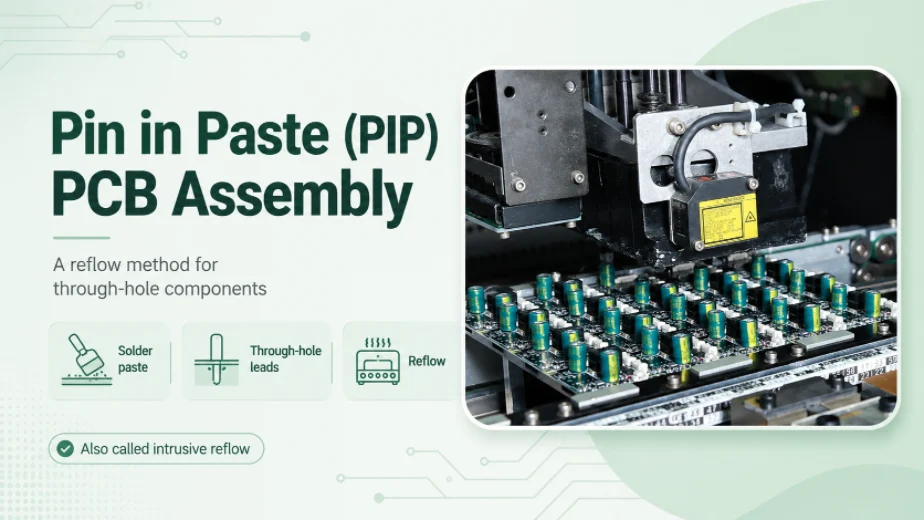
Figure 1. pin in paste PCB assembly
Last updated: May 2026 · A process and design guide to paste-in-hole reflow for mixed-technology boards
Pin in Paste (PiP) — also called paste-in-hole (PIH), through-hole reflow, or intrusive reflow — is a way to solder through-hole components in the same reflow oven that solders the surface-mount parts. Instead of running a separate wave-soldering or hand-soldering operation for the few leaded connectors and headers on a board, the assembler prints solder paste directly into the plated through-holes, inserts the component leads into that paste, and reflows everything together. Done correctly it removes an entire process step from a mixed-technology board, but it only works when the holes, the stencil, and the components are designed for it. This guide explains the mechanics, the paste-volume math, the design rules, and where PiP beats — and where it loses to — wave and selective soldering.
What Is Pin in Paste (PiP) PCB Assembly?
Most boards today are dominated by surface-mount devices, but they still carry a handful of through-hole (THT) parts — power connectors, board-to-board headers, large electrolytic capacitors, relays, RJ45 jacks, DC barrel jacks — that need the mechanical strength of a leg through the board. Traditionally those leaded parts are soldered separately: by wave soldering, by a selective-solder machine, or by hand. Each is a second process with its own setup, cost, and thermal exposure.
Pin in Paste folds that second process back into the first. The plated through-holes are filled with solder paste during the same stencil-printing step that pastes the SMT pads, the leaded component is placed so its pins sit inside the paste-filled barrels, and when the board passes through the reflow oven the paste in the holes melts alongside the paste under the chip parts, wicking through the barrel to form a proper fillet on both sides. One print, one place, one reflow.
Why Use Pin in Paste Instead of Wave Soldering?
The motivation is almost always to eliminate a step. On a board that is 95% SMT with three or four through-hole connectors, wave soldering forces the whole panel through a molten-solder wave just to make a dozen joints — an extra machine, a pallet to mask the SMT side, extra flux and cleaning, and a second thermal cycle for parts already reflowed once.
Choosing PiP instead delivers several concrete advantages:
- One thermal process. The board sees a single reflow profile instead of reflow plus wave, reducing thermal stress on heat-sensitive SMT parts and simplifying lead-free processing.
- Lower labour and floor space. No separate wave or selective machine in the line, no hand-soldering station, fewer operators touching the board.
- Consistent, measurable joints. Solder volume is set by the stencil aperture, so each joint gets a repeatable amount of paste rather than a hand-dependent result, with no wave bridging or icicles on the bottom.
The trade-off is that PiP is unforgiving about paste volume and component heat tolerance. If those two things are not engineered, the joints starve or the connector melts — which is what the rest of this guide is about.
The Pin in Paste Process, Step by Step
A typical Pin in Paste line looks almost identical to a normal SMT line, with the through-hole placement added before reflow rather than after. The only genuinely new step is the insertion; the only step that needs special engineering is the print.
- Stencil print — paste is printed onto SMT pads and forced into the plated through-holes through enlarged (overprinted) or stepped apertures. Key control: aperture design and stencil thickness, where paste volume is won or lost.
- SMT placement — the pick-and-place machine populates all surface-mount parts as usual.
- THT insertion — leaded components are inserted so their pins seat into the paste-filled holes, by hand, by a placement machine, or with an insertion fixture. Key control: pins must reach the paste without smearing it off the barrel walls.
- Reflow — the whole assembly passes through the oven; SMT and through-hole joints form in the same profile. Key control: the profile must fully heat the high-thermal-mass through-hole parts without cooking the SMT parts.
- Inspection — AOI checks SMT joints; through-hole fillets are checked visually or, where barrels matter, by X-ray for top/bottom fillet formation and barrel fill.
The Solder Paste Volume Problem in PiP (and Fixes)
Here is the central difficulty. A through-hole barrel is a relatively large volume that must be filled, with a fillet left on both sides of the board, but a normal stencil only prints a thin flat layer (typically 0.10–0.15 mm thick). Cut an aperture the size of the pad and most of that paste falls straight down the barrel; once the flux burns off in reflow, there is nowhere near enough metal left to fill the hole, and the joint comes out starved with no bottom fillet.
Assemblers close that gap with three main techniques, often in combination:
Overprinting
The stencil aperture is made larger than the annular pad so extra paste is printed in a ring around the hole; during reflow that paste flows into the barrel. Overprint apertures can be round, square, or teardrop shapes that bias paste toward the hole. This is the most common and lowest-cost method because it only changes the stencil artwork.
Step-up (stepped) stencil
The stencil is made locally thicker around the PiP holes — e.g. a 0.12 mm stencil stepped up to 0.20 mm only there — so each print deposits more paste while keeping fine-pitch SMT areas thin. It costs more and needs careful step placement so the squeegee still seals, but delivers large volumes without an oversized footprint.
Solder preforms
For the highest-volume holes (heavy power connectors, large barrels), a pre-shaped piece of solid solder — a preform — is added on top of the printed paste before reflow. It melts and supplements the paste, filling barrels no reasonable stencil could fill alone.
Whichever method is used, the paste also has to physically reach the barrel, which is why laser-cut stencils with smooth, well-tapered aperture walls matter for PiP: clean walls release the thicker deposit instead of leaving half of it stuck to the stencil.
How to Calculate Solder Paste Volume for Pin in Paste
PiP is one of the few assembly processes where you genuinely have to do a volume calculation rather than rely on a default. The logic is straightforward.
First, work out the final solder volume the joint needs:
Solder needed = barrel volume + top fillet + bottom fillet − lead volume inside the barrel
The barrel volume is the plated hole treated as a cylinder; subtract the part of the lead that sits inside it, and add a small allowance for the fillets that should form on each side. That gives the volume of solid solder you want at the end.
Second, convert that to wet paste volume. Solder paste is a suspension of metal powder in flux, and only about half of it by volume is metal — the rest is flux that volatilises during reflow. As a working rule of thumb, you therefore need roughly twice the final solder volume in wet printed paste:
Wet paste volume ≈ 2 × solder needed (exact factor depends on the paste’s metal loading — check the datasheet)
Third, design the aperture and stencil thickness so one print deposits that wet-paste volume. Aperture volume is the open area multiplied by stencil thickness, so you trade off overprint size against stencil thickness; if a flat aperture can’t reach the target without becoming absurdly large, that is the signal to step the stencil up or add a preform. The practical takeaway: never let a stencil house cut PiP apertures at “pad size” — size them from the volume calculation, with the paste’s metal-to-flux ratio built in.
Pin in Paste Design Rules: Holes, Leads, and Keep-Outs
Good PiP starts in layout, not on the line. A few rules keep the process printable and the joints sound:
- Hole-to-lead clearance: plated hole diameter ≈ lead diameter + 0.20–0.25 mm for round leads (a little more for square/rectangular). Too tight and the lead scrapes paste off the wall; too loose and paste falls through and the joint starves.
- Annular ring / pad: use a generous top-side pad so the overprint has somewhere to sit, supporting a larger paste deposit and a stronger fillet.
- SMT keep-out: keep fine-pitch SMT pads clear of the overprint ring so overprinted paste can’t bridge onto a neighbouring pad.
- Component standoff: allow a small gap under the body (or specify a part with standoffs) so paste can vent flux and form a top fillet; a part sitting flat traps it.
- Bottom-side clearance: keep nothing fragile or tall directly under a PiP hole on the opposite side — the bottom fillet needs room and the area sees full reflow heat.
- Thermal balance: relieve large copper planes connecting to the barrel with thermal spokes, or the barrel acts as a heat sink and may not reach reflow temperature.
These are exactly the kinds of issues a DFM review and an assembly (DFA) review catch before tooling is cut, when changing them is free rather than a respin.
Which Components Can Be Soldered with Pin in Paste?
The single biggest gating factor is heat. The component and its plastics must survive the full reflow peak — typically around 245–260 °C for lead-free SAC alloys. Many ordinary through-hole connectors are not rated for that; their housings will soften, droop, or melt. Manufacturers sell “reflow-compatible” or “high-temperature” versions of common connectors specifically for PiP, and those are the ones to specify.
Good candidates are reflow-rated parts with modest thermal mass and well-spaced pins: pin headers, box headers, and board-to-board connectors sold in reflow-compatible versions, through-hole RJ45 and USB jacks rated for reflow, and smaller power connectors and terminal blocks rated for the oven.
Poor candidates — better handled by wave, selective, or hand soldering — include connectors and plastics not rated for reflow temperatures, very large high-thermal-mass parts (big transformers, heavy bus bars) that won’t reach temperature in a normal profile, parts that sit flat with no venting path for flux, very large barrels that even preforms struggle to fill repeatably, and anything added after reflow for mechanical or test reasons.
When a board mixes a couple of PiP-friendly connectors with one part that cannot take reflow, a common answer is to PiP what you can and selectively solder the exception, rather than forcing everything through one method.
Pin in Paste vs Wave vs Selective Soldering
PiP is not always the right tool. It competes with wave soldering and selective soldering, and the best choice depends on how many through-hole parts there are and whether they can take reflow heat.
| Aspect | Pin in Paste | Wave soldering | Selective soldering |
|---|---|---|---|
| Best when | A few reflow-tolerant THT parts on a mostly-SMT board | Many THT parts on one side | A handful of THT parts that can’t take reflow, near dense SMT |
| Extra process step? | No — uses existing reflow | Yes — separate machine | Yes — separate machine |
| Component heat exposure | Full reflow peak — needs reflow-rated parts | Localised bottom-side heat | Localised, point-by-point heat |
| SMT side masking | None needed | Bottom SMT needs pallets/masking | Minimal |
| Throughput | High (no added line stage) | High for many joints | Slower, joint-by-joint |
| Main risk | Starved joints from too little paste | Bridging, thermal stress on whole board | Cost and cycle time per joint |
A useful decision rule: if the through-hole parts are reflow-rated and few, PiP is usually cheapest and cleanest. If there are many through-hole parts, wave still wins. If a small number of parts cannot survive reflow, selective soldering handles those exceptions without exposing the rest of the board.
Pin in Paste Assembly Services at Highleap
Highleap Electronics is a China-based PCB and PCBA manufacturer in Guangzhou that runs Pin in Paste as part of mixed-technology turnkey assembly. The value of working with a manufacturer that does PiP regularly is that the volume math and stencil design are handled before the board is built, not discovered after a batch of starved joints.
- Stencil engineering: overprint and step-up laser-cut stencils sized from a paste-volume calculation, plus solder preforms for high-volume barrels.
- DFM/DFA feedback: hole-to-lead ratios, keep-outs, thermal relief, and component reflow ratings reviewed against your footprints.
- Reflow profiling: profiles tuned so high-thermal-mass through-hole parts reach temperature without overcooking fine-pitch SMT.
- Inspection: AOI on SMT joints and X-ray where barrel fill needs verifying.
- Process selection: honest guidance on when PiP, wave, or selective soldering is the right method for your particular board.
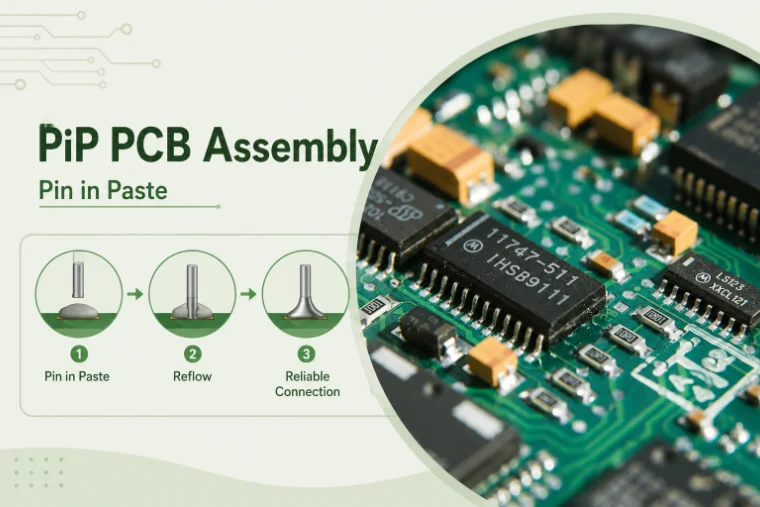
Figure 2. pin in paste PCB assembly details
Pin in Paste (PiP) FAQ
Is Pin in Paste the same as reflow soldering?
It uses reflow soldering, but the term refers specifically to soldering through-hole parts in the reflow oven by printing paste into the holes. Ordinary reflow solders surface-mount parts; PiP extends that same oven pass to leaded components so a separate wave or hand-solder step isn’t needed.
Why do my PiP joints come out starved or with no bottom fillet?
Almost always not enough paste. A flat, pad-sized aperture cannot fill a barrel. Fix it by overprinting (a larger aperture ring around the hole), stepping the stencil up locally, or adding a solder preform — and size the aperture from a volume calculation that accounts for paste being roughly half metal by volume.
Can any through-hole connector be soldered with PiP?
No. The part must survive the full reflow peak, typically about 245–260 °C for lead-free. Many standard connectors are not rated for that and will deform. Use the “reflow-compatible” or “high-temperature” version of the connector, which manufacturers make specifically for PiP.
When should I use wave soldering instead of PiP?
When the board has many through-hole parts, or parts that can’t take reflow heat. PiP shines on mostly-SMT boards with a few reflow-tolerant leaded parts. As the through-hole count rises, wave soldering becomes more efficient; for a few heat-sensitive exceptions, selective soldering is usually the answer.

Recommended Posts
TMM4 Filter PCB Manufacturing
TMM4 filter PCB manufacturing is controlled by the...
TMM3 PCB Manufacturing for RF Modules
TMM3 PCB manufacturing is most useful where the RF module...
TMM6 PCB Fabrication
TMM6 fabrication is the process-control page for a mid-Dk...

TMM10 PCB Manufacturing for Compact RF Designs
Table of contentsHow TMM10 Shrinks RF StructuresTMM10 vs...
How to get a quote for PCBs
Let‘s run DFM/DFA analysis for you and get back to you with a report. You can upload your files securely through our website. We require the following information in order to give you a quote:
-
- Gerber, ODB++, or .pcb, spec.
- BOM list if you require assembly
- Quantity
- Turn time
For PCBA services, please provide your BOM (Bill of Materials) and any specific assembly instructions. We also offer DFM/DFA analysis to optimize your designs for manufacturability and assembly, ensuring a smooth production process.