
Protoboard vs Breadboard: Which to Use
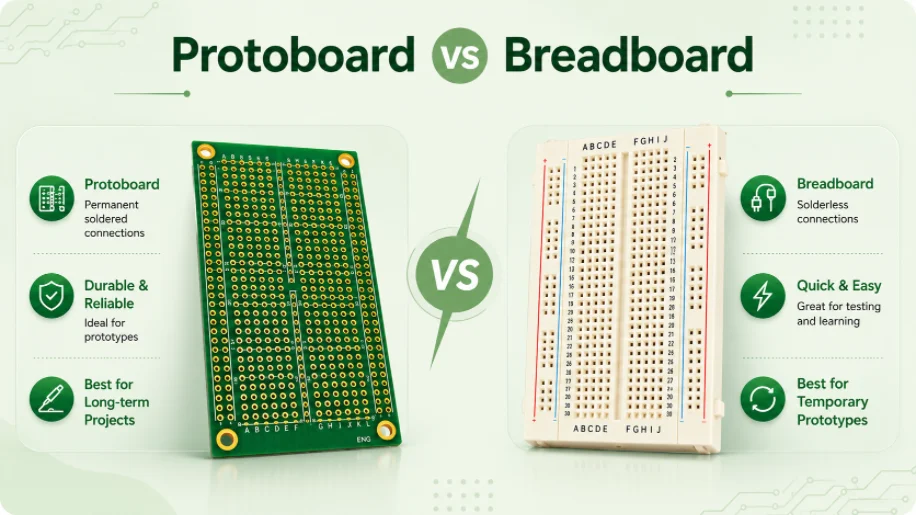
Figure 1. protoboard vs breadboard
Last updated: May 2026 · A plain-English guide for students, hobbyists, and engineers building their first circuits
The difference between a protoboard and a breadboard comes down to one thing: soldering. A breadboard (properly, a solderless breadboard) lets you push components and wires into spring-clip sockets with no soldering — it is reusable and perfect for designing and testing a circuit. A protoboard (also called perfboard or a prototyping board) is a PCB-like board with a grid of holes where you solder parts in place, producing a permanent, durable build. In short: breadboard = solderless, temporary, reusable; protoboard = soldered, permanent, robust. Most projects use both, in sequence — breadboard first to get it working, protoboard next to make it last.
Protoboard vs Breadboard: The Core Difference
Both boards do the same conceptual job — hold components and connect them — but they sit at different stages of building a circuit. A breadboard prioritizes speed and reversibility: you can build, change, and tear down a circuit in minutes with no tools. A protoboard prioritizes permanence and reliability: soldered joints don’t fall out, survive movement and vibration, and last for years. Choosing between them is really choosing between “I’m still experimenting” and “this works and I want to keep it.”
What Is a Breadboard and How Does It Work?
A solderless breadboard is a plastic block full of small sockets with metal spring clips underneath. You insert component leads and jumper wires into the holes, and the internal clips grip them and connect them electrically — no heat, no solder, no waiting.
Internal connections
- Terminal strips: the main field is arranged in short rows (commonly five holes) that are connected together within each row. A gap (channel) runs down the center so a DIP chip can straddle it with its two sides isolated.
- Power rails (bus strips): long lines along the top and bottom carry power and ground across the whole board.
Pros and cons
- Pros: no soldering, fully reusable, instant changes, ideal for learning and rapid experimentation, components survive unharmed for reuse.
- Cons: connections can be loose or intermittent, contact resistance and parasitic capacitance/inductance hurt high-speed and RF circuits, limited current capacity, messy with many wires, and nothing is permanent — bump it and a wire pops out.
What Is a Protoboard (Perfboard)?
A protoboard is a rigid board pre-drilled with a grid of holes (typically on a 0.1-inch / 2.54 mm pitch — the same spacing as breadboard holes and through-hole parts). You place components in the holes and solder them, building a permanent circuit. Several styles exist:
- Plain perfboard: each hole has an isolated copper pad (or no copper at all on bare phenolic). You make connections with wire or solder bridges. Maximum flexibility, most manual work.
- Stripboard (Veroboard): parallel copper strips run across the board; you place parts along the strips and cut the strips where you need to break a connection. Faster wiring, less freedom.
- Breadboard-style protoboard: the copper is pre-arranged to mimic a breadboard’s rows and power rails, so you can transfer a working breadboard layout almost hole-for-hole, then solder it down. The easiest path from breadboard to permanent.
Pros and cons
- Pros: permanent and rugged, reliable soldered joints, handles vibration and handling, better (though still imperfect) electrical behavior than a breadboard, cheap, and great for one-off finished projects.
- Cons: requires soldering skill and tools, changes mean desoldering, hand-wiring is slow and error-prone for complex circuits, and it is not suited to fine-pitch surface-mount parts or repeatable production.
Protoboard vs Breadboard: Side-by-Side Comparison
| Attribute | Breadboard | Protoboard / Perfboard |
|---|---|---|
| Connection method | Push-in spring clips (no solder) | Soldered joints |
| Permanence | Temporary | Permanent |
| Reusable | Yes, endlessly | No (must desolder) |
| Tools needed | None | Soldering iron, solder |
| Durability / vibration | Low — wires fall out | High |
| High-speed / RF behavior | Poor (parasitics) | Better, still limited |
| Best stage | Design & experimentation | Permanent one-off build |
| Repeatable copies | No | Not practically |
Breadboard vs Protoboard: Electrical Limits
Neither board is a substitute for a real PCB when signal quality matters. A breadboard’s spring clips add contact resistance and create stray capacitance and inductance between adjacent rows; long jumper wires act as little antennas. This is why fast digital edges, oscillators, and RF circuits often behave badly on a breadboard even when the design is correct. A soldered protoboard removes the loose contacts and shortens some connections, so it is more dependable — but hand-wiring still lacks controlled impedance, solid ground planes, and tight layout. For anything sensitive — high frequency, high current, precise analog, or fine-pitch SMD — a properly laid-out PCB is the right tool.
Breadboard or Protoboard: Which Should You Use?
| If you are… | Use |
|---|---|
| Learning electronics or testing an idea | Breadboard |
| Frequently changing the circuit | Breadboard |
| Making a working circuit permanent (one unit) | Protoboard / perfboard |
| Building something that must survive handling | Protoboard |
| Needing several reliable, identical copies | Custom PCB |
| Working with fine-pitch SMD, RF, or high speed | Custom PCB |
From Breadboard to Protoboard to PCB
These tools are stages, not rivals. A typical project flows through all three:
- Breadboard: prove the concept, tweak values, swap parts freely until it works.
- Protoboard: transfer the working circuit to a soldered board (a breadboard-style protoboard makes this nearly one-to-one) for a durable single unit or field test.
- Custom PCB: when you need repeatable quality, several copies, smaller size, surface-mount parts, controlled impedance, or assembly by a factory, you lay out a PCB and have it fabricated and assembled.
Each step trades flexibility for reliability and repeatability, ending at a board you can manufacture consistently.
When to Move from Protoboard to a Custom PCB
Protoboards stop making sense the moment you need more than one reliable copy, or your design uses parts a perfboard can’t host. Signs you’re ready for a real PCB include: hand-wiring is taking longer and getting flakier; you have surface-mount or fine-pitch components; the circuit is sensitive to noise or timing; or you want a finished, professional board you can reproduce on demand. At that point a fabricated PCB is cheaper, smaller, more reliable, and far easier to replicate than another evening with solder and perfboard.
From Prototype to Production with Highleap
Highleap Electronics is a China-based PCB and PCBA manufacturer that helps makers and engineers turn a working breadboard or perfboard circuit into a real, repeatable board — for customers in the United States, Europe, and Asia-Pacific.
- PCB fabrication from quick prototypes to production, with fast turnaround for first boards.
- Low-volume PCB assembly ideal for the first handful of real units after perfboard.
- DFM review to check your first layout is manufacturable before you order.
- PCB layout support if you’re moving from a schematic and breadboard to your first board.
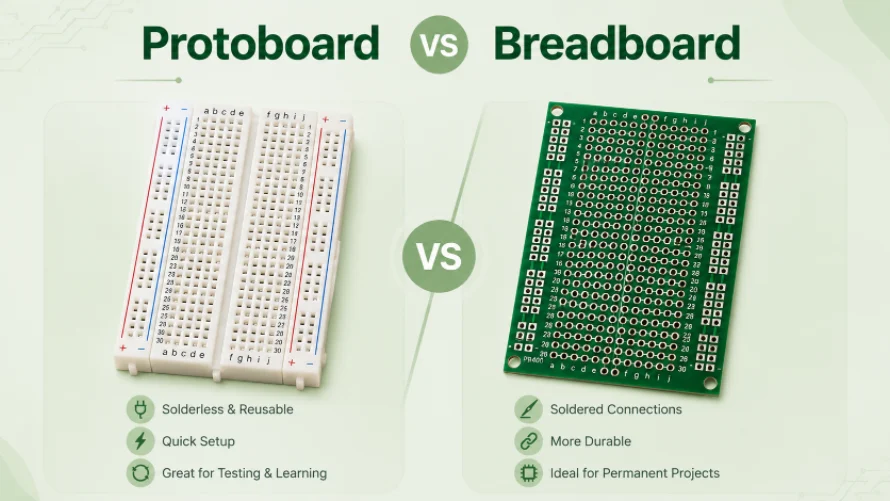
Figure 2. protoboard vs breadboard details
Protoboard vs Breadboard FAQ
Is a protoboard the same as a breadboard?
No. People sometimes use the words loosely, but they differ by connection method. A breadboard is solderless and reusable (push-in clips); a protoboard (perfboard) requires soldering and creates a permanent circuit. “Breadboard” almost always means the solderless type.
Can I solder on a breadboard?
No — a standard solderless breadboard is plastic with spring clips and would melt. If you want to solder, use a protoboard/perfboard, including the “breadboard-style” variety whose copper layout mirrors a breadboard so you can transfer your circuit and solder it.
Which is better for beginners?
Start on a breadboard. It needs no tools, lets you make mistakes freely, and protects your components. Once a circuit works and you want to keep it, move to a protoboard to practice soldering and make it permanent.
What is perfboard vs stripboard?
Perfboard has individual isolated pads at each hole, so you make every connection yourself with wire or solder. Stripboard (Veroboard) has continuous copper strips you cut to break connections. Stripboard is faster to wire; perfboard is more flexible.
Why does my circuit work on a breadboard but not on a protoboard (or vice-versa)?
Usually because the electrical environment changed. Breadboards add loose contacts and parasitic capacitance that can help or hurt; soldered protoboards remove those but may introduce wiring mistakes. For circuits sensitive to noise, timing, or RF, neither is ideal — a proper PCB with a ground plane is the reliable answer.
When should I switch from a protoboard to a custom PCB?
When you need multiple identical, reliable copies; when the design uses surface-mount or fine-pitch parts; when signal integrity matters; or when you want a compact, professional, reproducible board. A fabricated PCB is then cheaper and more dependable than repeated hand-built perfboards.
Can a manufacturer turn my breadboard circuit into a PCB?
Yes. With your schematic (and ideally a layout), a manufacturer can fabricate and assemble a real board. A DFM review first confirms your design is buildable, and low-volume assembly is well suited to the first batch of real units.
Are there current or voltage limits I should know about?
Yes. Solderless breadboards are rated for low currents (typically well under an ampere per contact) and modest voltages; high current heats the spring clips and high voltage risks arcing across the narrow gaps. Soldered protoboards handle more current because the joint is solid copper-to-copper, but trace width and wire gauge still set the limit. For any meaningful power, size the conductors deliberately — and for real power circuits, move to a PCB with appropriately wide copper.
Is a perfboard the same as a protoboard?
Yes — “perfboard” (perforated board) and “protoboard” are used interchangeably for a board with a grid of holes you solder components onto, creating a permanent circuit. That makes both different from a solderless breadboard, which is reusable and needs no soldering.

Recommended Posts
TMM4 Filter PCB Manufacturing
TMM4 filter PCB manufacturing is controlled by the...
TMM3 PCB Manufacturing for RF Modules
TMM3 PCB manufacturing is most useful where the RF module...
TMM6 PCB Fabrication
TMM6 fabrication is the process-control page for a mid-Dk...
TMM10 PCB Manufacturing for Compact RF Designs
Table of contentsHow TMM10 Shrinks RF StructuresTMM10 vs...
How to get a quote for PCBs
Let‘s run DFM/DFA analysis for you and get back to you with a report. You can upload your files securely through our website. We require the following information in order to give you a quote:
-
- Gerber, ODB++, or .pcb, spec.
- BOM list if you require assembly
- Quantity
- Turn time
For PCBA services, please provide your BOM (Bill of Materials) and any specific assembly instructions. We also offer DFM/DFA analysis to optimize your designs for manufacturability and assembly, ensuring a smooth production process.