
RO4003C vs FR4 PCB Comparison

Figure 1. RO4003C vs FR4 PCB
The comparison is kept at the finished-PCB level. Instead of treating RO4003C and FR-4 as interchangeable material labels, the analysis connects operating frequency, loss budget, dielectric thickness, trace geometry and the manufacturing tolerance that the finished board must hold. If the loss budget leads to a Rogers core, manufacturing the selected RO4003C construction should specify the actual copper, bonding and inspection requirements.
The useful comparison between RO4003C and FR4 is the board you intend to build, not a material table in isolation. Trace length, operating frequency, impedance tolerance, layer pairing and the available loss budget determine whether the material premium changes the finished PCB enough to matter. RO4003C and FR4 can follow different electrical and cost trade-offs — so the useful comparison is the finished board rather than the laminate price alone. This side-by-side comparison covers dielectric loss from 500 MHz to 24 GHz, Dk tolerance, thermal reliability, processing differences, and a clear four-tier decision framework that helps engineers choose between FR4, low-loss FR4, RO4003C, and higher-grade Rogers for their specific frequency and budget.
Table of Contents
- RO4003C vs FR4: Material Properties Comparison Table
- RO4003C vs FR4 Signal Loss at 1 GHz to 30 GHz
- Dk Tolerance and Impedance Stability: RO4003C vs FR4
- Thermal Reliability: RO4003C vs FR4 Under Stress
- Can You Process RO4003C on an FR4 Production Line?
- When to Use RO4003C Instead of FR4
- RO4003C and FR4 PCB Manufacturing at Highleap
1. RO4003C vs FR4: Material Properties Comparison Table
| Property | Rogers RO4003C | Standard FR4 (Tg 170 °C) | Why It Matters |
|---|---|---|---|
| Dk @ 10 GHz | 3.38 ± 0.05 | 4.2–4.5 (±10 %) | Impedance accuracy and trace width calculation |
| Df @ 10 GHz | 0.0027 | 0.018–0.025 | Insertion loss — 7–9× lower on RO4003C |
| Dk tolerance | ±1.5 % | ±5–10 % | Lot-to-lot impedance repeatability |
| Dk vs temperature | < 50 ppm/°C | 200–400 ppm/°C | Performance drift over operating temperature |
| Moisture absorption | 0.06 % | 0.10–0.15 % | Dk drift in humid environments |
| Tg | > 280 °C | 130–180 °C | Dimensional stability during lead-free reflow |
| Z-axis CTE (below Tg) | 46 ppm/°C | 50–70 ppm/°C | Plated through-hole reliability |
| Thermal conductivity | 0.71 W/m·K | 0.25–0.30 W/m·K | Heat spreading from power devices |
| Material cost | 3–5× FR4 | 1× (baseline) | BOM cost impact |
| Processing | FR4-compatible | Standard | No plasma treatment or special desmear needed |
The single most important number is Df. RO4003C’s dissipation factor of 0.0027 is roughly 7–9× lower than FR4 at 10 GHz. This gap is negligible below 500 MHz but widens rapidly with frequency, making Df the deciding factor in the material switch. When fire-rating or other requirements change the shortlist, RO4350B as a separate RF laminate choice should be evaluated separately from the FR-4 comparison.
2. RO4003C vs FR4 Signal Loss at 1 GHz to 30 GHz
Approximate insertion loss per centimeter of 50 Ω microstrip on 8 mil cores, 1 oz copper:
| Frequency | RO4003C (dB/cm) | FR4 (dB/cm) | Excess Loss on FR4 | Recommendation |
|---|---|---|---|---|
| 500 MHz | 0.02 | 0.04 | +0.02 | FR4 acceptable |
| 1 GHz | 0.03 | 0.06 | +0.03 | FR4 acceptable for short traces |
| 2.4 GHz (Wi-Fi) | 0.05 | 0.11 | +0.06 | FR4 marginal — evaluate trace length |
| 5.8 GHz (Wi-Fi 6) | 0.08 | 0.18 | +0.10 | RO4003C recommended |
| 10 GHz | 0.12 | 0.30 | +0.18 | RO4003C strongly recommended |
| 24 GHz | 0.20 | 0.55+ | +0.35 | FR4 not viable |
The crossover depends on trace length and loss budget. A 5 cm RF trace at 5.8 GHz on FR4 adds roughly 0.5 dB of excess loss versus RO4003C — enough to measurably degrade receiver sensitivity. Below 1 GHz, FR4 is almost always adequate. Between 1–6 GHz, evaluate by trace length and circuit sensitivity. Above 6 GHz, RO4003C or higher-grade Rogers is the standard for high-frequency PCB designs.
3. Dk Tolerance and Impedance Stability: RO4003C vs FR4
Lot-to-lot Dk tolerance. RO4003C holds Dk = 3.38 ± 0.05 (±1.5 %). A 50 Ω microstrip stays within 49–51 Ω from Dk variation alone. FR4 varies ±5–10 %, placing the same design anywhere from 45–55 Ω across production lots. For impedance-critical circuits — RF filters, coupled-line couplers, antenna feed networks — FR4 variation is unacceptable.
Dk vs temperature. RO4003C shifts less than 50 ppm/°C. Over −40 °C to +85 °C, total Dk change is roughly 0.02 — negligible. FR4 shifts 200–400 ppm/°C, producing a swing of 0.10–0.20 over the same range. For outdoor base stations, automotive electronics, or aerospace systems, this FR4 drift creates performance variation that Rogers eliminates.
Dk vs frequency. RO4003C maintains near-constant Dk from 1 GHz past 40 GHz. FR4’s Dk drops from roughly 4.5 at 100 MHz to 4.0 at 10 GHz — a 10 % change that detunes broadband filters and shifts impedance across the operating band.
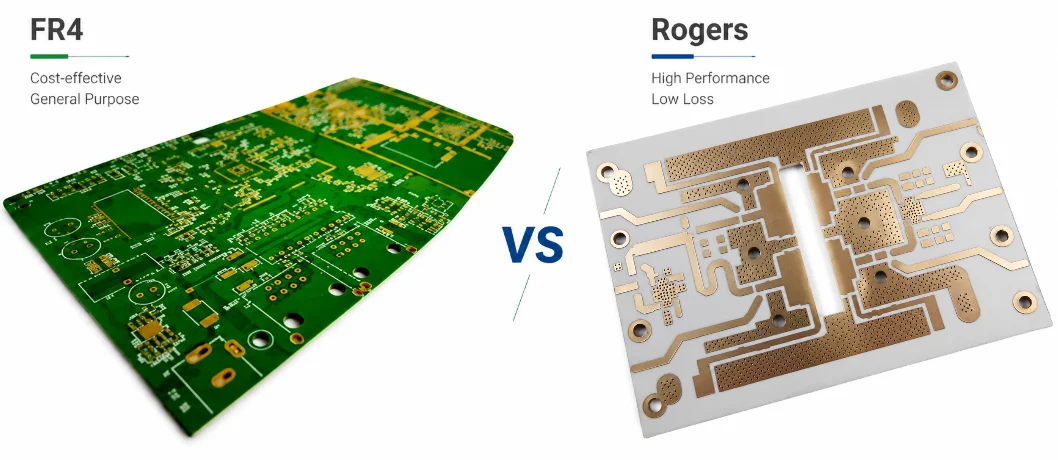
Figure 2. Rogers vs FR4 PCB
Material scope: the Rogers product name is used to identify the laminate specified for the PCB build. Highleap Electronics provides PCB fabrication and assembly, while the laminate is sourced and verified separately.
4. Thermal Reliability: RO4003C vs FR4 Under Stress
Lead-free reflow survival. RO4003C (Tg > 280 °C) does not soften during 260 °C lead-free reflow. Standard FR4 passes through its glass transition during reflow, expanding and softening. For boards with dense BGA arrays, RO4003C’s dimensional stability reduces solder joint defects.
Heat dissipation. RO4003C’s thermal conductivity (0.71 W/m·K) is more than double FR4 (0.25–0.30 W/m·K). In compact RF modules with power amplifiers and limited airflow, Rogers transfers heat to the ground plane more efficiently, lowering junction temperature.
Via reliability under thermal cycling. RO4003C’s Z-axis CTE (46 ppm/°C) is comparable to FR4 (50–70 ppm/°C), so baseline via reliability is similar. The advantage comes from Tg: RO4003C spends far less time in the high-CTE regime above Tg during thermal cycling, reducing cumulative barrel stress. For applications requiring 1,000+ thermal cycles, this translates to a measurable reliability margin.
5. Can You Process RO4003C on an FR4 Production Line?
Yes. RO4003C is a hydrocarbon/ceramic composite — not PTFE — so it does not require plasma treatment, sodium etch, or high-temperature lamination. Any factory equipped for FR4 can process it with minor adjustments:
| Process Step | FR4 Setting | RO4003C Adjustment |
|---|---|---|
| Drilling feed rate | Standard | Reduce 20–30 % (ceramic filler accelerates bit wear) |
| Drill bit life | 1,000+ hits | 400–600 hits per bit |
| Lamination | Standard FR4 cycle | Same temperature and pressure — fully compatible |
| Desmear | Permanganate | Standard permanganate — no plasma needed |
| Hybrid bonding | N/A | Standard FR4 prepreg or Rogers 4450F bondply |
This compatibility has three practical advantages. First, more suppliers can quote RO4003C than PTFE-based Rogers, creating competitive pricing. Second, hybrid stackups with FR4 are straightforward — no surface activation needed. Third, prototype timing depends on the exact RO4003C construction, board complexity, quantity and current material availability; the lead time should be confirmed against the released RFQ. From a manufacturing view, the main difference is how much electrical variability the stackup can tolerate. For an impedance-controlled hybrid board, the fabricator should review the actual dielectric thickness and copper geometry and then validate the finished result rather than copying nominal values from a catalog into the CAM setup. Exact material property values should be checked against the current supplier documentation for the specified grade and construction.
6. When to Use RO4003C Instead of FR4
| Material Tier | When to Use | Frequency Range | Example Applications |
|---|---|---|---|
| Standard FR4 | Dk tolerance ±10 % acceptable; cost primary constraint | Below 1 GHz | IoT, Bluetooth, sub-GHz telemetry |
| Low-loss FR4 (S1000-2M, Megtron 4) | Moderate loss reduction without Rogers cost | 1–3 GHz | GPS, low-band Wi-Fi, sub-6 GHz LTE |
| RO4003C | Tight Dk tolerance; insertion loss critical; thermal stability needed | 2–20 GHz | Wi-Fi 6/7 front-end, 5G sub-6, radar receiver, RF filters |
| Higher-grade Rogers (RO3003, 5880) | Ultra-low loss; frequency > 20 GHz; Dk within ±1 % | Above 20 GHz | 77 GHz radar, satellite, mmWave 5G |
RO4003C occupies the cost-performance tradeoff. It delivers 7–9× lower loss than FR4 and 4–7× tighter Dk tolerance while processing on standard FR4 equipment. For the majority of RF applications between 2 and 20 GHz, RO4003C is the right first choice before considering more expensive PTFE alternatives.
7. RO4003C and FR4 PCB Manufacturing at Highleap
Highleap Electronics manufactures RO4003C, FR4, and hybrid stackups combining the two. We help customers select the right material during quoting — share your operating frequency and requirements, and our team will recommend a suitable option for the released requirements before you commit.
Available RO4003C constructions are confirmed during quotation: 8, 10, 20, 32, and 60 mil cores with 0.5 oz and 1 oz copper. RO4450F bondply for multilayer and hybrid builds. Material availability and procurement cost are confirmed during quotation. Cost should be compared on the qualified board, not laminate price alone. Ask for the same board outline, copper, finish, testing and quantity in both quotes so the comparison includes tooling, yield assumptions and any additional RF verification.
Impedance-controlled fabrication: TDR-verified coupons on every panel. Tolerance ±5 % standard, ±3 % for precision RF.
Request a quote — include operating frequency, layer count, board dimensions, impedance targets, and quantity.

Recommended Posts
Taconic RF 35 vs RO4350B PCB
Table of contentsRF-35 vs RO4350B Procurement and...
TMM4 Filter PCB Manufacturing
TMM4 filter PCB manufacturing is controlled by the...
TMM3 PCB Manufacturing for RF Modules
TMM3 PCB manufacturing is most useful where the RF module...
TMM6 PCB Fabrication
TMM6 fabrication is the process-control page for a mid-Dk...
How to get a quote for PCBs
Let’s run DFM/DFA analysis for you and get back to you with a report. You can upload your files securely through our website. We require the following information in order to give you a quote:
-
- Gerber, ODB++, or .pcb, spec.
- BOM list if you require assembly
- Quantity
- Turn time
For PCBA services, please provide your BOM (Bill of Materials) and any specific assembly instructions. We also offer DFM/DFA analysis to optimize your designs for manufacturability and assembly, ensuring a smooth production process.