
Automotive Radar Rogers PCB Manufacturing

Automotive radar PCB manufacturing requires the RF layers, antenna structure, digital section and mechanical interfaces to be treated as one build. The page focuses on the manufacturing consequences of the radar frequency band, hybrid stackup, dimensional tolerance, surface condition and qualification requirements.
Figure 1. Rogers PCB Automotive Radar
Automotive radar systems operate at 77 GHz and 79 GHz, which are extremely high frequencies where conventional FR4 PCB materials fail to meet performance requirements. High-frequency automotive radar demands precise impedance control, ultra-low insertion loss, minimal signal distortion, and robust mechanical reliability to withstand engine bay temperatures from −40°C to +125°C. This guide covers rogers-pcb-automotive-radar design principles, including material selection, antenna layout, hybrid stackup configuration, manufacturing precision, and quality validation processes. It is intended for engineers, PCB designers, and automotive radar developers seeking reliable high-frequency PCB solutions.
Table of Contents
- Why 77 GHz Automotive Radar Requires Rogers PCB Material
- Best Rogers Materials for 77 GHz Radar PCBs
- 77 GHz Patch Antenna Layout on Rogers PCBs
- Rogers FR4 Hybrid Stackup for Radar Modules
- Automotive Radar PCB Qualification and Thermal Testing
- Automotive Radar PCB Manufacturing at Highleap
Why 77 GHz Automotive Radar Requires Rogers PCB Material
Automotive radar Rogers PCB manufacturing is dominated by tolerance control because the RF geometry is part of the sensor performance. The review should connect the selected construction to the actual radar frequency, board thickness, antenna or feed geometry and production tolerance. Automotive radar systems, including long-range radar (LRR), short-range corner radar (SRR), and 360° surround radar, operate in the 76–81 GHz frequency range worldwide. At these frequencies, the guided wavelength on the PCB is reduced significantly due to the substrate’s dielectric constant, making PCB material properties critical for maintaining RF performance, angular accuracy, and reliable detection ranges. If the radar stackup calls for RO3003, RO3003 antenna-board process review should establish the material and geometric controls used for fabrication.
Key technical requirements for 77 GHz radar PCBs include:
- Dielectric loss (Df): High Df materials cause significant insertion loss. FR4 (Df ≈ 0.02 at 77 GHz) results in over 1.5 dB/cm loss, severely limiting detection range. Rogers RO3003, with Df = 0.0013 at 10 GHz, achieves insertion loss below 0.3 dB/cm, extending radar range substantially.
- Dk stability: Precise dielectric constant (Dk) is essential for beam steering and antenna array accuracy. RO3003 maintains Dk = 3.00 ± 0.04 across automotive temperature variations, preventing phase shift and beam pointing errors.
- Thermal and mechanical reliability: Automotive PCBs must withstand repeated thermal cycles, vibration, and mechanical shock. Rogers PTFE-based materials have low Z-axis CTE (~24 ppm/°C for RO3003) and minimal moisture absorption (<0.04%), reducing warpage, via cracking, and impedance drift.
- Material compatibility: Advanced radar modules combine Rogers and FR4 layers in hybrid stackups. Designers must ensure thermal expansion, adhesion, and dielectric properties are compatible across all layers to avoid failures during lamination and operation.
- Impedance precision: Accurate impedance control is required for RF traces and microstrip transmission lines to maintain low insertion loss and signal integrity. Even small deviations in dielectric thickness or Dk can degrade radar performance.
Using inappropriate PCB materials at 77 GHz can result in catastrophic performance degradation, including reduced detection range, inaccurate beam steering, and poor thermal reliability. Selecting Rogers laminates ensures reliable, high-performance radar operation in harsh automotive environments.
Best Rogers Materials for 77 GHz Radar PCBs
Several Rogers material families are commonly evaluated for automotive radar; the preferred grade depends on frequency, loss budget, geometry, thermal range, and qualification evidence. Each is selected based on a balance of RF performance, manufacturing process compatibility, thermal stability, and cost-effectiveness.
| Material | Dk @ 77 GHz | Df @ 10 GHz | Z-CTE (ppm/°C) | Typical Radar Use | Relative Cost |
|---|---|---|---|---|---|
| RO3003 | 3.00 ± 0.04 | 0.0013 | 24 | Long-range radar (200+ m), premium ADAS | $ |
| RO4835 | 3.48 ± 0.05 | 0.0037 | 32 | Mid-range radar (100–150 m), cost-sensitive ADAS | $ |
| RO4003C | 3.38 ± 0.05 | 0.0027 | 46 | Short-range radar (30–80 m), corner radar | $ |
RO3003 provides the lowest loss and tightest Dk tolerance, well suited to high-precision long-range radar applications. It requires specialized PTFE processing including plasma treatment, careful drilling, and lamination control. RO4835 balances cost and performance, using hydrocarbon/ceramic composition that processes like FR4, suitable for mid-range automotive radar. RO4003C is the lowest-cost option, well suited to short-range radar and less critical applications, providing adequate insertion loss and FR4-compatible processing. Highleap focuses the DFM review on reference-plane spacing, controlled impedance, via transitions, surface finish and dimensional consistency. For qualification builds, first-article inspection and RF verification should be defined before the production lot so the acceptance criteria are known. Exact material property values should be checked against the current supplier documentation for the specified grade and construction.
These materials allow designers to optimize radar performance while maintaining manufacturability and meeting automotive reliability standards. Reference specifications are available for RO3003, RO4835, and RO4003C through Rogers material datasheets.
77 GHz Patch Antenna Layout on Rogers PCBs
The PCB itself functions as the antenna. Accurate patch layout is essential to maintain RF performance at 77 GHz.
- Microstrip patch arrays: Rectangular copper patches etched on the top Rogers layer, fed by a corporate feed network. Patch size ~1.0 × 1.2 mm, spacing ~1.1 mm (half guided wavelength). Etching accuracy ±25 µm is required for pattern symmetry.
- Series-fed linear arrays: Elements connected in series along a single feed line; simpler routing but sensitive to Dk variations along the array, affecting beam steering.
- Copper foil selection: Rolled annealed (RA) or very low-profile (VLP) copper (Ra ≤ 0.5 µm) minimizes insertion loss caused by skin effect.
- Solder mask: Avoid solder mask on antenna areas to prevent detuning; only mount component areas are masked.
Attention to copper roughness, dielectric uniformity, and mask-free antenna areas ensures consistent RF performance, low insertion loss, and accurate beam steering for automotive radar arrays.
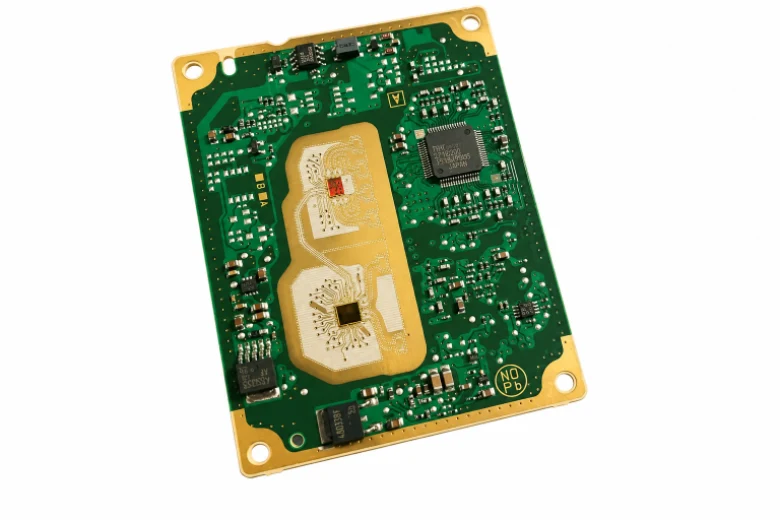
Figure 2. Rogers PCB Automotive Radar
Material scope: Highleap Electronics manufactures and assembles the finished PCB. The Rogers grade named on this page identifies the specified laminate; Highleap does not manufacture or sell Rogers laminates.
Rogers FR4 Hybrid Stackup for Radar Modules
Modern automotive radar modules integrate RF front-end (antenna, transceiver IC) and digital processors (MCU, CAN/Ethernet interface) on a single PCB. Hybrid stackups combine Rogers for RF layers and FR4 for digital/power layers, balancing performance and cost.
| Layer | Function | Material | Thickness |
|---|---|---|---|
| L1 (top) | 77 GHz antenna + RF traces | RO3003 core, VLP copper | 5–10 mil |
| L2 | GND (RF reference) | Core copper | 1 oz |
| Bondply | — | RO3001 / RO4450F | 3–4 mil |
| L3 | Digital routing / power | FR4 core (high-Tg) | 20–30 mil |
| L4 (bottom) | MCU, components | Core copper | 1 oz |
Layer 1 carries RF traces and antenna arrays; Layer 2 provides a continuous ground plane; Layer 3 handles digital signal routing and power distribution; Layer 4 accommodates processors and power regulators. Multi-layer hybrid stackups (6–8 layers) enable additional digital routing and multi-band radar functionality while maintaining thermal and mechanical stability.
Automotive Radar PCB Qualification and Thermal Testing
Automotive radar PCBs must withstand extreme conditions. Key tests include:
- Thermal cycling (AEC-Q100 Grade 1): −40°C to +125°C, ≥1000 cycles, <±5% impedance drift.
- Humidity resistance: the customer-defined humidity qualification profile for 1,000 hours. Rogers PTFE materials <0.04% moisture absorption; hybrid boards require pre-baking and conformal coating.
- Vibration and shock: ISO 16750-3 compliance; underfill and corner staking for heavy ICs; mounting features with adequate clearance.
- PPAP documentation: Production Part Approval Process with material certifications, capability studies, dimensional reports, and inspection records.
Automotive Radar PCB Manufacturing at Highleap
- Material qualification: RO3003, RO4835, RO4003C cores; VLP/RA copper foils. Traceability from lot to finished board serial number.
- Fabrication precision: Etching ±25 µm, dielectric ±0.5 mil, impedance ±3%, TDR verification, plasma desmear and PTFE activation for RO3003.
- Quality system: ISO 9001, IATF 16949, SPC monitoring, PPAP-ready documentation, APQP-aligned NPI.
- Testing: Electrical netlist verification, TDR impedance, microsection analysis, thermal cycling, VNA S-parameters, antenna insertion loss validation.
Request a quote for automotive radar PCB including radar type, material, layer count, board dimensions, and annual volume. For an RFQ, include the radar band, stackup, board drawing, copper, impedance limits, quantity and required reliability testing. This turns the quote into a qualification-ready manufacturing plan instead of a material-only estimate.

Recommended Posts
TMM4 Filter PCB Manufacturing
TMM4 filter PCB manufacturing is controlled by the...
TMM3 PCB Manufacturing for RF Modules
TMM3 PCB manufacturing is most useful where the RF module...
TMM6 PCB Fabrication
TMM6 fabrication is the process-control page for a mid-Dk...

TMM10 PCB Manufacturing for Compact RF Designs
Table of contentsHow TMM10 Shrinks RF StructuresTMM10 vs...
How to get a quote for PCBs
Let’s run DFM/DFA analysis for you and get back to you with a report. You can upload your files securely through our website. We require the following information in order to give you a quote:
-
- Gerber, ODB++, or .pcb, spec.
- BOM list if you require assembly
- Quantity
- Turn time
For PCBA services, please provide your BOM (Bill of Materials) and any specific assembly instructions. We also offer DFM/DFA analysis to optimize your designs for manufacturability and assembly, ensuring a smooth production process.